
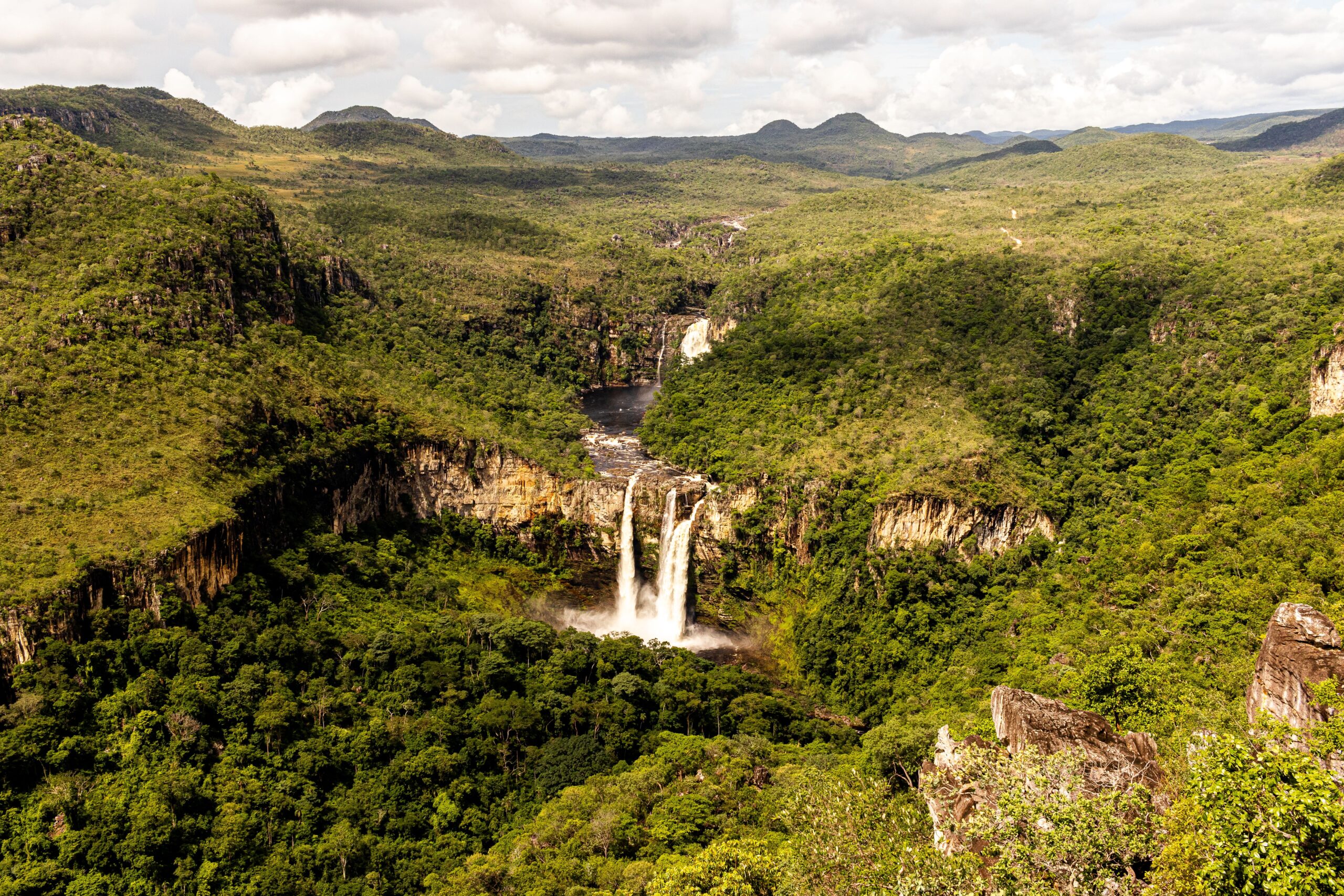
The route that gives Guyana its specific argument: the only English-speaking country in South America, the country with the largest unspoiled rainforest per capita on Earth, the country where the harpy eagle (Harpia harpyja — the largest eagle in the Americas, the wingspan at 2m, the specific apex raptor of the South American forest) is still sighted by the community ecotourist and where the Kaieteur Falls (the world’s largest single-drop waterfall by volume — 226m, 663 cubic metres of the Potaro River per second over the sandstone edge, four times the height of Niagara and five times the volume per metre of width) can be visited by the group of 20 visitors per day maximum that the Kaieteur National Park allows and that gives the specific encounter with one of the planet’s superlative natural events without the 6,000 people who view the Niagara at the same moment. Two days in Georgetown for the wooden colonial architecture (the St George’s Cathedral — the wooden Anglican cathedral, the tallest wooden building in the world at 43.5m) and the Stabroek Market (the cast-iron colonial market on the Demerara River), two days at the Kaieteur Falls (the fly-in from Georgetown — the light aircraft, the 35-minute flight over the unbroken forest canopy), and three days in the Rupununi Savannah (the 15,000 square kilometre savannah in the south — the giant river otter visible in the Rupununi River, the jabiru stork visible at the savannah wetland, the Amerindian community at the Dadanawa Ranch).
Reading time: 9 minutes | Last updated: 2026
Before You Leave
Getting there: Fly London-Georgetown (via New York (JFK) on Caribbean Airlines or via Port of Spain (Trinidad) on Caribbean Airlines — 12-15 hours total). UK citizens: Guyana visa-free 90 days.
Currency: Guyanese Dollar (GYD). 1 GBP ≈ 264 GYD (2025). Guyana is affordable by South American standards: mid-range daily budget GYD 15,000-30,000 / £57-114, but the fly-in to Kaieteur significantly increases the total.
The context: Guyana’s oil discovery in 2015 (the ExxonMobil Stabroek Block — the largest oil discovery in the Western Hemisphere in decades) has changed the country’s economic trajectory significantly. The infrastructure is improving; the eco-tourism sector that existed before the oil is still small and still genuine.
The Route
Georgetown (2 nights) → fly to Kaieteur Falls (2 nights, fly back to Georgetown) → fly to Lethem → Rupununi Savannah (3 nights)
DAYS 1-2 — Georgetown
Day 1: The Wooden Architecture and the Stabroek Market
St George’s Cathedral:
St George’s Cathedral (North Road — the 1892 Anglican cathedral, the 43.5m wooden spire (the tallest wooden building in the world), the specific Georgetown Victorian tropical architecture visible in the building that the Caribbean heat and the tropical humidity have not destroyed because the greenheart wood (Chlorocardium rodiei — the Guyana endemic hardwood, the wood so dense it sinks in water and resists the tropical rot) was used throughout):
Free. Open from 9am.
The Stabroek Market:
The Stabroek Market (the cast-iron 1881 market on the Demerara River waterfront — the clock tower visible from the river, the market at the working hour giving the specific Georgetown commerce: the cassava, the plantain, the pepper pot (the Amerindian stew with the cassareep (the cassava extract), the preserved meat, the specific Guyana dish that is said to have been cooking continuously in some households since the 18th century)):
Day 2: The Botanical Gardens and the Promenade
The National Museum and Botanical Gardens:
The Walter Roth Museum of Anthropology (North Street — the Amerindian collection, the specific Guyana indigenous cultures: the Warao (the Delta), the Arawak (the coast), the Wapishana (the Rupununi), and the 8 other groups):
Entry: GYD 200 / £0.76.
DAYS 3-4 — The Kaieteur Falls
The Cessna to Kaieteur:
The light aircraft from Cheddi Jagan International Airport to the Kaieteur National Park airstrip (the 35-minute flight over unbroken forest — the mahogany and the mora tree canopy visible at 300m below, the Potaro River visible as the silver thread through the green):
The Kaieteur Falls overflight (the pilot banks the Cessna to give the falls visible from the window before landing):
Day trip: USD 200-250 / £157-197 per person from Georgetown. Overnight stay at the Kaieteur guesthouse: add USD 80-120 / £63-95/night.
The falls at dawn:
The Kaieteur (226m single drop — the Potaro River falling over the sandstone escarpment of the Pakaraima Mountains):
At dawn: the mist rising from the plunge pool, the rainbow visible in the spray at 6am, the specific natural spectacle at the volume that Niagara gives at the height that Niagara does not.
The golden rocket frog (Anomalus — the Kaieteur endemic bromeliad frog, the gold colouration, the species found only at Kaieteur and in a few adjacent areas): visible in the Brocchinia bromeliads around the falls.
The maximum daily visitor number: 20 people at the falls platform simultaneously (the Kaieteur National Park regulation). The specific consequence: the visitor to the world’s largest single-drop waterfall by volume stands in a group of 20 rather than the 6,000 at Niagara.
DAYS 5-7 — The Rupununi Savannah
Fly Georgetown-Lethem:
The Lethem (the southern Guyana town on the Brazilian border — the gateway to the Rupununi Savannah):
The Rupununi Savannah (the 15,000 square kilometre savannah — the dry season (September-April): the grass visible as the cattle country that the Amerindian and the ranching economy has used for 200 years; the wet season (May-August): the savannah flooded as the seasonal wetland that the jaguar and the giant river otter and the jabiru stork use):
The Dadanawa Ranch:
The Dadanawa Ranch (the oldest operating ranch in Guyana, founded in 1857, the Rupununi Wapishana Amerindian community adjacent — the eco-tourism at the ranch giving the giant river otter (Pteronura brasiliensis) visible in the Rupununi River tributaries, the harpy eagle territory confirmed in the adjacent forest area, the giant anteater (Myrmecophaga tridactyla) visible on the savannah walk):
All-inclusive eco-lodge: USD 150-250 / £118-197/night including the guided activities.
What It Costs
| Category | Budget | Mid-Range |
|---|---|---|
| Return flights (UK-Georgetown) | £550-900 | £750-1,200 |
| Kaieteur Falls light aircraft | £157-197 | £157-197 |
| Georgetown-Lethem flight | £80-130 | £80-130 |
| 7 nights accommodation | £100-280 | £280-700 |
| Rupununi eco-lodge (3 nights) | £354-591 | £354-591 |
| Food (Georgetown: 4 days) | £30-70 | £70-180 |
| Total | £1,271-2,168 | £1,691-2,998 |
Guyana is the most expedition-style itinerary in the South America section of this library. The light aircraft and the eco-lodge costs dominate. The experience — the Kaieteur with 20 people, the giant river otter in the Rupununi, the harpy eagle territory — is available nowhere else in South America at this accessibility.