


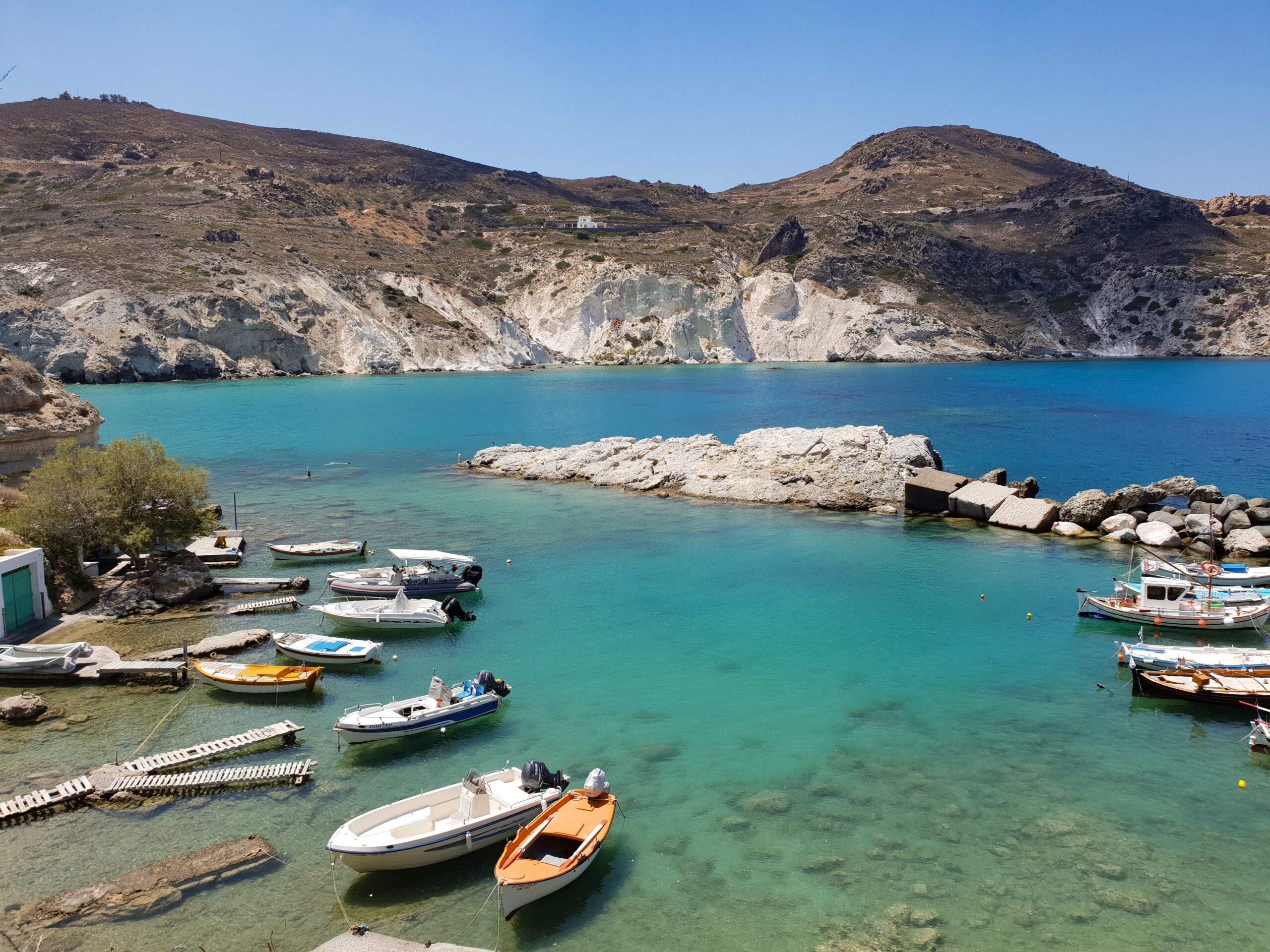
Santorini’s caldera views are genuinely spectacular, but the island now sees over 3 million visitors a year on a landmass smaller than Manhattan. Milos, two islands west in the Cyclades, offers volcanic landscapes, dramatic coastline, and a fraction of the crowds, at meaningfully lower prices.
Quick answer: swap Santorini for Milos if the priority is genuine volcanic scenery and beach variety without the crowds. Stick with Santorini if the caldera sunset view itself, the specific postcard image, is non-negotiable, since Milos doesn’t replicate that exact scene.
Santorini vs Milos: Head-to-Head
| Factor | Santorini | Milos |
|---|---|---|
| Annual visitors | 3+ million | Under 200,000 |
| Flight time from UK | 4h direct (seasonal) | No direct flights, via Athens (add 45 min) |
| Beach variety | Limited, mostly volcanic black sand | Exceptional, over 70 beaches with varied colours and textures |
| Accommodation (mid-range, per night) | £150-£280 | £70-£130 |
| Peak season crowding | Severe, particularly Oia | Minimal, even in August |
| Signature experience | Caldera sunset views | Volcanic beach hopping, Sarakiniko’s lunar landscape |
What Milos Actually Offers
Sarakiniko Beach, a stretch of white volcanic rock eroded into smooth, otherworldly formations, has become genuinely famous in its own right, resembling a lunar landscape more than a typical Greek beach. Unlike Santorini’s black volcanic sand beaches, which are functional rather than strikingly beautiful, Sarakiniko is a destination in itself.
- Sarakiniko: free access, best visited early morning before the midday heat makes the white rock surface genuinely uncomfortable underfoot
- Kleftiko: a sea cave and rock formation complex reachable only by boat, considered one of the best boat trip destinations in the Cyclades, from 35-50 EUR (£30-£43) for a half-day tour
- Plaka village: Milos’s traditional hilltop capital, offering the same whitewashed Cycladic architecture as Santorini’s villages, with a fraction of the visitors and correspondingly lower prices at its restaurants
- Firiplaka and Tsigrado beaches: genuinely stunning white sand and turquoise water, comparable to anything in the Cyclades, without Santorini’s crowd density
Why Santorini Still Wins for One Specific Thing
The caldera sunset view from Oia is genuinely unique, a product of Santorini’s specific volcanic geology, the collapsed caldera creating a natural amphitheatre for watching the sun set into the sea. Milos doesn’t have an equivalent, since its volcanic history shaped the island differently, into eroded coastal rock formations rather than a dramatic caldera rim.
The honest verdict: if the trip’s entire purpose is that specific photograph, Santorini remains the only option. For everyone else wanting genuine Greek island beauty, better beaches, and dramatically lower crowds and cost, Milos delivers more for less.
A Day in Milos That Doesn’t Exist in Santorini
Where a Santorini day typically revolves around securing a good spot for the Oia sunset, a Milos day looks structurally different. Morning at Sarakiniko before the heat builds, a boat trip to Kleftiko’s sea caves by midday, an afternoon swim at Firiplaka or Tsigrado, and dinner in Plaka’s hilltop village watching a sunset that, while not the caldera view, still delivers genuinely striking colour over the Aegean without needing to arrive two hours early to claim a viewing spot. The absence of crowd-management logistics is itself part of what makes Milos feel different, rather than any single missing feature.
Getting Around Milos
Unlike Santorini’s more walkable caldera-rim towns, Milos’s beaches and villages spread across the island, making a rental car or scooter a genuinely practical necessity rather than an optional add-on. Roads are generally well maintained, though some of the more remote beaches (Tsigrado in particular) require a short scramble down from the car park, worth factoring in for anyone travelling with mobility considerations or small children.
What Santorini Does Better Beyond the Sunset
Beyond the caldera view itself, Santorini’s tourism infrastructure is significantly more developed, meaning more restaurant variety, more organised tour options, and a wider range of accommodation styles from budget to ultra-luxury cliffside suites. Milos, by contrast, offers a narrower but still genuinely good range, mostly mid-range guesthouses and family-run tavernas, which suits travellers seeking authenticity over polish but may frustrate anyone specifically wanting a five-star infinity pool experience with a caldera backdrop, since Milos simply doesn’t have that particular category of accommodation in the same volume.
What a Week Actually Costs
| Category | Santorini (per person) | Milos (per person) |
|---|---|---|
| Accommodation (6 nights, split two ways) | £450-£840 | £210-£390 |
| Food | £150-£220 | £100-£150 |
| Activities/boat trips | £60-£100 | £50-£80 |
| Total (excluding flights) | £660-£1,160 | £360-£620 |
Milos runs roughly 40-45% cheaper across the board, largely driven by the accommodation gap, which reflects Santorini’s premium caldera-view pricing versus Milos’s more standard Cycladic guesthouse rates.
Photography Without the Crowd Battle
Santorini’s most photographed spots, the blue-domed churches of Oia in particular, now require genuine strategy to shoot without dozens of other tourists in frame, with some photographers arriving well over an hour before sunset simply to claim a clear angle. Milos’s beauty is more distributed across the island rather than concentrated in one famous vantage point, meaning even Sarakiniko’s striking white rock formations rarely involve the same scramble for a clean shot, simply because there’s more space and fewer people trying to capture the exact same frame at the exact same moment.
Step-by-Step: Planning a Milos Trip
- Fly into Athens and connect via a short domestic flight or ferry, since Milos has no direct UK flights. The domestic flight takes around 45 minutes; the ferry option (from Piraeus) takes 3-5 hours depending on the vessel.
- Rent a car or scooter for the island, since Milos’s beaches and sights are more spread out than Santorini’s compact caldera-rim towns, making independent transport genuinely useful rather than optional.
- Book the Kleftiko boat trip early in the stay, since it’s weather-dependent and having a backup day if the first booking is cancelled avoids missing it entirely.
- Visit Sarakiniko at sunrise or early morning, both for the light and to avoid the white rock surface becoming uncomfortably hot underfoot by midday.
- Base in Adamas (the port town) or Plaka for the best balance of central location and access to the island’s spread-out beaches.
Frequently Asked Questions about Milos
Is Milos as beautiful as Santorini?
Differently beautiful rather than directly comparable. Milos offers superior beach variety and a genuinely striking volcanic coastline, while Santorini’s specific caldera view remains unmatched by any other Cycladic island.
How do you get to Milos from the UK?
No direct flights exist; the standard route is flying into Athens and connecting via a 45-minute domestic flight or a 3-5 hour ferry from Piraeus port.
Is Milos suitable for a first-time Greek islands visit?
Yes, though travellers wanting the classic “Santorini postcard” experience should be aware Milos offers a genuinely different, arguably more varied, experience rather than a direct substitute for that specific caldera view.
What is the best time of year to visit Milos?
June and September offer the strongest combination of warm weather and lower crowds, similar to the general Cyclades pattern, with July-August bringing peak heat and, even by Milos’s lower-crowd standards, the busiest period of the year.
Can you combine Milos and Santorini in the same trip?
Yes, and it’s a genuinely popular strategy. Ferries connect the two islands directly in around 2-2.5 hours, making it straightforward to experience Santorini’s caldera view for a day or two while basing the bulk of a beach-focused trip in Milos.
Is Milos good for families with young children?
Reasonably, with some caveats. Several of Milos’s beaches (Sarakiniko in particular) have limited shade and involve walking over rock rather than sand, which can be less comfortable for very young children compared to Santorini’s more developed beach clubs with organised amenities. Papikinou and Provatas beaches offer gentler, sandier alternatives better suited to families.
The Bottom Line
Milos delivers better beaches, dramatically lower crowds, and meaningfully lower costs than Santorini, everything except that one specific caldera sunset view. For travellers whose trip doesn’t hinge on that exact photograph, the swap is a genuine upgrade in almost every other respect.