

Montenegro’s Bay of Kotor delivers scenery genuinely comparable to Croatia’s Dalmatian coast, fjord-like inlets, medieval walled towns, mountains dropping straight into the sea, at a fraction of the cost and crowd density. This is the full 7-day route: Kotor, Budva, and Durmitor National Park.
Quick answer: 7 days covering Kotor, Budva, and Durmitor costs roughly £380-£460 per person excluding flights, based on private guesthouse rooms, three meals a day, and local transport. UK passport holders can enter Montenegro visa-free for stays up to 90 days.
The 7-Day Route at a Glance
| Days | Location | Highlight | Accommodation Cost |
|---|---|---|---|
| 1-3 | Kotor | Old town, Bay of Kotor, city walls hike | £22-£38/night |
| 4-5 | Budva | Beaches, Sveti Stefan viewpoint | £25-£45/night |
| 6-7 | Durmitor National Park (Žabljak) | Black Lake, mountain hiking | £20-£35/night |
Montenegro’s compact size means all three regions connect via a manageable 2-3 hour drive or bus journey, making a rental car useful but not essential for this route.
Day-by-Day Breakdown
Days 1-3: Kotor
Kotor’s old town, a UNESCO World Heritage site, sits at the innermost point of the Bay of Kotor, ringed by mountains that drop dramatically into the water, the reason comparisons to a Norwegian fjord persist despite the bay being a submerged river canyon rather than a true glacial fjord.
- Kotor City Walls hike: 8 EUR (£6.90), a genuinely demanding climb (roughly 1,350 steps) to the Fortress of San Giovanni, rewarded with the best panoramic view of the bay available anywhere in the region
- Old town exploration: free to wander, a compact maze of Venetian-era stone streets and squares
- Our Lady of the Rocks boat trip: 5-10 EUR (£4.30-£8.60) for the short crossing to this artificial islet church near Perast, a genuinely striking small site worth the detour
- Dinner: a full seafood meal (Montenegro’s coast draws heavily on Mediterranean and Balkan influences) runs 12-20 EUR (£10.30-£17.20) per person
- Accommodation: guesthouses within or near the old town from £22-£38/night
The 6am principle applies most directly to the City Walls hike. Starting the climb at or before 7am avoids both the worst of the heat and the cruise ship day-trippers who arrive from mid-morning onward when Kotor’s port has a ship in dock, a genuinely significant crowd factor on days when large vessels are berthed.
Days 4-5: Budva
The drive or bus from Kotor to Budva takes roughly 45 minutes along the coastal road, one of the more scenic short drives in the region.
Budva combines a smaller old town (similarly Venetian in character to Kotor’s, though less dramatically set) with the region’s strongest beach infrastructure, making it the natural base for the beach-focused half of this trip.
- Budva old town: free to explore, smaller and more compact than Kotor’s
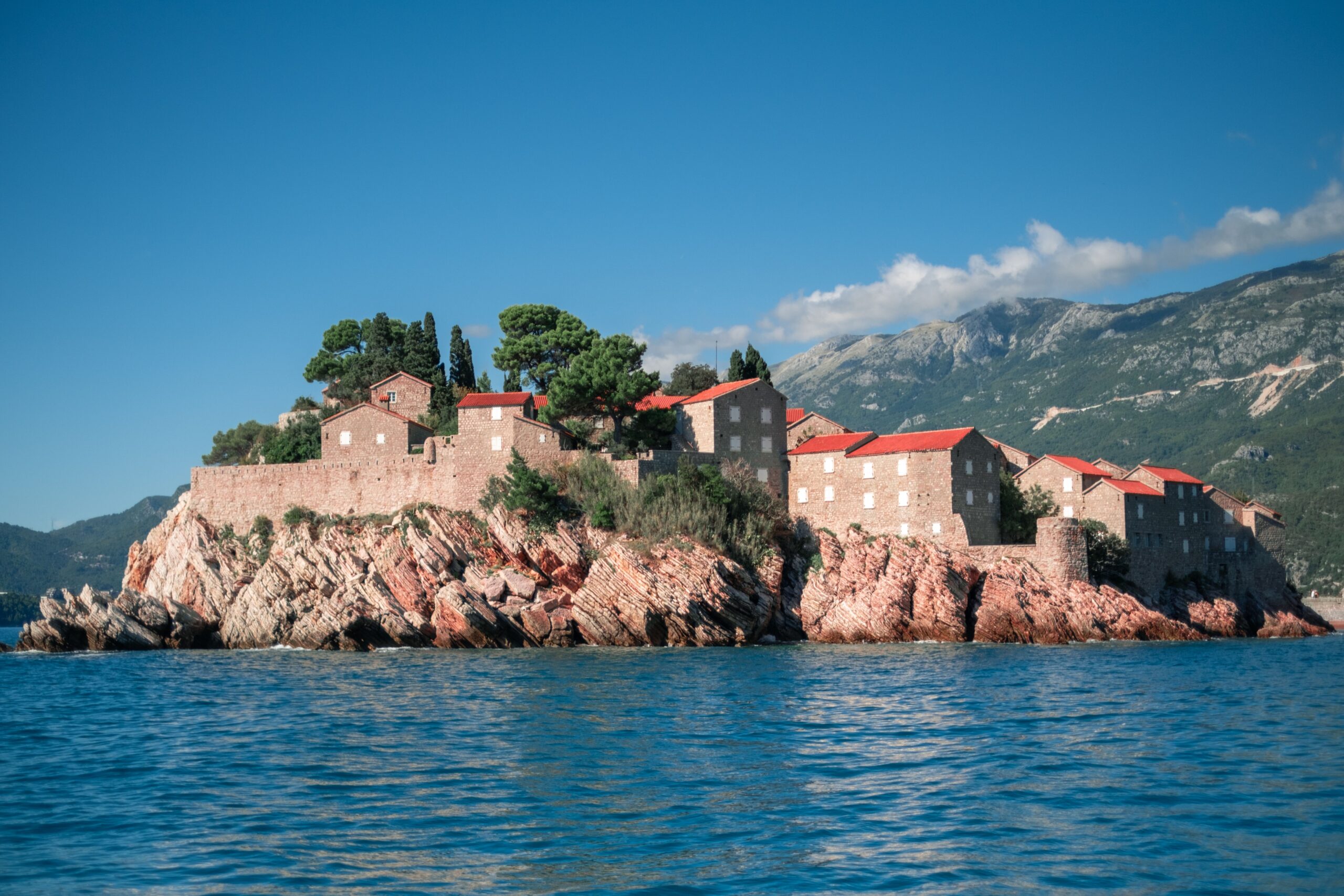
- Sveti Stefan viewpoint: free to view from the mainland (the island itself is a private luxury resort with restricted access), one of the most photographed sights on the Montenegrin coast
- Mogren Beach: free access, within walking distance of Budva’s old town, offering a genuinely pleasant stretch of coastline without needing to travel further afield
- Dinner: a full meal at Budva’s old town restaurants runs 15-25 EUR (£12.90-£21.50) per person
- Accommodation: guesthouses near the old town from £25-£45/night, rising notably in peak July-August season
The honest verdict on Budva vs Kotor: Kotor wins for atmosphere and hiking, Budva wins for straightforward beach time. Most travellers on this route find two days in Budva sufficient rather than needing longer, since the beach offering, while solid, doesn’t match the scenic drama of Kotor’s bay setting.
Perast: The Half-Day Detour Worth Adding
Between Kotor and the mainland approach to the Our Lady of the Rocks boat trip, the small town of Perast is worth a dedicated stop rather than just a passing view. Home to a collection of well-preserved Baroque palaces from its era as a wealthy maritime trading town, Perast offers a genuinely quieter alternative to Kotor’s more heavily visited old town, with a handful of excellent waterfront restaurants serving the same quality seafood at slightly lower prices than the more tourist-dense spots in Kotor itself.
Days 6-7: Durmitor National Park
The drive from Budva to Žabljak, the base town for Durmitor National Park, takes roughly 2.5-3 hours, climbing significantly in elevation and delivering a genuinely different landscape from the coastal days that precede it.
Durmitor is Montenegro’s premier mountain national park, home to Black Lake (Crno Jezero), one of the most photographed natural sites in the Balkans, and the Tara River Canyon, Europe’s deepest gorge.
- Black Lake circuit walk: free, a relatively easy 3.6km loop around the lake, suitable for most fitness levels
- Tara River Canyon viewpoint (Ćurevac): free, a short drive or hike to one of the best viewpoints over the canyon
- White-water rafting on the Tara River: 45-65 EUR (£38.60-£55.80) per person for a half-day guided trip, one of the best-regarded rafting experiences in Europe given the canyon’s scale
- Dinner: a full mountain-region meal (Montenegro’s interior cuisine leans more heavily on grilled meats and dairy than the coastal seafood focus) runs 10-18 EUR (£8.60-£15.50) per person
- Accommodation: guesthouses in Žabljak from £20-£35/night
What £380-£460 Actually Covers
| Category | Total for 7 Days (GBP, per person) |
|---|---|
| Accommodation (6 nights, split two ways) | £75-£130 |
| Food (three meals daily) | £90-£125 |
| Local transport (bus/car) | £30-£50 |
| Activities/entry fees | £30-£50 |
| Total | £225-£355 |
Step-by-Step: Booking This Route
- Fly into Podgorica or Tivat, both served by direct flights from several UK airports, with Tivat sitting closer to Kotor and the coastal leg of this route.
- Rent a car for the Durmitor leg specifically, even if relying on buses for the coastal towns, since Žabljak’s public transport connections are noticeably more limited than the coast.
- Check cruise ship schedules for Kotor if timing the City Walls hike around lower crowds. Port schedules are publicly available and worth a quick check the evening before.
- Book Durmitor accommodation ahead in July-August, since Žabljak’s guesthouse capacity is limited relative to demand during peak hiking season.
- Pack for a genuine temperature difference between the coast and Durmitor. The mountain leg runs noticeably cooler, even in summer, than the coastal days, worth an extra layer.
Frequently Asked Questions
Do UK citizens need a visa for Montenegro?
No, UK passport holders can enter Montenegro visa-free for stays of up to 90 days.
How does Montenegro compare to Croatia for cost?
Montenegro runs noticeably cheaper across accommodation, food, and activities, typically 30-40% below equivalent Dalmatian coast prices in Croatia, while offering genuinely comparable coastal scenery around the Bay of Kotor specifically.
Is Kotor as crowded as Dubrovnik in peak season?
Less so overall, though cruise ship days bring significant crowds to Kotor’s old town and City Walls hike specifically. Outside of ship-in-port hours, Kotor remains noticeably quieter than Dubrovnik’s consistent peak-season crowding.
What is the best time of year to visit Montenegro for this route?
May-June and September offer the best balance of warm coastal weather and manageable crowds, with July-August bringing both the highest temperatures and the most significant tourist volume, particularly along the coast.
Is Montenegro part of the EU or Schengen area?
No, Montenegro is not currently an EU or Schengen member, though it uses the Euro as its currency despite this. Entry for UK passport holders follows Montenegro’s own visa-free arrangement rather than the Schengen 90/180 rule, worth noting for travellers combining this trip with time in neighbouring Schengen countries.
Is a rental car necessary for this entire route, or just parts of it?
Just parts. The coastal leg between Kotor and Budva is well served by regular buses along the short coastal route, but a rental car (or organised transfer) is genuinely the more practical option for the drive up to Durmitor, given the more limited bus frequency to Žabljak and the value of flexibility once exploring the national park itself.
Is swimming safe and clean along Montenegro’s coast?
Yes, generally. The Adriatic waters along the Montenegrin coast are considered clean and safe for swimming, with the Bay of Kotor’s calmer, more sheltered waters offering a different swimming experience from Budva’s more open coastal beaches.
The Bottom Line
Montenegro delivers Croatia’s Dalmatian coast scenery, plus a genuinely striking mountain interior at Durmitor, for a noticeably lower cost and with less crowding outside of Kotor’s cruise ship peaks. The trade-off is a less developed tourism infrastructure than Croatia’s more established circuit, which rewards travellers comfortable with a slightly rougher-edged trip in exchange for the value and relative quiet.