



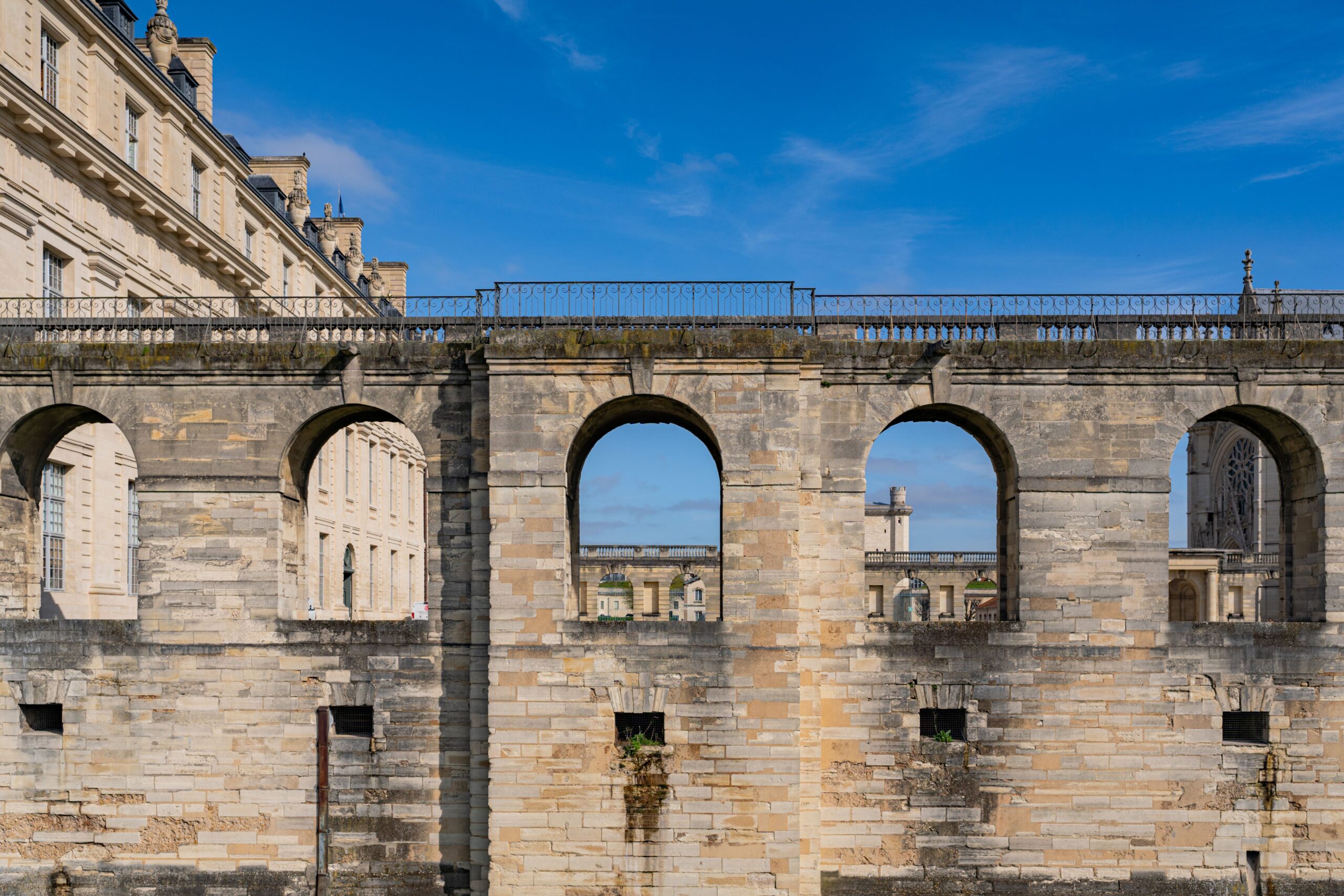
Versailles gets roughly 8 million visitors a year and, on a busy day, genuinely feels like it. Château de Vincennes, sitting at the eastern end of the Paris Métro Line 1, gets a fraction of that footfall while offering France’s tallest surviving medieval fortified keep, a genuinely different but equally significant royal history, at less than half the cost.
Quick answer: Château de Vincennes costs €9.50 (£8.15) entry versus Versailles’s €21-32 (£18-27.40) depending on which areas are included, is reachable directly by Métro without a separate RER ticket or transfer, and delivers genuinely uncrowded exploration of a castle with over 700 years of continuous royal and military use. It doesn’t replicate Versailles’s Hall of Mirrors or gardens, but for many travellers, the trade-off is worth it.
Versailles vs Vincennes: Head-to-Head
| Factor | Versailles | Château de Vincennes |
|---|---|---|
| Entry cost | €21-€32 (£18-£27.40) depending on package | €9.50 (£8.15) |
| Getting there | RER C train (30-40 min) plus a walk, or coach tours | Direct Métro Line 1 (30 min from central Paris) |
| Crowd level | Severe, particularly the Hall of Mirrors | Genuinely light, even on weekends |
| Architectural style | Baroque palace, extensive formal gardens | Medieval fortress keep, later royal apartments |
| Time needed | Full day for a thorough visit | Half day, genuinely completable in 2-3 hours |
What Vincennes Actually Offers
The Donjon (keep) at Vincennes is the tallest surviving medieval fortified structure in Europe, built in the 14th century and remarkably well preserved, offering a genuinely different historical experience from Versailles’s later Baroque grandeur.
- The Donjon: included in standard entry, climbing through several floors of the keep itself, including the king’s former private chambers, offering a tangible sense of medieval royal life distinct from Versailles’s more performative Baroque splendour
- Sainte-Chapelle de Vincennes: a smaller, less famous sibling to the Sainte-Chapelle in central Paris, but genuinely striking in its own right, with beautiful stained glass largely undamaged by the crowds that make photographing the central Paris version genuinely difficult
- The fortified walls and moat: free to walk around the exterior, offering a sense of the castle’s defensive scale that Versailles, built explicitly to abandon defensive architecture in favour of display, simply doesn’t have
- Bois de Vincennes: the surrounding park, Paris’s largest, offers a free, genuinely pleasant extension to the visit, including a lake and botanical garden
Why Versailles Still Wins for Specific Things
Versailles’s Hall of Mirrors and the palace’s extensive formal gardens are genuinely unique, without any real equivalent at Vincennes or anywhere else in France. The sheer scale and decorative ambition of Louis XIV’s palace, built explicitly to overwhelm visitors with royal power, isn’t something Vincennes attempts to replicate, since it comes from an entirely different architectural and political era.
The honest verdict: if seeing the Hall of Mirrors specifically is the point of a Paris trip, that requires Versailles itself, and no amount of Vincennes’s charm substitutes for that specific, singular room. For travellers who’ve already seen Versailles on a previous trip, or who want genuine medieval history without the crowds and cost, Vincennes delivers a meaningfully different, equally legitimate royal history experience.
The Historical Irony Worth Knowing
Vincennes was itself the primary French royal residence for centuries before Versailles existed, meaning a visit here isn’t a lesser substitute but a genuine look at where French kings actually lived and ruled from long before Louis XIV’s Baroque ambitions reshaped royal architecture entirely. Charles V, Louis IX (later canonised as Saint Louis), and numerous other French monarchs called Vincennes home, giving the site a depth of continuous royal history that in some respects outlasts Versailles’s own more concentrated, single-dynasty grandeur.
What the Savings Actually Look Like
| Category | Versailles (per person) | Vincennes (per person) |
|---|---|---|
| Entry | £18-£27.40 | £8.15 |
| Transport (RER vs Métro) | £6.90 (RER C return) | £3.90 (standard Métro fare, included in a day pass) |
| Total | £24.90-£34.30 | £12.05 |
The saving, roughly £13-£22 per person, funds a genuinely good Paris lunch or an additional activity elsewhere in the city, a meaningful trade-off for travellers prioritising value over Versailles’s specific fame.
Step-by-Step: Deciding Between the Two
- Choose Versailles if it’s a first Paris visit and the Hall of Mirrors specifically is a priority, since this remains a genuinely unmissable sight for many travellers despite the cost and crowds.
- Choose Vincennes if it’s a repeat Paris visit, or if medieval history and lower crowds matter more than Baroque grandeur.
- Book Versailles tickets online in advance regardless of choice, since walk-up queues at the palace can genuinely exceed an hour during peak season.
- Combine Vincennes with a Bois de Vincennes picnic, since the park itself offers a pleasant, free extension to a half-day castle visit.
- Check Vincennes’s Sainte-Chapelle opening hours separately from the Donjon, since access to specific areas within the complex can vary by season and requires a modest amount of pre-visit checking.
Frequently Asked Questions
Is Château de Vincennes worth visiting if you’ve already seen Versailles?
Yes, genuinely offering a different historical era and architectural style, medieval fortification rather than Baroque palace, making it a worthwhile addition rather than a repeat of the same experience.
How long does it take to get to Vincennes from central Paris?
Roughly 30 minutes by Métro Line 1, a direct connection without requiring a transfer or a separate RER ticket, considerably simpler than the Versailles journey.
Is Vincennes suitable for a family visit with children?
Yes, genuinely well-suited, with the Donjon’s climbable towers and the surrounding Bois de Vincennes park (including a zoo, separate to the castle entry) offering strong family appeal alongside the historical content.
Does Vincennes get crowded during peak Paris tourist season?
Noticeably less so than Versailles, even during peak summer, reflecting its lower international profile relative to its genuine historical significance.
Can you visit both Versailles and Vincennes on the same trip?
Yes, though not comfortably on the same day given Versailles alone warrants a full day for a thorough visit. Most travellers choosing to see both spread them across separate days of a longer Paris stay.
Is there an audio guide or tour available at Vincennes?
Yes, an audio guide is available in multiple languages, included with standard entry, offering genuine historical context on the Donjon’s construction and its various royal and later military uses through to the 20th century.
The Bottom Line
Château de Vincennes delivers a genuinely significant medieval royal history experience at less than half Versailles’s cost, with dramatically lower crowds and considerably simpler transport logistics. The trade-off is losing Versailles’s specific Baroque grandeur and the Hall of Mirrors, both genuinely unique and worth the cost and crowds for a first-time visitor prioritising that exact experience.