
The route that gives Mongolia its complete argument: two days in Ulaanbaatar for the Gandantegchinlen Monastery (the largest Buddhist monastery in Mongolia, the 26.5-metre Megjid Janraisig statue in gold and copper visible from the monastery entrance, the monks in the saffron robes visible at the morning puja from 10am) and the National Museum of Mongolian History (the full Mongol Empire narrative — the Genghis Khan gallery giving the specific 13th-century expansion that covered 24 million square kilometres, the largest contiguous land empire in history, visible in the single room of the artefacts), and five days on the steppe for the Gobi Desert (the Khongoryn Els — the sand dunes at 300 metres, the two-humped Bactrian camel (Camelus bactrianus ferus — the wild Bactrian camel, critically endangered, the population in the Gobi at approximately 950 individuals), and the Flaming Cliffs (Bayanzag — the red sandstone cliffs where Roy Chapman Andrews found the first dinosaur eggs in 1923) and the nomadic family ger stay (the overnight in the family ger (the circular felt tent), the airag (the fermented mare’s milk) and the tsuivan (the hand-pulled noodles with the mutton) at the family table, the specific Mongolia that the capital city does not give).
Reading time: 10 minutes | Last updated: 2026
Mongolia is the most sparsely populated country on Earth (3.3 million people across 1.566 million square kilometres — 2.1 people per square kilometre). Approximately 30% of the population remains nomadic. The specific Mongolia quality: the country where the landscape is the destination and the infrastructure is the adventure — the dirt track between the ger camps is the road, the off-road driving through the steppe is the transport, and the distance between any two recognisable landmarks is the specific Mongolia scale that the UK road atlas does not train the eye to comprehend.
Before You Leave
Getting there: Fly London-Ulaanbaatar (via Beijing (Air China), Seoul (Korean Air), or Moscow (MIAT Mongolian)) — approximately 10-13 hours total. Direct flights are not available from the UK.
UK citizens: Visa-free 30 days for UK passport holders (the 2014 Mongolia-UK visa waiver agreement).
The car and the guide: The Mongolia steppe circuit requires the hired 4WD with a driver-guide. Mongolia has approximately 2,500km of paved road outside Ulaanbaatar; the remainder is the dirt track or the open steppe. The hire car without the guide who knows the tracks is the guaranteed getting-lost scenario. Budget: USD 80-120 / £63-95 per day for the 4WD with the driver.
The ger accommodation: The tourist ger camp (the commercial ger camp with the meals included and the shower block — £40-80/night) or the nomadic family homestay (the family who agrees to host the traveller in their working ger, the authenticity at the cost of the convenience — £20-35/night with meals). Both require advance booking through the Ulaanbaatar tour operator.
The Route
Ulaanbaatar (2 nights) → Gobi Desert circuit by 4WD (5 nights: Khongoryn Els 2 nights, Bayanzag 1 night, Yolyn Am 2 nights) → return Ulaanbaatar, fly home
DAYS 1-2 — Ulaanbaatar
Day 1: The Gandantegchinlen Monastery
The Gandan Monastery:
The Gandantegchinlen (the “Great Place of Complete Joy” — the monastery complex on the Ulaanbaatar hill, the 14 temples, the monks’ college (the Tantric college training approximately 600 monks in 2025), and the Megjid Janraisig statue (the 26.5-metre Migjid Janraisig Bodhisattva — the copper and gold statue built in 1996 to replace the original melted by the Soviet authorities in 1938 to produce artillery shells, the specific Mongolia 20th-century religious suppression and restoration visible in the one statue)):
At 10am: the morning puja (the daily ceremonial prayer in the main temple — the monks visible in the circular seating arrangement, the dungchen (the long Tibetan horn) audible from the temple entrance). Free entry to the monastery grounds; ¥3,000 MNT / £0.67 per photo inside the temples.
The Sukhbaatar Square:
The Sukhbaatar Square (the Ulaanbaatar central square — the Genghis Khan statue complex on the south side (the seated Khan flanked by the standing Ögedei and Kublai), the parliament building, the specific Mongolia public space visible at the morning exercise hour from 7am):
Free.
Day 2: The National Museum and the Bogd Khan Palace
The National Museum of Mongolian History:
The Genghis Khan hall (the 13th-century Mongol Empire — the armour, the weapons, the specific artefacts of the empire that connected China to Eastern Europe in the single political entity that allowed the Silk Road to function for 100 years without the bandit tax): free.
The nomadic culture hall (the ger construction visible in the museum installation — the felt layers, the wooden lattice, the specific engineering of the portable dwelling that the nomadic life requires): MNT 8,000 / £1.78.
DAYS 3-7 — The Gobi Circuit
The drive from Ulaanbaatar to the Gobi:
The 500km drive south on the paved road to Dalanzadgad (the Southern Gobi aimag capital — 5-6 hours on the paved road), then the off-road circuit through the Gobi sites.
The Khongoryn Els (the Singing Sands):
The Khongoryn Els (the 180km dune system in the southern Gobi — the dunes at 100-300 metres, the wind on the dune crests producing the specific resonant sound (the bass hum audible when the sand moves — the sound the dunes have been making for the entire history of the Gobi) that gives the dunes their Mongolian name):
The Bactrian camel (Camelus bactrianus ferus): the two-humped wild camel — the camel visible in the wild Gobi at the Khongoryn Els area, the critically endangered species (the world population estimated at 950 individuals, the China-Mongolia Gobi Desert their only remaining habitat).
The dune ascent at sunset (the 45-minute climb to the main dune crest, the Gobi visible in every direction from the crest, the wind the only sound): the specific Mongolia desert moment.
The Bayanzag (Flaming Cliffs):
The Bayanzag (the red sandstone cliffs named Flaming Cliffs by Roy Chapman Andrews — the American Museum of Natural History paleontologist who found the first dinosaur eggs here in 1923, the 1920s expeditions that produced the specific Mongolia fossil discovery that rewrote the early understanding of dinosaur reproduction):
The dinosaur fossils (the protoceratops and the velociraptor fossils found here by Andrews — both the Mongolia-China endemic dinosaur species visible in the Ulaanbaatar Natural History Museum that the Bayanzag visit gives context for): free to visit the site; the fossils are in the museum, not at the site.
The Yolyn Am (Vulture Valley):
The Yolyn Am (the narrow canyon in the Gurvan Saikhan Mountains — the ice field visible at the canyon floor in early summer (the canyon’s orientation preventing the sun from reaching the floor, the ice from the previous winter persisting into June), the lammergeier vulture (Gypaetus barbatus — the bearded vulture, the wingspan at 2.5 metres, the specific Gobi raptor visible at the canyon updrafts)):
The canyon walk (3km, 1.5 hours return): free. The canyon is within the Gobi Gurvan Saikhan National Park (the park entry fee: MNT 3,000 / £0.67 per vehicle).
The nomadic family ger:
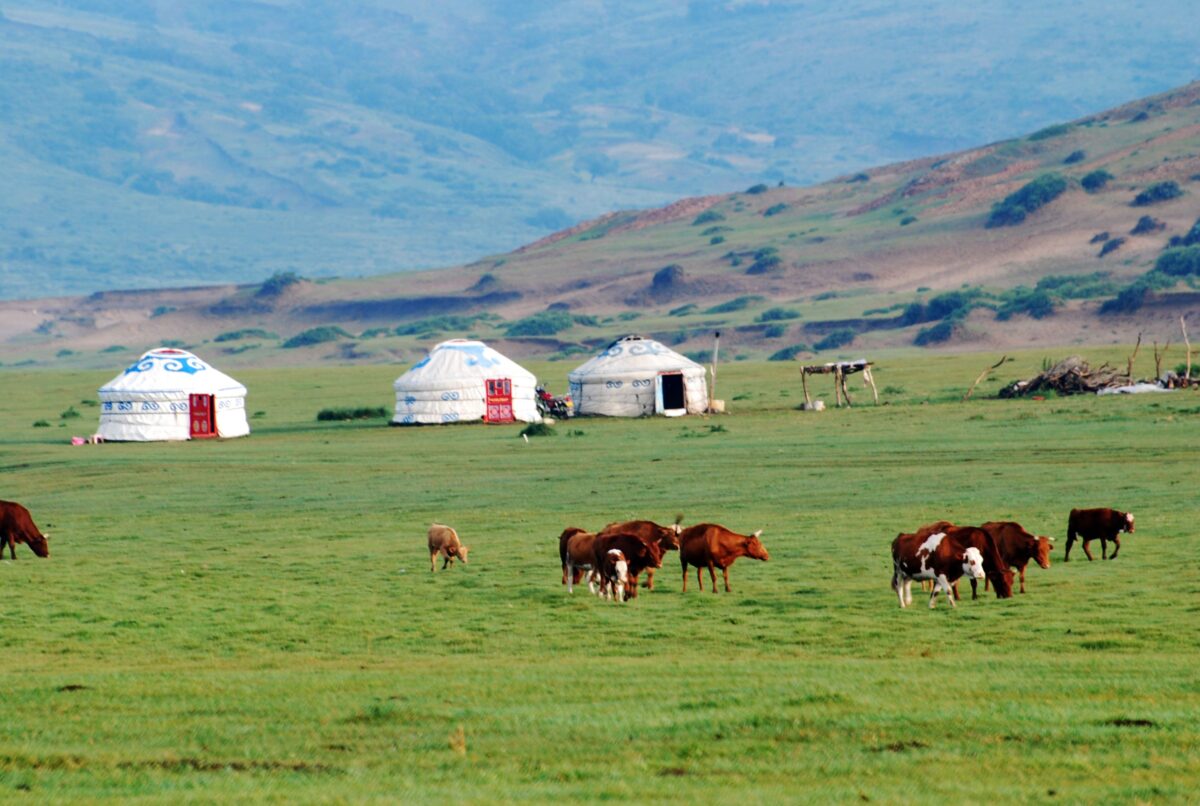
The overnight in the working ger (the family’s main residence in the summer camp — the ger oriented with the door facing south, the stove at the centre, the family’s bed on the northern side, the guest’s bed on the western side, the specific ger organisation that the nomadic tradition prescribes):
The airag (the fermented mare’s milk — 0.5-3% ABV depending on the fermentation stage, the specific Mongolia fermented dairy that the nomadic family produces from their own herd from June to September, the specific taste (sharp, effervescent, slightly alcoholic, specifically yoghurt-adjacent) that the BGGD take is: try it, form the view):
The tsuivan (the hand-pulled noodles with the mutton, the spring onion, the carrot — the specific Mongolia noodle dish cooked on the ger stove by the host family, the meal that the guest is served first as the specific Mongolia hospitality tradition):
What It Costs
| Category | Budget | Mid-Range |
|---|---|---|
| Return flights (UK-Ulaanbaatar) | £500-900 | £700-1,200 |
| 2 nights Ulaanbaatar hotel | £30-80 | £80-200 |
| 5 nights ger camp / nomadic homestay | £100-250 | £250-600 |
| 4WD + driver for Gobi circuit (5 days) | £315-475 | £475-750 |
| Food (7 days) | £20-60 | £60-150 |
| Entries and activities | £10-30 | £10-30 |
| Total | £975-1,795 | £1,575-2,930 |