
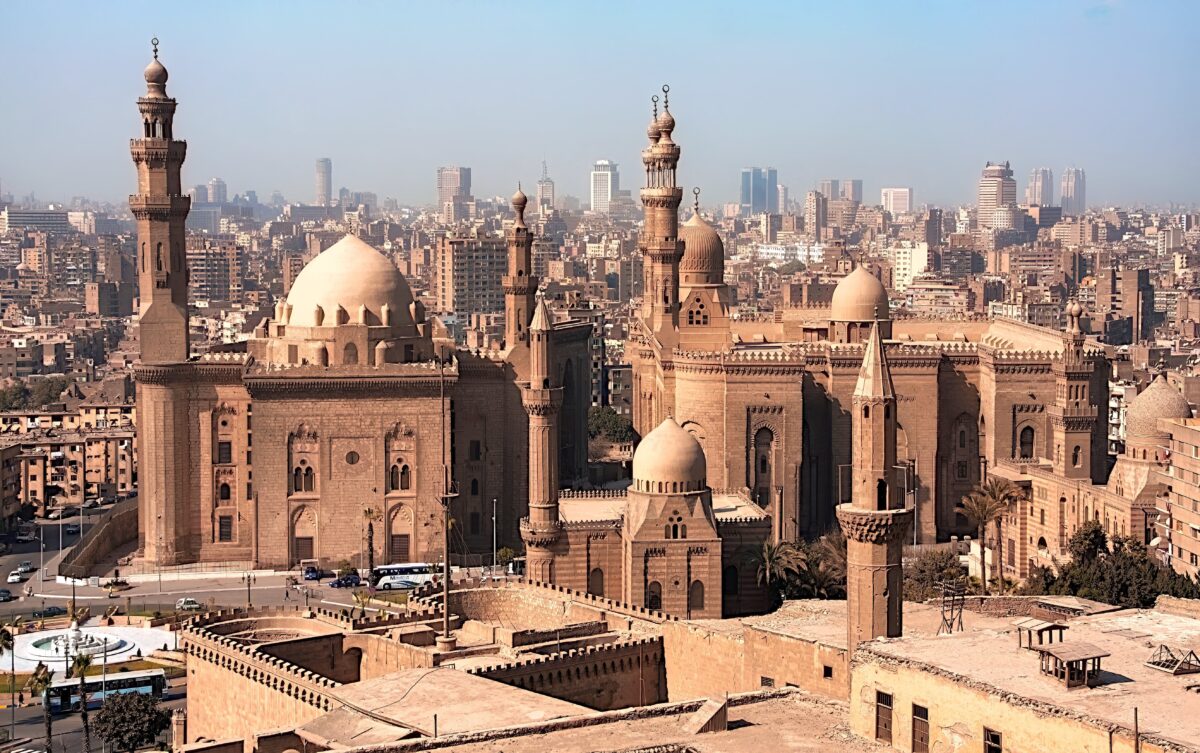
The specific Cairo argument: the city of 21 million people is the access point for the most significant archaeological site on Earth (the Giza Plateau — the three pyramids, the Sphinx, the solar boat) and the finest collection of ancient Egyptian artefacts outside London (the Egyptian Museum, the Tutankhamun gallery, the 120,000 objects), and these two things alone justify the 5-hour flight from Heathrow and the 48-hour commitment. Cairo itself — the Khan el-Khalili bazaar, the Al-Azhar Mosque, the specific Cairo afternoon light on the minarets at 4pm, the Nile felucca at sunset — adds the specific living city to the ancient one. Two days give both in the correct order: the ancient first, before the jet lag catches you; the living city second, when Cairo’s pace has found you.
Reading time: 8 minutes | Last updated: 2026
Before You Arrive
Getting there: Fly London-Cairo (EgyptAir, British Airways, Wizz Air — 5 hours). Visa on arrival: USD 25 / £19.69, paid in USD cash at the airport immigration counter. Or the Egypt e-Visa at visa2egypt.gov.eg (same cost, avoids the queue).
Currency: Egyptian Pound (EGP). 1 GBP ≈ 60-65 EGP (2025 — the rate has fluctuated significantly; verify before departure). ATMs widely available; carry EGP cash for the bazaar and the smaller restaurants.
The safety context: Cairo’s tourist areas are safe by the standards of a 21-million-person city. The Khan el-Khalili and the Giza Plateau have the concentrated harassment from guides and vendors that the visitor who is prepared for it manages and the visitor who is not finds overwhelming. The preparation: walk with purpose, make eye contact, say “la shukran” (no thank you) once and do not repeat it regardless of what follows.
Where to stay: Downtown Cairo (the central district — the Egyptian Museum within walking distance, the Khan el-Khalili reachable by the Metro): EGP 600-1,200 / £9.23-18.46/night budget. Zamalek (the Nile island neighbourhood — the most walkable area for the Nile, the restaurants, the specific calm within Cairo’s specific chaos): EGP 1,500-4,000 / £23.08-61.54/night.
DAY 1
5:30am — Giza at Dawn
The Giza Plateau:
The Great Pyramid of Khufu (the 146-metre original height — the tallest man-made structure on Earth for 3,800 years, the specific number that puts the timeline in perspective: built 2560 BCE, remained the tallest until Lincoln Cathedral was completed in 1311 CE), the Pyramid of Khafre (the pyramid that appears taller because of the higher elevation of the plateau at its base — the illusion visible from the entrance road), and the Pyramid of Menkaure (the smallest of the three, the red granite casing visible at the base):
At 5:30am: the plateau opens at 6am in summer, 7am in winter (verify the current opening hours at egypt.travel before visiting). Arrive at the car park at 5:45am and walk to the entry gate — the Giza Plateau in the first light, the pyramids without the 6,000 daily visitors who arrive from 9am.
Entry: EGP 450 / £6.92 (pyramids exterior). Interior of the Great Pyramid: additional EGP 400 / £6.15 — claustrophobic, airless, historically significant. Worth it once, not twice.
The Great Sphinx:
The Sphinx (the 73-metre-long limestone figure — the specific Giza image, the human head on the lion body, the nose missing (the popular claim that Napoleon’s artillery removed the nose is historically inaccurate — the Arab historian Al-Maqrizi documented the nose’s absence in the 14th century, 400 years before Napoleon)): included in the Giza plateau entry.
9am — The Solar Boat Museum
The Solar Boat Museum (the 1224 BCE cedar boat found in the sealed pit adjacent to the Khufu pyramid in 1954 — the full-scale ancient Egyptian vessel, 44 metres, reassembled from 1,224 pieces, visible in the climate-controlled museum at the pyramid’s south face): EGP 100 / £1.54.
11am — The Egyptian Museum
The Egyptian Museum (the Tahrir Square museum — the 120,000 objects on two floors, the Tutankhamun gallery (Room 3 and 4, second floor — the gold death mask, the golden throne, the alabaster canopic chest, the specific 1922 Howard Carter discovery visible at arm’s reach)):
The specific museum instruction: go directly to the Tutankhamun gallery. The museum is vast, inadequately signed in English, and requires 4 hours for a comprehensive visit. The Tutankhamun gallery alone requires 90 minutes and gives the most concentrated ancient Egyptian material culture available to the public anywhere.
Entry: EGP 450 / £6.92. Tutankhamun gallery: additional EGP 300 / £4.62.
3pm — The Khan el-Khalili
The Khan el-Khalili bazaar:
The Khan el-Khalili (the Islamic Cairo bazaar — the covered market established in 1382, the gold souk, the spice market, the brass and copper workshops, the qahwa (the traditional café)):
The Fishawi café (the Khan el-Khalili coffeehouse open continuously since 1773 — the shisha and the ahwa (the Egyptian coffee, the thick, sweet, spiced variety) visible at the tables that spill into the bazaar lane): EGP 80-120 / £1.23-1.85 per shisha, EGP 20-40 / £0.31-0.62 per coffee.
At 3pm (before the afternoon prayer and the subsequent tourist rush): the bazaar at the jewellery and the spice section, the specific Khan el-Khalili afternoon when the light enters the covered market at the angle that the 14th-century merchants had calculated correctly.
6pm — The Nile Felucca
The Nile felucca (the traditional lateen-sailed wooden boat — the felucca from the Zamalek or the Dokki embarcadero at sunset, the Nile visible in the specific Cairo light at dusk, the Cairo skyline visible above the water):
EGP 200-400 / £3.08-6.15 per hour for the private felucca (negotiate before boarding, agree the price and the duration, pay at the end).
DAY 2
8am — Saqqara and the Step Pyramid
The Saqqara (the necropolis 30km south of Cairo — the Djoser Step Pyramid (2650 BCE — the world’s oldest monumental stone structure, predating the Giza pyramids by 70 years, the architect Imhotep’s first experiment in the pyramid form that the Giza architects refined)):
The specific Saqqara instruction: Saqqara has fewer than 5% of the Giza visitor volume. The Step Pyramid at 9am is the Great Pyramid without the Great Pyramid crowd. The serdab (the sealed chamber with the Djoser statue visible through the peepholes — the statue facing north to the stars, the specific Egyptian funerary cosmology visible in a single design decision): included in entry.
Entry: EGP 450 / £6.92.
1pm — The Al-Azhar Mosque and the Muizz Street
Al-Azhar Mosque:
The Al-Azhar (the mosque established in 970 CE — the oldest continuously operating university in the world (972 CE), the specific Cairo institution that has trained Islamic scholars for 1,054 years): free entry for non-prayer visits, modest dress required (the abaya available at the entrance).
The Muizz Street:
The Muizz li-Din Allah al-Fatimi Street (the Fatimid-era street — the 1km of medieval Islamic architecture, the Qalawun complex, the Al-Salih Ayyub mausoleum, the Aqmar Mosque (1125 CE), the specific Cairo Islamic heritage visible at street level): free.
What It Costs (2 Days)
| Category | Budget | Mid-Range |
|---|---|---|
| Egypt visa | £20 | £20 |
| 2 nights accommodation | £18-46 | £46-123 |
| Transport (taxi/Uber) | £10-20 | £15-30 |
| Giza + Solar Boat + Egyptian Museum | £18 | £18 |
| Saqqara | £7 | £7 |
| Food (2 days) | £8-20 | £20-55 |
| Felucca | £3-6 | £6-12 |
| Total (excluding flights) | £84-137 | £132-265 |