
The specific Kathmandu argument: the world’s highest capital city (1,400 metres) is also the world’s most architecturally dense UNESCO concentration — seven UNESCO World Heritage Sites within the Kathmandu Valley (Pashupatinath, Boudhanath, Swayambhunath, Changu Narayan, the Kathmandu Durbar Square, the Patan Durbar Square, the Bhaktapur Durbar Square), the medieval courtyard cities visible between the satellite dishes and the motorbike traffic and the specific Kathmandu chaos that the first-time visitor finds overwhelming and the returning visitor finds familiar and then comforting and then indispensable. Two days give three of the UNESCO sites, the living goddess (Kumari), the Buddhist stupa, and the specific Thamel evening. They do not give the Himalayan view — for that, add one morning at Nagarkot (the ridge 32km east of Kathmandu, the Himalayas visible on clear mornings from the Nagarkot viewpoint, the Langtang and the Ganesh Himal and — on the clearest mornings — the Everest massif visible at 150km).
Reading time: 8 minutes | Last updated: 2026
Before You Arrive
Getting there: Fly London-Kathmandu Tribhuvan International Airport (via Doha, Dubai, or Delhi — 11-14 hours total). UK citizens: Nepal visa on arrival at the Tribhuvan Airport (USD 30 / £23.62 for 15 days, USD 50 / £39.37 for 30 days — bring USD cash and the passport photograph).
Currency: Nepalese Rupee (NPR). 1 GBP ≈ 170 NPR (2025). Cash economy in most of the UNESCO sites; ATMs in Thamel.
Altitude: Kathmandu at 1,400 metres is unlikely to cause altitude sickness for the fit adult. The specific caution: the trek to altitude (Everest Base Camp, Annapurna Circuit) requires the acclimatisation that the Kathmandu 48-hour visit does not — but if Kathmandu is the Everest trek starting point, the doctor at the CIWEC Clinic (the Kathmandu travel medicine clinic) is the first appointment.
Where to stay: Thamel (the tourist district — the guesthouses, the restaurants, the gear shops): NPR 1,500-4,000 / £8.82-23.53/night budget, NPR 5,000-15,000 / £29.41-88.24/night mid-range. The Dwarika’s Hotel (the heritage hotel in Battisputali — the 16th-19th century Newari architecture reassembled into the hotel courtyard) for the splurge: NPR 25,000-60,000 / £147-353/night.
DAY 1
7am — The Boudhanath Stupa
The Boudhanath:
The Boudhanath stupa (the largest stupa in Nepal and one of the largest in the world — the 36-metre-high dome with the painted eyes of the Buddha visible from the surrounding streets before the stupa itself comes into view, the prayer wheel path (kora) around the base visible at 7am as the Tibetan Buddhist community walks the clockwise circuit):
At 7am: the kora with the Tibetan community (the monks in the saffron robes, the elderly Tibetan women with the prayer beads, the butter lamp smell from the shrine rooms around the stupa base) before the tourist visits begin at 9am.
Entry: NPR 400 / £2.35. The kora circuit: 800 metres, 30 minutes, free (the entry fee is for the stupa terrace level).
The butter tea (po cha):
The Tibetan butter tea (po cha — the black tea, the yak butter, the salt, the specific Tibetan drink that the flavour profile of the first sip does not prepare the visitor for and that the regular Boudhanath visitor drinks comfortably by the second morning): NPR 80-150 / £0.47-0.88 at the stupa-edge café.
10am — The Pashupatinath Temple
The Pashupatinath:
The Pashupatinath (the 5th-century Hindu temple on the Bagmati River — the most sacred Shiva temple in Nepal, the cremation ghats visible from the eastern riverbank (non-Hindus cannot enter the main temple but can observe the ghats from the riverbank across the Bagmati)):
At 10am: the ghats at the working hour — the cremation visible in progress from the eastern bank, the sadhus (the Hindu holy men, the ash-covered renunciants, the orange robes) visible at the ghats. The specific Pashupatinath instruction: the cremation ghat is not a tourist attraction — it is the place where the Kathmandu Hindu community buries their dead. Observe with the respect that the place warrants. Do not photograph the cremation. Do not photograph the grieving family.
Entry: NPR 1,000 / £5.88 (foreign visitor rate). The sadhus charge separately for photographs — NPR 100-200 / £0.59-1.18 per photograph is the standard.
1pm — The Kathmandu Durbar Square
The Kathmandu Durbar Square (the medieval royal palace complex — the Hanuman Dhoka Palace, the Kumari Chowk (the home of the Kumari — the living goddess, the prepubescent girl selected by the specific ritual to embody the goddess Taleju until she reaches puberty), and the Kasthamandap (the 12th-century pagoda structure from which Kathmandu takes its name, reconstructed after the 2015 earthquake)):
The Kumari (Kumari Devi): the living goddess appears at the window of the Kumari Chowk at specific times (traditionally around the midday) — the window opening for seconds, the Kumari visible briefly, the crowd in the courtyard below. Photography of the Kumari’s face is not permitted.
Entry: NPR 1,000 / £5.88.
4pm — The Swayambhunath Stupa (the Monkey Temple)
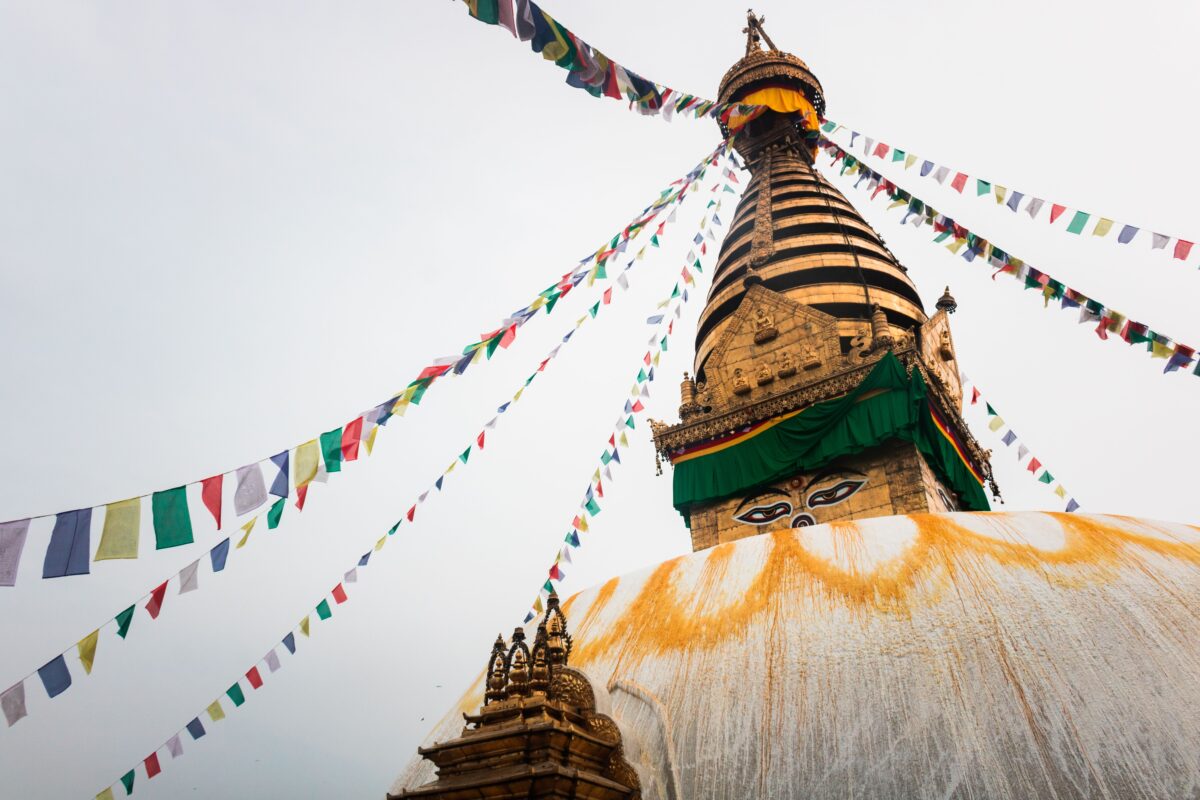
The Swayambhunath (the hilltop stupa west of the city — the 365 steps (one per day of the year) to the summit, the macaque monkeys (Macaca mulatta) visible throughout the ascent, the valley visible from the stupa terrace, the painted eyes of the Buddha visible above the stupa dome in the specific Kathmandu Valley orientation):
At 4pm: the stupa in the afternoon light, the Himalayan peaks visible to the north on clear days.
Entry: NPR 200 / £1.18.
DAY 2
6am — The Nagarkot Himalaya View (Optional but Recommended)
The Nagarkot ridge (32km east of Kathmandu by taxi — 1 hour, NPR 2,500-3,500 / £14.71-20.59 one way): the sunrise over the Himalayas, the Langtang Himal visible directly north, the Ganesh Himal to the northwest. On the clearest winter mornings (November-February): the Everest massif visible at 150km to the east. This is the specific reason to add one more day to the Kathmandu 48 hours.
10am — Patan Durbar Square
The Patan (the adjacent city — the Patan Durbar Square (the Newari medieval architecture at its finest, the Krishna Mandir (the 17th-century stone temple with the Mahabharata and the Ramayana friezes carved on the first two levels), the Patan Museum (the finest museum of Newar art and architecture in Nepal, in the restored palace wing)):
Entry: NPR 1,000 / £5.88 (includes the Patan Museum).
What It Costs (2 Days)
| Category | Budget | Mid-Range |
|---|---|---|
| Nepal visa on arrival | £24 | £39 |
| 2 nights accommodation | £18-47 | £58-176 |
| Food (2 days) | £5-15 | £15-45 |
| Transport (taxis, tuk-tuks) | £8-15 | £8-15 |
| All UNESCO site entries | £12 | £12 |
| Total (excluding flights) | £67-113 | £132-287 |