
Reykjavík absorbs the overwhelming majority of Iceland’s tourist traffic, and the country’s most famous geothermal attraction, the Blue Lagoon, has grown correspondingly crowded and expensive. Akureyri, Iceland’s “capital of the north,” offers genuine geothermal bathing and dramatic Icelandic scenery with a fraction of the visitor volume.
Quick answer: swap Reykjavík for Akureyri if the priority is genuine Icelandic geothermal bathing and dramatic northern scenery without the capital region’s tourist saturation. Keep Reykjavík on the itinerary if the Blue Lagoon specifically, or the wider Golden Circle’s proximity to the capital, are the non-negotiable draw, since Akureyri’s northern position doesn’t offer the same day-trip access to those particular sites.
Reykjavík vs Akureyri: Head-to-Head
| Factor | Reykjavík Region | Akureyri |
|---|---|---|
| Annual visitors (relative share of Iceland’s total) | Vast majority | A fraction, roughly 20% by most estimates |
| Signature geothermal bath | Blue Lagoon, genuinely crowded | Mývatn Nature Baths, considerably calmer |
| Accommodation (mid-range, per night) | £120-£200 | £90-£150 |
| Northern Lights viewing | Good, some light pollution affects visibility | Excellent, genuinely dark skies |
| Whale watching | Available from Reykjavík harbour | Genuinely strong, Eyjafjörður fjord access |
What Akureyri Actually Offers
Akureyri, Iceland’s second-largest urban area, sits at the head of Eyjafjörður, the country’s longest fjord, offering genuine access to northern Iceland’s dramatic landscape without the crowd density that increasingly defines the Reykjavík region’s most famous sites.
- Mývatn Nature Baths: a genuinely comparable geothermal bathing experience to the Blue Lagoon, with strikingly similar milky-blue mineral-rich water, at meaningfully lower cost and crowd density
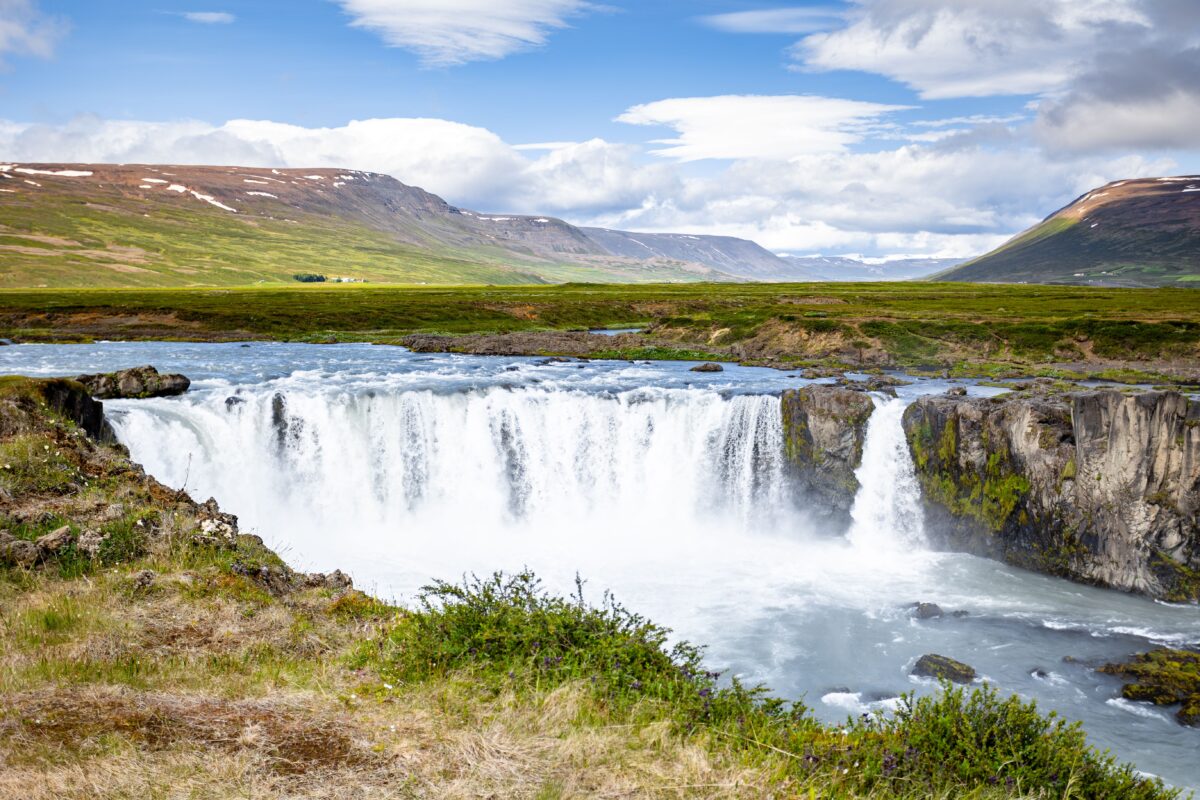
- Goðafoss waterfall: one of Iceland’s most dramatic waterfalls, genuinely rivalling the more famous Gullfoss in visual impact, with considerably fewer visitors given its northern position
- Whale watching in Eyjafjörður: the fjord’s waters offer genuinely strong whale watching conditions, with humpback whales frequently sighted, comparable to or exceeding Reykjavík’s own whale watching reputation
- Dark sky Northern Lights viewing: Akureyri’s position away from Reykjavík’s light pollution offers genuinely superior aurora viewing conditions during the winter season
Why Reykjavík Still Wins for Specific Things
Reykjavík’s proximity to the Golden Circle (Þingvellir, Geysir, Gullfoss) and the Blue Lagoon specifically represents a combination of easily accessible, world-famous sites that Akureyri’s more remote northern position doesn’t replicate. For travellers specifically wanting these particular attractions within an easy day-trip radius, that requires basing in or near Reykjavík.
The honest verdict: if the Golden Circle and Blue Lagoon specifically are the trip’s purpose, that requires accepting Reykjavík’s crowds. For travellers wanting comparably strong geothermal bathing, dramatic waterfalls, and genuinely excellent Northern Lights viewing without the capital region’s tourist saturation, Akureyri delivers a meaningfully calmer alternative.
What a Few Days Actually Costs
| Category | Reykjavík Region (3 nights, per person) | Akureyri (3 nights, per person) |
|---|---|---|
| Accommodation (split two ways) | £180-£300 | £135-£225 |
| Food | £150-£220 | £140-£210 |
| Geothermal bath and activities | £70-£130 | £60-£110 |
| Total | £400-£650 | £335-£545 |
Akureyri runs somewhat cheaper than Reykjavík, though the gap is more modest than some destination swaps given Iceland’s overall consistently high cost of living regardless of specific region.
Step-by-Step: Planning an Akureyri Trip
- Fly into Reykjavík and connect via a short domestic flight to Akureyri (roughly 45 minutes), or drive the scenic but longer route (roughly 5-6 hours) if time allows for a proper road trip.
- Book the Mývatn Nature Baths in advance during peak season, since demand has grown as more travellers seek out this Blue Lagoon alternative specifically.
- Plan Northern Lights viewing around genuinely dark sky conditions, taking advantage of Akureyri’s position away from Reykjavík’s light pollution for meaningfully better aurora visibility.
- Book a whale watching tour departing directly from Akureyri harbour, given Eyjafjörður’s genuinely strong reputation for reliable sightings.
- Rent a car for exploring the wider Lake Mývatn area, since Goðafoss and the region’s other geological features benefit significantly from independent transport.
Frequently Asked Questions
Is Akureyri’s geothermal bathing genuinely comparable to the Blue Lagoon?
Yes, the Mývatn Nature Baths offer a strikingly similar milky-blue mineral water experience, widely considered by repeat Iceland visitors to be a genuine equal to the Blue Lagoon at a considerably calmer, more affordable setting.
Do UK citizens need a visa for Iceland?
No, though Iceland isn’t an EU member, it is part of the Schengen Area, allowing UK passport holders to visit visa-free for stays up to 90 days within any 180-day period.
How do you get from Reykjavík to Akureyri?
A short domestic flight (roughly 45 minutes) or a scenic 5-6 hour drive both connect the two, with the flight offering practicality and the drive offering the chance to see more of Iceland’s dramatic countryside along the way.
What is the best time of year to visit Akureyri for Northern Lights?
September through April offers the core viewing season, with Akureyri’s genuinely dark skies providing meaningfully better viewing conditions than the more light-polluted Reykjavík capital region during the same months.
Combining Both Regions in a Longer Trip
For travellers with a longer Iceland itinerary, combining a few days in Reykjavík for the Golden Circle and Blue Lagoon with a further few days in Akureyri offers a genuinely comprehensive Iceland experience, covering both the capital region’s famous sites and the north’s calmer, equally striking landscape. The domestic flight between the two takes under an hour, making this combination genuinely practical rather than requiring an entire trip built around road-tripping the full Ring Road.
Akureyri’s Botanical Garden: A Genuine Surprise
Despite its northern, sub-Arctic position, Akureyri is home to one of the northernmost botanical gardens in the world, a genuinely unexpected green space given the region’s overall stark volcanic landscape. The garden’s ability to cultivate a surprising range of plant species, taking advantage of the town’s specific microclimate, offers a worthwhile, low-cost stop for anyone wanting a change of pace from the more dramatic natural attractions covered elsewhere in this guide.
Food and Local Character in Akureyri
Akureyri’s smaller scale supports a genuinely tight-knit local food scene, with several restaurants specialising in fresh Icelandic seafood and lamb sourced directly from the surrounding region, often at prices somewhat below Reykjavík’s more internationally geared, tourist-dense dining scene. The town’s compact centre also makes it genuinely easy to explore entirely on foot, a practical contrast to Reykjavík’s slightly more spread-out layout.
The Bottom Line
Akureyri delivers genuinely comparable geothermal bathing, dramatic waterfalls, strong whale watching, and superior Northern Lights viewing conditions, all with a fraction of the Reykjavík region’s tourist density. The trade-off is losing easy day-trip access to the Golden Circle and the specific Blue Lagoon experience, both genuinely valuable for travellers whose Iceland trip centres on those particular attractions.