


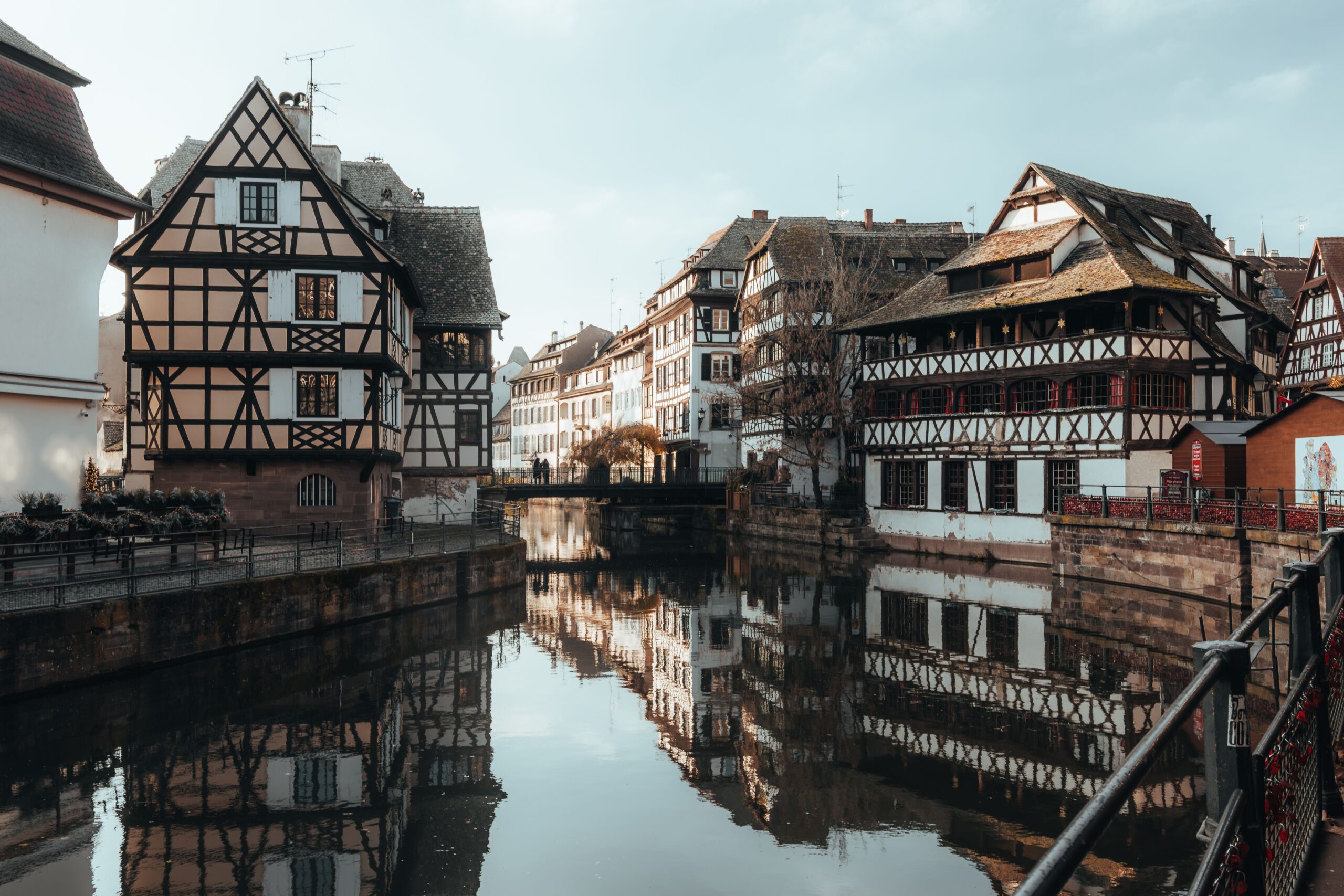
Paris’s status as France’s default city break destination has kept accommodation and dining costs consistently premium, particularly around the most photographed neighbourhoods. Strasbourg, capital of the Alsace region near the German border, offers genuinely striking half-timbered architecture, canal scenery, and strong wine culture at roughly half the cost.
Quick answer: swap Paris for Strasbourg if the priority is genuine European charm, distinctive Alsatian architecture, and wine culture without Paris’s premium pricing. Keep Paris on the itinerary if the Louvre, Eiffel Tower, and the specific scale of France’s capital are the non-negotiable draw, since Strasbourg’s smaller size doesn’t replicate that particular scope.
Paris vs Strasbourg: Head-to-Head
| Factor | Paris | Strasbourg |
|---|---|---|
| Accommodation (mid-range, per night) | €150-€280 (£128.55-£240) | €80-€150 (£68.55-£128.55) |
| Signature architecture | Haussmannian boulevards, iconic monuments | Half-timbered Petite France district |
| City scale | Vast, major world capital | Compact, genuinely walkable |
| Wine region access | Limited from central Paris | Direct access to Alsace Wine Route |
| Museums | World-class, extensive (Louvre, Musée d’Orsay) | Strong but considerably smaller scale |
What Strasbourg Actually Offers
Strasbourg’s La Petite France district, a UNESCO World Heritage Site, offers genuinely striking half-timbered houses along canals, delivering a fairy-tale European atmosphere distinct from Paris’s grander, more monumental architectural character.
- La Petite France: free to walk, canal-lined streets with colourful timber-framed houses, genuinely one of the most photogenic urban districts in France
- Strasbourg Cathedral: a striking Gothic cathedral with an astronomical clock and, for those willing to climb, panoramic views over the city and, on clear days, toward the Black Forest across the Rhine
- Canal boat tours: offering a genuinely relaxed way to see the city’s historic centre from the water, considerably less crowded than equivalent Seine river cruises in Paris
- Direct access to the Alsace Wine Route: Strasbourg sits at the northern end of this celebrated wine region, with villages like Riquewihr and Eguisheim reachable within a short drive, offering genuine wine tourism unavailable from central Paris
Why Paris Still Wins for Specific Things
Paris’s world-class museum collections, the Louvre, Musée d’Orsay, and its status as one of the world’s great capital cities, alongside iconic monuments like the Eiffel Tower, represent a genuinely unmatched combination Strasbourg’s smaller scale doesn’t replicate. For travellers specifically wanting these particular sights, that requires Paris itself.
The honest verdict: if the Louvre, Eiffel Tower, and Paris’s specific scale as a world capital are the trip’s purpose, that requires accepting the premium cost. For travellers wanting genuine European charm, distinctive architecture, and wine culture within a more relaxed, affordable city, Strasbourg delivers considerably more value.
What a Weekend Actually Costs
| Category | Paris (2 nights, per person) | Strasbourg (2 nights, per person) |
|---|---|---|
| Accommodation (split two ways) | £128.55-£240 | £68.55-£128.55 |
| Food | £90-£150 | £65-£110 |
| Activities/entry fees | £35-£60 | £20-£40 |
| Total | £253.55-£450 | £153.55-£278.55 |
Strasbourg runs roughly 35-40% cheaper than Paris, a meaningful gap for a genuinely comparable European city break weekend.
Step-by-Step: Planning a Strasbourg Trip
- Fly directly into Strasbourg or take the high-speed TGV from Paris (roughly 1 hour 50 minutes), both genuine options given the city’s strong connectivity.
- Book La Petite France area accommodation for the most atmospheric, walkable base within the city.
- Add a day trip to the Alsace Wine Route villages (Riquewihr, Eguisheim, or Colmar) if time allows, since this genuinely distinguishes Strasbourg from a standalone Paris trip.
- Visit Strasbourg Cathedral’s astronomical clock show (typically a daily performance), a genuinely unique attraction with centuries of mechanical history.
- Try choucroute (Alsatian sauerkraut with meats) or tarte flambée, both genuine regional specialties distinct from standard Parisian French cuisine.
Frequently Asked Questions
Is Strasbourg worth visiting if you’ve already done Paris?
Yes, genuinely offering a distinctly different architectural and cultural character (reflecting Alsace’s shared French-German history), making it a strong second France destination rather than a repeat of the Paris experience.
How do you get from Paris to Strasbourg?
The high-speed TGV connects the two in roughly 1 hour 50 minutes, making Strasbourg genuinely feasible as either a standalone trip or a combined itinerary with Paris.
Is Strasbourg suitable for a first-time visit to France?
Yes, particularly for travellers prioritising a relaxed pace and distinctive regional character over Paris’s iconic but crowded major monuments. First-time visitors specifically wanting the classic Eiffel Tower and Louvre experience should still prioritise Paris directly.
What is the best time of year to visit Strasbourg?
May-June and September-October offer the strongest combination of comfortable weather and manageable crowds, with Strasbourg’s Christmas markets (late November-December) also drawing a genuinely significant seasonal visit, among the oldest and most celebrated in Europe.
Strasbourg’s European Institutions: A Genuine Point of Interest
Strasbourg holds a distinctive status as the official seat of the European Parliament, alongside the Council of Europe and European Court of Human Rights, giving the city a genuinely significant political dimension beyond its architectural and culinary appeal. This isn’t typically the primary draw for leisure travellers, but it adds a layer of contemporary relevance to a city otherwise known primarily for its historic character, worth knowing for anyone with an interest in European politics and institutions.
Getting Around Strasbourg Without a Car
Strasbourg’s compact old town is genuinely walkable in its entirety, with the city’s modern tram network offering an efficient, cheap way to reach anywhere beyond the immediate historic centre. This walkability, combined with the city’s flat terrain, makes Strasbourg genuinely easy to explore without needing taxis or extensive public transport planning, a practical advantage over Paris’s larger, more spread-out layout.
Strasbourg’s German Cultural Influence
Alsace’s history of shifting between French and German control has left Strasbourg with a genuinely distinctive dual cultural identity, reflected in everything from the local dialect (Alsatian, a Germanic language) to the region’s cuisine and architecture. This blend gives the city a character genuinely unlike anywhere else in France, a compelling reason to visit beyond simple cost comparison with Paris, and a distinctive cultural texture worth experiencing on its own terms.
The Bottom Line
Strasbourg delivers genuinely striking Alsatian architecture, canal scenery, and direct access to celebrated wine country, at roughly two-thirds the cost of Paris and without its crowd density at major sights. The trade-off is accepting that Strasbourg’s smaller scale doesn’t replicate Paris’s world-class museum collections and status as one of the world’s great capital cities.