
The route that gives Kenya in its essential form: two days in Nairobi for the elephant orphans and the Giraffe Centre and the understanding of what the conservation context is before the safari begins, four days in the Masai Mara in the specific window when the wildebeest crossing is occurring, and the final morning flight back that gives you the savanna from the air at dawn — and why Kenya is the correct first African safari for the UK traveller who has not yet been to the continent.
Reading time: 11 minutes | Last updated: 2026
Kenya is the safari country — the country that established the game reserve system that East Africa now operates under, the country where Out of Africa was filmed, the country whose specific combination of accessible infrastructure (the direct British Airways flight from Heathrow, the Nairobi hub connecting to every Kenyan airstrip) and extraordinary wildlife density makes the first African safari most achievable.
The Masai Mara National Reserve is the specific reason. The reserve shares an unfenced border with Tanzania’s Serengeti National Park — together they form the world’s most significant large mammal ecosystem. The wildebeest migration (the annual movement of 1.5 million wildebeest and 500,000 zebra between Tanzania and Kenya, following the rains) passes through the Masai Mara from July to October, the river crossings visible at specific Mara River points from July through September.
This itinerary is built around the July-September window for the migration crossing. Outside this window, the Masai Mara is still excellent — the Big Five resident year-round — but the migration crossing is the specific experience this guide prioritises.
Before You Leave
The visa: The Kenya ETA (Electronic Travel Authorisation) required for UK citizens. Apply at etakenya.go.ke at least 72 hours before travel. Cost: $30 / £23.62. The ETA replaced the previous visa system in 2024.
The vaccinations: Yellow fever vaccine required for most Kenya entry points (consult a travel clinic — the requirement depends on your departure country and transit). Typhoid, Hepatitis A recommended. Malaria prophylaxis: required for the Masai Mara area (Malarone or Doxycycline — start 1-2 days before departure for Malarone).
The bush plane: The internal Kenya flights (the Wilson Airport in Nairobi to the Mara airstrips) are operated by Safarilink, Air Kenya, and Fly-SAX in the 12-seat Cessna Caravan. Maximum baggage: 15kg soft bag. No hard-sided luggage.
The safari operator: The quality of the guide determines the quality of the safari. The lodge’s in-house guides are typically excellent (the Kenya Professional Safari Guides Association KPSGA certification is the quality indicator). The booking through the lodge directly (or through a reputable Kenya safari operator) is the correct approach.
The Route
Nairobi (2 nights) → bush plane to Masai Mara (4 nights — camp in the reserve) → bush plane back to Nairobi, fly home
The 7 Days
DAY 1 — Arrive Nairobi
Afternoon:
The Giraffe Centre (the Rothschild giraffe breeding programme — the raised feeding platform, the giraffe at face level): full guide in Nairobi in 48 Hours. At 3pm, the Giraffe Centre as the arrival afternoon activity.
The Karen Blixen Museum (the Out of Africa farmhouse, the Ngong Hills visible from the garden): if time allows before the Giraffe Centre.
Evening: the Carnivore Restaurant
Book at carnivore.co.ke. The sword-skewer service, the game meat and conventional meats over the Maasai charcoal. The $45 / £35.43 per person fixed price. The white flag.
Where to stay: The Tribe Hotel (the Limuru Road boutique hotel: £100-180/night), the House of Waine (the Karen suburb near the Blixen Museum: £80-140/night).
DAY 2 — Nairobi: The Conservation Day
11:00am — The David Sheldrick Wildlife Trust
The orphaned elephant calf feeding at 11am — the most affecting wildlife encounter in Kenya outside a national park. Full guide in Nairobi in 48 Hours.
The specific Day 2 morning instruction: book the Sheldrick Trust visit at sheldrickwildlifetrust.org in advance (the 11am slot has a visitor limit, books out weeks ahead in peak season).
Afternoon: the Nairobi National Park
The game drive in the Nairobi National Park (the park with the lion and the rhinoceros visible against the Nairobi skyline): a half-day drive from 2pm to 5pm gives the afternoon wildlife activity and the sunset light on the savanna.
Why the conservation day matters:
The Day 2 Nairobi conservation experience — the elephant orphans at 11am, the game drive at 2pm — establishes the context for the Masai Mara before the flight. The visitor who arrives in the Mara without understanding the poaching threat, the habitat loss, and the conservation programmes that maintain the ecosystem has a different experience from the visitor who arrives with that context already established.
The David Sheldrick keeper who sleeps beside the orphaned calf for the first year of its life. The ranger in the Nairobi National Park who monitors the rhino GPS collars. These are the people who make the Masai Mara experience possible. Meeting them first — even in this limited way — changes how the game drive is experienced.
DAY 3 — Fly to the Masai Mara
8:30am — Wilson Airport
The Wilson Airport domestic terminal (not the main JKIA International — Wilson Airport is 6km from the city centre, accessible by taxi or Uber in 20 minutes): the Safarilink or Air Kenya check-in for the Mara airstrip flight.
The 45-minute bush plane flight: the Rift Valley visible from the aircraft window, the savanna beginning south of Nairobi, the Mara River visible as a silver thread through the grassland, the Mara airstrip the first landing.
The camp or lodge selection:
The Masai Mara has two primary zones: the National Reserve (the main reserve, government-managed, the highest tourist density, the best river crossing access) and the Private Conservancies (the Olare Motorogi, the Naboisho, the Mara North — private land agreements with the Maasai communities that give exclusive game drive access, the higher price, the lower tourist density, the off-road driving access that the reserve does not permit).
For the migration crossing: the National Reserve camp within reach of the Mara River crossing points (the Keekorok, the Oloololo — the two primary crossing areas). The camps closest to the river give the fastest access when the migration signal is received.
The camp options at the mid-range: the Mara Intrepids (the all-inclusive camp on the Talek River: £180-280/person/night), the Basecamp Masai Mara (the carbon-neutral camp on the Talek: £150-250/person/night).
The premium option: the camps in the private conservancies (the Angama Mara, the Mahali Mzuri — Richard Branson’s camp — the Sanctuary Olonana): £300-800/person/night, the exclusive game drive access justifying the premium for the visitor who wants the wilderness version.
Afternoon: First Game Drive (3pm-6pm)
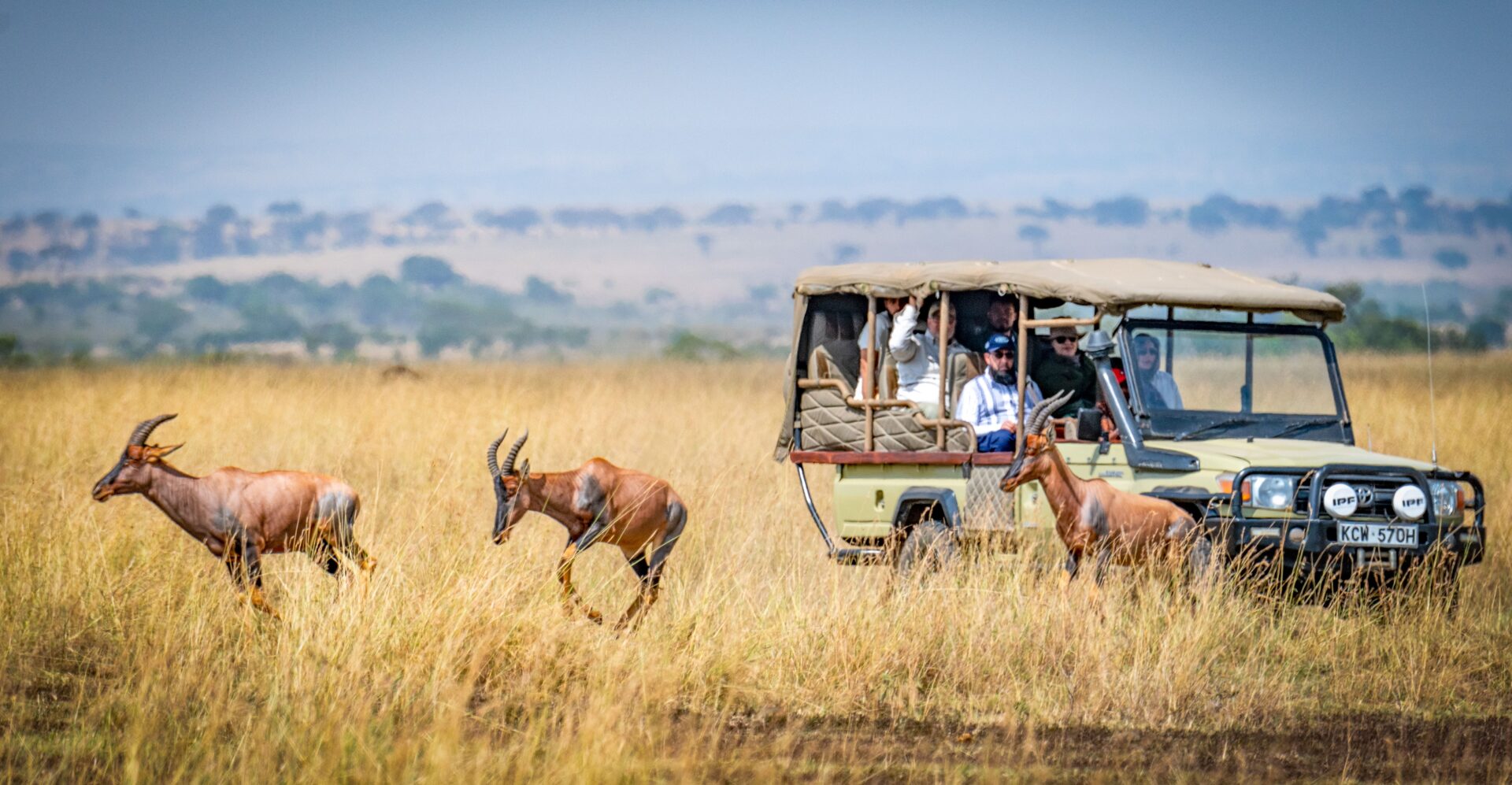
The afternoon game drive: the first orientation of the reserve, the lion pride location (the guide receives the ranger network radio communication giving the current lion positions), and the specific Mara light in the golden hour (the African savanna at 5pm in October, the light horizontal and warm, the animals at their most active in the cooling temperature).
The Big Five in the Masai Mara: all five (lion, elephant, buffalo, leopard, rhinoceros) are resident year-round. The lion sighting rate in the Masai Mara is the highest of any East African reserve. The leopard requires specific effort (the Mara’s leopards are habituated to vehicles but nocturnal in tendency — the dawn and dusk drives are the correct windows).
DAYS 4-5 — The Masai Mara: Migration Days
The daily schedule:
5:30am — Wake up call. Tea and coffee at the camp mess. 6:00am — Morning game drive (the dawn drive, the best light, the predator activity highest after the overnight hunt). 10:00am — Return to camp. Bush breakfast. 11am-3pm — Rest at camp (the midday heat is the least productive game drive period). 3:00pm — Afternoon game drive. 6:30pm — Sundowner in the field (the guide stopping the vehicle at a dramatic viewpoint, the gin and tonic in the bush — the specific safari ceremony, the sun at the horizon, the giraffes visible in the acacia trees). 7:30pm — Return to camp. Dinner at the mess tent.
The wildebeest crossing:
The crossing is the most dramatic single wildlife event available anywhere on Earth. The 1.5 million wildebeest that have been grazing the Serengeti since their Tanzania arrival need to cross the Mara River to reach the Kenya grasslands — and the Mara River in July-September contains the Nile crocodile (the crocodile population of the Mara River is the most concentrated in Africa, the individual animals weighing up to 600kg).
The crossing sequence: the wildebeest approach the river bank over 30-60 minutes (the herd building at the bank, the hesitation visible — the lead animals approaching the edge and retreating, the herd massing behind), then a tipping point (one animal commits, the herd follows in a stampede, 10,000-50,000 animals crossing in 15-40 minutes), then the crocodile activity (the opportunistic predation visible from the vehicle position on the bank).
The guide’s role at the crossing:
The guide monitors the radio network of ranger communications that track the herd position. The crossing signal (when the herd has massed at the bank and the commitment appears imminent) typically gives 30-60 minutes of advance notice. The vehicle positions at the riverbank before the crossing begins.
The guide who has worked the Mara for 10+ years has seen hundreds of crossings and knows the specific crocodile positions, the crossing points with the best vehicle sightlines, and the signs (the herd density, the individual animal behavior, the dust plume direction) that indicate the crossing is imminent rather than the false start that the herd performs repeatedly.
Day 5: The Maasai Village Visit
The Olchoro Maasai village visit (arranged through the camp — the visit to the working Maasai settlement within the conservancy or adjacent to the reserve): the traditional homestead (the enkiama — the circular compound of mud and dung houses, the livestock kraals, the thorny acacia fence), the warrior demonstration (the adamu — the jumping dance that demonstrates the warrior’s athleticism), and the craft market (the Maasai beadwork purchased directly from the makers at the village).
The specific village visit instruction: the village visit organised through the camp (the fee paid directly to the village community, not to a tour operator intermediary) is the correct version — the direct payment supports the community conservation partnership that gives the conservancy its land access.
DAY 6 — Final Masai Mara Morning
5:30am — The Hot Air Balloon Safari (Optional)
The hot air balloon flight over the Masai Mara (the Mara Balloon Safaris or the Adventure Aloft operations — the balloon launching at dawn, the 1-hour flight over the savanna, the champagne bush breakfast after landing): $450-600 / £354.33-472.44 per person. The most expensive single activity in this guide. The view: the Mara from 300 metres at sunrise, the herds visible in their overnight positions, the river visible from above.
The balloon safari is not the correct choice for every visitor — the cost is significant and the wildlife density viewed from the air is lower than from the vehicle. It is the correct choice for the visitor for whom the aerial view of the savanna at dawn is the specific experience they are seeking.
Morning Game Drive:
The last morning game drive before the Wilson Airport flight: the specific instruction is the cheetah. The Masai Mara has the highest cheetah population density in East Africa — the cheetah hunts in the morning (the ambush predator whose speed requires the cooler morning temperature) and is most visible in the 6-9am window.
DAY 7 — Return to Nairobi, Fly Home
11:00am — Bush Plane to Wilson Airport
The return flight from the Mara airstrip to Wilson Airport: 45 minutes. The airport transfer to JKIA. Kenya Airways or British Airways home.
The departure instruction: Nairobi traffic to JKIA is significant in the afternoon — allow 2 hours from Wilson Airport. The Kenya Airways international departures are from JKIA Terminal 1C; the British Airways departures from the international terminal. Confirm in advance.
What It Costs
| Category | Budget | Mid-Range | Premium |
|---|---|---|---|
| Return flights (Heathrow-Nairobi) | £450-650 | £550-800 | £800-1,200 |
| Internal flights (Nairobi-Mara-Nairobi) | £200-300 | £250-350 | £300-450 |
| Nairobi accommodation (2 nights) | £80-180 | £160-320 | £300-600 |
| Masai Mara camp (4 nights, all-inclusive) | £600-900 | £900-1,500 | £1,500-4,000+ |
| Park fees (National Reserve) | £200-250 | £200-250 | £0 (conservancy included) |
| Activities (Sheldrick, Giraffe Centre, village) | £80-120 | £100-150 | £120-200 |
| Total per person | £1,610-2,400 | £2,160-3,370 | £3,020-6,450+ |
The all-inclusive safari camp pricing (all meals, all game drives, all camp activities included) means the mid-range total is the complete cost — no significant additional daily expenditure within the camp.