

The Maxwell Food Centre at 7:30am for the chicken rice that has been served from the same stall since 1970, the Gardens by the Bay Supertrees at 7:45pm when the light show begins, the Peranakan shophouses of the Joo Chiat neighbourhood that most visitors to Singapore never reach, the Singapore Botanic Garden at 6:30am when the orchid garden is empty, and why Singapore — the country most UK travellers treat as a layover — is worth coming for specifically.
Reading time: 9 minutes | Last updated: 2026
Singapore is a city-state of 6 million people on an island of 728 square kilometres at the southern tip of the Malay Peninsula. It is simultaneously the most orderly city in Southeast Asia, the most expensive, the most efficiently designed, and the one where the gap between the surface (the gleaming MRT system, the shopping malls, the air conditioning) and the substance (the hawker culture, the multilingual street life, the specific Peranakan heritage) is most worth closing.
Most UK travellers stop in Singapore for 6-24 hours as a Changi layover. These 48 hours cover the city worth coming for specifically.
The 48 Hours
DAY ONE
6:30am — The Singapore Botanic Garden
The Singapore Botanic Garden (the Cluny Road entrance) — UNESCO-listed, the oldest garden in Southeast Asia, 82 hectares of tropical rainforest, cultivated gardens, and the National Orchid Garden (the collection of 60,000 orchids, 400 species, the specific Singapore national obsession that produced the Vanda Miss Joaquim — the national flower, the orchid that is Singapore’s botanical argument to the world).
At 6:30am: the garden before the school groups and the joggers at scale. The Jacob Ballas Children’s Garden is closed at this hour. The Symphony Lake section and the path around the lake give the garden at its most specifically rainforest-like: the morning humidity, the birdsong, the specific smell of tropical vegetation in the early morning.
National Orchid Garden entry: S$5 / £2.88. Garden entry: free.
8:00am — The Maxwell Food Centre
The Maxwell Food Centre (Chinatown, Maxwell Road) — the hawker centre that contains Tian Tian Hainanese Chicken Rice (stall 10 and 11), the most celebrated chicken rice stall in Singapore. The dish: the poached chicken (the white-cut chicken method — the whole chicken lowered into a sub-boiling stock, the heat off, the chicken cooking in the residual heat for 40 minutes), served on the rice cooked in the same chicken stock with ginger and pandan leaf, the three sauces alongside (the chilli, the dark soy, the ginger-garlic).
The queue at Tian Tian at 8am on a weekday: 10-15 minutes. At 11am: 45-60 minutes.
Cost: S$5-7 / £2.88-4.03 per plate. The finest value meal in Singapore.
The Maxwell Food Centre at 8am also has: the Ah Tai Hainanese Chicken Rice (the competing stall, founded by a former Tian Tian chef — the Gordon Ramsay of chicken rice drama), the popiah stall (the fresh spring rolls made to order in front of the customer), and the kaya toast counter.
9:30am — Chinatown
The Chinatown Heritage Centre (Pagoda Street, 48) — the museum in three restored shophouses covering the history of Chinatown’s Cantonese, Hokkien, Teochew, and Hakka immigrant communities, the early 20th-century living conditions (the “death houses” where the elderly came to die; the opium dens; the coolie quarters), and the specific Singapore Chinese immigrant experience. Entry: S$18 / £10.37.
The Buddha Tooth Relic Temple (South Bridge Road, 288) — the relic temple housing what is claimed to be the left canine tooth of the Buddha, housed in a 420kg solid gold stupa on the top floor. The building is 2009 (not ancient) but the interior is extraordinary — four floors of Buddhist art, the Wheel of Life on the ground floor, the relic chamber on the fourth. Entry: free.
The Chinatown wet market (Smith Street, the covered market behind the shophouses): the morning produce market serving the restaurants of Chinatown, the specific market that supplies the chicken rice stalls and the other hawker centres in the district.
11:30am — The Clarke Quay to Boat Quay Walk
The river walk from Clarke Quay to Boat Quay — the restored colonial-era warehouses and shophouses along the Singapore River, the site of the entrepôt trade that made Singapore the commercial hub of Southeast Asia from 1819. The colonial buildings (Empress Place, the Asian Civilisations Museum) on the north bank, the old godowns (warehouses) on the south. The river at 11:30am: the tourist boat traffic, the office workers at lunch.
The Asian Civilisations Museum (1 Empress Place) — the finest museum of Asian material culture in Southeast Asia, the collection covering the full arc of Asian trade networks from the Indian Ocean to the South China Sea: entry S$20 / £11.52.
1:00pm — Lunch: the Tekka Centre (Little India)
The Tekka Centre (Bukit Timah Road, 665, Little India) — the hawker centre that is the least tourist-facing of the major Singapore markets. The Indian Muslim stalls (the biryani, the mee goreng — the Indian-Malay fried noodle, one of Singapore’s most specific cultural hybrids), the fish head curry (the Tamil preparation, the fish head in the spiced curry with the eggplant and the okra), and the roti prata (the South Indian flatbread griddle-cooked with the curry for dipping). At 1pm: the Little India working population. Meal: S$8-14 / £4.61-8.07.
The Little India neighbourhood walk after lunch: Serangoon Road (the main artery, the gold jewellery shops, the sari fabric shops, the Hindu temple), the Mustafa Centre (the 24-hour department store, the most specific Singapore shopping experience — everything from Indian spices to electronics to gold at prices below the tourist district), and the Sri Veeramakaliamman Temple (Buffalo Road — the coloured gopuram tower, the interior of active Hindu worship, free entry).
3:30pm — The National Museum of Singapore
The National Museum of Singapore (Stamford Road, 93) — the oldest museum in Singapore (established 1887), the collection covering Singapore’s history from its founding as a British trading post to independence. The Glass Rotunda (the original 1887 dome, preserved inside the modern extension), the History Gallery, and the specific Singapore story: the Japanese occupation (1942-1945), the merger with Malaysia (1963), the separation (1965), and the 60-year transformation from fishing village to first-world city-state that has no equivalent in the 20th-century development literature.
Entry: S$15 / £8.64 (free Friday evenings 6-9pm).
5:30pm — The Peranakan Shophouses of Joo Chiat
The Joo Chiat neighbourhood (Geylang area, 15 minutes from the city centre by MRT: Paya Lebar or Eunos station) — the most intact concentration of Peranakan (Straits Chinese) shophouse architecture in Singapore. The Peranakan people: the descendants of Chinese immigrants who married local Malay women in the 18th-19th centuries, developing a specific hybrid culture — the Baba (the men) and the Nyonya (the women) — with its own language (Baba Malay), cuisine (the laksa, the ayam buah keluak), and material culture (the specific tilework, the embroidery, the carved wooden shutters).
Joo Chiat Road and Koon Seng Road: the preserved shophouses with the most elaborate tile facades in Singapore. The specific Koon Seng Road section (between Joo Chiat Terrace and Tembeling Road) is the reference block for Peranakan shophouse photography — the buildings in their original turquoise, yellow, green, and terracotta.
The Katong Laksa (the neighbourhood’s specific contribution to Singapore food culture — the laksa from the Katong area, characterised by the coconut milk broth and the cut noodles that can be eaten entirely with a spoon): from any of the Original Katong Laksa stalls in the area. S$6-8 / £3.46-4.61.
7:45pm — Gardens by the Bay Supertrees
The Gardens by the Bay (18 Marina Gardens Drive) — the reclaimed land development that is Singapore’s most ambitious act of landscape design: 101 hectares of gardens, the two climate-controlled conservatories (the Flower Dome and the Cloud Forest), and the Supertrees.
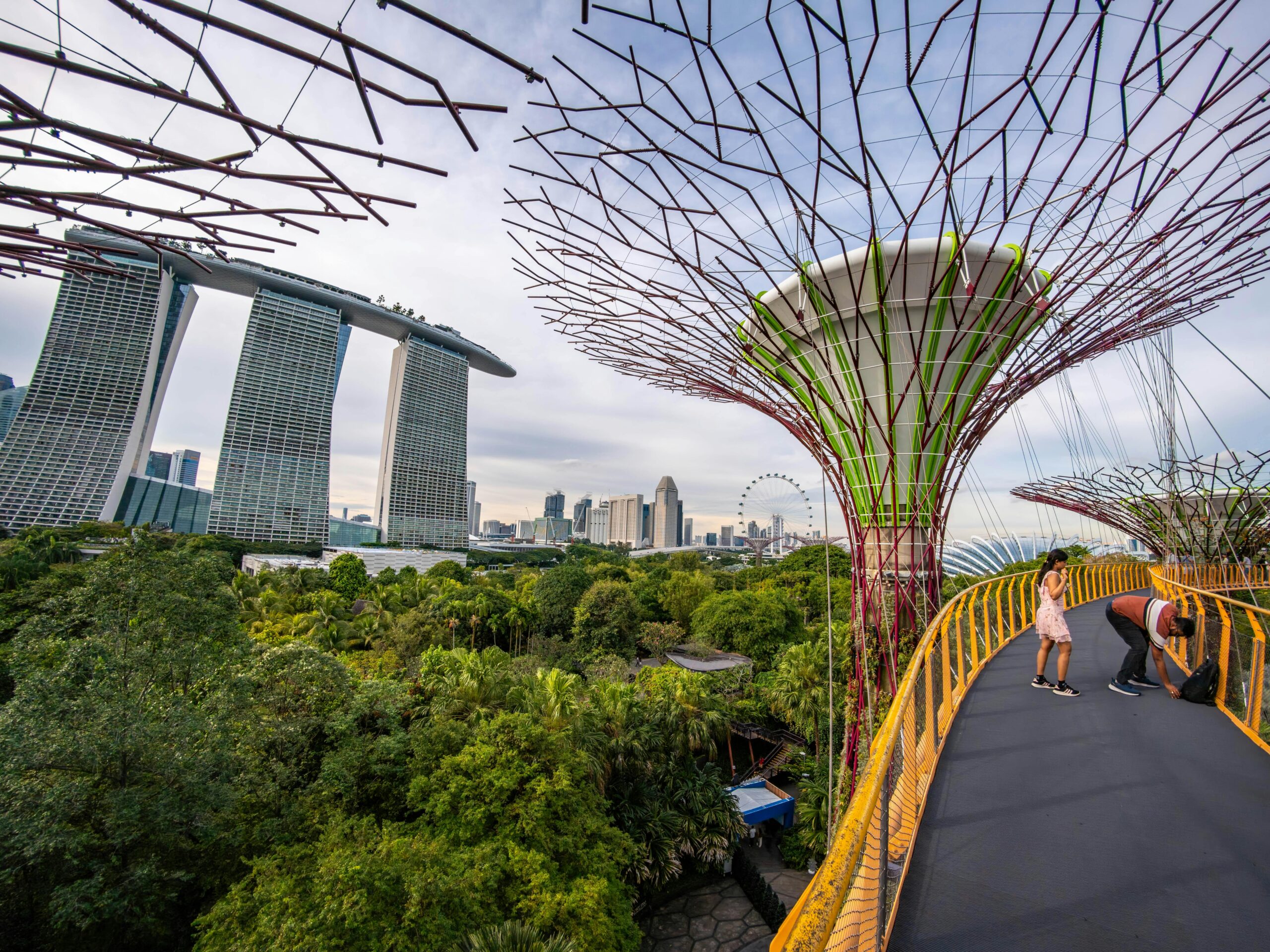
The Supertrees at 7:45pm: the nightly Garden Rhapsody light show (7:45pm and 8:45pm, 15 minutes) illuminates the 18 tree-like structures (25-50 metres tall, covered in 162,900 plants from 200 species) with synchronised music and light. Free to watch from the ground; S$10-14 / £5.76-8.07 for the OCBC Skyway (the aerial walkway connecting two Supertrees 22 metres above the ground).
The best viewing position: the OCBC Skyway gives the Supertree Grove from above. The ground level gives the Marina Bay Sands (the three-tower hotel with the Infinity Pool on the rooftop bridge) in the background.
9:00pm — Dinner: the Newton Food Centre
The Newton Food Centre (Clemenceau Avenue) — the hawker centre that appeared in Crazy Rich Asians and that, despite the film fame, remains a genuinely excellent hawker centre with working-price stalls.
The specific stalls: the satay (the grilled skewers of chicken, mutton, and beef in the peanut sauce — negotiate the price per stick before ordering, the correct price is S$0.80-1.20 / £0.46-0.69 per stick), the chilli crab (the Singapore signature dish — the Sri Lankan crab in the thick, sweet-spicy chilli sauce, eaten with the man tou fried buns: S$40-80 / £23.04-46.08 depending on the crab size, for sharing between two), and the oyster omelette (or luak — the starchy omelette with the small oysters embedded, the specific texture produced by the tapioca starch in the egg mixture).
DAY TWO
7:00am — The East Coast Park
The East Coast Park (the 15km parkland along Singapore’s southeastern coast, the closest the city comes to an unmanicured beach) at 7am: the cyclists, the rollerbladers, the sea visible between the casuarina trees, the early morning Southeast Asian light.
The MacRitchie Reservoir Park (in the central island, the treetop walk between two forested hills, the 11-species of primates including the long-tailed macaque) is the alternative for the nature-first visitor: the TreeTop Walk (a 250-metre suspension bridge through the forest canopy) at 8am opening gives the equatorial forest at its most accessible.
9:00am — The Indian Heritage Centre and Kampong Glam
The Indian Heritage Centre (Campbell Lane, 5, Little India): the four-floor museum covering the history of Indian communities in Singapore and Southeast Asia, the collection of South Asian textiles, jewellery, and material culture. Entry: S$8 / £4.61.
The Kampong Glam neighbourhood (the Arab Quarter — Sultan Gate, Arab Street, Haji Lane): the Sultan Mosque (the 1825 mosque rebuilt in 1928, the golden dome visible from the Bugis MRT station, free to enter outside prayer times), the Arab Street fabric market, and the Haji Lane (the narrow pedestrian lane with the independent boutiques, the street art, and the neighbourhood cafés that have displaced the original hawker culture over the past decade but replaced it with an excellent coffee scene).
11:00am — The National Orchid Garden (Second Visit at Peak Bloom)
Return to the Singapore Botanic Garden for the National Orchid Garden at 11am — the orchids at the best viewing temperature (the garden is cooled to 23-25°C inside, significantly below the ambient Singapore temperature), the collection at its most easily photographed in the mid-morning light.
The specific draws: the VIP Orchid Garden (the orchids named after visiting dignitaries — Princess Diana, Nelson Mandela, Pope John Paul II — each named orchid with the visitor photograph and the hybridisation details), and the Coolhouse (the plants from the temperate mountain zones, the rare cloud forest orchids).
1:00pm — The Changi Experience Studio (the Correct Use of Changi)
Singapore Changi Airport — repeatedly rated the world’s best airport — is 30 minutes from the city centre by MRT (the East-West Line to Changi Airport station). The specific Changi attractions:
The Jewel (the indoor forest and waterfall complex in the Terminal 1-3 connector): the Rain Vortex (the world’s tallest indoor waterfall at 40 metres, the water falling through the glass dome into the basement levels) and the canopy park (the bouncing net, the hedge maze, the topiary walk). No airport ticket required to access the Jewel. Entry to some Jewel attractions: S$6-15 / £3.46-8.64.
The airport itself (with a valid boarding pass or the Changi Airport visitor pass — apply at any information counter): the butterfly garden (Terminal 3, departures, free), the cactus garden (Terminal 1, transit, free), the sunflower garden (Terminal 2, free), and the rooftop pool (Terminal 1 — the only airport rooftop pool accessible to passengers: S$17 / £9.79 for non-guests of the Airport Hotel).
Changi is not where you wait for a flight. It is a destination that happens to have a departure hall.
3:00pm — Haw Par Villa
Haw Par Villa (Pasir Panjang Road, 262) — the most specifically Singaporean attraction and the one most visitors never reach. The 1937 theme park built by the Aw family (the creators of Tiger Balm) to demonstrate Chinese mythology and moral teachings, featuring 1,000 statues and 150 dioramas, including the Ten Courts of Hell (the graphic depiction of the punishments awaiting sinners in the afterlife — the disembowelling, the grinding, the boiling in oil — the most visceral moral education available at any tourist site in Asia). Entry: free.
Haw Par Villa is not ironic. It is entirely sincere. The moral framework of Chinese folk religion expressed in polychrome concrete.
5:30pm — The Singapore Sling at the Long Bar
The Raffles Hotel Long Bar (Beach Road, 1) — the bar where the Singapore Sling cocktail was created in 1915 by bartender Ngiam Tong Boon. The drink (the gin base, the cherry heering, the Dom Benedictine, the Cointreau, the pineapple juice, the lime juice, the grenadine) costs S$37 / £21.31. The bowl of peanuts is free, the peanut shells thrown on the floor by tradition. The Long Bar at 5:30pm is the specific Singapore occasion that the budget-conscious visitor earns by eating at hawker centres for two days.
8:00pm — Final Dinner: the Lau Pa Sat
The Lau Pa Sat (Boon Tat Street, 18, the CBD) — the Victorian cast-iron market building (1894) converted to a hawker centre, the most architecturally significant hawker centre in Singapore. The outdoor satay street (Boon Tat Street) operates from 7pm — the satay vendors taking over the street with their charcoal grills, the smoke visible from the CBD buildings above.
The standard Lau Pa Sat Satay Street order: 15 sticks of chicken and mutton satay, one portion of ketupat (the compressed rice in palm leaf packages), the peanut sauce. S$15-22 / £8.64-12.67 for the full satay spread. Beer: S$12-15 / £6.91-8.64 per bottle.
The Essentials
Getting to Singapore: Singapore Airlines, British Airways, Virgin Atlantic, Scoot direct from Heathrow and Gatwick. 13 hours. Return: £500-900. The layover version: Singapore Airlines allows free stopovers (24-72 hours) on many long-haul routes — Singapore as a stopover on the Australia or New Zealand route is one of the most efficient uses of a long-haul itinerary.
Getting around: The MRT (the Singapore Metro — the EZ-Link card, available at any MRT station: S$10 / £5.76 minimum load, the card itself free to new accounts) is the primary transport. Taxis and Grab are reliable and inexpensive (S$8-15 / £4.61-8.64 for most city journeys).
The GST refund: Singapore operates a 9% Goods and Services Tax. Visitors are eligible for a full refund on purchases over S$100 / £57.60 at registered retailers — the electronic Tourist Refund Scheme (eTRS) operates at Changi Airport. Worth claiming on larger purchases.
Where to stay: The Wanderlust Hotel (Dickson Road, Little India, £100-160/night), the Hotel Mono (Mosque Street, Chinatown, £80-130/night), the Generator Singapore (Mosque Street, private rooms from £45-70/night).
The Closing Moment
I was at the Maxwell Food Centre at 7:35am. The queue at Tian Tian was twelve people. The Ah Tai queue was four. I chose Ah Tai.
The plate arrived: the chicken, the rice, the three sauces, the soup on the side. The chicken had been poached in stock at sub-boiling temperature. The skin was gelatinous. The flesh was specifically not dry — the quality difference between the correct preparation and the incorrect is immediate and complete.
I ate the entire plate in 11 minutes.
Singapore is a city built on efficiency. The MRT arrives every 3 minutes. The airport has a butterfly garden in the transit zone. The hawker centre opens at 6am and serves the population at prices that have been held low by deliberate government policy since the 1970s.
The chicken rice costs S$5.50 / £3.17. The Raffles Long Bar Singapore Sling costs S$37 / £21.31.
Both are the correct choice. One in the morning, one in the evening. A city that contains both — and considers both part of its essential identity — has figured something out.