


The question that arrives in the BGGD inbox approximately twelve times per week. The honest answer involves a question: what are you actually going to Thailand for?
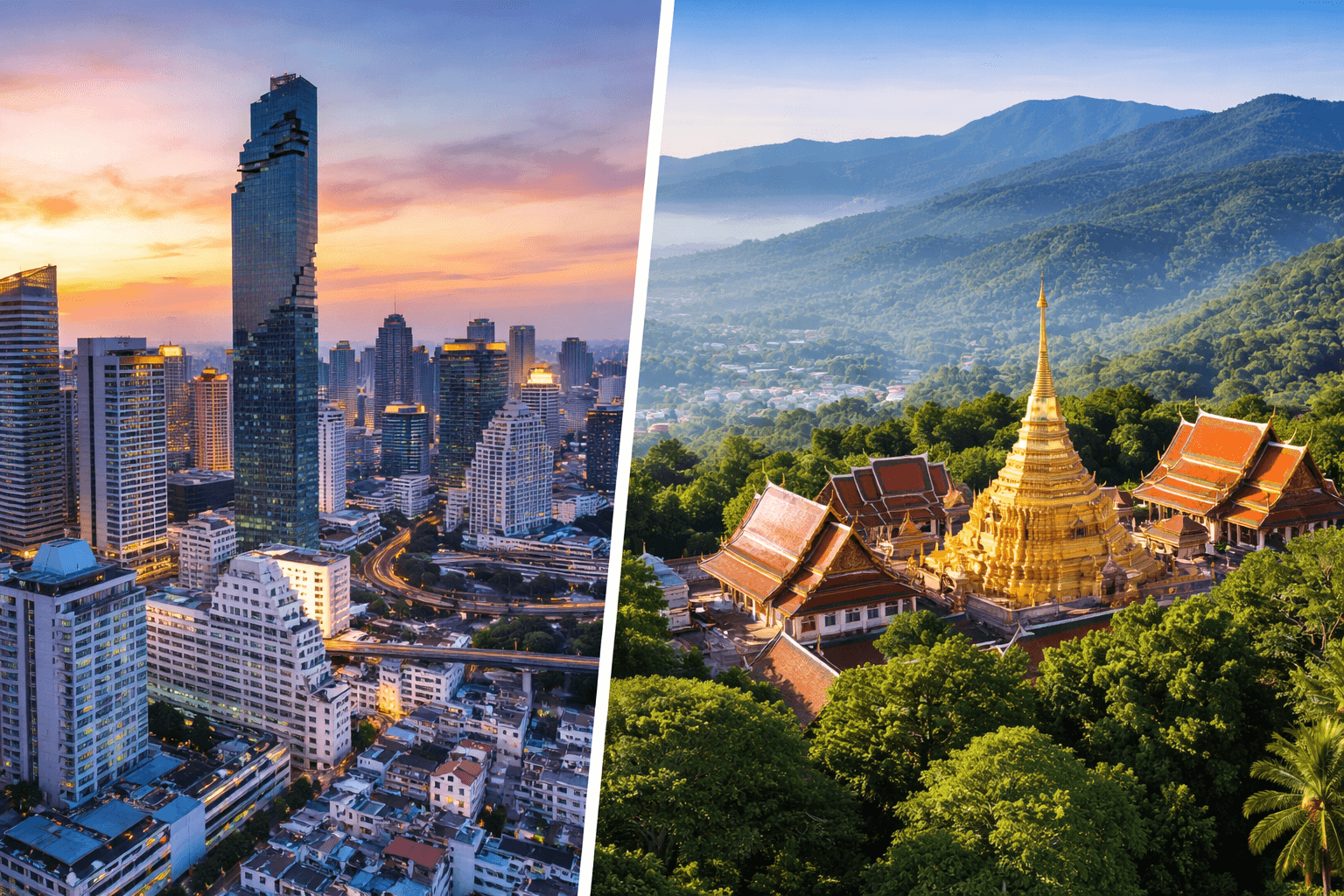
Bangkok and Chiang Mai are the two cities that define the Thailand trip for most UK visitors — and they are so different in character that choosing which one to visit first, or whether to visit both, or how long to spend in each, is genuinely worth thinking about before booking.
This is the framework.
What Each City Does Best
Bangkok does:
Scale. Energy. The concentrated food culture of a capital city of 10 million people where every regional Thai tradition has a representative in a food court, a market, or a restaurant. The temples at density (Wat Pho, the Grand Palace, Wat Arun — all within 5km of each other). The transit infrastructure (the BTS Skytrain, the Metro, the Chao Phraya ferry) that makes a city of 10 million navigable. The nightlife from 9pm to 4am without interruption. The department store basement food halls. The weekend markets (Chatuchak — the largest weekend market in the world). The rooftop bars. The specific Bangkok weight: you feel like you’re somewhere genuinely significant.
Chiang Mai does:
Scale at one-tenth of Bangkok’s register. The walkable old city moat district. The northern Thai cuisine — the khao soi, the sai oua, the nam prik ong, the food traditions that are categorically different from Bangkok’s central Thai tradition and that most visitors to Thailand never encounter because they stay in Bangkok. The day trips (Doi Inthanon, the elephant sanctuaries, the Mae Hong Son Loop for those with more time). The craft culture (the silver, the silk, the ceramics of the San Kamphaeng road). The prices at 30-40% below Bangkok equivalents. The pace.
The First City Question
If you’re visiting Thailand for the first time and you have 10-14 days:
Start in Bangkok. 3 nights in Bangkok (the temples, the markets, the food) gives the Thailand that the international imagination has — the Chao Phraya, the Grand Palace, the Yaowarat. Then 3 nights in Chiang Mai gives the northern Thai version that corrects the single-city impression of the country.
Why Bangkok first: The cultural reference points arrive in Bangkok in sequence — the Grand Palace, the street food, the BTS, the scale, the chaos — and each one recalibrates expectations usefully before the quieter, more specifically northern experience of Chiang Mai. Arriving in Chiang Mai first and then going to Bangkok feels like the wrong order: the scale shock is better navigated toward rather than away from.
The Food Argument (Usually Decides It)
The single strongest argument for spending more time in Chiang Mai than Bangkok: the khao soi.
The khao soi at Khao Soi Khun Yai at 8am — the coconut milk curry broth, the egg noodles soft and crispy simultaneously, the pickled mustard greens, the shallots, the lime — is the finest £1.76 meal in Southeast Asia. It does not exist in Bangkok in its authentic form. It exists at Khun Yai’s counter in Chiang Mai, and at approximately 200 similar counters throughout the northern Thai cuisine zone, and nowhere else.
For the food-first traveller: this single dish is sufficient argument for spending 4-5 days in Chiang Mai rather than 3.
The Duration Guide
| Trip length | Bangkok | Chiang Mai | Recommendation |
|---|---|---|---|
| 7 days | 3 nights | 3 nights | 1 island night or transit |
| 10 days | 3 nights | 3 nights | 4 nights island |
| 14 days | 3 nights | 4 nights | 7 nights island |
| 21 days | 3 nights | 4 nights | 7 nights island + Mae Hong Son Loop |
The island is the third element that both cities are gateways to — Bangkok for the Gulf of Thailand islands (Koh Samui, Koh Tao, Koh Phangan), Chiang Mai for the southern Andaman islands by connection via Bangkok or via direct flight to Krabi.
The Specific Situations
Go to Bangkok first, longer, if: You’ve come specifically for the temples and the Buddhist art tradition. The Grand Palace and Wat Pho alone justify 3 days in Bangkok. The National Museum’s collection of Thai art across the Ayutthaya and Rattanakosin periods is the finest in the country.
Go to Chiang Mai first, longer, if: You’re focused on food, cooking classes, and the northern Thai cultural tradition. The cooking class (the Thai Farm Cooking School, the Asia Scenic Thai Cooking School) needs a minimum of 3 days to do properly — the market visit, the class itself, and the eating of what you’ve made.
Go to Bangkok only if: You have 5 days or fewer. Bangkok is the more efficient single-city Thailand — more accessible from the airport, better transport, more covered in a shorter time. Chiang Mai rewards the slow pace; Bangkok can be covered quickly.
Go to Chiang Mai only if: You have 5 days or fewer and you specifically want the northern Thai food and craft culture rather than the capital city experience. This is the less common situation but a legitimate one.
The Honest Chiang Mai Assessment
Chiang Mai has gentrified. The Nimman area — the neighbourhood immediately outside the old city that used to be the inexpensive local commercial district — is now a collection of specialty coffee shops, coworking spaces, and boutique hotels where a flat white costs the same as a bowl of khao soi. This is the Chiang Mai that the digital nomad ecosystem built.
The Chiang Mai that is worth going to is still accessible — it’s 10 minutes by foot from the Nimman strip. The morning market at Chiang Mai Gate. The neighbourhood noodle stalls inside the moat. The Sunday and Saturday night walking streets. The cooking schools that operate out of farm kitchens in the countryside outside the city rather than in demonstration kitchens in the tourist district.
The city has not been consumed by its tourist economy. It has been supplemented by it.
The Practical Logistics
Getting between the cities:
Bangkok Don Mueang to Chiang Mai: AirAsia, Nok Air, Lion Air — 1 hour, £10-30 booked in advance. Multiple daily departures. This is the correct transit method.
The overnight train (Bangkok Hua Lamphong to Chiang Mai, 13 hours, the 1st-class sleeper at £18-25 one way) is the classic romantic option and genuinely comfortable. Worth doing once, not twice.
Accommodation geography:
Bangkok: the Silom/Surawong area or the riverside for the first visit. The Sukhumvit corridor (BTS accessible) for the mid-range. The Khao San area for the budget backpacker circuit — though Khao San is its own ecosystem, not representative Bangkok.
Chiang Mai: inside the moat (the old city area) for the easiest temple access. Nimman for the café culture. The riverside Ping area for the quieter boutique guesthouse option.