
Arthur’s Seat at 6:30am when the city is in the valley below and the Firth of Forth is visible on clear mornings from the summit, the Scotch Whisky Experience that the whisky specialists recommend over the distillery tours on the Isle of Islay that require the ferry, the Victoria Street that appears in every Diagon Alley reference and is better than the Harry Potter tour, the Old Town closes (the narrow alleyways hidden behind the Royal Mile that contain a 15th-century city that most visitors walk past without noticing), and why Edinburgh — the city that most UK travellers have already been to — rewards a more specific visit than the one most people have done.
Reading time: 9 minutes | Last updated: 2025
Edinburgh is the most visited city in the UK after London — approximately 4.9 million overnight visitors per year in a city of 550,000 permanent residents. Most of those visitors have been before and have done the Royal Mile, the Castle, and the Fringe. This guide is for the second visit and for the first visitor who wants the Edinburgh that exists behind the tourist infrastructure.
The 48 Hours
DAY ONE
6:30am — Arthur’s Seat
Arthur’s Seat — the 251-metre extinct volcanic summit in Holyrood Park, 20 minutes walk from the Royal Mile — is the finest urban hill walk in Britain. At 6:30am: the path from the St. Margaret’s Loch car park (the eastern approach, gentler than the western face) to the summit in 40 minutes, the city below in the morning light, the Firth of Forth visible to the north on clear days, the Pentland Hills to the south.
The geology: Arthur’s Seat is the remnant of a volcano that erupted 350 million years ago. The basalt columns visible on the western face (the Salisbury Crags, the sheer rock face above the Royal Mile visible from Princes Street) are the same formation as Fingal’s Cave and the Giant’s Causeway — the slow cooling of volcanic rock in regular columns.
At 6:30am in October: sunrise visible from the summit (the sunrise in Edinburgh in October is at approximately 7:30am — you reach the summit in the dark and watch the city emerge below). In June: the summit in the full dawn light from 4:30am.
Free. No booking. No entry fee. The most important 90 minutes of an Edinburgh visit.
8:30am — Breakfast: the Valvona & Crolla Caffè Bar
Valvona & Crolla (Elm Row, 19 — the Italian deli and café established 1934, the oldest Italian delicatessen in the UK) at 8:30am: the breakfast of scrambled eggs with the Italian cured meats from the deli, the espresso from the La Marzocco machine, and the specific morning atmosphere of an Edinburgh institution that was here before the Festival, before the tourism, before the mass market Italian deli.
The Valvona & Crolla deli counter: the Italian wines (the finest Italian wine selection in Edinburgh, the staff who have been selecting these wines for 40 years), the pasta, the cheese. The bottle of Barolo to take away: the correct Edinburgh souvenir from a city that has had the finest Italian provision since the 19th-century Italian immigrant community established itself here.
10:00am — The Royal Mile Closes
The Royal Mile (Castlehill, Lawnmarket, High Street, Canongate — the medieval spine of the Old Town running from the Castle to Holyrood Palace) contains, behind its main street facades, the closes: the narrow alleyways that descend from the ridge on both sides, the remnants of the medieval city that existed before the Georgian New Town was built.
The specific closes worth entering:
Mary King’s Close (2 Warriston’s Close): The underground streets of the 17th-century city, now accessible on a guided tour — the rooms sealed when the upper levels were built over, the plague history, the specific atmosphere of the city beneath the city. Book at realmarysclose.com. Entry: £17.50 / £17.50. Open from 10am.
Riddle’s Court (322 Lawnmarket): The 16th-century courtyard that once hosted James VI’s lavish banquets, now restored as an adult learning centre. The courtyard visible from the close entrance: free.
Advocates Close (357 High Street): The steep descent to the Cockburn Street, the 17th-century well visible at the close base, the view back up to the Royal Mile. Free.
Anchor Close (241 High Street): The close where Robert Burns’s Caledonian Mercury was printed, the first Scottish literary magazine. Free.
Walk the full length of the Royal Mile (1 mile, 20 minutes without stops) looking left and right for the close entrances — the narrow openings in the building facades that most visitors walk past. Each one contains a different century.
12:00pm — The Scottish National Museum
The Scottish National Museum (Chambers Street, Edinburgh’s finest free museum) — the collection covering Scottish history and culture from the Neolithic to the present. The specific floors: the Scotland Galleries (the Lewis Chessmen on loan — the 12th-century chess pieces carved from walrus ivory, found on the Isle of Lewis, 11 of the 93 pieces held in Edinburgh with the majority at the British Museum in London), the Technology floor (Dolly the sheep — the first mammal cloned from an adult cell, 1996, the taxidermied body on display), and the Fashion and Style gallery (the specific Scottish textile tradition visible in the knitwear, the tartan, the tweed).
Entry: free. The rooftop terrace (level 7): the view over the Old Town rooftops and toward Arthur’s Seat — the finest rooftop view in Edinburgh that requires no tower climbing.
2:00pm — Lunch: the Grassmarket
The Grassmarket (the open square below the Castle esplanade on the western side) — the market square that was Edinburgh’s place of public execution from 1785, the gallows visible in the cobblestones. At 2pm: the pub lunch at the Last Drop (Grassmarket, 74 — the pub named for the last drop of the noose, the historic gallows location marked outside), the Scotch pie (the hot-water-crust pastry with the minced mutton — the most specifically Scottish street food, available at any Scottish bakery from £1.50-2.50 / £1.50-2.50).
3:30pm — Victoria Street and the Cowgate
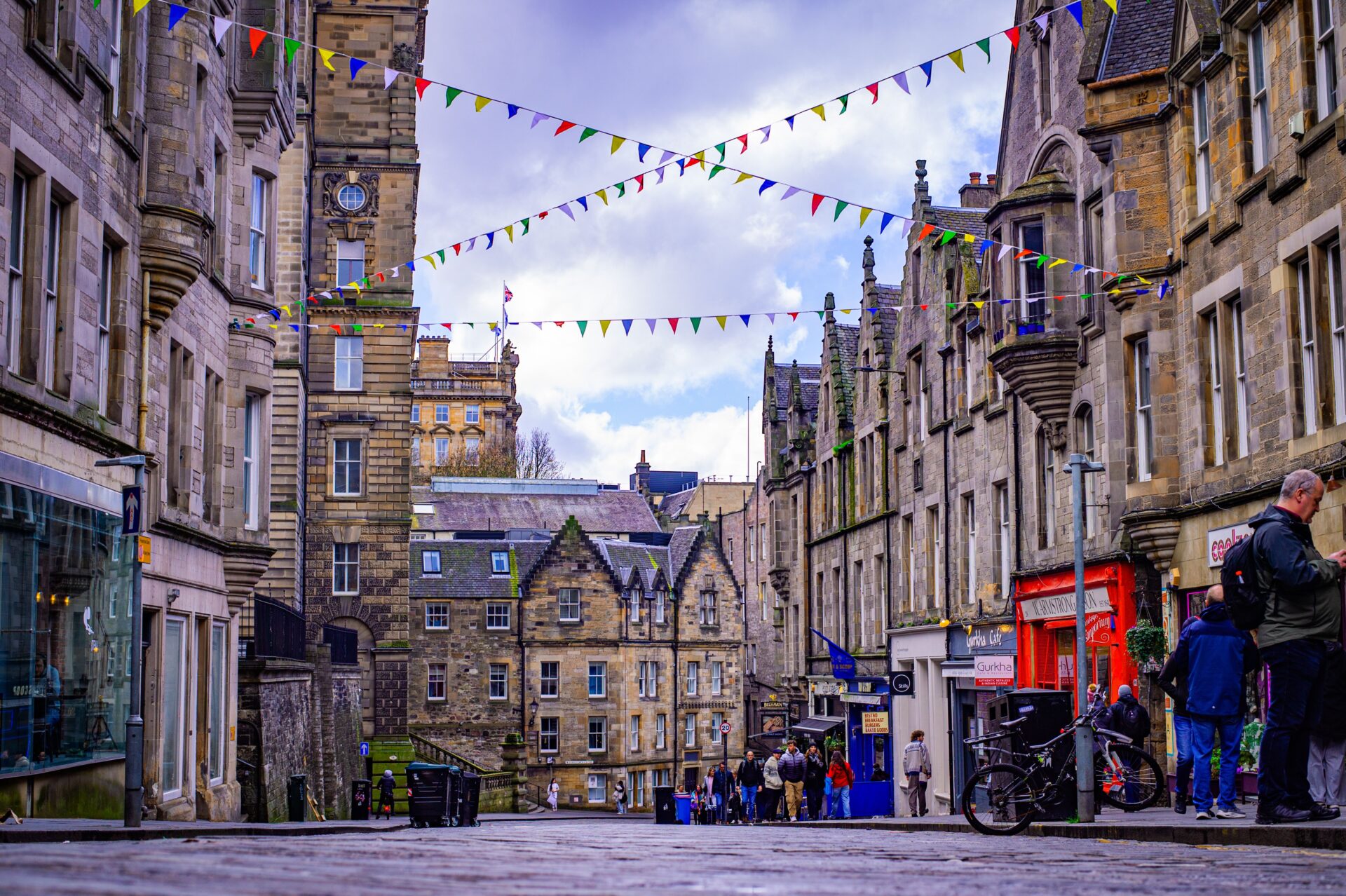
Victoria Street — the curved, two-level street leading from the Grassmarket to the George IV Bridge, the brightly coloured shopfronts (the antique shop, the cheese shop, the independent clothing boutique, the magic shop), the upper walkway with the cast-iron balustrade. The J.K. Rowling-Diagon Alley reference is unavoidable and not inaccurate — the curved street with the coloured shops does give the specific atmosphere. The comparison is less important than the street itself.
The Cowgate (below Victoria Street, accessible by the stairs at the curve) — the street that was Edinburgh’s Irish immigrant quarter in the 19th century, now the club and bar district below the Old Town bridges. At 3:30pm: the street quiet, the bars not yet open, the Victorian infrastructure visible in the arches above.
5:00pm — The Scotch Whisky Experience
The Scotch Whisky Experience (Castlehill, 354 — adjacent to the Castle entrance) — the most accessible introduction to Scotch whisky available without taking the ferry to Islay or the train to Speyside. The Silver Tour (45 minutes, £19 / £19): the overview of the four whisky regions (Highlands, Speyside, Islay, Lowlands), the nosing of the regional styles, and access to the world’s largest collection of Scotch whisky (3,384 bottles, the Diageo collection).
The specific whisky instruction for Edinburgh visitors:
Speyside: the Glenfiddich, the Glenlivet, the Macallan — the fruity, accessible style that most people encounter first.
Islay: the Lagavulin, the Ardbeg, the Laphroaig — the peated, maritime style, the smoke and the iodine and the seaweed. The style that divides opinion and rewards the converted.
The Whisky Experience gives a pour of each regional style. This is more efficient than a distillery tour if the goal is to understand the range rather than to see the stills.
7:30pm — Dinner: the Leith Shore
The Shore (the waterfront street of the Leith neighbourhood, 20 minutes by bus from the Royal Mile on the 22, 35, or 36 — or 40 minutes on foot via the Water of Leith walkway) — the restaurant and bar strip along the Water of Leith before it joins the Firth of Forth. The specific Leith Shore restaurants:
The Kitchin (Commercial Quay, 78 — Tom Kitchin’s restaurant, the youngest-ever Scottish chef to win a Michelin star, the “From Nature to Plate” philosophy): book at thekitchin.com. Tasting menu from £95 / £95.
The alternative: The Fishers (The Shore, 1) — the seafood bistro that has been on the Leith Shore since 1991, the langoustines from the west coast, the Edinburgh native oysters. €40-55 / £40-55 per person with wine.
The Leith Shore at 8pm in October: the specific atmosphere of a waterfront that has been a working port since the 12th century and is now the food and drink destination for the Edinburgh professional class.
10:00pm — The Oxford Bar (Rebus’s Pub)
The Oxford Bar (Young Street, 8 — the New Town, 15 minutes walk from the Leith Shore) — the pub used by Ian Rankin as the fictional watering hole of Detective Inspector John Rebus. The Oxford Bar is not a themed tourist pub; it is a real Edinburgh pub that happens to appear in a fiction. The difference is visible: the regular customers at the bar, the absence of Rebus merchandise, the Deuchars IPA and the Caledonian 80/- at working-pub prices.
Ian Rankin is a regular. This information is provided not as a celebrity-spotting instruction but as evidence that the pub is genuine.
DAY TWO
8:00am — The Dean Village
The Dean Village (the 800-year-old milling village in the Water of Leith valley, accessible from the city centre by the Bell’s Brae path or from the Queensferry Street end of the Dean Bridge) at 8am: the most surprising single neighbourhood in Edinburgh — the medieval granaries and mill buildings on the Water of Leith 10 minutes walk from Princes Street, visible from nobody who walks above on the Dean Bridge.
The Water of Leith Walkway (the 13-mile path following the river from Balerno to Leith) from Dean Village to the Scottish National Gallery of Modern Art: 30 minutes, the river path through the gorge, the Ramsay Garden visible above, the specific Edinburgh that exists at water level below the city grid.
9:30am — The Scottish National Gallery
The Scottish National Gallery (The Mound — the free national collection of European and Scottish painting): the Velázquez (An Old Woman Cooking Eggs, 1618 — the most significant Velázquez outside the Prado, the genre painting that established his early reputation), the Titian (Diana and Actaeon — the erotic mythological painting that the National Gallery of Scotland and the National Gallery in London jointly purchased for £50 million in 2012, alternating between the two collections), and the entire room of Scottish Colourists (the Peploe, the Cadell, the Fergusson — the early 20th-century Scottish painters whose Fauve-influenced work is the most undervalued in British art history).
Entry: free.
11:00am — Edinburgh Castle
The Edinburgh Castle (the volcanic rock above the city, inhabited since at least 900 BCE, the military garrison that has defined the Edinburgh skyline for 1,000 years): the Crown Jewels of Scotland (the Honours of Scotland — the crown, the sceptre, the Sword of State, the oldest royal regalia in the UK: the Scottish crown predates the English crown by 74 years), the Stone of Destiny (the sandstone block on which Scottish kings were crowned, returned from Westminster Abbey in 1996), and the One O’Clock Gun (the daily gun fired from the Half Moon Battery at 1pm — a tradition since 1861, originally a time signal for ships in the Firth of Forth).
Entry: £19.50 / £19.50. Book at edinburghcastle.scot. The 1pm gun, if timed correctly, is a specific Edinburgh sound experience.
1:00pm — Lunch: the Stockbridge Market (Sunday) or the Real Food Café
Stockbridge Market (Saunders Street, Sundays 10am-5pm) — the neighbourhood market of the Stockbridge district (the Georgian New Town village, the most characterful residential neighbourhood in Edinburgh). The stalls: the artisan bread (The Bakery at No 1), the Scottish charcuterie, the Isle of Mull cheddar, the venison sausages. Lunch from the market stalls: £8-15 / £8-15.
On non-Sundays: the Real Food Café (equivalent neighbourhood café in Stockbridge serving the local population).
2:30pm — The New Town
The Edinburgh New Town (the Georgian planned city built between 1765 and 1850, the grid of streets and squares that was the most ambitious urban planning project in 18th-century Britain) — the walk along George Street (the main commercial street, the banks and offices that were the financial heart of Scotland for 200 years, now the bars and restaurants), the Charlotte Square (the Robert Adam masterpiece — the north side of Charlotte Square is the finest Georgian terrace in Scotland, the Georgian House museum at No. 7: entry £8 / £8 including the audio guide), and the Princes Street Gardens (the gardens in the valley between the Old Town and the New Town, the Ross Fountain, the Scott Monument visible against the Castle rock).
The Scott Monument (Princes Street — the 61-metre Gothic spire commemorating Sir Walter Scott, the highest monument to a writer in the world): climb the 287 spiral steps for the view: £9 / £9.
4:30pm — The Portobello Beach
The Portobello Beach (Portobello, 20 minutes by bus from the city centre on the 26 or 45) — Edinburgh’s Victorian seaside resort, the beach that the Madrileños would recognise as a balneario and the Barcelonans would recognise as their own coast, scaled appropriately for Edinburgh. At 4:30pm in October: the beach walkers, the occasional wild swimmer, the specific Edinburgh light on the Firth of Forth. Free.
7:00pm — Final Dinner: the Canongate
The Canongate (the lower section of the Royal Mile between the High Street and Holyrood Palace) at 7pm — the restaurant that the Edinburgh food press discusses rather than the ones the tourist guidebooks recommend:
Purslane (St. Stephen Street, 33a — technically Stockbridge, but worth the 10-minute walk from the Canongate): the tasting menu using Scottish seasonal produce, the langoustines, the Orkney scallops, the venison from the Highland estates. Book at purslanerestaurant.co.uk. Tasting menu from £65 / £65.
The alternative: The Outsider (George IV Bridge, 15) — the most consistent value-for-quality restaurant in Edinburgh, the modern Scottish menu, the view of the Castle from the table, the two-course dinner at £25 / £25 that has been the Edinburgh resident’s answer to “where should we eat” for two decades.
The Essentials
Getting to Edinburgh from the UK: LNER from London King’s Cross (4.5 hours from £30 advance, the correct London-Edinburgh transport — the train arrives in the city centre rather than the airport). easyJet, British Airways, Ryanair from London airports (1.5 hours, from £20-50 return, but includes the airport-city transit time).
Getting around Edinburgh: The city centre is walkable. The Lothian Buses day ticket (£4.50 / £4.50, available from the driver or the Lothian Buses app) covers all buses for the day. The trams (the Edinburgh Tram, running from the airport through the New Town to Newhaven) are useful for the Leith Shore.
The Edinburgh Festival: The Edinburgh International Festival and the Fringe run simultaneously in August — the largest arts festival in the world. Book accommodation 4-6 months ahead. The city in August is extraordinary and exhausting.
Where to stay: The Nira Caledonia (Gloucester Place, 10, New Town: £120-200/night), the Knight Residence (Lauriston Street, 12 — serviced apartments: £90-150/night), the Edinburgh Central Youth Hostel (Robertson’s Close, Cowgate: private rooms from £35-55/night).
The Closing Moment
I was on Arthur’s Seat at 7:12am in October. The city was below me — the Castle on its rock to the west, the New Town beyond, the Old Town between. The Firth of Forth was silver to the north. The Pentland Hills were blue to the south.
A woman passed me on the descent, already on her way down. She had been up before me. She had a dog and running shoes and the specific confidence of someone for whom this hill is Tuesday.
Edinburgh is a city that contains one of the finest art collections in Europe (free), the finest medieval urban archaeology in Britain (largely free), a mountain in the city centre (free), and some of the finest whisky available to a visitor in any form outside the producing regions.
It also has a pub where the novelist who wrote the fictional detective who drinks there is a regular.
I went to Arthur’s Seat the second morning too. Different light. Same city below. Worth it both times.