
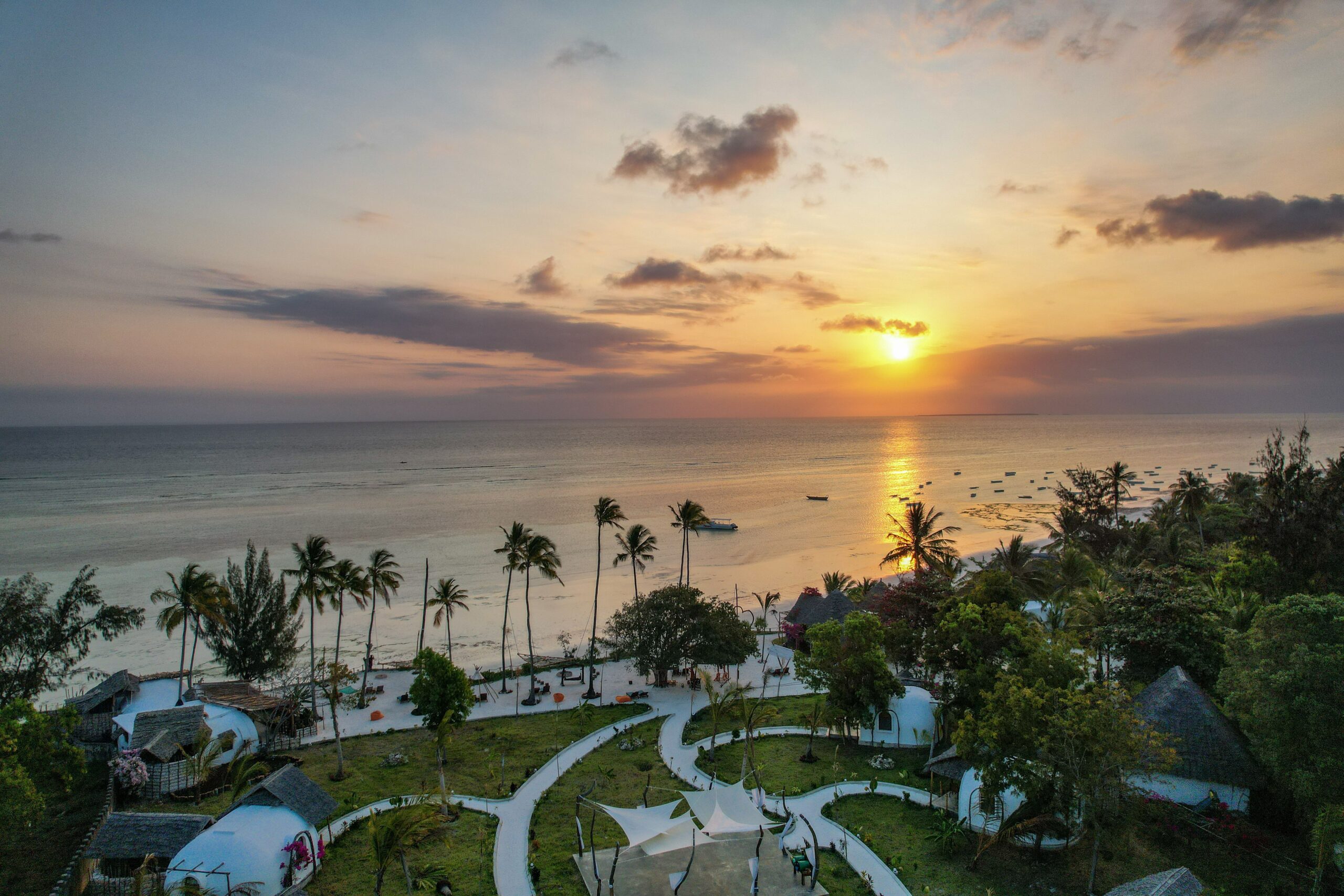
The standalone Zanzibar guide the library was missing: three days in Stone Town for the UNESCO Swahili-Arab trading city and the Old Fort and the Forodhani Gardens night market (the grilled seafood, the Zanzibar pizza, the sugar cane juice at 7pm when the gardens open) and the Freddie Mercury birthplace (the Mercury House, the birthplace of Farrokh Bulsara who became Freddie Mercury, on Kenyatta Road, the specific Zanzibar fact that the island presents with the pride of the country that produced someone extraordinary), and four days on the coast for the Nungwi beach (the northwestern beach, the dhow-building village adjacent to the resort strip) and the Mnemba Atoll (the coral reef accessible by the boat from the Matemwe beach — the sea turtle visible at 3 metres depth from the snorkel, the specific Zanzibar marine encounter that earns the flight) and the Jozani Forest (the endemic Zanzibar red colobus monkey (Piliocolobus kirkii) — found only on Zanzibar, the monkey visible in the Jozani Forest at 20 metres from the trail).
Reading time: 10 minutes | Last updated: 2026
Before You Leave
Getting there: Fly London-Zanzibar (Abeid Amani Karume International Airport, ZNZ — via Nairobi (Kenya Airways), via Dar es Salaam (Tanzania Airlines), or via Addis Ababa (Ethiopian Airlines). Approximately 12-13 hours total. UK citizens: Tanzania visa required — e-Visa at immigration.go.tz (USD 50 / £39.37).
The season: June-October (the dry season — the sea calm, the visibility for snorkel and dive at 20-30 metres, the beach weather at 25-28°C). December-February (the short dry season, the humpback whale visible off the north coast in August-October).
The Route
Stone Town (3 nights) → Nungwi (2 nights) → Matemwe / Mnemba (2 nights)
DAYS 1-3 — Stone Town
Day 1: The Forodhani Gardens and the Old Fort
7pm — The Forodhani Gardens Night Market:
The Forodhani Gardens (the seafront park in central Stone Town — the night market opening at 7pm, the grilled seafood (the lobster, the prawn, the calamari, the fish visible at the charcoal grill), the Zanzibar pizza (the thin dough filled with the egg and the cheese and the meat, folded and fried on the griddle — the specific Zanzibar street food that the Forodhani Gardens gives at USD 1-3 / £0.79-2.36 per piece), and the fresh juice (the sugar cane, the tamarind, the passion fruit)):
At 7pm: the gardens at the market opening hour, the evening crowd assembling, the specific Stone Town evening at the seafront.
The Old Fort:
The Arab Fort (the 17th-century Omani fort at the Forodhani waterfront — the fort built by the Omani Arabs who ruled Zanzibar from 1698 to 1964, the amphitheatre in the courtyard (the fort now the cultural centre — the evening performances in the amphitheatre)):
Entry: free for the fort exterior; cultural events at varying prices.
Day 2: The Slave Market and the Spice Tour
The Slave Market:
The Anglican Cathedral (the site built on the former slave market closed by Sultan Barghash in 1873 under British pressure — the cathedral nave built over the former whipping post (the post is preserved in the cathedral floor, visible through the glass panel), the slave chambers beneath the adjacent slave house (the underground chambers where enslaved people were held before auction, accessible on the guided tour)):
Entry: USD 5 / £3.94.
The specific Zanzibar instruction: Zanzibar was the centre of the East African slave trade — at its peak in the 1860s, approximately 50,000 enslaved people per year passed through the Zanzibar slave market. The cathedral, the slave chambers, and the palace museums give this history at the physical scale that the historical account does not.
The Spice Tour:
The Zanzibar spice tour (the farm visit giving the clove, the nutmeg, the cinnamon, the cardamom, the pepper, the vanilla, and the lemongrass on the single working spice farm — the guide identifying each plant and giving the specific use, the tasting of the fresh spice at the source):
USD 15-25 / £11.81-19.69 per person. Half-day tour with transport from Stone Town.
Day 3: Freddie Mercury and the Palace Museum
The Mercury House:
The Mercury House (the birthplace of Farrokh Bulsara at Kenyatta Road, Stone Town — the house marked with the plaque (the plaque erected in 2016, the specific Zanzibar claim on the Queen frontman)):
The specific Zanzibar-Freddie Mercury context: Bulsara was born in Zanzibar in 1946, grew up on the island until moving to India at 8 for boarding school, and later moved to the UK where he became Freddie Mercury. The Stone Town that Bulsara grew up in is visible in the narrow lane, the Arabian architecture, the specific Swahili-Arab cultural synthesis that the Stone Town UNESCO listing protects.
DAYS 4-5 — Nungwi
The Nungwi beach:
The Nungwi (the north tip of Zanzibar — the beach facing the open Indian Ocean (not the sheltered lagoon that the east coast gives), the water at 28-30°C, the dhow visible moored at the village fishing harbour adjacent to the resort strip):
The dhow building village:
The Nungwi dhow builders (the traditional wooden dhow — the lateen-sailed vessel of the Swahili coast, constructed at the Nungwi beachside workshops using the jackfruit and the mango wood, the craftsmen visible at work from 7am):
The specific Nungwi morning: the dhow builder at 7am, the hull visible in the half-assembled state, the specific artisanal shipbuilding that the Gulf oil wealth has otherwise funded into obsolescence on the Arabian coast.
The turtle sanctuary:
The Mnarani Aquarium (the Nungwi community turtle sanctuary — the sea turtles in the lagoon pool, the rescue-and-release programme, the hawksbill (Eretmochelys imbricata) and the green (Chelonia mydas) visible from the wooden platform at the pool edge): USD 5 / £3.94.
DAYS 6-7 — Matemwe and Mnemba Atoll
The Mnemba Atoll snorkel:
The Mnemba Atoll (the private island and the surrounding marine protected area — the boat from the Matemwe beach (30 minutes), the snorkel at the coral reef surrounding the atoll, the sea turtle visible at 3-5 metres depth throughout the reef):
Snorkel boat from Matemwe: USD 30-50 / £23.62-39.37 per person.
The Jozani Forest:
The Jozani Chwaka Bay National Park (the forest on the south of Zanzibar Island — the Zanzibar red colobus monkey (Piliocolobus kirkii) visible in the forest canopy, the species found only on Zanzibar with a population of approximately 3,000 individuals):
The specific Jozani instruction: the Zanzibar red colobus is the critically endangered species whose entire world population exists on this single island. The visitor who knows this sees the monkey differently from the visitor who sees a monkey in a forest.
Entry: USD 10 / £7.87.
What It Costs
| Category | Budget | Mid-Range |
|---|---|---|
| Return flights (UK-Zanzibar via connection) | £450-800 | £650-1,100 |
| Tanzania e-Visa | £39 | £39 |
| 7 nights accommodation | £70-210 | £210-700 |
| Food (7 days) | £30-80 | £80-200 |
| Spice tour, Mnemba boat, Jozani entry | £40-80 | £60-120 |
| Total | £629-1,209 | £1,039-2,159 |