
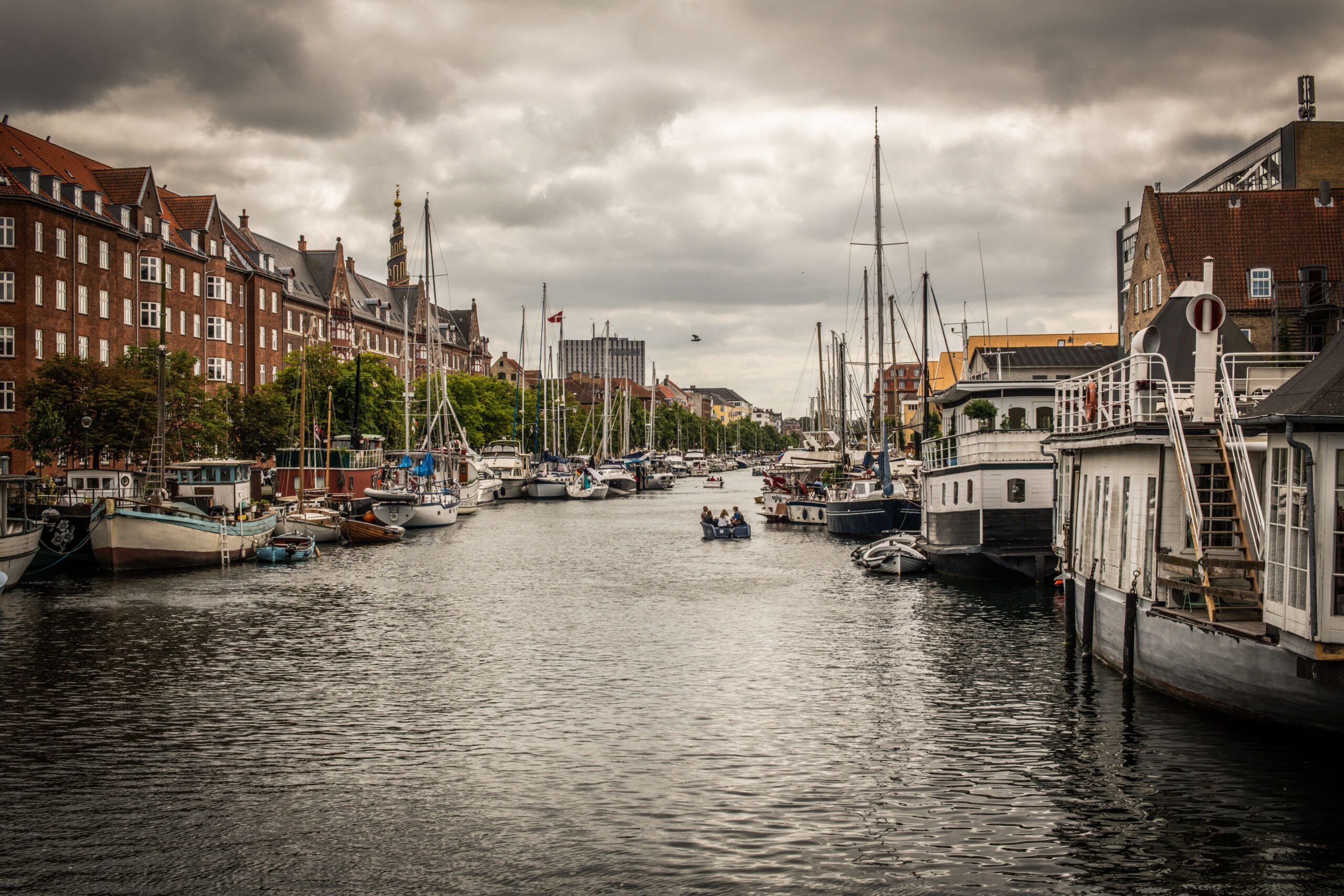
The route that gives Denmark more than the Copenhagen restaurant that costs £300 per head and the design shop on the Strøget: two days in Copenhagen for the Nyhavn at 6am (the coloured townhouses visible in the canal reflection before the tourist boat begins), the National Museum of Denmark (the Viking collection — the Trundholm Sun Chariot (the 1400 BCE Bronze Age cult object, the horse pulling the sun on the gilded disc, the specific Scandinavian Bronze Age visible in the object that predates the Vikings by 1,400 years), and the Freetown Christiania (the autonomous self-governing neighbourhood in Christianshavn, the painted buildings, the working blacksmith, the push-cart food vendors, the specific 1971 squatter settlement that has maintained its autonomous status for 54 years through a combination of community politics, legal battles, and the specific Copenhagen tolerance that produced it), two days on the North Jutland coast for the Rubjerg Knude (the lighthouse being consumed by the sand dune — the lighthouse that has been moving as the dune migrates south at 15 metres per year, the lighthouse that the Danish government spent DKK 5.3 million / £576,000 moving 70 metres back from the edge in 2019 because the dune will consume it anyway in 30-50 years — the most specifically honest single monument to the temporary nature of the permanent in Scandinavia), and three days in the Lake District (Søhøjlandet) and the Jutland interior.
Reading time: 10 minutes | Last updated: 2026
Before You Leave
Getting there: Fly London-Copenhagen (British Airways, Ryanair, SAS, Norwegian — 2 hours, from £35 one way). Denmark is Schengen — UK citizens visa-free 90 days.
Currency: Danish Krone (DKK). 1 GBP ≈ 8.68 DKK (2025). Copenhagen is Scandinavia’s second most expensive capital after Oslo. Daily mid-range budget: DKK 700-1,200 / £80-138.
The hygge note: The concept has been marketed to the point of self-parody (the hygge scented candle, the hygge lifestyle book, the hygge brand extension). The specific thing the concept describes — the deliberate creation of the cosy, the warm, the social moment against the dark — is real and is visible in the specific Danish winter behaviour (the candle in the café window, the wood fire in the coastal house, the gløgg (the mulled wine) at the Christmas market). The word is real. The scented candle is not necessary.
The Route
Copenhagen (2 nights) → North Jutland coast / Skagen base (2 nights, 4 hours by train) → Lake District / Silkeborg base (3 nights, 2 hours from Skagen)
DAYS 1-2 — Copenhagen
Day 1: The National Museum and Christiania
9am — The National Museum:
The National Museum of Denmark (Nationalmuseet — the museum on Ny Vestergade, free entry):
The Trundholm Sun Chariot (the 1400 BCE Bronze Age cult object — the horse (cast bronze, gilded on one side) pulling the sun disc on the wheeled cart, the specific Danish Bronze Age visible in the oldest existing representation of the Nordic sun cult): free.
The Viking Age collection (the runic stones, the gold jewellery, the specific Viking material culture at the source): free.
2pm — Freetown Christiania:
The Freetown Christiania (the autonomous neighbourhood in Christianshavn — the 1971 squatter settlement in the former military barracks, the 900 residents, the car-free community, the community rules (no violence, no hard drugs, no stolen goods, no bulletproof vests)):
The Pusher Street (the open cannabis market — the hash legal in the sense that the police have adopted a pragmatic non-enforcement position, illegal in the sense that Danish law has not changed): the visitor instruction: the photography on Pusher Street is specifically not permitted by the community and this restriction should be respected. The rest of Christiania is photographable.
The Christiania bike (the Christiania cargo bike — the front-loading three-wheeler invented in Christiania in the 1980s, the bike visible throughout Copenhagen as the child and grocery transport that the specific Copenhagen cycling culture adopted from the specific Christiania engineering innovation): free to observe.
Day 2: Nyhavn and the Louisiana
6am — Nyhavn:
The Nyhavn (the 17th-century canal harbour — the coloured townhouses at 6am before the restaurant and café service begins, the reflection in the still canal water, the tourist boats moored at the quay):
The Louisiana Museum of Modern Art:
The Louisiana Museum of Modern Art (the Humlebæk, 35km north of Copenhagen by train (S-train + train, 45 minutes, DKK 108 / £12.44 return)) — the museum in the converted villa on the Øresund, the garden sculptures (the Calder, the Arp, the Giacometti) visible between the trees with the sea visible beyond:
Entry: DKK 165 / £19.01.
DAYS 3-4 — North Jutland
The Skagen:
The Skagen (the northernmost point of Denmark — the spit where the Skagerrak and the Kattegat meet, the specific oceanographic phenomenon visible from the beach (the two sea currents meeting at the sand spit tip, the specific line where the North Sea and the Baltic exchange), the Skagen Painters (the late 19th-century Danish artist colony that the specific Skagen light — the double-sea light, the ambient reflected from the water on both sides — attracted)):
The Skagen Museum (the Skagen Painters collection): DKK 120 / £13.82.
The Rubjerg Knude Lighthouse:
The Rubjerg Knude (the lighthouse on the North Jutland coast — the dune migration visible at the lighthouse base, the sand visible advancing at 15 metres per year, the lighthouse that the 2019 engineering operation moved 70 metres east in 12 hours using 200-tonne capacity hydraulic systems):
Free to visit. The specific photography: the lighthouse visible at a lean into the prevailing wind from the west, the dune encroaching from the west visible in the frame.
DAYS 5-7 — The Lake District and Jutland Interior
The Silkeborg Lake District:
The Tollund Man (the Silkeborg Museum, Silkeborg — the 2,400-year-old Iron Age bog body found in 1950, the face preserved by the acidic peat in the specific condition that the museum visitor sees as the specific conjunction of the antiquity and the humanity: the face is recognisably a person, the noose visible at the neck, the last meal (wild plant seeds) analysable from the stomach content):
Entry: DKK 140 / £16.13.
The canoe on the Gudenå (the Gudenå river, the longest river in Denmark, the specific Jutland interior waterway — the canoe rental from Ry or Silkeborg, the day paddle between the lakes): DKK 400-600 / £46.08-69.12 per day for the two-person canoe with transport return.
What It Costs
| Category | Budget | Mid-Range |
|---|---|---|
| Return flights (UK-Copenhagen) | £35-120 | £60-200 |
| 7 nights accommodation | £175-420 | £420-980 |
| Food (7 days) | £60-140 | £140-360 |
| Louisiana + National Museum (free) + Skagen | £33 | £33 |
| Trains (CPH-Skagen, Skagen-Silkeborg) | £35-55 | £35-55 |
| Canoe hire | £46-69 | £46-69 |
| Total | £384-837 | £734-1,697 |