


Uzbekistan went from a niche Central Asia detour to one of the most searched Silk Road destinations for UK travellers once visa-free entry and the new high-speed rail line made a week-long trip genuinely straightforward. This is the exact first-timer route: Tashkent, Samarkand, and Bukhara, connected by the Sharq high-speed train.
Quick answer: 7 days covering all three cities costs roughly £320-£380 per person excluding flights, based on mid-range guesthouses, three meals a day, and high-speed rail between cities. UK passport holders can enter visa-free for stays up to 30 days.
The Three-City Route at a Glance
| City | Days | Highlight | Accommodation (per night) |
|---|---|---|---|
| Tashkent | 2 | Chorsu Bazaar, Metro stations | £20-£35 |
| Samarkand | 2-3 | Registan Square, Shah-i-Zinda | £22-£38 |
| Bukhara | 2 | Old town, Lyab-i Hauz | £18-£30 |
The Sharq and Afrosiyob high-speed trains connect all three cities, cutting what used to be a full-day drive between Tashkent and Samarkand down to just over two hours.
Day-by-Day Breakdown
Days 1-2: Tashkent
Tashkent doesn’t get the postcard reputation of Samarkand or Bukhara, but it earns its two days through two things most first-timers don’t expect: a genuinely stunning Soviet-era metro system and one of the best bazaars in Central Asia.
- Tashkent Metro: stations built between the 1970s and 1990s feature mosaic ceilings, chandeliers, and marble columns that rival some European palaces. A single ride costs 1,700 UZS (roughly 10p), and photography is now permitted after years of restriction.
- Chorsu Bazaar: the domed main hall is worth an hour alone, with the spice and dried fruit sections particularly strong for gifts. A full lunch of plov (Uzbekistan’s national rice dish) here runs 25,000-35,000 UZS (£1.50-£2.20).
- Accommodation: boutique guesthouses in the old city district from £20-£35/night for a private double
The 6am principle applies loosely here. Chorsu gets genuinely busy by mid-morning, so an early visit means clearer photos and easier navigation through the covered hall, though it never reaches the crowd levels of Registan Square.
Beyond the Metro and Bazaar
Tashkent’s Applied Arts Museum, housed in a former merchant’s residence, is easy to underestimate from the outside but holds one of the strongest ceramics and textile collections in Central Asia. Entry runs 25,000 UZS (£1.50) and rarely takes more than an hour, making it a natural pairing with an afternoon at Chorsu. The nearby Museum of Timurid History is worth a shorter visit for context on the Timurid Empire before arriving in Samarkand, where that history becomes far more visible in the architecture itself.
Days 3-4 (or 3-5): Samarkand
The Sharq high-speed train from Tashkent to Samarkand takes roughly 2 hours 10 minutes and costs 90,000-140,000 UZS (£5.50-£8.50) depending on class, departing from Tashkent’s main station several times daily.
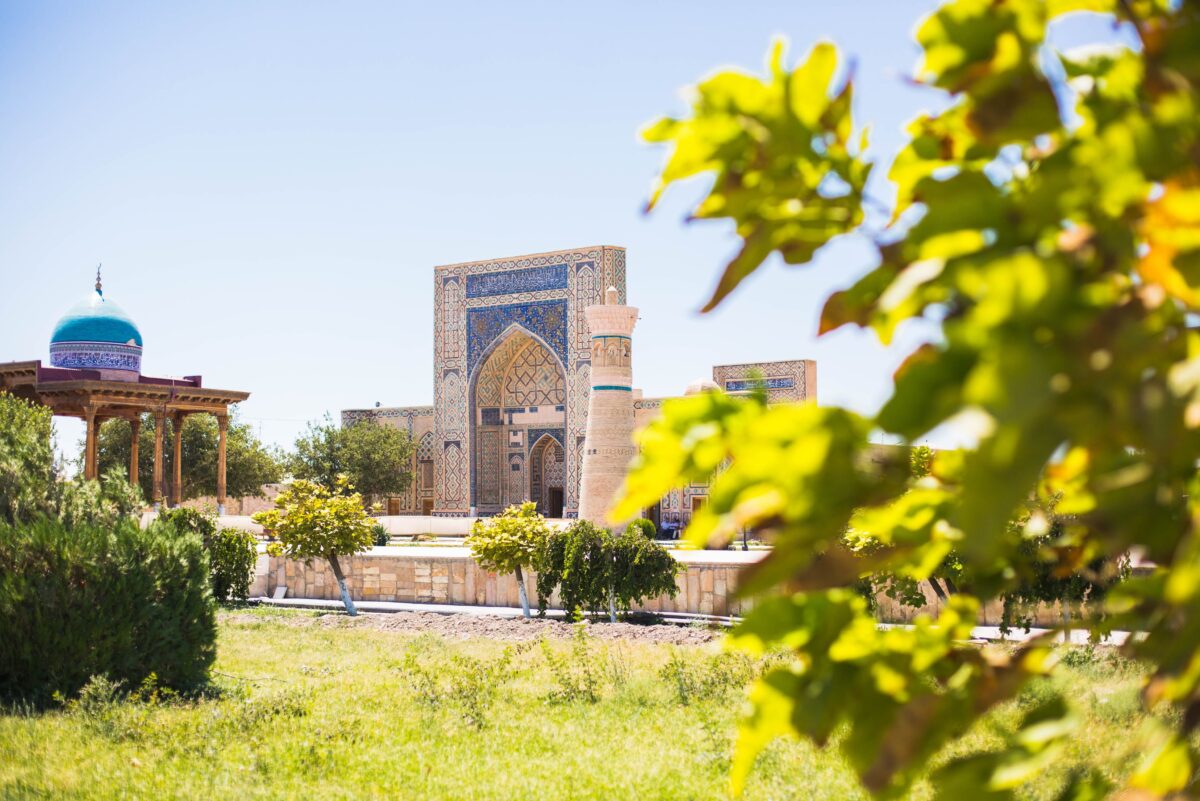
Registan Square is the reason most people book this trip, and it deserves the full sunrise-to-sunset treatment. The three madrasahs (Ulugh Beg, Sher-Dor, and Tilya-Kori) are illuminated at night and largely empty at opening, with tour groups arriving from 9:30am onward.
- Registan Square entry: 50,000 UZS (£3), evening illumination viewing from outside is free
- Shah-i-Zinda necropolis: 40,000 UZS (£2.50), a lesser-visited but arguably more atmospheric complex of tiled mausoleums
- Dinner: a full meal with local wine (Samarkand’s wine region is genuinely underrated) runs 60,000-90,000 UZS (£3.70-£5.50) per person
- Accommodation: guesthouses near the old town from £22-£38/night
Where to Eat in Samarkand Beyond the Tourist Strip
Most restaurants immediately surrounding Registan Square price for tour groups rather than independent travellers. Walking 10-15 minutes into the surrounding residential streets finds family-run cafes serving the same plov, laghman noodle soup, and shashlik at roughly half the price, with the added benefit of watching bread being baked fresh in a traditional tandir oven, a common sight in the mornings across the old town.
Days 5-6 (or 6-7): Bukhara
The Afrosiyob or Sharq service from Samarkand to Bukhara takes around 1 hour 40 minutes, costing 70,000-110,000 UZS (£4.30-£6.70).
Bukhara’s old town is more compact and walkable than Samarkand’s, built around the Lyab-i Hauz pool complex where much of the city’s evening life still happens. Skip the guided walking tours in favour of a self-directed loop, since the entire historic centre is small enough to cover on foot in a day and a half without losing anything by going independently.
- Ark of Bukhara (old fortress): 25,000 UZS (£1.50)
- Po-i-Kalyan complex: 20,000 UZS (£1.25)
- Dinner at Lyab-i Hauz: a full meal with tea service runs 50,000-70,000 UZS (£3-£4.30) at the terrace restaurants surrounding the pool
- Accommodation: old town guesthouses from £18-£30/night, often converted traditional courtyard houses
Bukhara’s Trading Domes
Scattered through the old town are several restored trading domes (Toki Zargaron, Toki Telpak Furushon, and Toki Sarrafon), each historically dedicated to a specific trade, jewellers, hat-makers, and money-changers respectively. Today they house craft workshops and small shops selling suzani embroidery, ceramics, and miniature paintings. Prices are generally more reasonable than Samarkand’s Registan-adjacent shops, and several workshops allow visitors to watch pieces being made, a better souvenir-shopping approach than the fixed-price tourist stores nearer the main sights.
What £320-£380 Actually Covers
| Category | Total for 7 Days (GBP, per person) |
|---|---|
| Accommodation (6 nights, split two ways) | £120-£150 |
| Food (three meals daily) | £90-£120 |
| High-speed rail (both legs) | £10-£15 |
| Activities/entry fees | £15-£25 |
| Local transport (taxis, metro) | £10-£15 |
| Total | £245-£325 |
The remaining £75-£55 of budget headroom covers souvenirs, since Bukhara and Samarkand both have genuinely strong ceramics and textile markets that are hard to walk past entirely.
Step-by-Step: Booking This Route
- Confirm visa-free eligibility. UK passport holders can currently enter Uzbekistan visa-free for stays up to 30 days, though this should be reconfirmed on Uzbekistan’s official e-visa portal before booking, since Central Asian visa policy shifts more frequently than Western Europe’s.
- Book Sharq/Afrosiyob train tickets online in advance, particularly for the Tashkent-Samarkand leg, which sells out during peak spring and autumn travel months.
- Withdraw som (UZS) from a Tashkent ATM on arrival. Rates and reliability are better in the capital than in smaller cities.
- Download an offline translation app before travel. English is spoken in tourist-facing businesses but far less widely elsewhere, and Uzbek and Russian are both commonly used.
- Pack modest clothing for religious sites. Shoulders and knees covered is expected at all major mosque and madrasah complexes, regardless of gender.
Uzbekistan Frequently Asked Questions
Do UK citizens need a visa for Uzbekistan?
No, UK passport holders can currently enter Uzbekistan visa-free for stays of up to 30 days. Confirm current rules on the official Uzbekistan e-visa portal before booking, as Central Asian visa policy changes more often than Western European rules.
How long does the train take from Tashkent to Samarkand?
The Afrosiyob and Sharq high-speed services cover the route in approximately 2 hours 10 minutes, a significant improvement over the 4-5 hour road journey.
Is Uzbekistan safe for solo travellers?
Uzbekistan is generally considered safe for tourists, including solo travellers, with low rates of violent crime in the main tourist cities. Standard precautions around belongings in crowded bazaars apply, as with most destinations.
What is the best time of year to visit Uzbekistan?
Spring (April-May) and autumn (September-October) offer the most comfortable temperatures. Summer in Samarkand and Bukhara regularly exceeds 40°C, which makes extended walking through the old towns genuinely uncomfortable.
Can you drink the tap water in Uzbekistan?
Tap water is not recommended for drinking anywhere in Uzbekistan, including Tashkent. Bottled water is cheap and widely available, typically 2,000-3,000 UZS (12-18p) per litre from any corner shop.
Is Uzbekistan expensive compared to other Central Asia destinations?
No, Uzbekistan remains one of the more affordable Silk Road destinations, comparable to or slightly cheaper than Kyrgyzstan and noticeably cheaper than Kazakhstan, particularly for accommodation and dining once outside the handful of premium hotels in each city.
Do you need to speak Russian or Uzbek to travel independently?
No, though it helps outside the main tourist sites. English is spoken at hotels, major restaurants, and ticket counters in Tashkent, Samarkand, and Bukhara, but taxi drivers and smaller guesthouses often rely on Russian or Uzbek. A translation app with offline Russian and Uzbek packs downloaded in advance solves most day-to-day gaps.
The Bottom Line
Uzbekistan delivers a week of Silk Road architecture that genuinely rivals anything in the Middle East or South Asia, at a fraction of the cost, connected by a rail network that removes most of the logistical friction that used to make Central Asia a harder sell. The trade-off is a shorter travel season than most destinations on this list, with summer heat ruling out large stretches of the year.