


Oman sits two hours’ flight from Dubai and shares the same dramatic desert and mountain landscapes, but has deliberately avoided the mega-resort, skyscraper-first development model. This is a self-drive route through Muscat, the Hajar Mountains, and the Wahiba Sands, built around actual wadis and forts rather than shopping malls with a desert theme park attached.
Quick answer: an 8-day Oman self-drive road trip covering Muscat, Nizwa, Jebel Akhdar, and the Wahiba Sands costs roughly £650-£800 per person including a 4×4 rental, mid-range accommodation, and food, excluding flights. UK passport holders can obtain an e-visa in advance or on arrival.
The 8-Day Route at a Glance
| Days | Location | Highlight | Accommodation Cost |
|---|---|---|---|
| 1-2 | Muscat | Sultan Qaboos Grand Mosque, Mutrah Souq | £45-£75/night |
| 3-4 | Nizwa & Jebel Akhdar | Nizwa Fort, mountain terraces | £50-£90/night |
| 5-6 | Wahiba Sands | Desert camp, dune driving | £60-£110/night (full board) |
| 7-8 | Sur & the coast | Turtle beach, dhow-building yards | £45-£70/night |
A 4×4 is genuinely necessary for this route, not optional. Jebel Akhdar’s mountain roads and the Wahiba Sands both require proper ground clearance and, for the dunes specifically, deflated tyres and low-range gearing.
Day-by-Day Breakdown
Days 1-2: Muscat
Muscat spreads along the coast rather than clustering into a single dense centre, meaning a rental car from day one makes far more sense than relying on taxis between sights.
- Sultan Qaboos Grand Mosque: free entry (open to non-Muslim visitors mornings only, modest dress required including headscarves for women), one of the few mosques in the Gulf genuinely open to tourists rather than exterior-only viewing
- Mutrah Souq: free to browse, one of the oldest markets in the Arab world, strongest for frankincense, silver jewellery, and spices
- Mutrah Corniche: free, a genuinely pleasant evening walk along the harbour with views of the old merchant houses climbing the hillside
- Dinner: a full meal at a local Omani restaurant (shuwa, slow-cooked marinated meat, is the dish to seek out) runs 8-14 OMR (£16.50-£29) for two
- Accommodation: mid-range hotels in Muscat from £45-£75/night
The 6am principle applies at the Grand Mosque specifically. Visiting hours for non-Muslim visitors are limited to mornings, and arriving close to opening avoids both the heat and the coach-tour crowds that build by mid-morning.
Days 3-4: Nizwa & Jebel Akhdar
The drive from Muscat to Nizwa takes roughly 1.5-2 hours on well-maintained highway, a gentle introduction before the mountain roads that follow.
Nizwa Fort, one of Oman’s best-preserved forts, dominates the old town and pairs naturally with the adjacent Friday livestock and produce market if timing allows. From Nizwa, the road up to Jebel Akhdar (“Green Mountain”) climbs to over 2,000 metres through a checkpoint requiring 4×4 verification, a rule genuinely enforced given the steep, unpaved sections beyond the checkpoint.
- Nizwa Fort entry: 5 OMR (£10.30)
- Jebel Akhdar rose and pomegranate terraces: free to view from several viewpoints, best visited in spring during the rose harvest (typically April-May) for a genuinely striking agricultural landscape at altitude
- Dinner: a mountain lodge dinner with valley views runs 10-16 OMR (£20.60-£33) for two
- Accommodation: mountain lodges in Jebel Akhdar from £50-£90/night, worth the premium for the views and cooler altitude temperature
Days 5-6: Wahiba Sands
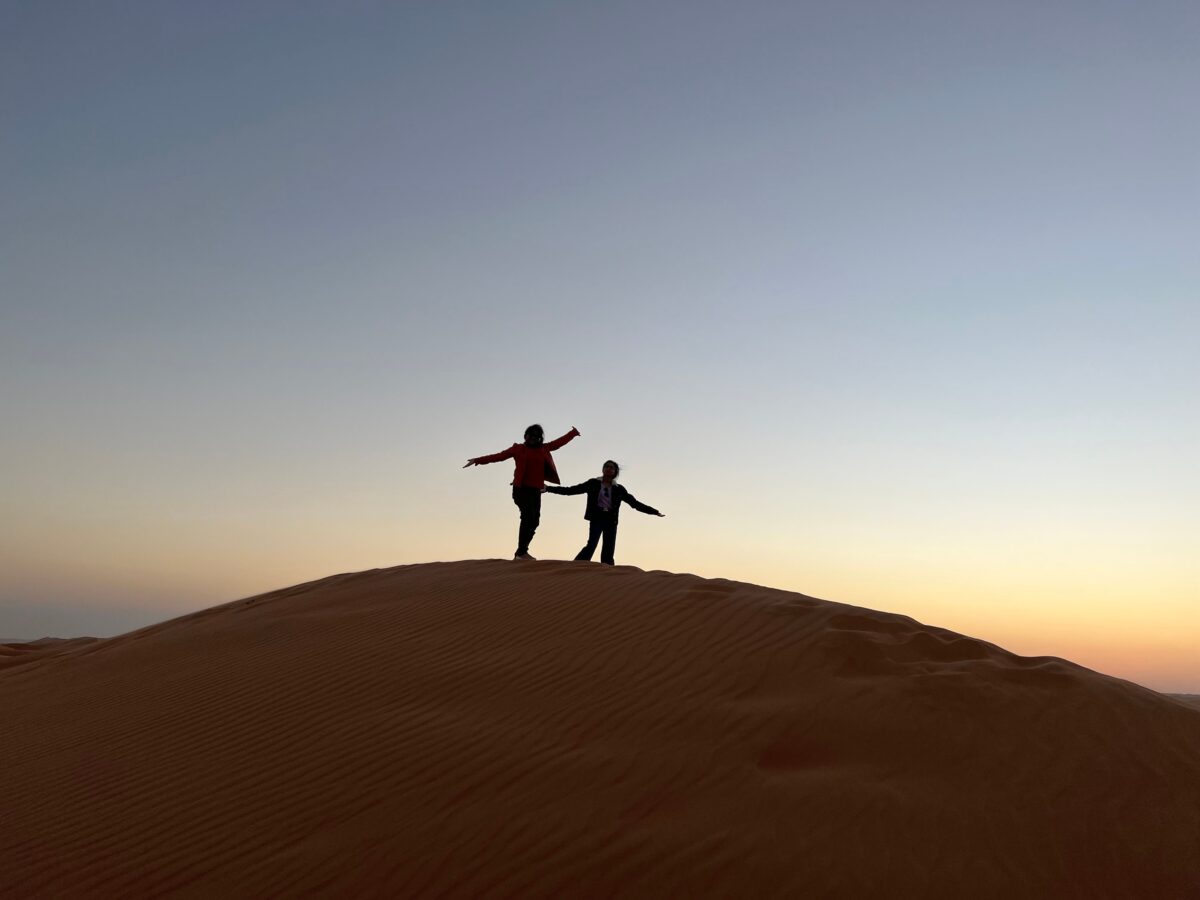
The drive from Jebel Akhdar down to the Wahiba Sands takes around 3-3.5 hours, dropping back to sea-level desert terrain. This is where the 4×4 requirement becomes non-negotiable, since accessing most desert camps requires driving several kilometres over soft dune sand.
- Desert camp (full board, typically includes dinner, breakfast, and a guided dune drive): 45-85 OMR (£93-£175) per night for two
- Camel trekking: often included with camp packages, or bookable separately for 10-15 OMR (£20.60-£31)
- Overnight stargazing: free, and genuinely spectacular given the complete absence of light pollution this deep into the desert
The honest verdict on desert camps: the more expensive, luxury-tent camps closer to 100+ OMR/night mainly buy better bedding and private bathrooms rather than a meaningfully different experience. A mid-range camp at 50-60 OMR delivers the same dunes, same stars, and same dinner around a fire.
Driving the Dunes Safely
Soft-sand driving is the single skill this route genuinely demands beyond standard road driving. Most desert camps offer a guided convoy option for the final approach, worth taking on a first visit even for confident drivers, since getting stuck alone in soft sand with no phone signal is a genuinely common and avoidable problem. Basic technique involves maintaining steady momentum rather than accelerating hard or braking suddenly, and carrying a tow rope and a shovel, both of which most rental companies include as standard for desert-route bookings.
Days 7-8: Sur & the Coast
The drive from the Wahiba Sands to Sur takes roughly 2 hours, returning to paved coastal roads. Sur is Oman’s traditional dhow-building centre, where wooden boats are still constructed by hand using techniques largely unchanged for generations.
- Dhow-building yards: free to observe, genuinely active working yards rather than a staged tourist demonstration
- Ras Al Jinz turtle reserve: 8 OMR (£16.50) for a guided night visit during green turtle nesting season (roughly May-September), one of the more reliable turtle-watching experiences in the region
- Wadi Shab (short detour): free entry, requiring a short boat crossing (1 OMR/£2.10) and a 45-minute walk to reach the swimmable pools
- Accommodation: guesthouses and mid-range hotels in Sur from £45-£70/night
What £650-£800 Actually Covers
| Category | Total for 8 Days (GBP, per person, based on two sharing) |
|---|---|
| Accommodation (7 nights) | £220-£310 |
| 4×4 rental (8 days, split two ways) | £140-£190 |
| Fuel | £30-£45 |
| Food | £110-£150 |
| Activities/entry fees | £60-£90 |
| Total | £560-£785 |
Solo travellers should budget an additional £120-£150 to cover the full 4×4 rental cost without splitting it, since a proper 4×4 is genuinely required for the mountain and desert legs rather than an optional upgrade.
Step-by-Step: Booking This Route
- Confirm e-visa requirements before booking flights. UK passport holders can apply for an Oman e-visa online in advance, typically processed within 2-3 business days, or in some cases on arrival; confirm current requirements on Oman’s official e-visa portal.
- Book the 4×4 rental from a reputable local company, not just the cheapest option. Jebel Akhdar’s checkpoint and the Wahiba Sands both require genuine off-road capability, and budget rental companies sometimes provide vehicles unsuited to the terrain despite listing them as 4×4.
- Download offline maps before leaving Muscat. Mobile signal drops out across large stretches of the mountain and desert route.
- Deflate tyres before driving onto the Wahiba dunes, typically to around 15-18 PSI; most desert camps or local guides can advise on the exact pressure and reinflate on the way out.
- Pack modest clothing throughout, not just for mosque visits. Oman is considerably more conservative in dress expectations than Dubai, and this applies to beaches and towns alike, not just religious sites.
Oman Road Trip Frequently Asked Questions
Do UK citizens need a visa for Oman?
Yes, but it’s a straightforward e-visa rather than a traditional embassy visa, applied for online in advance and typically approved within a few days.
Is Oman safe for a self-drive road trip?
Yes, Oman is generally considered one of the safer countries in the Middle East for independent travel, with well-maintained main roads and low crime rates. The main risks are terrain-related (flash floods in wadis, soft sand in the desert) rather than personal safety.
Do you need a 4×4 for the entire Oman road trip, or just parts of it?
Just parts, technically, since Muscat, Nizwa, and Sur are all reachable by standard car on paved roads. Jebel Akhdar’s checkpoint requires 4×4 verification, and the Wahiba Sands genuinely require it for accessing most desert camps, making a 4×4 the practical choice for the full route rather than switching vehicles partway through.
How does Oman compare to Dubai for a first Gulf trip?
Oman offers a slower-paced, less commercially developed alternative with a stronger emphasis on natural landscapes and historic forts over skyscrapers and shopping. Dubai suits travellers wanting luxury infrastructure and nightlife; Oman suits those wanting mountains, desert, and coastline with a lighter tourist footprint.
What is the best time of year for an Oman road trip?
October to April offers the most comfortable temperatures across all three terrains covered in this route. Summer (June-August) brings extreme heat, particularly in the desert and lowland coastal areas, where daytime temperatures regularly exceed 45°C, ruling out most of the walking and outdoor activity this itinerary depends on.
The Bottom Line
This route delivers mountains, desert, forts, and coastline in eight days without a single mega-mall or artificial island, at a cost broadly comparable to a mid-range European road trip once the 4×4 rental is split between two travellers. The trade-off is a genuine reliance on driving skill and preparation, since the mountain checkpoint and desert dunes aren’t forgiving of an underprepared vehicle or driver.