
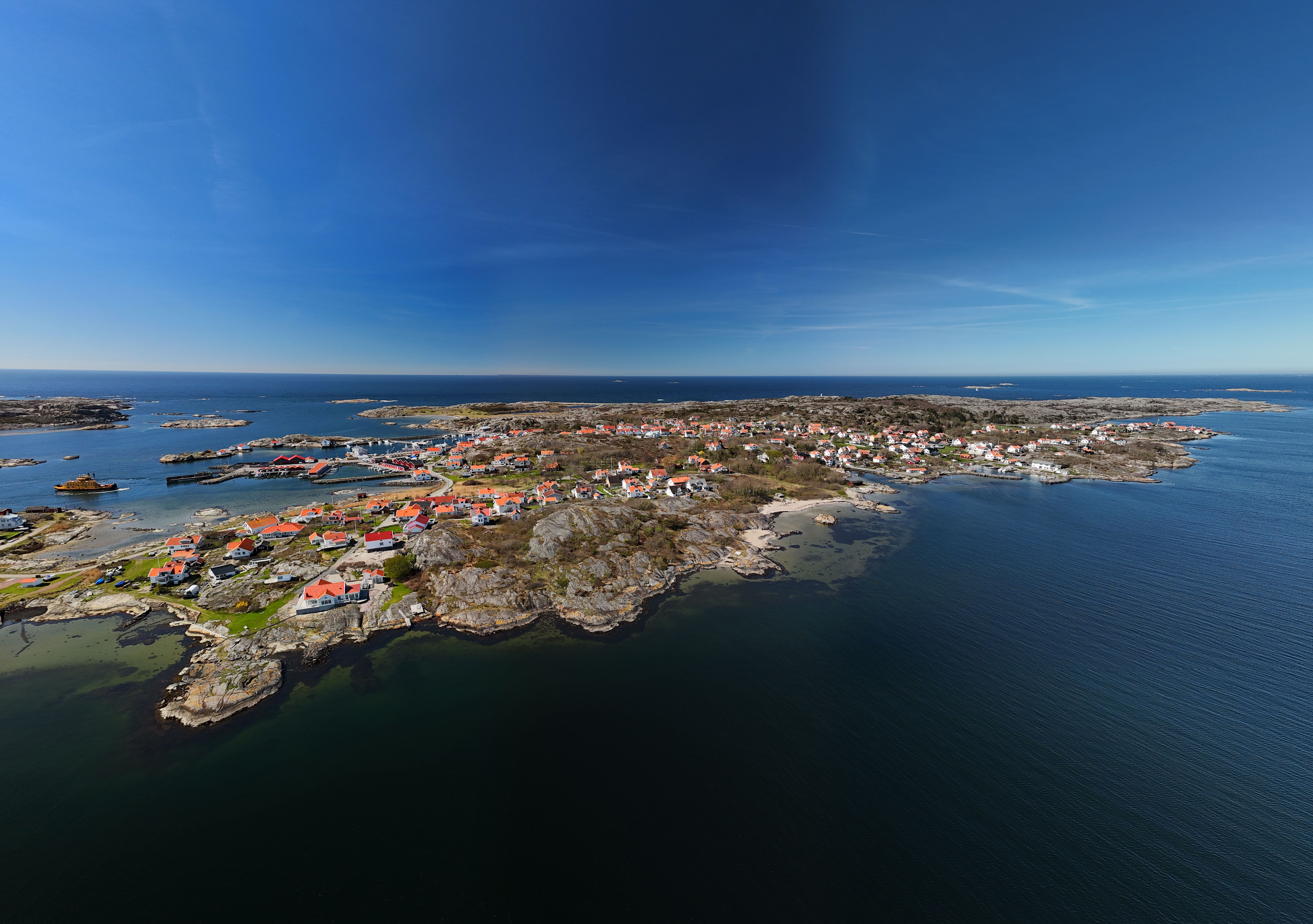

The complete guide for travellers: the north-to-south route, Ha Long Bay without the convoy, the train you absolutely must book, the food that costs £1 and changes your benchmark forever, and what it actually costs.
Reading time: 19 minutes | Last updated: 2026
Most people who go to Vietnam once immediately start planning how to go back. I’ve never encountered a more consistent pattern in travel.
The country has something that’s hard to pin down precisely. It’s not just the food, though the food is extraordinary. It’s not just the landscape, though the landscape shifts from tropical karst bays to highland rice terraces to colonial towns to Mekong waterways across 3,200km of country. It’s something about the pace — the way Vietnam demands you pay attention and rewards you when you do.
The French colonised it for 70 years. The Americans bombed it for another decade. Vietnam absorbed all of that, kept what it wanted, discarded the rest, and emerged with a culture and a cuisine and a travel infrastructure that somehow manages to feel entirely itself. It’s one of the most visited countries in Southeast Asia and one of the best at not feeling like it.
This guide is the north-to-south route. It’s the one most people do on their first trip and the one most people say they’d do again, differently, knowing what they know now. That’s the version I’ve tried to write — with the hindsight included.
Quick Navigation
- The Case for Vietnam — The Honest One
- When to Go — The Regional Reality
- Hanoi — Three Days of Beautiful Chaos
- Ninh Binh — The Day Trip That Steals the Trip
- Ha Long Bay — The 2-Night Cruise Question
- Phong Nha — The Cave System Nobody Knows About
- Hoi An — The Ancient Town and the Early Morning Rule
- Da Nang — The City Most People Use as a Transit Stop
- Ho Chi Minh City — The South
- The Mekong Delta — The Part Most People Skip
- Sapa and the North — A Different Vietnam
- The Vietnam Train — Book It Before You Book Anything Else
- What It Costs — Real Numbers
- Eating in Vietnam — The Actual Guide
- Practical Notes
- The 2-Week North-to-South Itinerary
The Case for Vietnam — The Honest One
Vietnam is one of the best-value countries on earth for a UK traveller. A mid-range 2-week trip — boutique guesthouses, restaurant dinners, a Ha Long Bay cruise, a cooking class in Hoi An — costs £950–1,250 all in from the UK. A budget version costs £700–900. A comfortable version with nicer hotels costs £1,300–1,700.
For comparison: a week in Santorini at mid-range costs more than a fortnight in Vietnam.
That’s the financial case. The experiential case is harder to summarise.
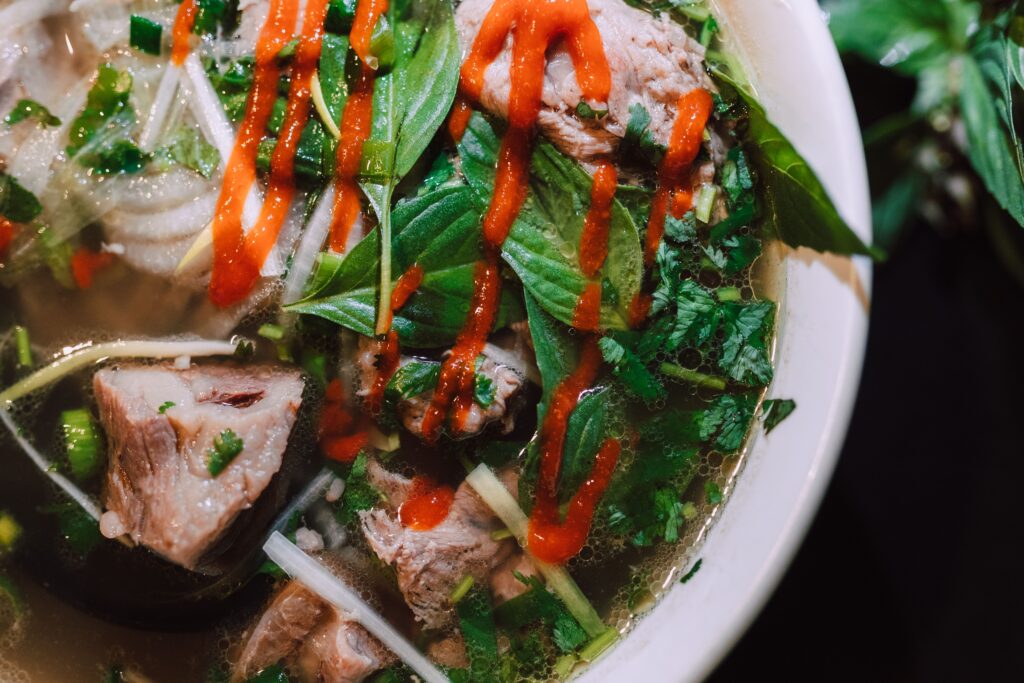
The food. The pho at 7am, broth that’s been going since 4am, eaten on a plastic stool watching the street wake up. The Bun Cha in Hanoi. The Banh Mi from a woman with a cart who has been making the same sandwich in the same spot for fifteen years and has never needed to advertise. The Cao Lau noodles that are, technically, only properly made in Hoi An because the water is from a specific ancient well. The egg coffee in Hanoi that sounds like a gimmick and tastes like nothing else in the world.
Then there’s the landscape. Ha Long Bay — 1,600 limestone islands in the Gulf of Tonkin, mist at dawn, the scale of it landing slowly as you move between the karsts by boat. The rice terraces of Sapa, carved into steep mountain hillsides over centuries by H’mong and Red Dao people, turning jade-green in summer and gold at harvest time. The Phong Nha cave system — the world’s largest — where a river disappears underground and reappears in chambers tall enough to house cathedrals. Hoi An at 6am, before the lanterns come down.
I’m going to stop describing it and just tell you where to go.
When to Go — The Regional Reality
Vietnam is long and thin. Weather in the north and weather in the south are often completely different, and understanding this is the key to planning the trip.
November to April: Dry Season in the South
Ho Chi Minh City, the Mekong Delta, and the southern coast are best November to April. Hot (30–35°C), clear, very little rain. Peak for beach areas like Phu Quoc and Mui Ne.
February to August: Best for Central Vietnam
Hoi An and Da Nang are best February through August. The central coast gets hit by rain from October through December — Hoi An genuinely floods in November and parts of the Ancient Town go underwater. Do not plan to visit Hoi An between October and January unless you’re there specifically for the atmospheric floods, which some people are.
October to March: Best for the North
Hanoi, Ha Long Bay, and Ninh Binh are most comfortable October to March. Ha Long Bay in summer (June–August) gets occasional typhoons and persistent humidity. October is the sweet spot — the weather is stable, the light is clear, and the bay is significantly less busy than peak winter season.
Sapa: June to September for Green, October for Gold
The rice terraces peak green from June to September. The harvest — when the terraces turn gold — begins in late September and runs through October. Sapa in January is cold (genuinely cold — 5–10°C) and sometimes foggy. Beautiful in its own way but the terraces are brown.
The Route Timing:
If you’re doing north-to-south in 2 weeks, March is the single best month. The north is dry and not too hot, the central coast is excellent, and the south is at its finest. October is a close second if you avoid Hoi An.
Hanoi — Three Days of Beautiful Chaos
Hanoi is the most overwhelming city I’ve been to in Southeast Asia. I mean that as the highest possible compliment, and I understand the ambiguity.
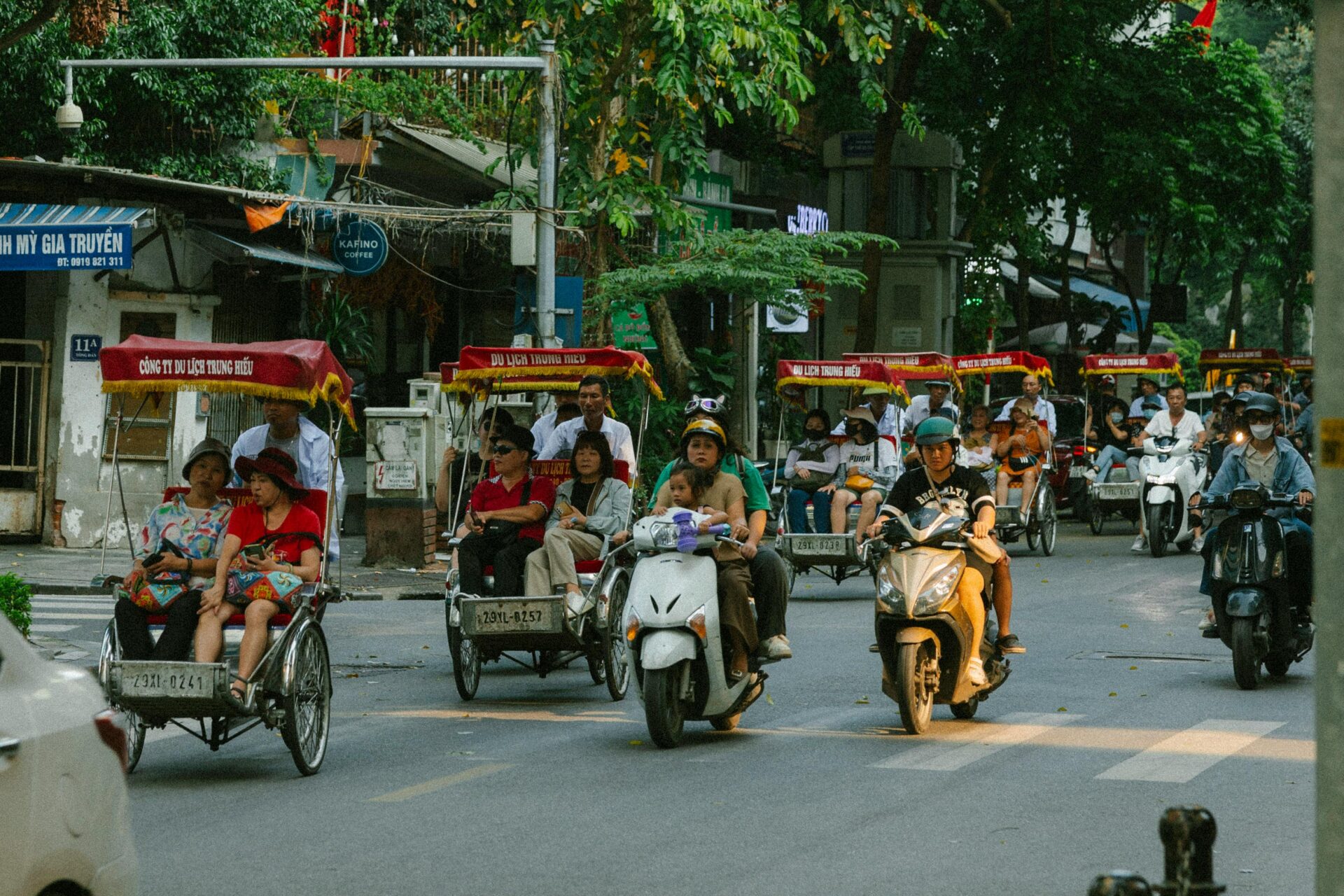
The Old Quarter — the 36 ancient streets, each traditionally named for the guild that operated there — is a labyrinth of narrow lanes where the motorbikes never stop, the street food never stops, and the noise never stops. Crossing the road requires a specific technique: walk slowly, at a constant pace, and trust that the traffic will part around you. It works. Stopping in the middle of the road is more dangerous than walking through it.
By the second morning, it makes sense in a way that’s hard to explain. The chaos has a logic. The old woman selling baguettes from a bicycle is always in the same spot at the same time. The pho stall on Hang Manh Street opens at 6am and has a queue by 6:15. The city runs on its own internal system and you start reading it faster than you expect.
The Old Quarter at 6am
Before the motorbikes take over — and this is a genuine window, from roughly 5:30am to 7am — the Old Quarter is one of the most atmospheric streets in Asia. Early morning taichi by Hoan Kiem Lake. Women with bamboo yoke baskets carrying breakfast ingredients through the empty lanes. The French colonial facades still dark, the lantern shops still shuttered, the street cats picking through the previous night’s debris.
Set the alarm. Walk without a destination for an hour. This is the version of Hanoi that stays with you.
Hoan Kiem Lake
The lake in the centre of the city. Ngoc Son Temple sits on a small island accessible by a red wooden bridge. Circumnavigating the lake takes 20 minutes and crosses through several microenvironments — the lakeside cafes, the early morning exercise groups, the lovers’ benches, the hawkers. In the morning, turtles surface occasionally (the lake’s legendary giant turtle died in 2016, but smaller turtles remain). At night, the lake is lit and the bridge glows and it’s one of those things that’s better than the photos.
Bia Hoi Corner
The intersection of Ta Hien and Luong Ngoc Quyen streets. Every evening, plastic stools appear on the pavement, coolers of fresh bia hoi (draught beer brewed daily, very low alcohol, very cold) are set out, and the intersection fills with people. The beer costs 25 pence. There’s no English menu. You point at food from the surrounding stalls and someone brings it over. You stay until you’re ready to leave. This is the best bar in the world.
The Ho Chi Minh Mausoleum
The embalmed body of Ho Chi Minh is preserved in a granite mausoleum and viewed by the public on Tuesday, Thursday, Saturday, and Sunday mornings (7–10:30am). The queue is orderly, the guards are immaculate, silence is required, and the experience of standing in front of a preserved revolutionary leader in a climate-controlled glass case in the middle of a communist capital is genuinely strange. Worth doing.
The Ba Dinh Square around the mausoleum contains also: the One Pillar Pagoda (a Buddhist temple on a single stone pillar in the middle of a pool, built 1049, rebuilt 1954 after the French destroyed it in their retreat), the Ho Chi Minh Museum, and the Presidential Palace (viewed from outside). A solid half-day.
The Vietnam Museum of Ethnology
The most important museum in Hanoi and the most overlooked. An extensive collection covering Vietnam’s 54 ethnic groups — traditional houses reconstructed in the outdoor grounds, the best textile collection in the country, context for the hill tribe communities you’ll see in Sapa. Taxi from the Old Quarter (£2). Entry £3. Budget 2 hours.
What to Skip in Hanoi
The Hanoi Opera House is beautiful from the outside and the performances are fine. It’s not the reason to be in Hanoi.
The Turtle Tower on Hoan Kiem Lake is, once you know what it is, simply a small tower on an island. The legend is more interesting than the structure.
The water puppet theatre — Thang Long Water Puppet Theatre on Dinh Tien Hoang — is fine once. A traditional Vietnamese art form, genuinely distinctive, 45 minutes long. Go once, don’t feel guilty about not going twice.
Ninh Binh — The Day Trip That Steals the Trip
Two hours south of Hanoi by local bus (£3.50). Almost nobody stays more than a day. Stay two.
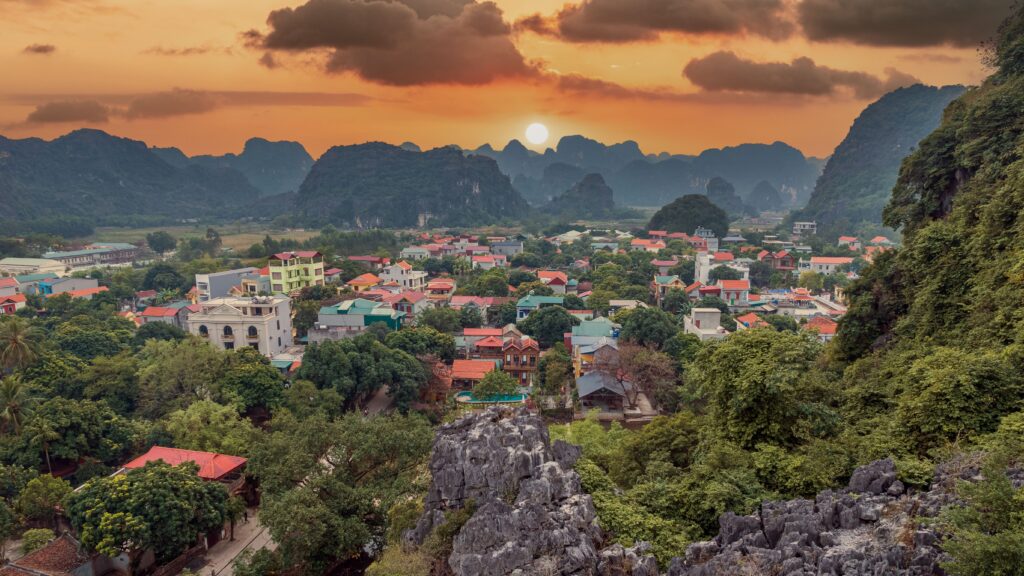
Ninh Binh is, loosely, an inland version of Ha Long Bay — the same limestone karst formations, but rising from rice paddies and rivers instead of sea. Boats navigate narrow channels between the outcrops. Water buffaloes graze in the fields. Herons stand in the shallows without blinking. The ancient capital of Hoa Lu sits at the base of the mountains, temple columns still standing from the 10th century.
Tam Coc
The boat trip. Three narrow cave passages through the limestone, paddled by local women who use their feet on the oars — both hands occupied with selling souvenir fans to tourists, a multitasking achievement that deserves acknowledgment. The cave entrances are dark and low and the boat slides through with inches to spare, emerging into the next rice-paddy stretch of river each time.
Go early. By 7:30am the boats are leaving. By 10am the river is crowded with tourists. By 7:30am it’s you and a handful of other boats and the herons.
Cost: £3.50 for the 2-hour trip. Rent a bicycle from your guesthouse (£1.50/day) to reach the pier rather than paying for a taxi.
Trang An
A larger cave system than Tam Coc, UNESCO World Heritage, slightly more expensive (£5 for the boat trip), and in some ways better — the caves are longer and more dramatic, the landscape is wilder, and it’s less frequently recommended so marginally less crowded. If you have time for both, do Tam Coc in the morning and Trang An in the afternoon.
Hoa Lu Ancient Capital
The two temples of Dinh Tien Hoang and Le Hoan, set against the limestone cliffs. Not the most extraordinary temples in Vietnam but the setting — mountain backdrop, ancient stonework, almost no visitors — is unusual and worth the bicycle ride.
Where to Stay in Ninh Binh
Tam Coc village (not the town of Ninh Binh itself) is where you want to be — closer to the boat pier, quieter, guesthouses from £8–15/night. Ninh Binh town has train and bus connections but is a 20-minute bicycle ride from the main attractions.
Ha Long Bay — The 2-Night Cruise Question
Ha Long Bay is, depending on which set of photos you’ve been shown, either exactly what you expected or significantly more extraordinary than anything you were prepared for. For most people it’s the second.
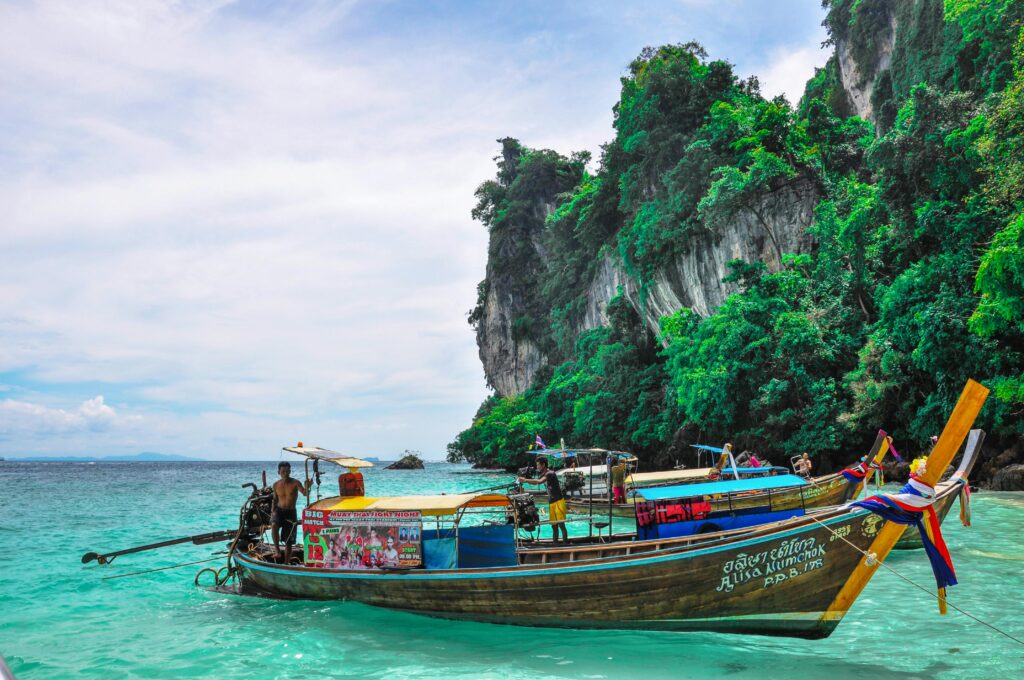
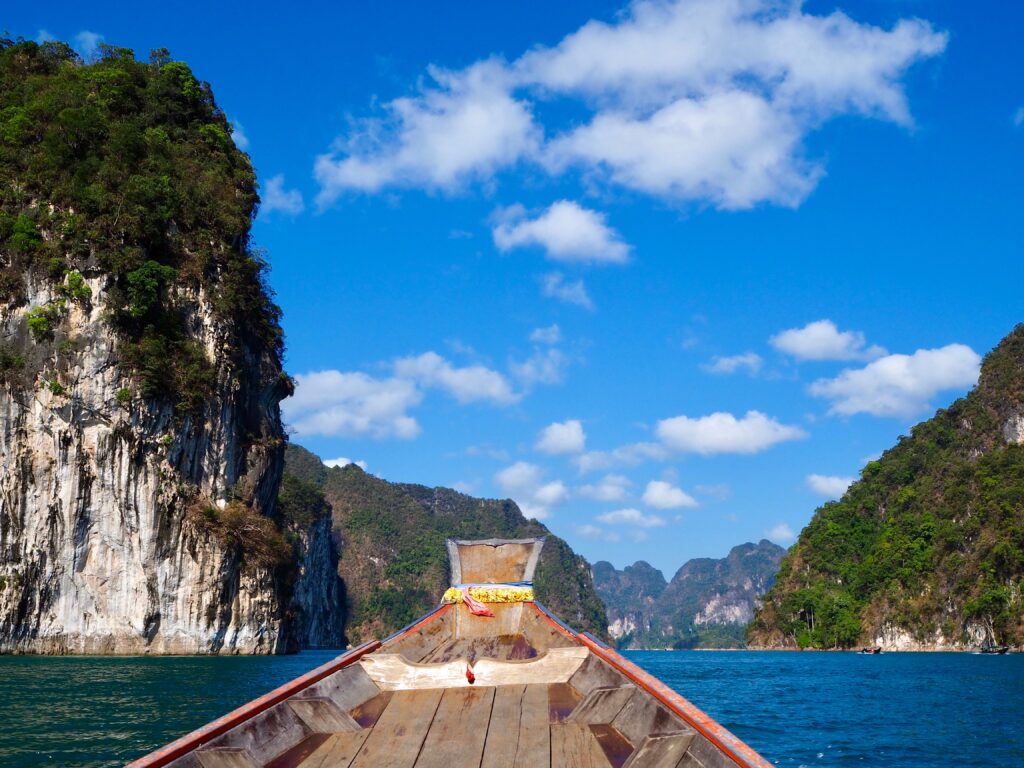
1,600+ limestone islands and islets rise from the Gulf of Tonkin. Some are forested. Some are hollow — sea caves accessible by kayak or swim-through. The water shifts from grey-green in flat light to deep jade in sun to silver at dawn. At 5:30am, when the mist sits between the karsts and the first light comes through from the east and there are no other sounds except water, Ha Long Bay is one of the finest places on earth.
You will not experience any of that on a day trip.
The day trip problem:
The day trips from Hanoi leave at 6am, drive 3.5–4 hours to Ha Long City, board a boat with 40–60 other passengers, spend 4 hours on the water in convoy with every other day-trip boat (the same caves, the same kayaking spots, the same photos), and drive 4 hours back. You arrive in Hanoi at 10pm having spent £30–45 and having seen Ha Long Bay in the same way you see a city by looking at a postcard.
The 2-night cruise:
The boats that run 2-night cruises leave Ha Long City in the afternoon (after the day-trip boats have already departed) and don’t return until the third morning. You get the bay at dawn — both dawns. You get the bay at night when the day-trip boats have gone back to harbour and the water is still and lit by stars. You kayak into caves that the day trips don’t reach because they don’t have time to get there.
Cost: £85–180/person depending on the boat quality, all meals included.
Which boat to book:
Book a boat that carries a maximum of 20–25 passengers. Boats carrying 40+ passengers are a different experience. Check reviews on TripAdvisor or Google in the last 6 months specifically.
Operators worth looking at: Era Cruises, Paradise Cruises, Indochine Cruises, Pelican Cruises. Book 4–6 weeks ahead for peak season (November–February, July–August). Book 1–2 weeks ahead in shoulder season.
Bai Tu Long Bay:
Adjacent to Ha Long Bay, half the boats, 80% the scenery. Some cruises extend into Bai Tu Long — worth asking about if you’re booking a higher-end cruise.
Lan Ha Bay:
Near Cat Ba Island, at the southern end of the Ha Long formation. Even fewer boats than Bai Tu Long. The Cat Ba Island base offers kayaking and cycling in addition to the bay itself. A legitimate alternative to Ha Long if you want the landscape with significantly less company.
Phong Nha — The Cave System Nobody Knows About
Most people’s Vietnam itinerary runs: Hanoi → Ha Long Bay → Hoi An → Ho Chi Minh City. Phong Nha sits between Ha Long Bay and Hoi An, 6 hours south of Hanoi, and most people drive past it on a bus that doesn’t stop.
This is a mistake.
Phong Nha-Ke Bang National Park contains the world’s largest cave system. Son Doong Cave — the single largest cave on earth by volume — is here. It’s large enough to contain a forest, a cloud system, and a river. A guided expedition costs £2,500 and books out a year in advance. It is, by all accounts, one of the most extraordinary things a human being can experience.
Most people don’t go to Son Doong. They go to Paradise Cave.
Paradise Cave
31 kilometres long. 150 metres high in the main chamber. The formations — stalactites and stalagmites built over millions of years — are extraordinary enough that the first word most visitors say when they walk in is not a word at all.
The walkway takes you 1km into the cave. £8 entry. No tour guide required for the basic visit.
The advanced jungle route (an additional £30, advance booking required) takes you deeper into the cave beyond the tourist walkway, through a section of the cave that involves some scrambling and wading. Not technically demanding. Completely different experience.
Dark Cave
A cave on the Chay River where the experience includes: zip-lining across the river into the cave mouth, kayaking through a dark section, swimming through a flooded chamber, and emerging into a pool where you can kayak back out. Sounds implausible. Is genuinely excellent. £12, half-day.
Phong Nha Village
Base yourself here rather than in the town of Dong Hoi (the nearest city, 50km north). The village is small, quiet, and has a cluster of excellent guesthouses (£8–18/night) and a few good restaurants. Easy Riders (local motorcycle guides who take you through the national park on the back of motorbikes) can be arranged here.
Getting to Phong Nha: overnight sleeper bus from Hanoi (9 hours, £10–14) or local bus from Ha Long via Vinh. Most travellers pass through on the way from Hanoi to Hoi An — the stop adds a day and is worth it.
Hoi An — The Ancient Town and the Early Morning Rule
Hoi An is the most beautiful town in Vietnam. It’s also, in peak season between 10am and 5pm, genuinely overwhelming. The solution is simple and consistent: be there before 7am.
The Ancient Town is a UNESCO World Heritage site — a trading port from the 15th to 19th centuries, when merchants from China, Japan, and Europe converged here. The architecture reflects all of them: Chinese assembly halls, Japanese covered bridge, French colonial facades, Vietnamese tube houses. The lanterns — hung from every building, red and gold and green — are on at dawn and lit again at dusk.
At 6:30am, the lanterns are still lit, the river mist is still present, and the streets are almost entirely empty except for early traders setting up stalls. This is the Hoi An that makes people miss it before they’ve left.
By 10am, the tour buses have arrived. By noon, the old town’s narrow main streets are crowded. By 3pm, you’re grateful for the café with the fan.
The Tailors
Hoi An has 400+ tailors. Quality varies enormously. The rule: anyone who approaches you on the street, decline. Walk into a shop with a visible portfolio and recent reviews on Google Maps. Yaly Couture and Bebe Tailor appear consistently in recommendations. Order on the day you arrive. Pick up 24–48 hours later. A custom-made shirt costs £20–35 depending on fabric. A dress: £30–60.
An Bang Beach
4km from the old town by bicycle (rent from any guesthouse, £1.50/day). The road winds through rice paddies and past rice paper drying frames before reaching a long, sandy, relatively quiet beach. Better than Cua Dai Beach to the south, which has suffered significant erosion. The seafood shacks at the northern end serve whole grilled fish with rice for £5–7. Spend the afternoon.
My Son Sanctuary
40km from Hoi An (£10–15 for a half-day tour). The ruins of a Hindu Cham kingdom — towers and temples built from the 4th to 13th century in a jungle valley below sacred mountains. Significantly damaged by US bombing in 1969; what remains is still extraordinary and, crucially, almost always quieter than Angkor Wat in Cambodia. Worth the half-day.
The Full Moon Lantern Festival
On the 14th of every lunar month, motorbikes are banned from the old town, the electric lights are turned off, and the streets are lit by paper lanterns. The effect is genuinely transformative — the already-beautiful old town becomes something from another century. Dates shift annually (lunar calendar), check before you book.
Da Nang — The City Most People Use as a Transit Stop
Da Nang is the nearest airport to Hoi An (30 minutes south by taxi, £8–12). Most people fly in, take a taxi to Hoi An, and don’t think about Da Nang again until they need to catch their next flight.
This is fine. Da Nang is primarily a city rather than a destination — Vietnam’s third largest, modern, prosperous, with less accumulated character than Hanoi or Hoi An.
The two things worth doing if you have time between flights:
My Khe Beach — 30km of wide sandy beach directly accessible from the city. Clean, well-serviced, good surf. If you want a beach day that doesn’t involve the hour journey to Hoi An’s beaches, this is it.
The Marble Mountains — five marble-and-limestone hills 8km south of the city, containing Buddhist sanctuaries and caves within the rock. The climb to the top (entry £1.50) gives views over Da Nang, the beach, and the sea. 30 minutes from the airport.
The Dragon Bridge — Da Nang’s famous bridge — breathes fire and water on weekend nights. It’s worth catching if you’re around on a Saturday or Sunday but doesn’t merit a detour.
Ho Chi Minh City — The South
The old name — Saigon — is still used colloquially by almost everyone, including many official signs. The government calls it Ho Chi Minh City. Most people call it Saigon. Both are correct.
HCMC is a different energy from Hanoi. Faster, more commercial, more international. The French colonial imprint is heavier in the architecture (the Post Office, the Notre-Dame Cathedral, the Continental Hotel). The food is different — sweeter, richer, the Chinese and Khmer influences more visible. The traffic is, if anything, denser.
The Essential Day
Morning: The War Remnants Museum. The most important museum in Vietnam and one of the most important in Southeast Asia. Photographs and documents from the American War (the Vietnamese term for what the US calls the Vietnam War), from Vietnamese and international journalists. The photography sections are extraordinary and disturbing in roughly equal measure. Allow 2 hours minimum. Entry £1.50.
Midday: Bến Thành Market. A French-era covered market that now functions primarily as a tourist market — handicrafts, clothing, food. The surrounding streets are better for authentic shopping than the market interior. Eat in the food hall at the back.
Afternoon: Reunification Palace. The former Presidential Palace of South Vietnam, frozen in 1975 when the North Vietnamese tanks drove through the gates. The décor is unreconstructed 1970s — maps still on the walls, the communications room operational, the rooftop helicopter pad where the last evacuation helicopter lifted off. £2 entry, self-guided, 90 minutes.
Evening: The Thủ Thiêm Ferry. Cross the Saigon River by ferry (one of the cheapest journeys in Vietnam at 4,000 VND / 12p each way) to the Thủ Thiêm district, then take the ferry back as the skyline of Dong Khoi lights up behind you. The best view of the HCMC skyline is from the water at dusk.
Cu Chi Tunnels
40km northwest of HCMC (£6 per person entry, half-day tour from £8). The 250km network of underground tunnels used by the Viet Cong during the American War — living quarters, kitchens, hospitals, command centres. Some sections are widened for tourists to crawl through. The experience of being underground in the dark in a tunnel that narrows to 60cm in width is viscerally effective context for understanding the war.
Book a tour from your hostel or hotel — they run daily.
The Mekong Delta — The Part Most People Skip
3.5 hours from HCMC by bus (£4). The Mekong River splits into nine channels as it reaches the sea in southern Vietnam, creating a waterworld of interconnected rivers, canals, floating markets, rice paddies, and fruit orchards that looks completely unlike anything in the north.
17 million people live in the delta. Tourism infrastructure is thin outside of Can Tho, the regional capital.
Cai Rang Floating Market
The largest floating market in the delta. 5:30–7am. Wholesale trading by boat — each vessel advertising its cargo by hanging a sample from a pole on the bow. Pineapples. Watermelons. Sweet potatoes. Durian. Coconuts. All bought and sold on the water.
Hire a small boat from the Can Tho riverfront: £6–8/hour, negotiate directly with the boatwomen. Do not book through a hotel tour desk — the price doubles and the experience is identical.
Ben Tre
The coconut province. Two hours from Can Tho. Boat trips through narrow channels past coconut candy factories, honey bee farms, and rice paper workshops. The coconut candy made fresh and still warm is the reason to go.
Cycling the Canal Roads
Rent a bicycle from your Can Tho guesthouse (£2/day) and cycle the canal-bank roads into the surrounding countryside. The roads are flat, quiet, lined with coconut palms, and cross bridges so narrow they accommodate one bicycle at a time. Stop at any house with a coconut candy factory sign. They’ll invite you in and give you samples.
This is the Mekong Delta that doesn’t appear in any itinerary — and it’s the best part of it.
Sapa and the North — A Different Vietnam
The rice terraces of Sapa are in the northwest of Vietnam, near the Chinese border. 380km from Hanoi by overnight sleeper train (from £10) or overnight bus, then a cable car or local bus up to the town at 1,500m above sea level.
Sapa itself is a small mountain town that has been significantly touristed since the early 2000s. The town’s character has been compressed by tourism; the surrounding landscape has not.
The Rice Terraces
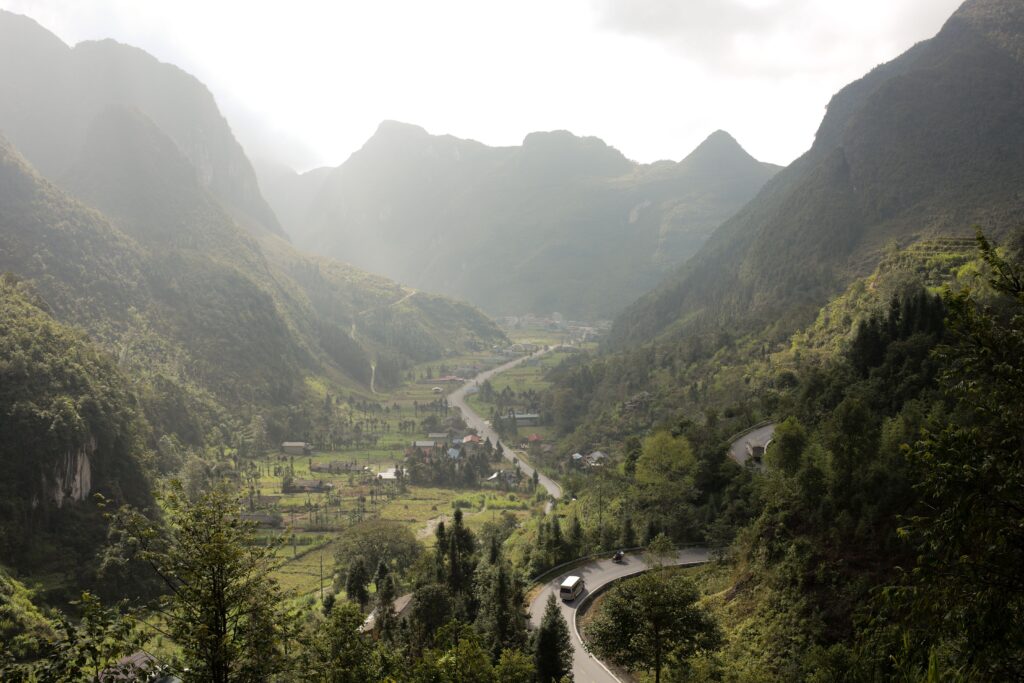
Carved into the mountain hillsides over centuries by the H’mong and Dao ethnic minority communities, the terraces are one of the most visually extraordinary landscapes in Asia. The scale — thousands of terraced fields stepping down from the mountain peaks to the valley floor — doesn’t transfer to photographs. You need to stand in it.
Peak green: June to September. Peak gold (harvest): late September and October. Flowers and planting season (new water in the paddies): April to May.
The trekking routes from Sapa into the valley villages (Cat Cat, Y Linh Ho, Lao Chai, Ta Van) are well-marked and manageable without a guide on the main paths. A local H’mong guide (£10–20/day) significantly enriches the experience with context about the communities.
Cat Cat Village
The nearest village to Sapa town, 2km downhill. The entry fee (£1.50) has turned it into the most visited, which means it’s the least representative. Start here for orientation but continue down-valley for the better experience.
Homestays
Staying in a homestay in the valley — rather than in a hotel in Sapa town — is the best decision you can make in the area. Guesthouses from £12–18/night typically include dinner and breakfast. The difference in experience between looking at the terraces from Sapa town and waking up in the middle of them is considerable.
The Vietnam Train — Book It Before You Book Anything Else
The Reunification Express runs from Hanoi to Ho Chi Minh City along the entire length of the country. 1,726km. The full journey takes 30–34 hours.
Most people take sections of it. The most important section is this: Hoi An → Da Nang → Hanoi by overnight sleeper.
Technically: Hoi An to Da Nang by taxi (30 minutes, £3.50). Da Nang to Hanoi by overnight sleeper train (19 hours, £18–25 depending on class and advance booking).
The soft sleeper cabin: 4 berths, air conditioning, bedding included. The train rocks gently. The countryside passes outside the window for the sections where daylight allows it. The Hai Van Pass — a coastal mountain section north of Da Nang where the track clings to a cliff above the sea — passes in early morning light and is the most beautiful coastal railway in Asia. Then you’re in the Danang mountains, then the Hue plains, then the flat green country of central Vietnam.
You arrive in Hanoi at 9am having slept. The alternative is a 90-minute flight. You don’t want the alternative.
How to book: Vietnam Railways at dsvn.vn, or Baolau.com which has an English interface. Book up to 30 days in advance. The soft sleeper class (nằm mềm) is the right choice — the hard sleeper is fine but the berths are narrower and the bedding is thinner.
For the southbound direction — Hanoi to Ho Chi Minh City via Hoi An — the same logic applies but you’ll likely take multiple train segments rather than the full route.
What It Costs — Real Numbers
Daily Budgets
Budget (£30–40/day)
- Hostel dorm or budget guesthouse: £6–12/night
- Street food and local restaurants: £6–10/day
- Local buses and sleeper buses between cities
- Ha Long Bay day trip (the compromise — see above)
Mid-range (£55–70/day)
- Boutique guesthouse private room: £22–35/night
- Mix of local and mid-range restaurants: £12–18/day
- Sleeper trains between cities
- Ha Long Bay 2-night cruise (amortised across the trip)
- Cooking class, cave entry, day trips
Comfortable (£90–120/day)
- Boutique hotel: £35–60/night
- Restaurant dinners, good lunches: £25–35/day
- Occasional taxis and private transfers
- Premium Ha Long Bay cruise
What 2 Weeks in Vietnam Actually Costs from the UK
| Category | Budget | Mid-Range |
|---|---|---|
| Return flights (open jaw, 3 months ahead) | £450–550 | £550–700 |
| 14 nights accommodation | £100–180 | £300–420 |
| Ha Long Bay 2-night cruise | £85–120 | £120–180 |
| Food (14 days) | £85–140 | £140–210 |
| Internal transport (trains, buses, taxis) | £60–100 | £80–120 |
| Activities (cooking class, caves, tunnels) | £40–80 | £80–130 |
| Total | £820–1,170 | £1,270–1,760 |
Eating in Vietnam — The Actual Guide
Vietnamese food is one of the great cuisines of the world — and almost completely misrepresented by Vietnamese restaurants outside Vietnam. The version most people know (spring rolls, pho, banh mi) is a fraction of what actually exists, and the versions of those things that exist in Vietnam bear limited resemblance to the exported product.
The Dishes to Seek
Pho (Hà Nội) The national dish. A clear broth (beef or chicken) with rice noodles, fresh herbs, and either rare beef slices or shredded chicken. In Hanoi, the broth is cleaner, more delicate, less embellished with sauces. Order it at a shop that has a queue at 7am. Do not dress it with hoisin and sriracha until you’ve tasted the broth clean.
Bun Cha (Hanoi) Grilled pork patties and slices of pork belly, served in a bowl of sweet vinegary broth with rice vermicelli noodles and a plate of fresh herbs. The dish that Barack Obama ate with Anthony Bourdain in Hanoi. Available everywhere in Hanoi; barely available in the south. Hang Manh Street in the Old Quarter is the place.
Bánh Mì The French baguette, colonised by Vietnam. Pâté, pickled daikon and carrot, fresh chilli, coriander, and your choice of filling (pork belly, grilled chicken, fried egg, smoked sausage). Madam Khanh in Hoi An is often cited as the best — the queue at 7am confirms it. Costs 20,000–35,000 VND (£0.60–1.00).
Cao Lầu (Hoi An only) Thick rice noodles, pork slices, bean sprouts, mint, and crunchy rice crackers, dressed in a dark soy and star anise broth. The dish is only properly made in Hoi An — the noodles use water from a specific ancient Cham well and ash from trees on a specific island in the Thu Bon River. Restaurants in other cities serve versions of it. They are not the same.
Bún Bò Huế (Hue / Central Vietnam) The spicier northern cousin of pho. A deep red broth flavoured with lemongrass, shrimp paste, and chilli, with sliced beef and pork and thick round noodles. Not on enough menus outside Hue and Hoi An. Order it wherever you see it.
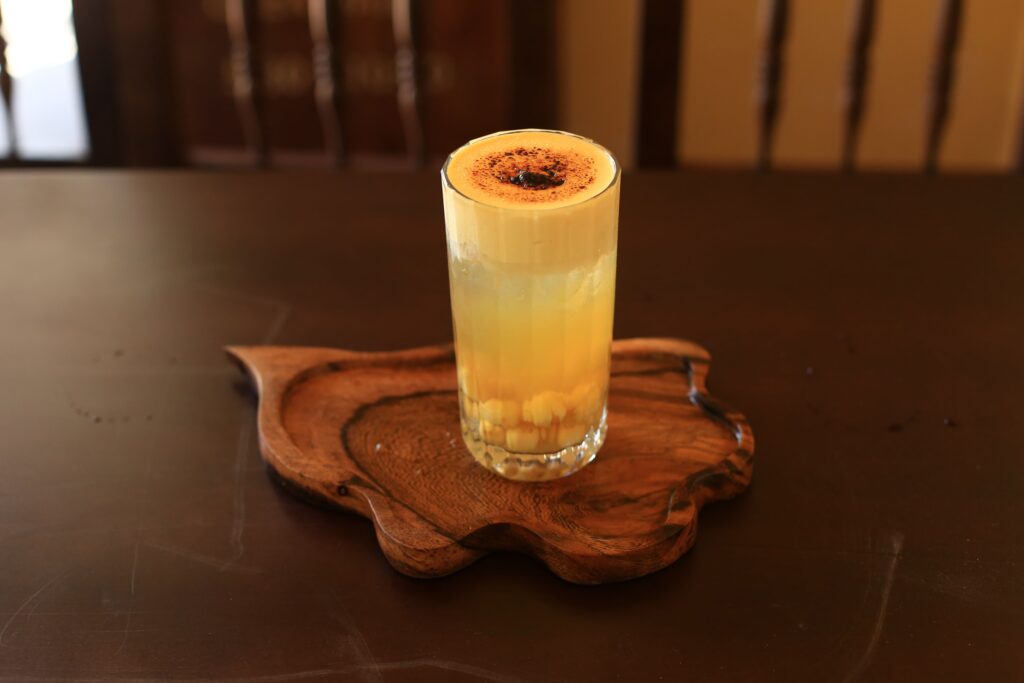
Egg Coffee (Hanoi) An invention of the Hanoi café scene: a robusta espresso base topped with a thick, sweet foam made from egg yolk beaten with condensed milk and Vietnamese coffee. Sounds like a gimmick. Tastes like a rich, sweet coffee mousse over espresso. Giang Café in Hanoi’s Old Quarter (and a newer branch near Hoan Kiem Lake) is the originator.
Bánh Xèo (Central and South) A crispy rice-flour crepe, bright yellow from turmeric, stuffed with pork, prawns, and bean sprouts. Eat it by tearing off a piece, wrapping it in a lettuce leaf with fresh mint and perilla, and dipping it in nuoc cham. Available everywhere; best in Hue and HCMC.
Cơm Tấm (Ho Chi Minh City) Broken rice — a byproduct of the milling process, coarser in texture — served with grilled pork chop, shredded pork skin, steamed egg meatloaf, and a fried egg. The breakfast and lunch of HCMC. Every neighbourhood has a com tam stall. Follow the queues.
The Rule That Works Everywhere
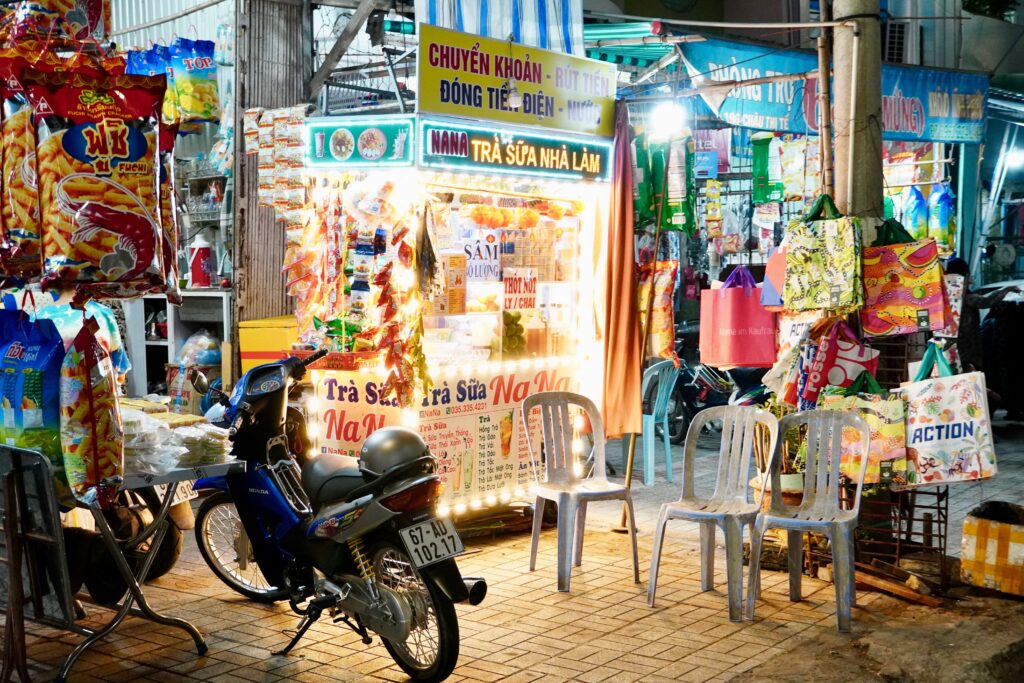
The plastic stool rule. The places with plastic stools and no English menu, where the menu is either on the wall in Vietnamese or simply what they’re making today — these are almost always excellent. The places with laminated menus in English and photographs of dishes are almost always not. The overlap between “has photos on the menu” and “food that local people eat” is approximately zero.
Practical Notes
Visa: UK passport holders receive a 45-day e-visa, obtainable online at evisa.xuatnhapcanh.gov.vn. Apply a few days before travel. Cost: approximately £17. Processing time: 3 working days typically, though allow a week to be safe.
Getting there: Return flights London → Hanoi or Ho Chi Minh City from £450–700. Vietnam Airlines, Qatar Airways, Thai Airways, and Emirates are the main carriers. Open-jaw routing — fly into Hanoi, out of HCMC — avoids backtracking and is often the same price as a return.
Getting a SIM: Buy a tourist SIM at the airport on arrival. Viettel has the best coverage nationwide, including rural areas and Sapa. A 30-day SIM with 60–100GB data costs approximately £7–10. Alternatively, activate an Airalo eSIM before you land.
Getting around within Vietnam: Grab (the regional equivalent of Uber) works in all major cities and is the most reliable way to take a short taxi journey. The app shows the price before you book. For intercity travel: the train for scenic routes and longer overnight journeys, sleeper buses for the budget option, domestic flights on Vietjet or VietAir for when time is the constraint.
Currency: Vietnamese Dong (VND). £1 ≈ 31,000 VND at the time of writing (verify before travel). ATMs are widely available in cities; bring cash for markets, smaller restaurants, and rural areas. Vietcombank ATMs are the most reliable for accepting foreign cards.
Safety: Vietnam is a very safe country for travellers. The main risks are: motorbike accidents (as passenger or cyclist — be cautious), petty theft in crowded tourist areas, and aggressive touts in some tourist zones. The scam landscape is lighter than in some neighbouring countries.
The 2-Week North-to-South Itinerary
This is the route most people do and, adjusted for hindsight, it’s still the right one.
Days 1–3: Hanoi Day 1: Arrive, recover, Old Quarter walk at dusk. Day 2: Hoan Kiem Lake at 6am. Ho Chi Minh Mausoleum complex. Vietnam Museum of Ethnology. Bia Hoi Corner evening. Day 3: Day trip to Ninh Binh (Tam Coc boats, Trang An, Hoa Lu). Return to Hanoi evening.
Days 4–6: Ha Long Bay Day 4: Transfer to Ha Long City. Board cruise mid-afternoon. Kayaking, cave exploration, sunset on the sundeck. Day 5: Full day on the bay. Tai chi on the top deck at dawn. Day 6: Morning on the bay. Return to Hanoi by midday. Overnight sleeper train from Hanoi to Phong Nha (or bus).
Days 7–8: Phong Nha Day 7: Paradise Cave. Chay River and Dark Cave. Day 8: Jungle boat trip through Phong Nha cave. National park motorbike circuit. Overnight sleeper bus to Hoi An (via Da Nang).
Days 9–11: Hoi An Day 9: Ancient Town at 6:30am. Bicycle to An Bang Beach afternoon. Lanterns at dusk. Day 10: Cooking class morning. Tailors. My Son Sanctuary afternoon. Day 11: Morning market, pick up tailored items, slow pace. Taxi to Da Nang for evening train north (if going back) or bus south.
Days 12–14: Ho Chi Minh City Day 12: Arrive. Reunification Palace. War Remnants Museum. Thủ Thiêm ferry at dusk. Day 13: Cu Chi Tunnels half-day. Ben Thanh Market area afternoon. Dinner in the Pham Ngu Lao area. Day 14: Half-day Mekong Delta day trip (Ben Tre or Can Tho, depending on time). Fly home from Tan Son Nhat Airport.
Total cost estimate:
| Category | Mid-Range |
|---|---|
| Return flights (open jaw, 3 months ahead) | £550–700 |
| 14 nights accommodation (mix of guesthouse and boutique) | £300–420 |
| Ha Long Bay 2-night cruise | £120–180 |
| Food + activities (14 days) | £200–320 |
| Internal transport | £80–120 |
| Total | £1,250–1,740 |
For the full day-by-day version with accommodation picks, restaurant names, booking links, and exact transport schedules, the free Vietnam Planning Guide is available at bggdworld.com.
Final Thought
The moment that changed how I think about Vietnam happened in Hanoi, on a Tuesday morning, at a pho stall on a street with no signage. I’d been there 4 days and I was just starting to feel like I could navigate the city without concentrating on it.
The woman who made the pho was older. She’d been there since 5am. She handed me the bowl without looking at me, added the herbs and the lime without asking, and went back to the broth. I ate it standing up. The broth had been going since before I’d arrived.
There was nothing remarkable about this. That was the remarkable thing.