
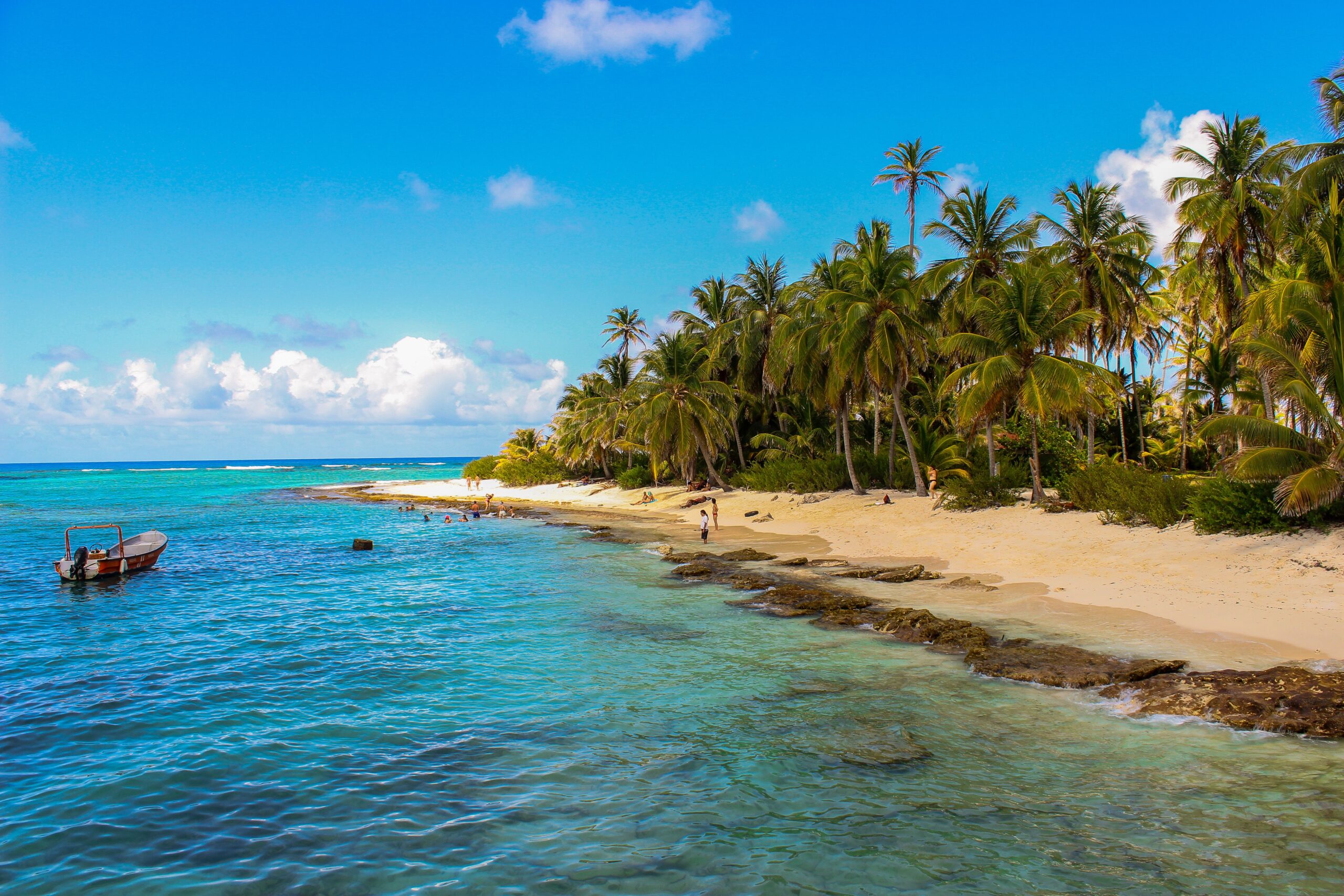
The route that gives Panama its full argument: two days in Panama City for the Casco Viejo (the UNESCO colonial quarter, the church ruins and the restored houses visible in the same block as the specific Panama City contradiction of the luxury development adjacent to the heritage conservation) and the Miraflores Locks (the Panama Canal visitor centre where the ships transiting from the Pacific to the Atlantic are visible from the observation deck at the scale that makes the engineering comprehensible — the Panamax container ship visible at 25 metres from the lock wall) and the Amador Causeway (the causeway built from the rock excavated during the Canal construction, the specific engineering byproduct that became the Panama City evening promenade), and five days in the San Blas Islands (the Guna Yala Comarca — the autonomous indigenous territory of the Guna people, the 365 islands of the San Blas archipelago accessible only by small aircraft or by the 4WD road through the Darién, the most specific Caribbean island experience available to the UK traveller who has seen the resort Caribbean and wants the thing the resort does not give).
Reading time: 10 minutes | Last updated: 2026
Before You Leave
Getting there: Fly London-Panama City Tocumen International Airport (Copa Airlines via Panama City, Iberia via Madrid, American via Miami — approximately 12-14 hours total). UK citizens: Panama visa-free 180 days.
The routing: Panama City (2 nights) → small aircraft to the San Blas Islands (the Guna Yala airstrips — Air Panama connects from Albrook Airport, the domestic terminal in Panama City; approximately 30-45 minutes, USD 60-100 / £47-78 one way; book weeks ahead as capacity is limited) → San Blas Islands (5 nights) → return Panama City, fly home.
The currency: The US Dollar. Panama uses the USD as its official currency alongside the Panamanian Balboa (the Balboa is pegged at 1:1 with the USD; coins are interchangeable).
The Route
Panama City (2 nights) → fly to San Blas Islands (5 nights)
DAYS 1-2 — Panama City
Day 1: The Miraflores Locks and Casco Viejo
The Miraflores Locks:
The Miraflores Visitor Centre (the Panama Canal observation deck — the Panamax ship visible at the lock wall during the lock cycle):
The lock cycle (the ship enters the lock, the lock doors close, the water level rises 26 metres in approximately 8 minutes, the ship rises with the water, the lock doors open, the ship exits at the new level): the specific Panama Canal engineering visible at human scale from the observation deck — the 65,000-tonne container ship rising 26 metres in 8 minutes by water displacement alone, no pumps, the specific gravity-driven lock mechanism designed in 1904.
Entry: USD 15-20 / £11.81-15.75.
The Casco Viejo:
The Casco Viejo (the 17th-century founding city quarter of Panama City — the UNESCO World Heritage Site, the specific Panama City contradiction visible in a single block: the restored Colonial house at USD 1 million in renovation cost adjacent to the empty ruin on the corner (the Panama City property development pattern: the restored buildings have sold; the unrenovated wait for the developer)):
The sancocho (the Panamanian national dish — the chicken soup with the ñame (the yam), the culantro (the long coriander), the corn, the specific Panama comfort food at the Casco Viejo restaurant from USD 8-12 / £6.30-9.45):
DAYS 3-7 — The San Blas Islands (Guna Yala)
The Guna Yala:
The San Blas Islands (the 365 islands of the Guna Yala Comarca — the autonomous indigenous territory of the Guna people, the territory governed by the Guna General Congress rather than the Panamanian national government, the tourism regulated by the Guna Yala government (the visitor fee of USD 20 / £15.75 per person per day goes to the community)):
The specific Guna Yala distinction: The San Blas Islands are not the resort. The accommodation is the Guna family hut (the thatched bamboo ulu, the hammock or the cot, the family who hosts you, the dinner at the family table). The electricity is the solar panel; the shower is the ocean; the toilet is the outhouse above the sea. This is the specific Caribbean island that no resort replicates because the resort’s business model requires the amenity that the Guna Yala’s governance specifically refuses.
The mola:
The mola (the Guna textile art — the layered, cut-and-sewn fabric panels that the Guna women wear as the front and back panel of the blouse, the geometric and figurative patterns visible in the specific mola colour combinations that identify the community and the maker): the mola at the island village at USD 15-50 / £11.81-39.37 per panel (the larger and the more complex the mola, the higher the price, the correct pricing in a cultural economy).
The snorkel:
The San Blas coral (the Caribbean coral reef at 1-5 metres depth visible from the snorkel — the starfish, the sea turtle, the parrotfish visible in the specific Caribbean clarity that the San Blas location (the sheltered leeward side of the San Blas ridge) gives):
The dugout canoe to the reef (the Guna dugout — the canoe from the island to the reef, the paddled by the Guna family member who has been navigating these waters since the age when he could reach the paddle): USD 5-10 / £3.94-7.87 per person.
What It Costs
| Category | Budget | Mid-Range |
|---|---|---|
| Return flights (UK-Panama City) | £400-700 | £600-1,000 |
| Domestic flights (Panama City to San Blas, return) | £94-156 | £94-156 |
| Guna Yala daily visitor fee (5 days) | £79 | £79 |
| San Blas accommodation (5 nights, all-inclusive) | £150-300 | £300-600 |
| Panama City accommodation (2 nights) | £40-100 | £100-250 |
| Food and activities outside accommodation | £30-80 | £60-150 |
| Total | £793-1,415 | £1,233-2,235 |