
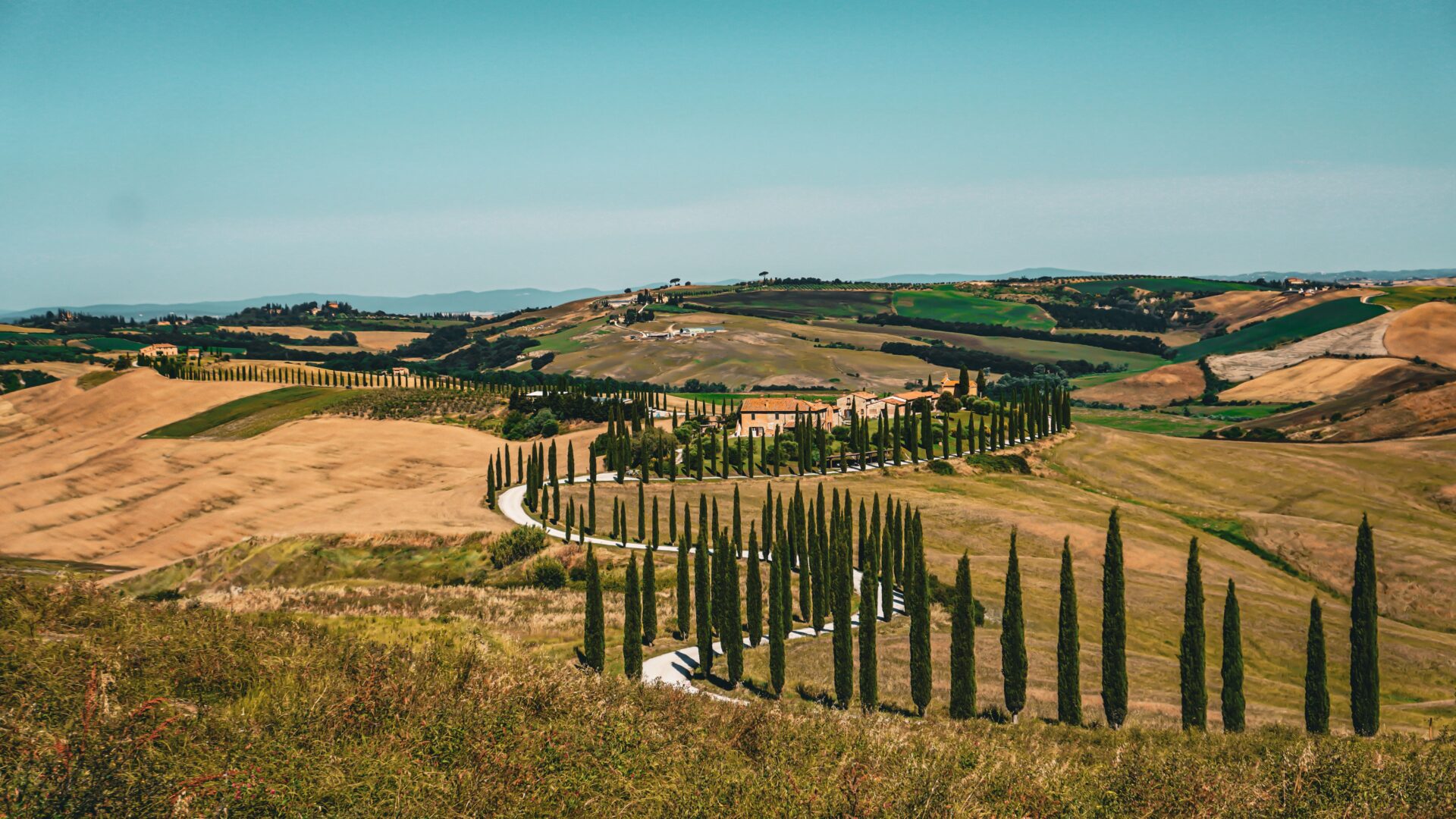
The route that gives Tuscany in its full depth: two days in Florence for the Uffizi and the Oltrarno and the bistecca fiorentina, two days driving the Val d’Orcia (the UNESCO landscape of the cypress avenues and the Brunello vineyards and the thermal springs), and three days based in Siena and San Gimignano for the medieval cities and the saffron risotto and the vernaccia wine at the vineyard — and why the September Tuscany is the correct Tuscany, when the harvest is beginning and the light is the specific golden quality that the Sienese painters used as their technical problem.
Reading time: 11 minutes | Last updated: 2026
Tuscany is the most painted region on earth. The cypress avenues, the rolling wheat fields, the hilltop towns, the olive groves in the stone terraces — these are the visual vocabulary that Western Europe’s painting tradition used for 600 years to represent the idea of a beautiful landscape. The specific reason: the Val d’Orcia (the valley of the Orcia River between Siena and Montepulciano) was the landscape that the Sienese painters of the 14th-15th century used as the background for their altarpieces. When Ambrogio Lorenzetti painted the Effects of Good Government in the Siena Palazzo Pubblico in 1338, the landscape in the background was the actual landscape visible from the city walls. The painting and the landscape are the same thing.
Seven days gives the full Tuscany — not everything, but the depth that the region rewards. The 3-day Florence and Pisa circuit that most visitors do gives Tuscany as a single city. This gives it as a region.
Before You Leave
Car hire: Essential from Day 3. Pick up in Florence, return in Florence or at the Pisa airport. The Val d’Orcia is only accessible by car — no train service, the bus infrequent. Rentalcars.com or AutoEurope.
The September timing: The vendemmia (the grape harvest) begins in the Chianti and Brunello zones in mid-September. The sunflowers are past, but the sunflower fields become the backdrop for the harvest activity. The Val d’Orcia landscape in late September: the wheat fields cut and ploughed (the brown earth rather than the gold of summer photographs), the olive harvest beginning in October (the October Tuscany is the olive oil Tuscany — the new oil presses available from November).
The Uffizi: Book at uffizi.it — the first Saturday of every month is free entry, book immediately when the month’s free tickets are released. Otherwise, €30 / £25.87 with timed entry. The 9am slot is the correct opening slot.
The Route
Florence (2 nights) → Val d’Orcia circuit (2 nights — Pienza or Montalcino base) → Siena (2 nights, with San Gimignano and San Quirico d’Orcia day trips)
The 7 Days
DAYS 1-2 — Florence
Day 1: The Uffizi and the Oltrarno
9:00am — The Uffizi Gallery
The Uffizi (the Piazzale degli Uffizi — the gallery in the former Medici administrative offices, the collection representing the full arc of Italian painting from the Byzantine to the High Renaissance): the rooms to prioritise in the 3-hour morning visit:
Room 2 (Cimabue and Duccio): The transition from the Byzantine flat-gold tradition to the naturalism that Giotto would develop — the three Maesta paintings side by side (Cimabue’s, Duccio’s, and Giotto’s) showing the same subject treated in three successive visual languages.
Room 10-14 (Botticelli): The Primavera and The Birth of Venus. The Primavera (the 2.07 × 3.14 metre painting, the 500 plants identified by botanists in the foreground alone, the allegory whose specific interpretation has been debated for 500 years): stand 3 metres back and look at the full painting before approaching. The Birth of Venus (the foam-born goddess, the wind gods Zephyr and Aura, the three graces) directly opposite.
Room 41 (Caravaggio): The Medusa (the decapitated head on the parade shield — the specific Caravaggio psychological weight, the blood mid-drop, the expression of the moment of death), and the Bacchus (the slightly drunk adolescent Bacchus, the fruit bowl with the rotting fruit, the specific Caravaggesque realism applied to a classical subject).
1:00pm — Lunch in the Oltrarno
Cross the Arno at the Ponte Vecchio (the 14th-century bridge, the gold shops on both sides — the medieval rent structure that favoured the goldsmiths who replaced the butchers banned from the bridge in 1593): the Oltrarno neighbourhood on the south bank.
The Buca Mario (Piazza degli Ottaviani — the oldest restaurant in Florence, operating since 1886): the ribollita (the Tuscan bread soup, the cavolo nero and the white beans and the day-old bread cooked together into the specific winter thickness of the Florentine peasant tradition), the bistecca fiorentina (the Chianina beef T-bone, minimum 1.2kg, served rare — the specific Florence instruction: the bistecca is served at the English “rare” and the Italian “al sangue”, the pink centre the correct preparation, the request for “ben cotta” the wrong answer): €55-75 / £47.41-64.66 for the full bistecca for two people.
3:00pm — The Boboli Gardens and the Palazzo Pitti
The Palazzo Pitti (the 15th-century palace that is the largest in Florence, the royal residence of the Medici and then the Savoy, the complex containing five separate museums): the Boboli Gardens (the formal garden behind the palace, the amphitheatre, the fountain, the cypress allée, the view over Florence from the garden’s upper terrace): entry €10 / £8.62 for the gardens.
The Palatine Gallery (the collection of Raphael paintings including the Madonna della Seggiola — the Madonna in the rounded tondo format, the three figures filling the circular composition in a way that demonstrates Raphael’s specific solution to the tondo’s compositional problem): entry €16 / £13.79.
Evening: the Oltrarno
The Oltrarno at 7pm (the neighbourhood restaurant street — the Borgo San Jacopo, the Piazza della Passera, the streets behind the Pitti): the working-Florentine dinner at the Osteria dell’Enoteca or the Buca dell’Orafo.
Day 2: The Accademia and the Duomo Circuit
9:00am — The Galleria dell’Accademia
The David (Michelangelo, 1501-1504 — the 5.17-metre marble statue in the rotunda at the gallery’s end, the most celebrated single sculpture in Western art): arrive at the Accademia opening at 9am (book at galleriaaccademiafirenze.it — the timed entry is mandatory, the queue without a booking is 90 minutes in peak season).
The approach to the David (the long corridor, the unfinished Prisoners — the four figures struggling to emerge from the marble, the specific insight into Michelangelo’s working method visible in the unfinished surfaces): the David at the end of the corridor, the scale not yet apparent until the last 20 metres.
The specific instruction: stand directly in front of the statue and look at the face. The anxiety is there — the brow furrowed, the eyes directed to the left (toward Goliath), the muscles tense. Donatello’s David is triumphant (the head of Goliath already at his feet). Michelangelo’s David is before the moment.
11:00am — The Duomo and Brunelleschi’s Dome
The Cattedrale di Santa Maria del Fiore (the Cathedral — the largest brick dome in the world, Brunelleschi’s solution to the engineering problem that had been unsolved for 120 years): the climb to the dome lantern (463 steps, €30 / £25.87 — book at duomo.firenze.it, the advance booking mandatory in peak season): the view from the lantern at 114 metres, the Florentine roofscape, the Fiesole hills visible to the north.
The specific dome interior instruction: the walk between the outer and inner dome shells (the two structural layers of Brunelleschi’s construction, the gap between them visible as you climb the stairs within it) gives the engineering visible from inside. The herringbone brick pattern (the specific brick arrangement that Brunelleschi used to allow the dome to support its own weight without centring — the innovation that made the dome possible) is visible on the inner surface.
Afternoon: Day Trip or the Bargello
The Bargello Museum (the former civic palace and prison, the finest sculpture museum in Florence — the Donatello rooms, the Verrocchio, the Cellini bronze): entry €10 / £8.62.
Or: the day trip to Fiesole (the Etruscan town on the hill above Florence, the Roman theatre, the view of Florence from the hillside — 20 minutes by bus from the San Marco square).
DAYS 3-4 — The Val d’Orcia Circuit
Day 3: Florence to Pienza (pick up car)
The Chianti Road (the Via Chiantigiana, SR222):
The drive from Florence to Pienza via the Chianti wine road (the route through Greve in Chianti, Radda, Gaiole): 2.5-3 hours including stops. The vine-covered hills, the castle towers of the Chianti Classico zone, the estate wineries with tasting rooms visible from the road.
Stop at the Castello di Brolio (the Ricasoli estate near Gaiole — the family whose baron Bettino Ricasoli developed the modern Chianti formula in the 1870s, the castle, the tasting room open to visitors): the Chianti Classico Riserva at the estate tasting, the view over the Brolio valley from the castle ramparts. €15-25 / £12.93-21.55 for the tasting.
Pienza:
The hilltop town redesigned by Pope Pius II in 1459 as the ideal Renaissance city (the grid plan, the Cathedral, the Palazzo Piccolomini all commissioned simultaneously — the first planned Renaissance town, UNESCO-listed): the Piazza Pio II (the central square, the Cathedral facade visible straight ahead, the Piccolomini palace to the right), and the pecorino di Pienza (the sheep’s milk cheese specific to Pienza — the fresh, semi-stagionato, and stagionato versions from the shops on the Corso Rossellino, the specific cheese that is the reason food travellers come to Pienza in addition to the architecture).
Day 4: The Val d’Orcia Drive
San Quirico d’Orcia and the Horti Leonini:
The walled garden of San Quirico (the 16th-century public garden in the medieval village centre — the box hedges in the geometric pattern, the holm oaks clipped to shape, the least-visited formal garden in Tuscany): free entry.
Montalcino and the Brunello:
The hilltop town above the Orcia valley, the source of Brunello di Montalcino (the wine made from the Sangiovese Grosso clone — the most age-worthy wine in Italy, the minimum 5 years from harvest to release for the standard version, 6 years for the Riserva): the fortress (the 14th-century Fortezza, the enoteca inside the walls serving the Brunello by the glass): €8-15 / £6.89-12.93 per glass for the current vintage.
The Castello Banfi (the estate south of Montalcino, the most internationally recognised Brunello producer, the visitor centre and tasting room): €20-40 / £17.24-34.48 for the Brunello flight.
Terme di Bagno Vignoni:
The thermal spring town — the specific Tuscany experience that most Tuscany guides omit. The central piazza of Bagno Vignoni is a thermal pool (the open-air pool of hot spring water that has been the town’s central feature since the Roman period, the Lorenzo de’ Medici taking the waters here in the 15th century). The pool itself is not swimmable (protected), but the thermal water flows down to the Parco dei Mulini (the park of the abandoned mills) where the natural pools allow bathing: free.
The Posta Marcucci hotel (the historic thermal hotel with the outdoor pool fed by the same spring): day use of the thermal pool: €30-50 / £25.87-43.10.
DAYS 5-7 — Siena and San Gimignano
Day 5: Siena
The Piazza del Campo:
The Piazza del Campo (the fan-shaped central square — the most beautiful urban square in Italy and one of the most beautiful in Europe, the shell-shaped brick paving, the Palazzo Pubblico with the Torre del Mangia visible from any point in the square): the square at 9am, the Fonte Gaia at the upper edge, the cafés beginning to fill.
The Torre del Mangia (the 88-metre tower attached to the Palazzo Pubblico — the 400-step climb, the view over the Sienese rooftops and the Val d’Orcia countryside in all directions): €15 / £12.93.
The Palazzo Pubblico and Lorenzetti:
The Sala del Mappamondo (the council room with the Simone Martini Maestà — the enthroned Madonna as the symbol of Siena’s civic government, the painting that established Martini as the greatest Sienese painter of the 14th century) and the Sala dei Nove (the room with Ambrogio Lorenzetti’s Allegory of Good and Bad Government — the most politically significant medieval painting in Italy, the Effects of Good Government fresco showing the actual Val d’Orcia landscape in its background): entry €12 / £10.34.
The Duomo:
The Siena Cathedral (the 13th-century Gothic Cathedral, the black-and-white marble banding on the exterior, the Pisano pulpit, the Piccolomini Library with the Pinturicchio frescoes): the Piccolomini Library (the frescoes celebrating the life of Pope Pius II, the colours unfaded after 500 years, the best-preserved Renaissance fresco cycle in Tuscany): entry €8 / £6.89.
Day 6: San Gimignano Day Trip
San Gimignano (30km northwest of Siena, 40 minutes by Tiemme bus from the Siena train station): the medieval town with 14 surviving towers (72 towers existed in the 13th century — the towers were status symbols, the taller your tower the more powerful your family), the UNESCO listing, and the vernaccia di San Gimignano (the white wine — the first Italian wine to receive DOC designation in 1966, the dry, slightly mineral style from the soil of the San Gimignano hillside).
The specific San Gimignano instruction: arrive by 9am (the first bus from Siena arrives at 9:30am — take the earlier bus from the Siena train station). The Piazza della Cisterna and the Piazza del Duomo in the morning before the tour buses arrive are the correct San Gimignano. By 11am: full tourist density.
The vernaccia tasting at Teruzzi & Puthod (one of the most established San Gimignano estates, the estate tasting room on the estate 2km from the town): €10-18 / £8.62-15.52 for the flight.
Day 7: Montepulciano and Return
Montepulciano (the hilltop town 50km east of Siena, the Piazza Grande at the summit, the Vino Nobile di Montepulciano wine — the Sangiovese-based wine from the highest altitude Tuscan wine town, different in character from the Chianti and the Brunello despite sharing the same grape variety):
The Contucci Cantina (the historic winery in the medieval cellars below the Palazzo Contucci on the Piazza Grande — the Vino Nobile bottles stacked in the ancient vaulted cellars, the tasting at the cellar bar): free tasting, purchase at the end if wished.
Return to Florence by the SS146 road (the road through the Val d’Orcia offering the specific Tuscany panorama — the cypress avenues, the hilltop towns, the Val d’Orcia landscape that Lorenzetti painted 700 years ago and that looks the same).
Return car in Florence. Fly home from FLR (Florence Peretola) or PSA (Pisa Galileo Galilei).
What It Costs
| Category | Budget | Mid-Range |
|---|---|---|
| Return flights (UK-Florence or UK-Pisa) | £50-130 | £80-180 |
| Car hire (5 days) | £100-180 | £150-250 |
| 7 nights accommodation | £280-490 | £560-980 |
| Food (7 days) | £140-280 | £280-490 |
| Wine tastings and site entries | £60-100 | £80-150 |
| Total | £630-1,180 | £1,150-2,050 |