
The city at 1,400m that most travellers use only as a transit point for the Himalayan treks. It’s better than that.
The Honest Assessment
Kathmandu is chaotic in a way that the well-managed chaos of Bangkok and the organised chaos of Cairo don’t quite prepare for — the combination of traffic, construction, altitude (slight shortness of breath on arrival from sea level), and the density of everything within the Thamel tourist district can overwhelm. The correct response: leave Thamel.
The Kathmandu that exists outside the Thamel guesthouse corridor is a city of extraordinary historical layering — the Newari civilisation that produced the most sophisticated temple architecture in the Himalayas, the specific syncretic religion (Hindu and Buddhist traditions so intertwined that the same deity often appears at both a Hindu temple and a Buddhist stupa simultaneously), and the Kathmandu Valley cities (Patan, Bhaktapur) that have maintained their medieval urban form intact in a way that Kathmandu itself hasn’t.
Day 1
7am: Pashupatinath Temple
The most sacred Hindu site in Nepal — the Shiva temple on the Bagmati River, the cremation ghats visible from the eastern bank (non-Hindus may not enter the main temple complex but the ghats and the surrounding compound are accessible). The morning cremations begin at 7am — attending requires the awareness that this is an active funerary context, not a tourist spectacle. Observe respectfully from the eastern ghats viewpoint.
Entry to the surrounding complex: NPR 1,000 / £6.31 for foreigners. The temple area is best in the early morning before the tourist groups arrive at 9am.
10am: Boudhanath Stupa
The largest stupa in Nepal and one of the largest in the world — the 40m-high whitewashed hemisphere with the painted all-seeing eyes of the Buddha, the prayer flags extending from the pinnacle. The stupa is ringed by Tibetan Buddhist monasteries (the Buddhist refugees from the 1959 Tibetan diaspora settled here); the kora (the clockwise circumambulation of the stupa) is performed continuously by the monks and the lay community throughout the day.
The rooftop cafés surrounding the stupa plaza give the eye-level view of the stupa pinnacle and the prayer flags — the correct vantage point.
Entry: NPR 400 / £2.52.
1pm: Lunch in Patan
Taxi from Boudhanath to Patan Durbar Square (20 minutes, NPR 300-500 / £1.89-3.15). The Patan Museum café (on the ground floor of the museum within the Durbar Square compound) gives lunch overlooking the Mul Chowk — the finest café location in the Kathmandu Valley.
2pm: Patan — The Better Durbar Square
Patan Durbar Square: the finest concentration of Newari temple architecture in Nepal — the Krishna Mandir (the stone temple, the carved frieze depicting the Mahabharata and Ramayana across all three levels), the Bhimsen Mandir, and the Patan Museum (the finest museum in Nepal, the collection of gilded temple deities and the contextual interpretation of Newar Buddhism: entry NPR 700 / £4.41). More intact and more atmospheric than the Kathmandu Durbar Square (which suffered significant earthquake damage in 2015).
6pm: Thamel for the Gear
If equipping for a trek: the Thamel outdoor gear district is the most comprehensive trekking equipment market in Asia. The North Face, Mammut, and Arcteryx fakes (openly sold, the quality variable but typically adequate for a one-trip use) alongside genuine Nepali-made gear (the fleece, the wool, the merino base layers). For multi-day trekking: budget NPR 3,000-6,000 / £18.93-37.86 for a complete outfit of mid-range replica gear.
Day 2
7am: Swayambhunath (The Monkey Temple)
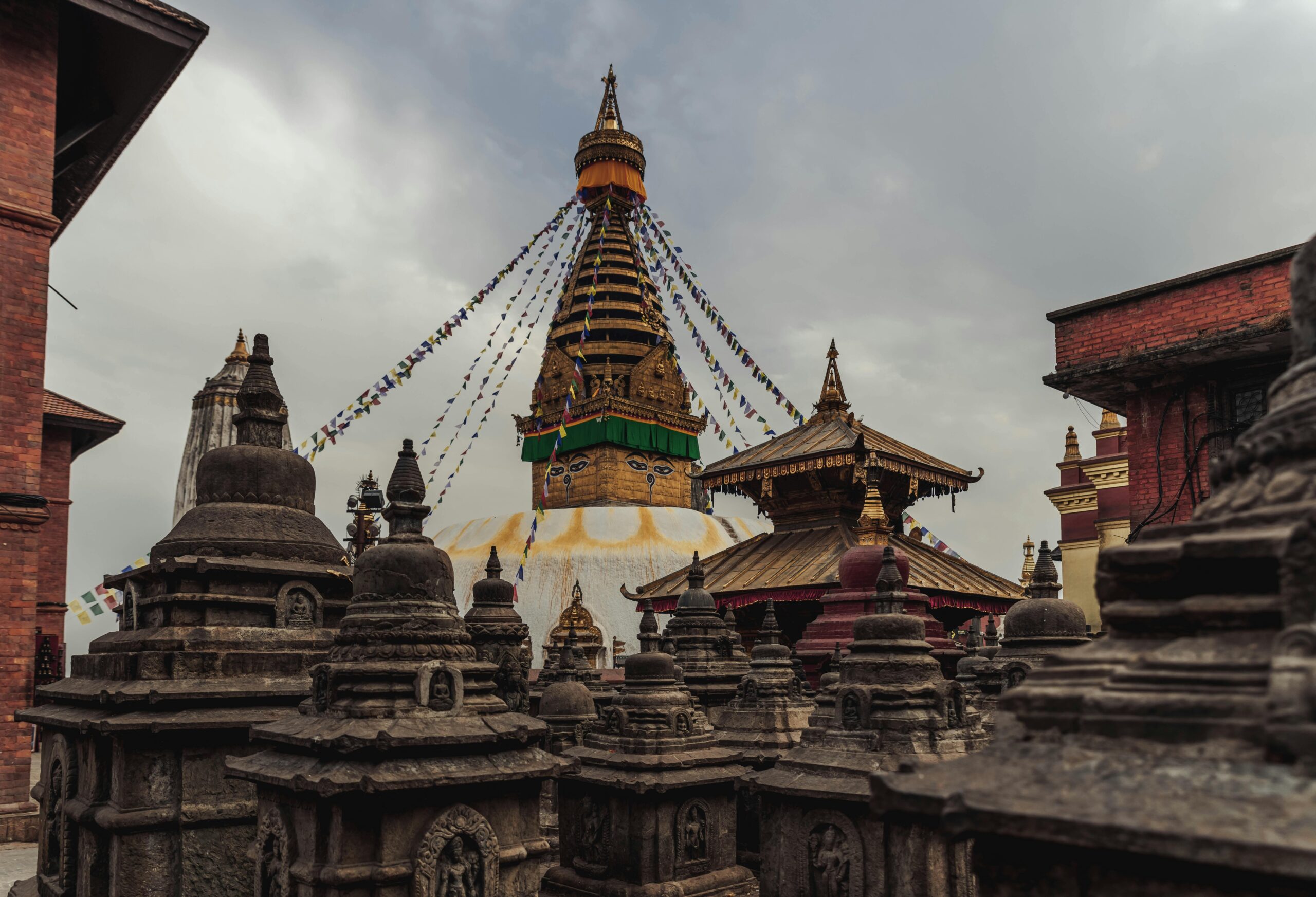
The stupa on the hill above Kathmandu — 365 steps to the summit (the number matching the days of the year, the Newari calendar significance), the rhesus macaques that have colonised the temple complex (the “Monkey Temple” name is accurate — the monkeys are numerous, assertive, and entertaining). The view from the summit: the Kathmandu Valley, the Himalayan peaks visible above the valley rim on clear mornings.
Free access to the hill; entry to the stupa compound: NPR 200 / £1.26.
10am: Bhaktapur — The Preserved City
1 hour from Kathmandu by taxi (NPR 800-1,200 / £5.05-7.57). The medieval Newari city that has maintained its urban fabric more completely than Kathmandu or Patan — the Durbar Square, the Taumadhi Square (the Nyatapola Temple — the 5-storey pagoda that is the tallest traditional building in Nepal), and the pottery square. Entry: NPR 1,500 / £9.46 for foreigners (includes the Bhaktapur museums).
The Bhaktapur curd (the Juju Dhau — the “king curd,” the thick buffalo milk yoghurt set in small clay pots that is the most specific Bhaktapur product): at any curd shop in the Taumadhi Square from morning.
2pm: Return to Kathmandu, Trek Preparation
The trek permit office (TIMS Card + National Park permit) at the Nepal Tourism Board (NTB) office in Pradarshani Marg — allow 45-60 minutes. Bring two passport photos and photocopies of the passport data page.
Practical Notes
The altitude: Kathmandu is at 1,400m — enough for a mild headache on the first day for some visitors. Hydrate, avoid alcohol on the first evening, and the effect typically passes within 24 hours.
The dust: Kathmandu’s air quality is poor (the construction, the traffic, the topography that traps particulates in the valley). A light face covering (the N95 mask, not the surgical mask) reduces the impact for sensitive respiratory systems.
The taxi: Kathmandu taxis should use the meter — insist on the meter or agree the price before entering. The Pathao and InDrive apps work in Kathmandu and give a more transparent pricing experience than negotiating on the street.