

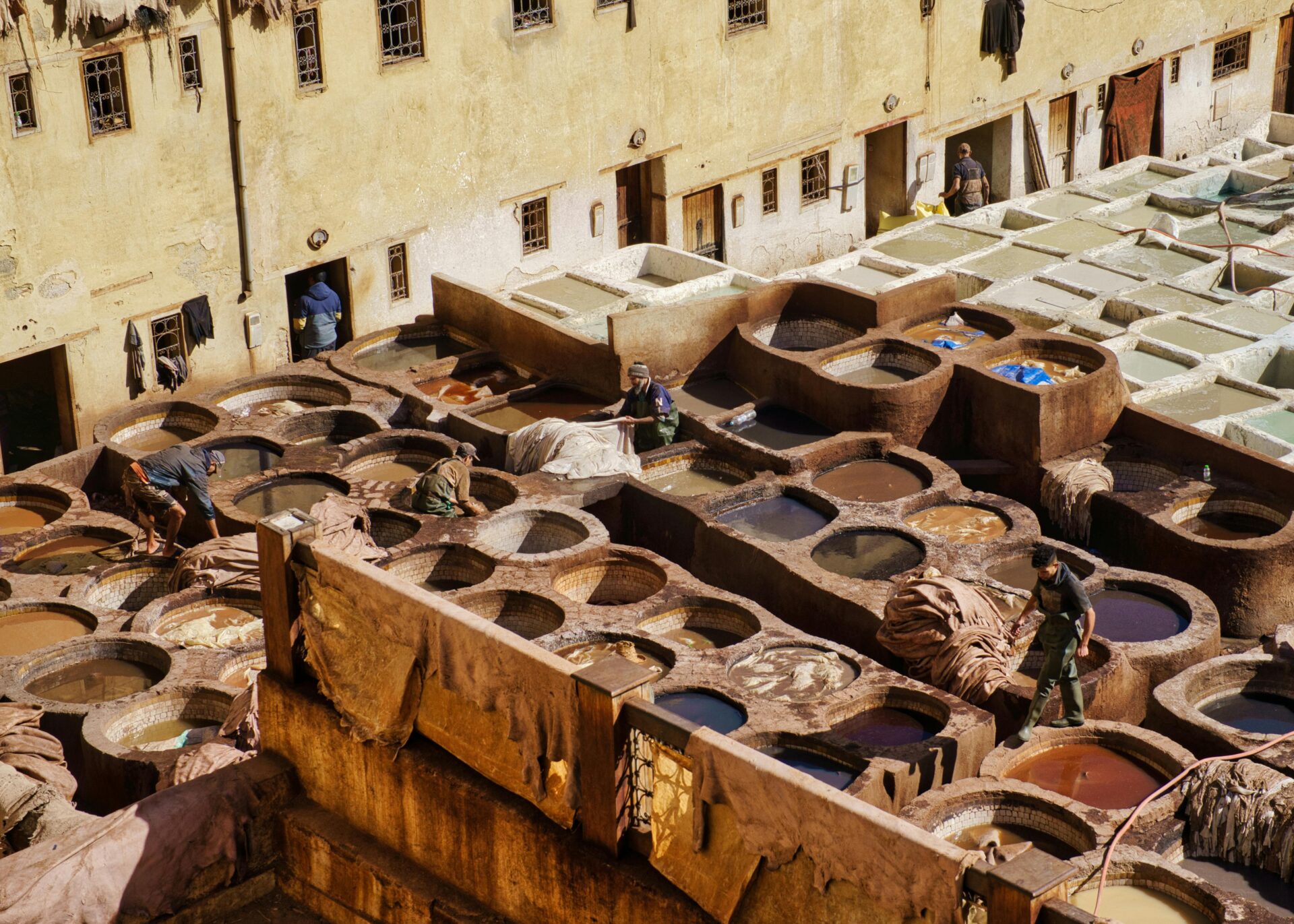
The largest living medieval city in the world. 9,400 streets. 150,000 residents. One of the 41 tanneries visible from above. This is the navigation that works.
The Context
The Fes el-Bali (the Old Fes) is the largest car-free urban area in the world — the medina (the old city, literally “city” in Arabic) of Fez was founded in 789 CE and has been continuously inhabited since. The street network is not a grid but a labyrinth: the medina was designed for maximum privacy (the streets narrow to shoulder-width in the residential sections to discourage strangers from penetrating too far) and minimum navigational logic. First-time visitors, and many return visitors, become lost within 5 minutes.
The getting lost is not entirely the problem — the getting lost and emerging in the wrong souk 45 minutes later than intended, or being guided by the “helpful local” whose specific destination is the carpet shop whose owner pays a commission, is the problem.
This guide gives the navigational framework that keeps the exploration productive.
The Orientation Framework
The three zones:
Zone 1 — The main arteries: Talaa Kebira and Talaa Seghira (the two main streets running from the Bab Bou Jeloud gate down through the medina). These are wide enough to orient from, consistently present, and impossible to mistake. If you’re lost: find a main artery.
Zone 2 — The souks: The commercial districts around the main arteries — the spice souk, the henna souk, the metalwork souk, the textile souk, the leather souk. Each has a specific smell and sound that identifies it: the spice souk through the nose, the metalwork souk through the hammering, the textile souk through the specific density of fabric on display.
Zone 3 — The residential derbs: The private lanes that connect the residential quarters to the main arteries. These are where the medina stops being a market and becomes a place where people live. Navigation in Zone 3 without invitation or purpose is discouraged and will reliably produce confusion.
The Four Things Worth Finding
1. The Chouara Tanneries (from above):
The tanneries are viewable from the leather shop terraces surrounding the tanning pits — the shopkeepers offer free access to the terrace in exchange for the social contract of viewing the leather goods before leaving (the social contract is real; it does not require purchasing). The fresh mint sprigs handed at the entrance should be used — the smell of the dyeing process is significant.
Navigation: From Bab Bou Jeloud, take Talaa Kebira all the way to the Medersa Bou Inania. Turn left at the medersa, follow the smell of the tanning (this instruction is genuine — the specific combination of pigeon excrement (the ammonia source), the vegetable dyes, and the water produces a scent that guides from 200m). The terrace entry: look for the signs saying “Tannerie” or “Vue sur la tannerie.” Enter any leather shop that faces the pits.
Time: The tanneries are most active in the morning (8am-noon). By afternoon the workers have typically completed the day’s dyeing cycle.
2. The Medersa Bou Inania:
The 14th-century Islamic college — the finest example of Marinid architecture in Fes, the zellige tilework (the geometric mosaic tilework, the individual tiles cut and fitted to create the complex geometric patterns that cover the lower walls), the carved stucco (the plaster carved into arabesque patterns covering the middle walls), and the carved cedar (the woodwork of the upper balconies and the roof structure). The courtyard: the central pool reflecting the decoration, the proportion of the courtyard space to the surrounding decoration the finest architectural composition in the Fes medina.
Entry: 70 MAD / £5.60. Worth every dirham.
3. The Nejjarine Fountain and Museum:
The 18th-century Nejjarine Fountain (the carved cedar and tile fountain at the centre of the carpenters’ souk) and the Nejjarine Museum of Wooden Arts and Crafts (the former fondouk converted to a museum — the 3-storey courtyard, the roof terrace with the view over the medina rooftops). Entry: 20 MAD / £1.60 for the museum and the rooftop.
The rooftop: The finest accessible view over the Fes medina that doesn’t require paying for a carpet.
4. The Al-Qarawiyyin Mosque and University:
Founded 859 CE — the oldest continuously operating university in the world (the claim is contested but the institution is genuine, predating Bologna by 200 years). Non-Muslims may not enter, but the entrance gates give a view of the courtyard and the fountain. The exterior of the building (the 14 doorways, the minaret visible above the surrounding buildings) gives the scale of the complex.
The Navigation App
Maps.me (download offline Fes map before entering the medina — the data connection in the dense medina is unreliable) gives turn-by-turn navigation on the Fes street network including the narrow derbs. It is not perfect but it significantly reduces the lost-in-Zone-3 problem.
The useful bookmark: The Bab Bou Jeloud gate (the main entrance to the medina from the new city) and the Moulay Idriss II shrine (the geographical centre of the medina) as two reference points. When lost: navigate to either of these and reorient.
The Official Guide vs the Unofficial
The official guide: Licensed guides available from the Fes tourist office (2 Boulevard Moulay Youssef, outside the Bab Bou Jeloud) at 250-400 MAD / £20-32 for a half-day. The licensed guides wear a specific badge and do not receive commissions from shops (this is the licensing condition). The official guide gives the Quranic school interiors, the private fondouks (the merchant guesthouses), and the residential derbs that cannot be navigated independently.
The unofficial guide: The “student” who offers to show you to the tanneries or the medersa for free. The free tour ends at a specific carpet shop, leather goods shop, or silver shop. The commission the guide receives from the sale is the entire economic model of the interaction. This is not a moral judgment — it is a description of the transaction so you can make an informed decision before engaging.