

The Wahiba Sands where the dunes reach 100 metres and the Bedouin camps have been here for centuries, Wadi Shab where the canyon walk ends at a waterhole that requires swimming through a submerged cave to reach a chamber of turquoise water, the Mutrah Souk of Muscat where the frankincense and the silver and the halwa have been traded for 2,000 years, the Jebel Akhdar rose harvest in April when the mountain villages smell of distilled petals, and why Oman is the most civilised and the most consistently underestimated country in the Gulf.
Reading time: 14 minutes | Last updated: 2026
Oman is the Gulf country that chose a different model. Where its neighbours built skyscrapers and artificial islands and Formula 1 circuits, Oman built museums, restored its traditional architecture, protected its desert and mountain wilderness, and maintained a hospitality culture that is the most genuine in the Arabian Peninsula.
The country is the size of the United Kingdom with a population of 4.5 million — the vast majority of the land is uninhabited desert, mountain, and wadi (dry riverbed) landscape. The specifics: the Rub’ al Khali (the Empty Quarter) in the south and west, the Hajar Mountains running northeast with peaks to 3,000m, the Dhofar region in the south where the Indian Ocean monsoon (the khareef) transforms the landscape from June to September into the green version of Arabia that appears nowhere else in the Gulf.
The traveller arriving in Oman expecting Gulf modernity finds instead: a country that has been continuously civilised for 5,000 years, that maintains an architecture (the mudbrick falaj irrigation systems, the aflaj water channels, the tower houses of the interior villages) that belongs to the pre-oil era and that the oil wealth has been used to restore rather than replace, and a people whose warmth is specifically the warmth of a culture that has been welcoming travellers from the Indian Ocean trade network for millennia.
Quick Navigation
- When to Go — The Khareef and the Mountain Spring
- Getting There
- Muscat — The Capital
- The Mutrah Souk
- Nizwa and the Interior Forts
- The Jebel Akhdar — The Green Mountain
- The Wahiba Sands
- Wadi Shab — The Canyon Walk
- Wadi Bani Khalid
- Sur and the Dhow Building
- Salalah and the Dhofar
- The Musandam Peninsula
- Omani Food — Shuwa, Halwa, and the Coffee Ritual
- What It Costs
- Practical Notes
- The 7-Day Itinerary
When to Go — The Khareef and the Mountain Spring
October to April — The Primary Window
The main Oman season: temperatures comfortable throughout the country (Muscat 25-32°C, the interior 20-28°C, the mountains 15-22°C). The desert is accessible, the wadis clear, the mountain roads open.
The specific best months:
March-April: the Jebel Akhdar rose harvest — the Damask roses in full flower in the mountain villages, the distilleries producing the rosewater that is the most specifically Omani product. The jabal in spring green after the winter rains.
October-November: the post-summer arrival — the country cooling after the extreme summer heat (May-September in Muscat reaches 42-46°C), the first rains greening the landscape.
June to September — The Khareef (Salalah only):
The monsoon that reaches only Dhofar — the Arabian Felix of the ancients, the land of frankincense — transforms Salalah and the surrounding mountains from June to September. The coconut palms in the mist, the waterfalls, the livestock grazing on the green plateau. The khareef is the reason Salalah fills with Gulf tourists during the summer months when the rest of Arabia is uninhabitable outdoors.
May to September (everywhere except Salalah): Avoid. Muscat in August is 43°C average with 80% humidity. The interior wadis are impassable. The Wahiba Sands in July are a heat emergency.
The BGGD recommendation: March for the roses and the clear desert. October for the post-summer green and the manageable temperatures. Both give the full Oman.
Getting There
Muscat International Airport (MCT):
Oman Air direct from London Heathrow (7.5 hours). British Airways direct from Heathrow. Emirates via Dubai (9 hours total), Qatar Airways via Doha (9 hours). Return flights from UK: £320-550.
Oman is 7.5 hours from London — the closest major Arabian Peninsula destination that isn’t the UAE. The direct Oman Air route is frequently the same price as the connecting alternatives while saving 1.5 hours.
Getting around:
Car hire is essential for the full Oman circuit — the distances between the key destinations (Muscat to Nizwa: 140km; Nizwa to the Wahiba Sands: 160km; Wahiba to Sur: 120km) require a vehicle. A 4WD is recommended but not always mandatory — the main desert camps in the Wahiba are accessible in 2WD on marked tracks, and most of the Jebel Akhdar road to Al Hamra is now tarmac.
Car hire from Muscat Airport: OMR 15-25 / £29.42-49.03/day for a compact 4WD (the most common rental in Oman). Agencies: Avis, Budget, Thrifty all operate at the airport.
Muscat — The Capital
Muscat is not the city of skyscrapers that the Gulf tourism press prepares travellers for — it is a low-rise, spread-out, architecturally coherent city where the building height regulations (no building taller than the minaret of the nearest mosque) and the design codes (all new buildings must use traditional Omani architectural elements — the crenellations, the arched windows, the whitewashed walls) have produced the most visually consistent Gulf capital.
The Sultan Qaboos Grand Mosque:
The largest mosque in Oman — the main prayer hall accommodating 20,000 worshippers, the chandelier (the second-largest chandelier in the world, 14 tonnes of Swarovski crystal), and the hand-knotted carpet (the largest single carpet in the world, 70m × 60m, woven by 600 Khorasani master craftspeople over 4 years). Non-Muslims may visit outside prayer times: 8am-11am Saturday-Thursday. Entry: free. Modest dress required (the mosque provides abayas and scarves).
The Royal Opera House Muscat:
The finest opera house in the Middle East — the traditional Omani exterior (the arched galleries, the carved stucco, the teak woodwork) surrounding a 1,100-seat auditorium of international standard. Opened 2011, the programming covers opera (La Scala has performed here), classical concerts, jazz, and Arabic music. Check the schedule at rohmuscat.org.om — performances in the October-May season.
The National Museum of Oman:
Opened 2016 — the definitive collection on Omani history and culture, the archaeology (the Bronze Age Magan civilisation, the frankincense trade), the maritime tradition (Oman’s seafaring heritage — the dhows of Sur, the Indian Ocean trade routes), and the collection of arms and armour from the Omani military tradition. Entry: OMR 5 / £9.81. The finest new museum in the Gulf.
The Mutrah Souk
The Mutrah district — the old port quarter of Muscat, the Mutrah corniche running along the harbour, and the Mutrah Souk (the covered market, one of the oldest in the Gulf) behind the harbour waterfront.
The souk: the frankincense (the Boswellia sacra resin from the Dhofar region — the specific Omani frankincense, considered the finest in the world, available in four grades from the market stalls, the price rising from OMR 0.5 / £0.98 for the common grade to OMR 8-15 / £15.69-29.42 for the premium dark Hougari grade), the silver Omani jewellery (the traditional Omani bedlace — the silver bead necklaces, the khanjar daggers), and the halwa (the Omani sweet — the gelatinous confection of sugar, rose water, cardamom, saffron, and ghee, sold by weight from the halwa shops, the correct welcome gift from an Omani household).
The Mutrah at 7am:
The souk from 7am (the market open from 7am-1pm and from 4pm-10pm): the merchants opening their stalls, the coffee vendors pouring the cardamom-scented qahwa (the Omani coffee), the frankincense smoke from the thuribles at the souk entrance. The 7am version is the working Mutrah — the souk serving its own neighbourhood before the cruise ship passengers arrive at 9am.
Nizwa and the Interior Forts
Nizwa is the cultural capital of the Oman interior — the city that was the seat of the Ibadhi Imamate (the specifically Omani Islamic tradition, distinct from both Sunni and Shia Islam, the Ibadhi scholarship that produced the Nizwa academic tradition) and that contains the most significant concentration of forts in the country.
The Nizwa Fort:
The round tower fort — the massive cylindrical tower (40m in diameter, the interior containing the labyrinthine system of tunnels and chambers designed to confuse attackers who breached the outer defences), the roof of the tower giving the finest view over the Nizwa date palm oasis and the Hajar Mountains behind. Entry: OMR 5 / £9.81. Open from 8am.
The Friday Market:
The Nizwa livestock market operates every Friday from 7am — the cattle, the goats, and the camels auctioned in the market adjacent to the souk, the Omani men in their dishdasha (the white ankle-length robe) conducting the bidding in the specific Nizwa auction tradition (the livestock held by a rope around the neck while the bidders call from the circle). The specific experience: an agricultural market unchanged in essential character from the Ibadhi trading markets of the 18th century, operating in the present.
The Bahla Fort:
UNESCO-listed, 40km west of Nizwa — the largest mudbrick fort in the world, the walls extending 12km around the oasis town of Bahla. The fort is under ongoing restoration; the sections accessible give the most atmospheric mud-brick fortress experience in Oman.
The Jebel Akhdar — The Green Mountain
The Jebel Akhdar (the Green Mountain) — the plateau section of the Western Hajar range at 2,000-2,500m altitude, the specific microclimate of the plateau producing the fruit and rose cultivation that has made it the most famous agricultural landscape in Oman. The pomegranates (the Jebel Akhdar pomegranate, a specific variety with a sweeter flavour than the lowland equivalent), the peaches, the walnuts, the figs, and the Damask roses (the April rose harvest — the specific 3-week window when the roses are at full flower and the distilleries are producing the rosewater).
Access:
The Jebel Akhdar road from Nizwa to the Al Ayn plateau is tarmac and accessible in any car. 4WD is required for the villages beyond the main road (the Wadi Bani Habib route, the Sharaijah village access). The military checkpoint at the bottom of the jebel road requires registration (passport details, destination, duration) — a formality that takes 5 minutes.
The Hanging Village of Karak:
The village of Al Karak on the canyon edge of the Jebel Akhdar — the houses built on the edge of a 500m vertical drop, the date palms and the rose terraces visible below the village on the canyon walls. The walk from the main Jebel Akhdar road to Karak (30 minutes) gives the canyon views that are the specific Jebel Akhdar highlight.
The Alila Jabal Akhdar Resort:
Perched on the canyon edge, the Alila is the finest resort in Oman and one of the finest in the Middle East — the infinity pool above the canyon, the breakfast with the cliff edge visible, the specific quality of a resort positioned for the landscape rather than for the beach. Peak prices: OMR 120-200 / £235-392 per night. Worth it as a one-night splurge for the canyon experience.
The Wahiba Sands
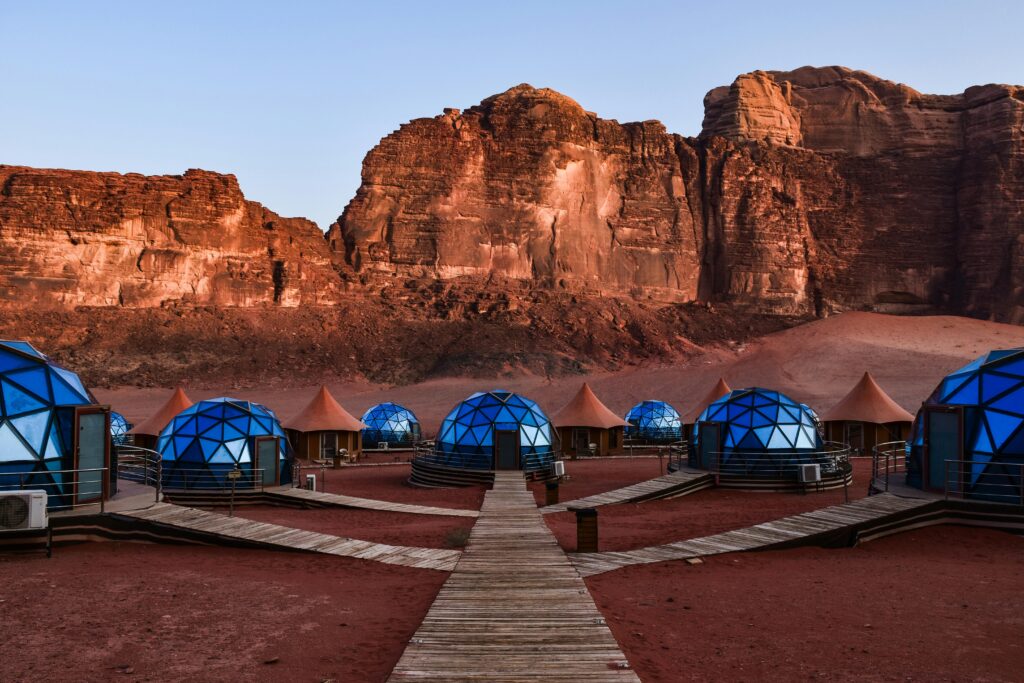
The Wahiba Sands (the Sharqiyah Sands) — the sand sea east of Nizwa, the dunes reaching 100m in the central section, the specific red and gold colour of the Wahiba sand (the iron content of the Wahiba sand higher than the pale desert of the Empty Quarter, the colour more saturated). The Wahiba at sunset: the dunes turning deep copper, the shadows in the slipfaces blue.
The overnight camp:
The Wahiba overnight camp is the correct format — arriving at 4pm for the sandboarding and the sunset dune walk, the dinner under the stars (the Omani shuwa if the camp prepares it — the slow-cooked lamb buried in an earth oven, the most specific Omani culinary experience), and the dawn from the dune summit.
The Bedouin context:
The Wahiba has been inhabited by the Bani Wahiba tribe for centuries — the specific Bedouin culture of the Wahiba (the weaving tradition, the camel husbandry, the orientation in the desert by the dune shape and the star positions) is present in the better-managed camps that employ local Bedouin guides rather than imported staff. Ask before booking whether the camp employs Wahiba Bedouin.
Camp recommendations:
1000 Nights Camp (the most established quality camp in the Wahiba, the tented accommodation with the full desert experience, OMR 40-70 / £78.43-137.25 per person including dinner and breakfast), Desert Nights Camp (the slightly more luxury version, OMR 65-90 / £127.45-176.47 per person).
Access: 4WD required for the final section to the camps — most camp vehicles meet guests at the Bidiyya junction (the last tarmac point). If hiring a 4WD independently, the sand tracks to the camps are marked but require basic off-road awareness.
Wadi Shab — The Canyon Walk
The most celebrated single-day experience in Oman — the canyon walk through Wadi Shab (the Wadi of the Trees) ending at the turquoise waterhole accessible only by swimming through a submerged cave.
The walk:
From the Wadi Shab car park (2 hours south of Muscat on the coastal highway), a boat crosses the wadi entrance (OMR 0.5 / £0.98 each way, the boatman waiting). The walk: 2.5km through the canyon floor (the path beside the water, the palms and the oleander above, the canyon walls 200m high), two sections requiring wading knee-deep through the pools.
The cave:
At the end of the walkable section, a submerged passage (the entry in the canyon wall is visible from the water surface) leads through darkness for approximately 8 metres into a domed chamber lit by a natural skylight above — the water in the chamber a specific intense turquoise from the refracted light through the skylight. The chamber: approximately 10m across, the sound of the waterfall falling through the skylight from above.
The honest instruction:
The cave passage requires comfort in the water (holding breath for 5-8 seconds while pushing through the submerged section) and reasonable swimming ability. The water is cold (spring-fed, approximately 20°C). Non-swimmers can enjoy the canyon walk to the cave entrance without entering — the walk itself is worthwhile without the chamber.
What to bring: Swimming clothes under hiking clothes (changing facilities are non-existent), a dry bag for phone and wallet (available to buy in Muscat for OMR 2-5 / £3.92-9.81), water (2L minimum), sandals that can get wet. Free entry to the wadi.
Wadi Bani Khalid
The most accessible swimming wadi in Oman — 240km from Muscat, the permanent blue-green pools in the canyon accessible by the paved road that runs 12km into the wadi from the coastal highway.
The specific advantage over Wadi Shab: no swimming through dark passages required. The pools are simply there — the clear water in the canyon, the fish visible in the shallows, the canyon walls reflecting in the surface. The deeper pools require swimming to cross; the shallower sections allow wading. Entry: free.
The village of Muqal in the upper wadi has the finest swimming pools in the canyon and a restaurant (the basic Omani menu — the rice and the meat and the Omani bread) for lunch.
Sur and the Dhow Building
Sur is the dhow-building capital of Oman — the coastal city where the traditional Omani wooden vessels (the baghla, the sambuk, the boom) have been built by hand since at least the 16th century. The Sur Dhow Factory (the main dhow workshop, visible from the corniche, the construction conducted in the open yard) gives the most direct access to the living tradition of Arabian wooden shipbuilding.
The turtles: Ras al-Jinz, 30km south of Sur, is the nesting site for the green turtle (Chelonia mydas) — one of the largest turtle nesting sites in the Indian Ocean, accessible only through the Ras al-Jinz Turtle Reserve (entry: OMR 7 / £13.73, the organised tours leaving from the reserve visitor centre at dawn and at dusk to minimise disturbance to the nesting females). Dawn viewing (4:30am departure): the females returning to the sea after the night’s laying.
Salalah and the Dhofar
Salalah is 1,000km south of Muscat — a separate destination requiring either a domestic flight (Oman Air from Muscat, 1 hour, OMR 25-45 / £49.03-88.25 one way) or a 12-hour drive through the Empty Quarter.
The Dhofar region: the frankincense country. The Boswellia sacra trees (the Arabian frankincense tree, found only in the Dhofar mountains and in small areas of northern Somalia and Yemen) grow in the limestone hillsides above Salalah, the specific resin produced when the tree bark is cut and left to harden.
Wadi Darbat:
The most dramatic landscape near Salalah during the khareef — the waterfall visible from the road (the wadi in full flow from the monsoon rain, the falls 100m into the canyon below). Outside the khareef (the October-May dry season): the wadi is dry, the pools permanent but smaller. June-September: the falls at maximum.
The ancient city of Sumhuram (Khor Rori):
The UNESCO-listed ancient port of the frankincense trade — the Hadhrami city built in the 4th century BCE on the creek above the sea, the ruins giving the clearest picture available of the pre-Islamic Arabian Peninsula trading civilisation. Entry: OMR 3 / £5.88.
Omani Food — Shuwa, Halwa, and the Coffee Ritual
Shuwa:
The national celebration dish — the whole lamb or goat rubbed with a paste of dried chillies, coriander, cumin, cardamom, and turmeric, wrapped in banana leaves, sealed in the burlap sacks, and buried in the sand pit (the tandoor underground oven) for 24-48 hours. The shuwa is the Eid feast dish — prepared the day before the celebration, the meat falling from the bone after the long slow cook, the paste deeply penetrated into the flesh.
Shuwa is not available at most restaurants (the preparation time makes it impractical for daily service) — the correct occasion is an Omani household invitation or a Wahiba Sands camp with 24 hours advance booking.
The Qahwa ritual:
The Omani coffee ceremony — the qahwa (the cardamom and saffron-flavoured coffee served in the handleless finjan cups, refilled continuously until the guest shakes the cup side to side to indicate sufficiency) is the gesture of Omani hospitality. The coffee is served first, the halwa follows.
The halwa:
The Omani sweet — gelatinous, intensely flavoured with rose water and saffron, the texture somewhere between Turkish delight and set toffee, the colour a deep amber. Consumed by the spoonful with the qahwa. The finest halwa comes from Nizwa (the inland variety, drier and more intensely spiced) and from the Dhofar (the coastal variety, softer and more rosewater-forward).
The daily food:
Omani restaurant cooking: the tharid (the bread and lamb stew, the bread broken into the broth to absorb the cooking liquid), the arsiya (the slow-cooked chicken and rice, the rice broken down to a thick porridge, the chicken pulled from the bone into it), and the fish preparations of the coast (the samak mashwi — the grilled kingfish, the tuna, the hammour — at the simple fish restaurants of the Sur and Muscat coast).
What It Costs
Oman is mid-range by Gulf standards — cheaper than the UAE, roughly equivalent to Saudi Arabia for accommodation, slightly more expensive than Jordan.
| Category | Daily Budget | Daily Mid-Range |
|---|---|---|
| Accommodation | OMR 15-25 / £29-49 (guesthouse) | OMR 35-65 / £69-127 (hotel) |
| Food | OMR 5-9 / £9.81-17.65 | OMR 10-18 / £19.61-35.29 |
| Car hire | OMR 15-20 / £29.42-39.22 | OMR 20-30 / £39.22-58.82 |
| Daily total | OMR 35-54 / £69-106 | OMR 65-113 / £127-222 |
The 7-day Oman budget:
| Item | Budget | Mid-Range |
|---|---|---|
| Return flights (Oman Air direct) | £320-450 | £400-550 |
| 7 nights accommodation | £200-340 | £480-890 |
| Food (7 days) | £70-125 | £140-250 |
| Car hire (7 days) | £205-275 | £275-410 |
| Wahiba Sands camp (1 night) | £78 | £130 |
| Total | £873-1,268 | £1,425-2,230 |
Practical Notes
Visa: UK citizens require a visa for Oman — apply online at evisa.rop.gov.om ($20 / £15.76 for a 30-day single entry). The e-visa is issued within 24-48 hours; apply before departure.
Currency: Omani Rial (OMR). £1 ≈ 0.51 OMR. The rial is pegged to the US dollar — one of the highest-value currencies in the world (1 OMR ≈ £1.96 / $2.60). ATMs throughout Muscat; limited in the interior and the desert.
Driving: Right-hand traffic. The main roads (the Sultan Qaboos Highway from Muscat along the coast, the road to Nizwa and the interior) are excellent. The GPS coverage: Google Maps works throughout Oman; the Off-Road Oman app (available on iOS and Android) gives the best coverage for wadi tracks.
Alcohol: Oman permits alcohol for non-Muslim visitors at licensed hotel bars and restaurants. No alcohol sold in supermarkets or independent restaurants. Budget accordingly for evenings.
Safety: Oman is among the safest countries in the Middle East for UK visitors — the FCO advises no specific precautions beyond normal travel awareness. The Musandam Peninsula (the Omani exclave surrounded by UAE territory) requires separate consideration for the UAE border crossing.
Dress: More conservative than the UAE in public spaces. Shoulders and knees covered outside the hotel. Swimwear appropriate at beach areas and hotel pools.
The 7-Day Itinerary
Day 1: Arrive Muscat
Afternoon: Mutrah Souk before 6pm (closes for the afternoon prayer period). The Sultan Qaboos Grand Mosque visit (8am-11am, Wednesday to Monday — check the Friday closure schedule). Evening: Muscat corniche walk, fish market.
Day 2: Muscat to Nizwa
2.5 hours by car on the Muscat-Nizwa highway. Arrive for the Nizwa Fort (9am opening). The Friday market if it’s Friday (depart Muscat by 6am to arrive by 8am). Afternoon: the Bahla Fort (40km west). Night in Nizwa.
Day 3: Jebel Akhdar
Morning: drive to the Jebel Akhdar (45 minutes from Nizwa). The Karak village canyon walk. The rose distillery visit (April only) or the pomegranate orchards (September-October). The Alila Jabal Akhdar for lunch or afternoon tea on the canyon terrace (non-guests welcome at the restaurant — OMR 12-18 / £23.53-35.29). Return to Nizwa.
Day 4: Wahiba Sands
2.5 hours from Nizwa to the Wahiba (via the Al Mintrib road). The camp vehicle meets at Bidiyya. The afternoon dune walk and sandboarding. The sunset from the dune summit. The zarb-cooked dinner. The night sky. The dawn.
Day 5: Wadi Shab
2.5 hours from the Wahiba to Wadi Shab. The canyon walk (3-4 hours round trip including the cave chamber). Picnic lunch at the poolside. Continue to Sur (1 hour south of Wadi Shab).
Day 6: Sur and Ras al-Jinz
Morning: the Sur dhow yard. The Al Ayjah village (the fishing village on the opposite side of the creek from Sur, the traditional Omani fishing boats visible from the bridge). Afternoon: Ras al-Jinz Turtle Reserve — the dusk turtle viewing tour (OMR 7 / £13.73, depart the reserve visitor centre at 6:30pm). Night: the reserve guesthouse (OMR 50-70 / £98.04-137.25 per person including dinner and breakfast) or return to Sur.
Day 7: Return to Muscat
The coastal highway from Sur to Muscat (200km, 3 hours). The stop at Wadi Bani Khalid (120km from Sur, the swimming pools at the canyon — 1-2 hours). Arrive Muscat by 2pm. Departure.
Final Thought
I was at the Wadi Shab cave at 11:30am. The swim through the submerged passage took 6 seconds — the cold of the spring water, the complete darkness, then the light of the chamber from above.
The chamber: perhaps 10m across, the water the specific Wadi Shab turquoise, the skylight above giving a beam of light that hit the water at an angle that made the colour more intense at the entry point than at the chamber wall. The waterfall from the skylight: the sound before the sight, the mist reaching the water surface.
There were three other people in the chamber.
The walk back through the canyon: the oleander still flowering in the October heat, the canyon walls 200m above on both sides, the water cold enough to feel in the afternoon air.
Oman does not perform for visitors. It exists — the forts, the frankincense, the wadis, the Bedouin camps — in the specific way that a country exists when it has had 5,000 years of practice at being itself.
The cave was worth the swim.