


Lima has the finest food scene in South America and one of the ten finest in the world. The ceviche at the market, the anticuchos from the street cart, the 45-course tasting menu at Central if you have the reservation — this is the circuit.
The Market Ceviche
Covered briefly in the Lima 48-hour guide. The full picture:
Ceviche is Peru’s most significant culinary contribution to the world — the raw fish (typically corvina, lenguado, or cojinova) cured in leche de tigre (the “tiger’s milk,” the marinade of lime juice, fish broth, chilli, onion, coriander, and the fish’s own juices, the acid “cooking” the protein without heat), served immediately with choclo (the giant-kernel Peruvian corn), camote (sweet potato), and cancha (the toasted corn kernels).
The freshness requirement: Ceviche must be made immediately before serving. The fish cannot sit in the leche de tigre for more than 3-5 minutes or the texture becomes rubbery. The leche de tigre is mixed in the serving bowl, not prepared in advance. Any ceviche that has been made more than 10 minutes before serving is not correct ceviche.
The market version:
Mercado de Surquillo (Benavides Avenue, Surquillo): the wholesale market adjacent to Miraflores. The cevichería counters at the market perimeter purchase the morning’s catch directly from the fish section inside. The ceviche here: S/15-25 / £3.03-5.06, made in front of the customer with the fish that arrived this morning.
The restaurant version:
La Mar Cevichería (Avenida La Mar 770, Miraflores): Gastón Acurio’s cevichería, the menu extending through the full taxonomy of Peruvian ceviche — the clásico (the white fish in leche de tigre), the mixed (the shellfish addition), the nikkei (the Japanese-Peruvian fusion ceviche with soy and ginger), and the tiradito (the thin-sliced fish in leche de tigre without the onion — the raw fish dish that shows the Japanese sashimi influence on Peruvian cuisine).
Book 2-3 weeks ahead for the weekend lunch service. S/60-90 / £12.14-18.21 per person.
The Anticucho Cart
The cart that appears at the corner of Huiracocha and Emilio Fernández in Surquillo from 6pm — Grimanesa Vargas’s anticucho operation, the most celebrated street food cart in Lima and the basis for the successful restaurant she subsequently opened.
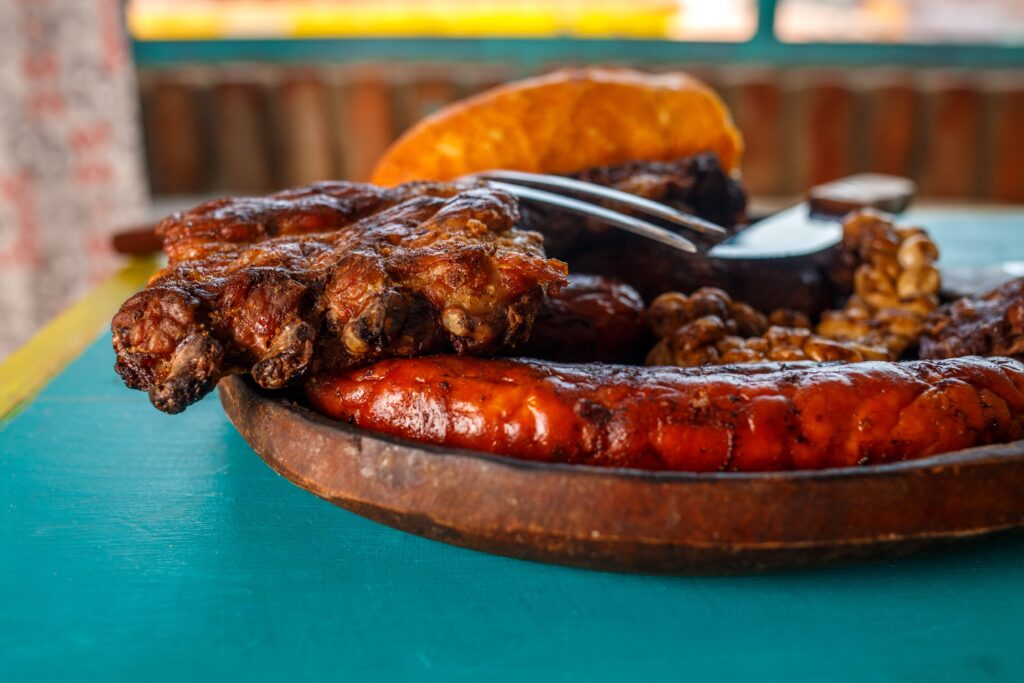
The anticucho: the beef heart skewer, marinated in a paste of ají panca (the dark dried Peruvian chilli) and cumin, grilled over charcoal until charred on the outside and still tender inside. Served with the corn cake (el choclo) and the potato (the small Andean potato varieties, boiled and served with the yellow chilli cream sauce — ají amarillo).
The specific flavour: the beef heart has a texture denser and a flavour more intensely mineral than the typical beef cut. The ají panca marinade gives the characteristic dark red colour and the specific dried chilli sweetness. The charcoal gives the char that makes the anticucho a cart food rather than a kitchen food.
Where: Grimanesa Vargas (Huiracocha 108, Surquillo) — the cart from 6pm (arrive by 6pm or join the queue). S/5-8 / £1.01-1.62 per skewer.
The Causa
The cold potato terrine — the Peruvian yellow potato (the papa amarilla, the most flavourful of the hundreds of potato varieties cultivated in Peru) mashed with ají amarillo paste, lime, and oil, then layered with a filling (typically tuna with avocado, or chicken with mayonnaise) and topped with another potato layer. Served cold.
The specific Peruvian culinary logic: the papa amarilla with the ají amarillo (both yellow, both Peruvian, the colour connection intentional in the Peruvian culinary aesthetic) gives the causa its characteristic warmth-without-heat.
Where: At the Miraflores market food stalls, at any traditional Peruvian restaurant. The causa at Isolina (Av. San Martín 101, Barranco) — the Lima chef José del Castillo’s tavern, the traditional Peruvian cooking at its most precise.
The Tasting Menu
Central (Avenida Pedro de Osma 301, Barranco):
The most celebrated restaurant in South America — the Virgilio Martínez tasting menu that explores Peru’s biodiversity across elevation from the Amazon basin (below sea level) to the Andes (above 4,000m). Each course represents a specific altitude and the specific ingredients that grow only at that altitude.
The menu: 17 courses, approximately S/595 / £120.36 per person (wine pairing additional). Book 2-3 months ahead at exploretock.com.
The specific course that earns the restaurant its reputation: the high jungle preparation (the palm heart, the cocona, the paiche — the giant Amazonian fish), a single plate that compresses a specific Peruvian ecosystem into three components.
The alternative: If Central is unavailable or beyond the budget, Maido (Nikkei — Japanese-Peruvian, similarly acclaimed, S/400-500 / £80.97-101.21) or Isolina (the traditional Limeño home cooking elevated, S/80-120 / £16.19-24.29 per person) both give Lima’s culinary intelligence at different price points.