
The qvevri wine that Georgia invented 8,000 years ago and that the rest of the world is only now catching up with, the Gergeti Trinity Church at 2,170m above the Kazbegi valley that appears in the pre-dawn mist like a civilisation making an argument to God, the sulphur baths of Tbilisi that have been running since the 5th century and cost £2.66 for an hour, the supra feast table where the tamada leads the toasts and the guests eat until the concept of fullness is renegotiated, and why Georgia is the most underestimated country in Europe — not quite Europe, not quite the Middle East, entirely itself.
Reading time: 14 minutes | Last updated: 2026
Georgia sits at the intersection of the Caucasus Mountains, the Black Sea, the civilisational boundaries of Europe and Asia, and 3,000 years of continuous cultural production. The country of 3.7 million people has produced: the oldest winemaking tradition in the world (the qvevri clay-vessel method, recognised by UNESCO in 2013), a unique alphabet (the Georgian script, one of the world’s most beautiful writing systems, developed in the 5th century CE and unchanged since), the highest-altitude permanently inhabited village in Europe (Ushguli in Svaneti, 2,200m), and a specific hospitality culture that is not performative but genuinely structural — the Georgian supra (the feast table) is a social institution, not a tourist product.
It is also, for UK travellers, one of the cheapest high-quality destinations available. Wizz Air flies direct from London Gatwick for £100-220 return. The Georgian Lari gives £1 approximately 3.76 GEL in purchasing power. A dinner with wine costs £8-14. A sulphur bath costs £2.66 for a private room with an hour in the hot mineral water. The wine at a Tbilisi wine bar costs £4-8 per glass for wine that would cost £18-25 per glass in London if it were available at all.
Quick Navigation
- When to Go
- Getting There
- Tbilisi — The Capital
- The Sulphur Baths
- The Wine — Qvevri and the Natural Wine Revolution
- Mtskheta — The Ancient Capital
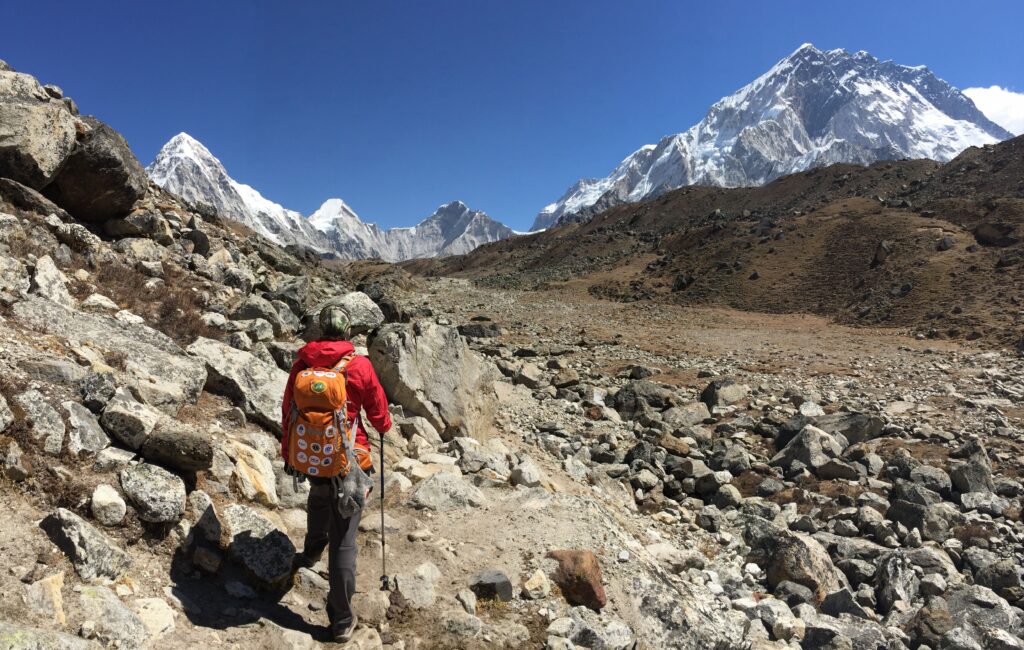
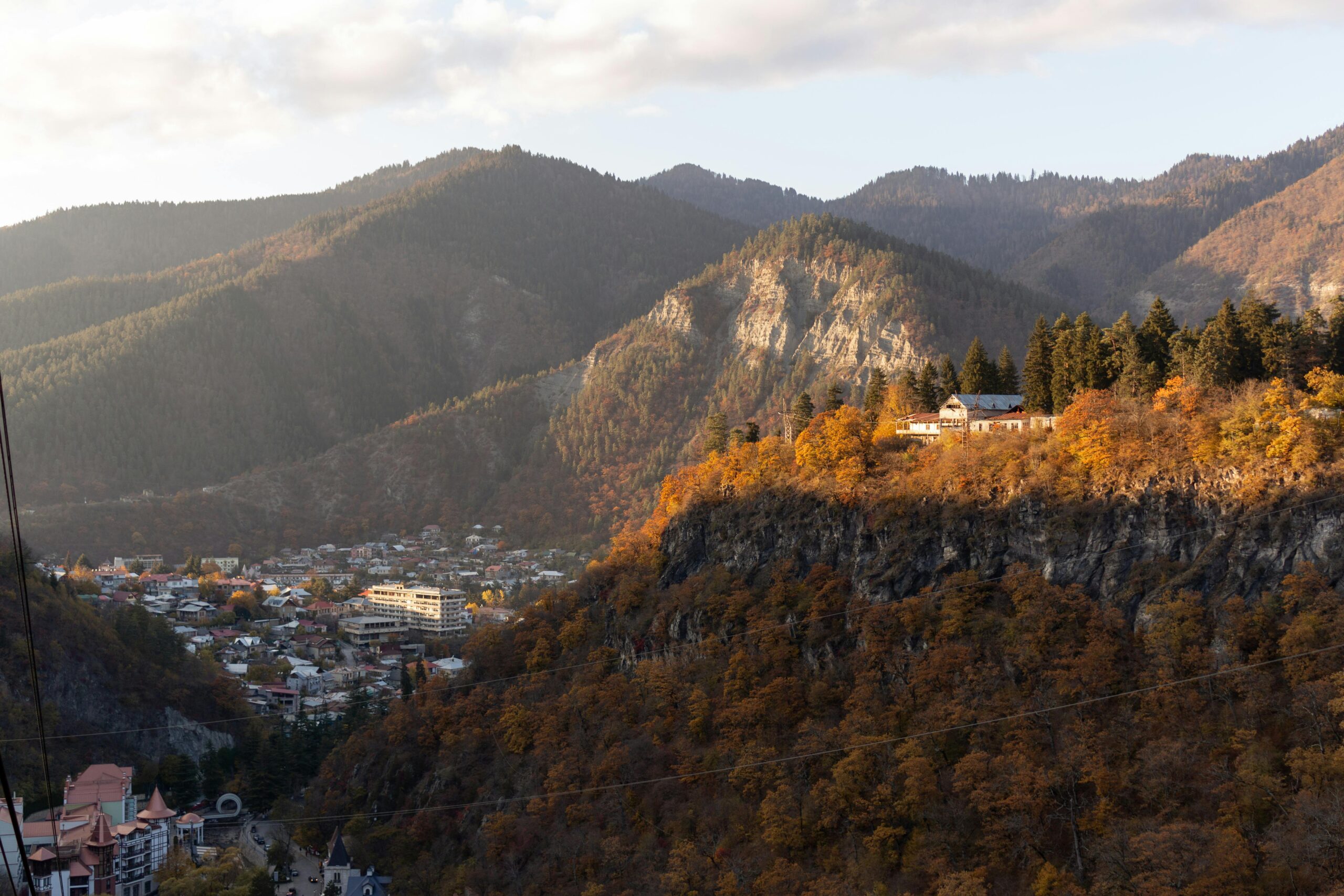
- Kazbegi and the Caucasus Mountains
- Svaneti — The Tower Villages
- Batumi — The Black Sea
- The Wine Regions — Kakheti
- Georgian Food — The Supra Table
- What It Costs
- Practical Notes
- The 10-Day Itinerary
When to Go
April to June and September to October — The Primary Windows
Spring: the Tbilisi gardens in flower, the Kakheti vineyards green before the summer heat, the Kazbegi trails accessible from late April. The specific quality of Georgian spring: the wild plum blossom visible on every hillside in March-April before the leaves appear.
Autumn: the grape harvest (the rtveli — the traditional grape harvest, one of the most significant events in the Georgian cultural calendar, celebrated in Kakheti in late September-October), the Svaneti passes still open, the Tbilisi light in October.
July and August:
Hot in Tbilisi (35-40°C), comfortable in the mountains (Kazbegi 20-28°C, Svaneti 18-25°C). The Black Sea coast (Batumi) at its most active. The mountain regions are the correct July-August destination.
November to March:
Tbilisi in winter: cold (2-8°C), occasionally snowy, the city quiet. The Gudauri ski resort (120km from Tbilisi) operates December-March. Svaneti snowbound from November to April.
The BGGD recommendation: Late September — the rtveli harvest, the Kakheti vine colour, the Tbilisi autumn. Book the Kakheti wine estate stays 4-6 weeks ahead for the harvest period.
Getting There
Tbilisi International Airport (TBS):
Wizz Air from London Gatwick direct (4.5 hours, return £100-220). Turkish Airlines via Istanbul (6.5 hours total). Georgian Airways from various European hubs. The Wizz Air direct is the most efficient and typically the cheapest.
Tbilisi — The Capital
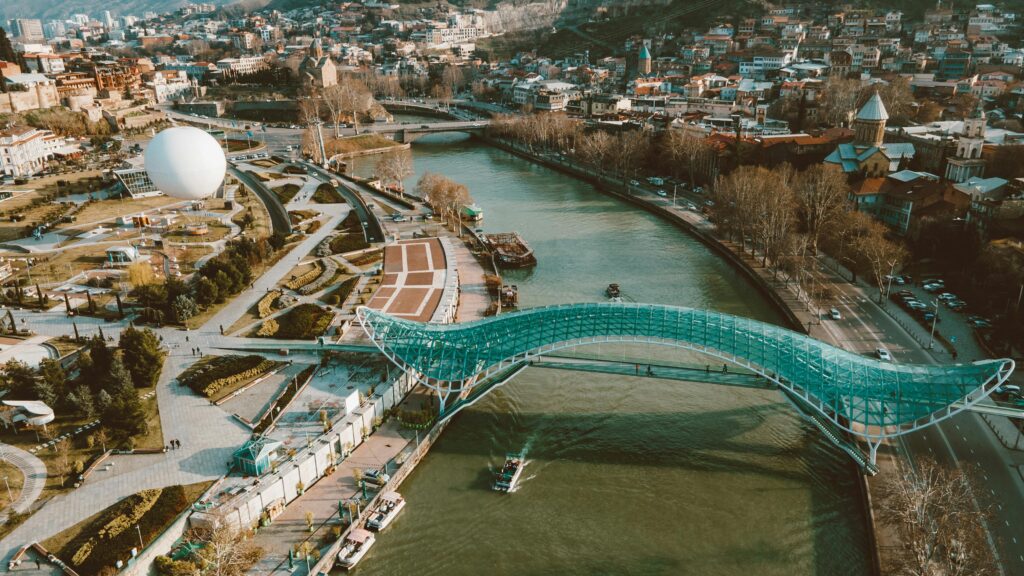
Tbilisi is covered in full in the Tbilisi in 48 Hours city guide. The country context:
The Narikala Fortress at dawn (the 4th-century fortification above the old city, the Mtkvari River below, the Caucasus visible to the north on clear mornings). The Abanotubani sulphur bath district — the domed brick bathhouses above the natural hot sulphur springs. The Shardeni Street wine bars (the orange wine programme, the natural qvevri whites). The Dry Bridge flea market on Sunday (the Soviet-era cameras and medals, the Georgian silver, the 30-year accumulation of a post-Soviet country selling its objects). Metelkova — no, that’s Ljubljana. The Meidan square in the old city and the Old Tbilisi lanes.
The specific Tbilisi quality: a capital city that has been invaded, burned, and rebuilt 40 times in 1,500 years and maintains its character through each reconstruction. The wrought-iron balconies, the carved wooden screens, the painted facades — not preserved as a museum but inhabited and maintained by the people who live in them.
The Sulphur Baths
The Abanotubani (bath district) of Tbilisi — the domed brick bathhouses fed by the natural sulphur springs that are the reason the city was founded here. The name Tbilisi derives from the Old Georgian word “tbili” — warm. The springs were discovered (according to the foundation legend) when King Vakhtang I was hunting and his falcon chased a pheasant; both fell into the hot spring and were cooked. The king decided to build his capital at the location of the spring.
The baths have been in continuous operation since at least the 5th century CE. The experience: the private room (a large pool of sulphur water at 36-38°C), the kisi scrub (the rough-glove exfoliation applied by the attendant), the soap massage, the rinse. The sulphur smell (more subtle than expected) and the mineral effect on the skin (tangible after 45 minutes — the skin soft in the way that no commercial product replicates).
Cost: 10-20 GEL / £2.66-5.32 per hour for a private room (2-4 people), tip for the scrub service: 5-10 GEL / £1.33-2.66.
The Chreli-Abano (the most atmospheric bathhouse, the oldest in Abanotubani) and the Orbeliani Baths (the blue-tiled 17th-century facade, the most photographed single building in the bath district). Book in advance at weekends.
The Wine — Qvevri and the Natural Wine Revolution
Georgia is the birthplace of wine — the earliest evidence of wine production (the grape seeds, the wine residue in clay vessels) dates to 6000 BCE in the South Caucasus, 3,000 years before the next earliest evidence elsewhere. The Georgian qvevri method (the clay vessel buried in the earth, the grapes fermented on their skins — stems, seeds, and all — for 6 months in the temperature-stabilised underground vessel) produces wines that the contemporary natural wine movement has adopted as its ancestral reference.
The specific Georgian wines:
Rkatsiteli (the most planted white variety in Georgia, grown in Kakheti): fermented in qvevri on the skins produces the amber wine (orange wine) with its characteristic tannin structure, the skin contact giving the wine a texture unlike any conventionally-made white wine. The colour ranges from pale gold to deep amber depending on the skin contact time.
Saperavi (the red grape of Kakheti, the most intensely coloured grape variety in the world — the skin and the flesh both dark red): produces wines of extraordinary depth and aging potential, the Mukuzani (a Kakheti sub-appellation) giving the finest structured examples.
Chinuri and Goruli Mtsvane (the white varieties of the Kartli region around Tbilisi): lighter in character than the Kakheti whites, more floral.
The wine in Tbilisi:
The Vino Underground (Galaktion Tabidze Street) — the wine bar that introduced Georgian natural wine to the international press, the cellar of 300+ small-producer Georgian wines. The G.Vino (Nikoloz Baratha Square) — the second-generation Tbilisi wine bar, the menu concentrating on the experimental producers. Wine by the glass: 12-30 GEL / £3.19-7.98.
The wine at the supermarket:
A bottle of genuinely excellent Saperavi at the Fresco or Goodwill supermarket: 10-20 GEL / £2.66-5.32. The same wine in London, if available: £18-30.
Mtskheta — The Ancient Capital
20km north of Tbilisi — the ancient capital of the Kingdom of Kartli, the city where Christianity was introduced to Georgia by St. Nino in 327 CE. The Svetitskhoveli Cathedral (the “Living Pillar Cathedral” — the 11th-century cathedral where the robe of Christ is traditionally believed to be buried beneath the central pillar, the most sacred church in Georgia) and the Jvari Monastery (the 6th-century monastery on the ridge above the confluence of the Mtkvari and Aragvi rivers, the view from the monastery of the two rivers joining visible as the founding image of Georgian Christian geography).
The Jvari moment:
The monastery was the inspiration for Mikhail Lermontov’s narrative poem Mtsyri (1839) — the monk who escapes the monastery walls and discovers the three days of freedom in the Caucasus landscape before dying. The view from the Jvari that Lermontov described (the two rivers, the valley, the mountains beyond) is unchanged. Free entry.
Getting there: Marshrutka (shared minibus) from the Didube bus station in Tbilisi: 1 GEL / £0.27, 30 minutes. The Jvari Monastery: taxi from the Mtskheta centre, 5-8 GEL / £1.33-2.13.
Kazbegi and the Caucasus Mountains
3 hours north of Tbilisi on the Georgian Military Highway (the road built by Russia in the 18th century to connect the Caucasus territories to the Russian Empire, now the main road between Tbilisi and the Russian border at Stepantsminda).
The Gergeti Trinity Church:
The 14th-century Sameba (Holy Trinity) church at 2,170m above the Kazbegi valley floor — the church on the rocky spur above the town of Stepantsminda, the Kazbeki mountain (5,047m, the third-highest peak in Georgia) directly behind it. The church at dawn: the mist in the valley below, the church emerging above it, the specific mountain light of the Caucasus at 5am in October.
Access: the 2-hour hike from Stepantsminda town (the path through the village, the steep upper section). Or taxi (negotiated from Stepantsminda, 30-40 GEL / £7.98-10.64 for the car): the road to the church is rough but passable in a 4WD. The hike gives the experience of arriving; the taxi gives the dawn without the 4am departure required to hike and reach the church before the sun.
The Dariali Gorge:
The gorge below the Gergeti where the Terek River enters from Russia — the road runs through the gorge for 20km, the cliffs 300-400m above the river. The Dariali Monastery (the 6th-century monastery built into the cliff face of the gorge) is visible from the road.
The Truso Valley:
The mineral spring valley east of Stepantsminda — the travertine deposits (the calcium carbonate crystallised from the mineral springs, the formations orange and white on the valley floor), the abandoned village of Ketrisi, and the Georgian-Russian border visible at the valley head. A day walk from Stepantsminda (3-hour return, 8km).
Svaneti — The Tower Villages
The most remote inhabited region of Georgia — the Svaneti highlands in the Greater Caucasus, the village clusters where the medieval defensive towers (the koshkis — stone towers rising to 25-30m, built for inter-family warfare in the medieval period) are the defining architectural feature of every settlement.
Mestia:
The main town of Upper Svaneti — accessible by domestic flight from Tbilisi (Mestia Airport, 40 minutes, 80-120 GEL / £21.28-31.92 one way on Georgian Airways or from Kutaisi) or by 8-hour minibus from Tbilisi. The Svaneti Museum of History and Ethnography in Mestia: the finest collection of Georgian medieval religious art outside Tbilisi — the enamelled icons, the liturgical objects, the specific Svan material culture.
Ushguli:
46km east of Mestia — the highest permanently inhabited village cluster in Europe (2,200m), the UNESCO-listed Chazhashi tower settlement, and the Shkhara Glacier visible above the village. The road from Mestia to Ushguli: unpaved, river-crossing, 4WD required (shared 4WD from Mestia: 60-80 GEL / £15.96-21.28 per person for the day trip).
The specific Ushguli quality: the cluster of 30-40 medieval towers rising from a settlement of perhaps 50 families, the glacier above, the snow-capped peaks on three sides. The most concentrated medieval landscape still inhabited in Europe.
The Wine Regions — Kakheti
Kakheti (the easternmost region of Georgia, 80km from Tbilisi) produces approximately 70% of Georgian wine. The wine villages of the Alazani Valley — Telavi (the regional capital), Sighnaghi (the walled town above the valley, the most touristic of the Kakheti towns), Napareuli, Kvareli, Gurjaani — are accessible as a day trip from Tbilisi or as a 2-3 day circuit with guesthouse stays.
The Kakheti wine estate circuit:
The major estates (Château Mukhrani, Teliani Valley, Schuchmann Wines) offer tastings and cellar tours. The small family-production wineries (available through the Kakheti Wine Tourism association and through the guesthouses of Sighnaghi and Telavi) give the qvevri production visible — the buried vessels in the marani (the wine cellar), the rtveli harvest in September-October.
Sighnaghi:
The most visited Kakheti town — the 18th-century town walls (the only complete town walls in Georgia, 4km in circumference), the view over the Alazani Valley toward the Caucasus range. The specific Sighnaghi character: the town that has been the most consciously developed for tourism in Kakheti, the boutique hotels and the wine bars concentrated here, the result pleasant but slightly theme-parked relative to the working agricultural towns of the valley.
Georgian Food — The Supra Table
The supra (the feast table) is the Georgian social institution — the formal dinner organized around the tamada (the toastmaster), who leads the table through a structured sequence of toasts. The toasts cover: the first toast always to peace, then to God, to parents, to the homeland, to the women at the table, to the children, to the guests, to absent friends, and finally to the future. Each toast requires the consumption of wine — the tamada drinks from a horn (the kantsi) or a shallow bowl (the chokhi), the guests drink from glasses.
The specific dishes:
Khinkali (the large Georgian dumpling — the spiced meat and broth enclosed in a thick pasta, the dumpling held by the topknot and the broth drunk from the side before eating the meat; the topknot is not eaten, the number of eaten dumplings visible in the pile of topknots indicating consumption). At the Khinkali bar in Tbilisi: 1.50-2.50 GEL / £0.40-0.67 per dumpling. Order 8-10 per person.
Khachapuri (the cheese bread — the Adjarian version, the boat-shaped bread filled with sulguni cheese, a raw egg, and butter stirred in at the table, is the most dramatic; the Imeretian version, the flat round bread with the cheese baked inside, is the everyday version). At any Georgian bakery: 5-8 GEL / £1.33-2.13.
Badrijani nigvzit (the aubergine rolled with walnut paste and garlic — the cold mezze dish that appears at every Georgian feast, the walnut paste spiced with fenugreek and garlic, the aubergine providing the vessel).
Mtsvadi (the Georgian shashlik — the skewered meat grilled over grapevine wood, the smoke characteristic, the fat rendering into the fire). At any Tbilisi meidan restaurant: 15-25 GEL / £3.99-6.65 per skewer.
Churchkhela (the candle-shaped confection — the walnuts threaded on a string and dipped repeatedly in grape must thickened with flour, the coating building up in layers). From any market stall in Kakheti or Tbilisi: 2-5 GEL / £0.53-1.33.
What It Costs
| Category | Daily Budget | Daily Mid-Range |
|---|---|---|
| Accommodation | £12-20 (guesthouse) | £28-45 (boutique hotel) |
| Food | £8-14 (restaurants + market) | £18-30 (good restaurants) |
| Wine (evening) | £4-8 (wine bar) | £8-16 (wine bar) |
| Transport | £2-5 (marshrutka) | £8-15 (taxi/private) |
| Daily total | £26-47 | £62-106 |
10-day Georgia budget:
| Item | Cost |
|---|---|
| Return flights (Wizz Air direct) | £100-220 |
| 10 nights accommodation | £140-320 |
| Food and wine (10 days) | £140-280 |
| Transport (Tbilisi-Kazbegi-Svaneti circuit) | £60-120 |
| Total | £440-940 |
Practical Notes
Visa: UK citizens do not require a visa for stays up to 365 days. No pre-arrival registration required.
Currency: Georgian Lari (GEL). £1 ≈ 3.76 GEL. ATMs throughout Tbilisi; limited in Svaneti (carry sufficient cash from Mestia).
Language: Georgian (the Mkhedruli script is one of the world’s most distinctive alphabets). Russian is widely spoken by the over-40 population. English spoken by the younger professional class in Tbilisi. “Gamarjoba” (hello), “Madloba” (thank you), “Gaumarjos” (cheers).
The marshrutka:
The shared minibus network connecting all Georgian cities and towns — the standard intercity transport. Tbilisi to Kazbegi: 8 GEL / £2.13, 3 hours, departs from the Didube bus station when full. Tbilisi to Kutaisi: 10 GEL / £2.66, 3 hours.
The 10-Day Itinerary
Days 1-2: Tbilisi. Narikala dawn. Abanotubani sulphur bath. Shardeni wine bar.
Day 3: Mtskheta (marshrutka, 30 min). Svetitskhoveli Cathedral. Jvari Monastery.
Days 4-5: Kazbegi. Gergeti Trinity Church at dawn. Truso Valley hike. Dariali Gorge.
Days 6-8: Svaneti (fly Tbilisi to Mestia, 40 min, or 8-hour bus). Mestia Museum. Ushguli day trip.
Days 9-10: Kakheti (marshrutka from Tbilisi to Telavi, 2.5 hours). Winery visits. Sighnaghi evening.
Final Thought
I was at the Gergeti Trinity Church at 5:40am in October. The mist was in the valley below — the town of Stepantsminda invisible. The church was above the mist, the Kazbeki peak behind it catching the first light.
The church was built in the 14th century. It has been looted and burned and restored. The frescoes inside (accessible with the key from the priest who lives adjacent — knock, he is usually awake by 6am) are not remarkable by Georgian art-historical standards. What is remarkable is the location: the argument the building makes simply by existing here, at this altitude, on this specific rock above this specific valley, since 1386.
Georgia makes this argument continuously: that the specific location, the specific material, the specific cultural tradition, persists. The alphabet unchanged since the 5th century. The wine unchanged since the 6th millennium BCE. The hospitality unchanged since — the tradition insists — before any recorded memory of it.
A country of 3.7 million people making an argument to continuity in the specific language of their own civilisation.
The church at 5:40am. The mist in the valley. The mountain above.
The argument is made.