

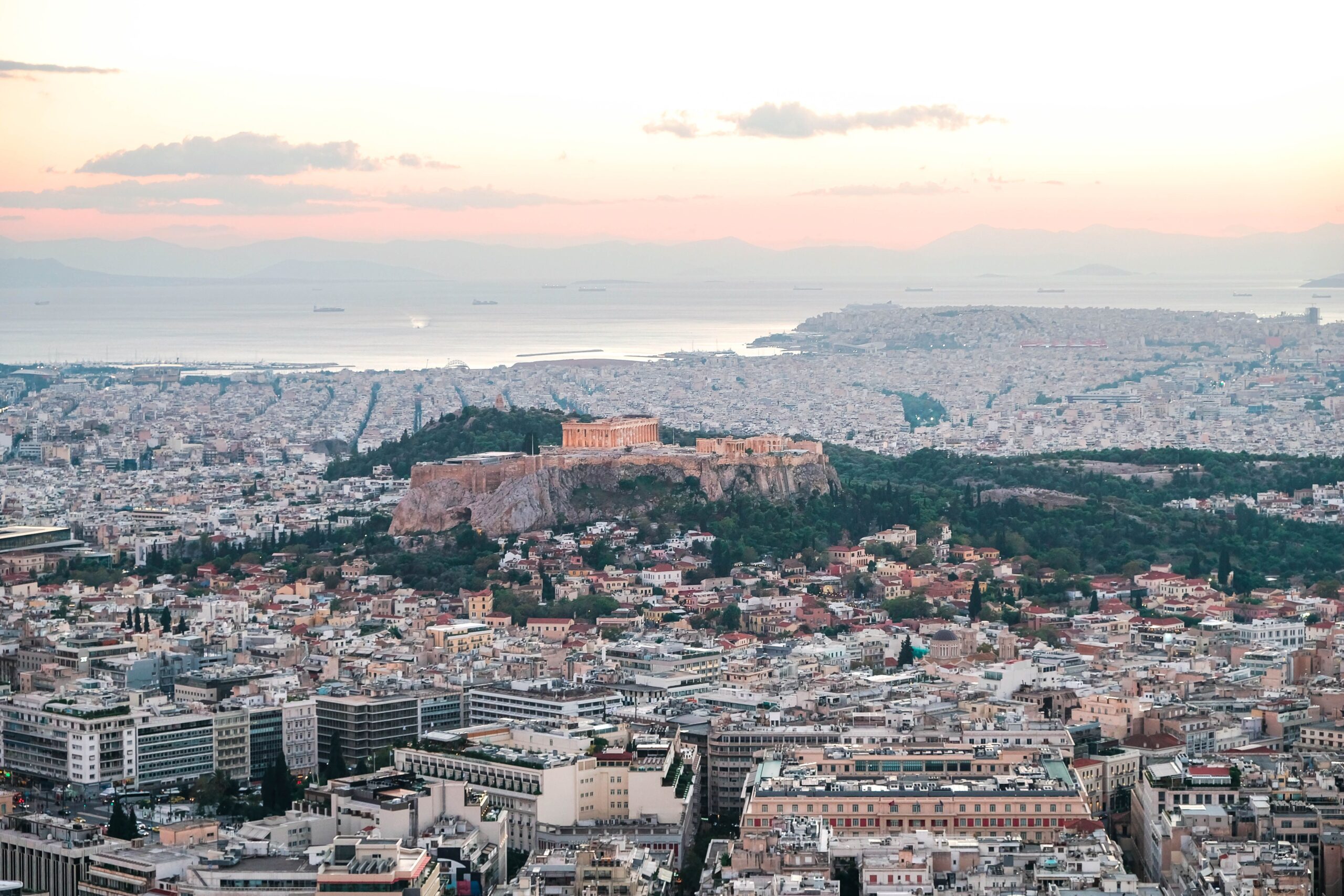
The Acropolis at 8am opening before the 15,000 daily visitors reduce the Parthenon to a crowd-management problem, the Monastiraki flea market on Sunday morning when the dealers are still laying out their tables, the Athens Central Market where the lamb heads are arranged with the same care as the flowers, the rooftop bars of the Psyrri neighbourhood where the Acropolis is lit at 9pm and the cocktail costs €12, the specific Athens that existed before it became the European short-break capital, and the 48 hours that give the ancient and the contemporary simultaneously.
Reading time: 8 minutes | Last updated: 2025
Athens has solved a problem that most ancient cities haven’t: it has become an extraordinary contemporary city without losing the ancient one. The Acropolis is visible from every rooftop in the city. The streets below it are full of the best street food in Greece. The neighbourhoods of Monastiraki, Psyrri, and Koukaki have developed restaurant and bar cultures that rival any European capital. The museums — specifically the new Acropolis Museum — have produced the finest purpose-built archaeological museum in the world.
The Athens visitor experience divides between two failure modes: the first-day Acropolis pilgrimage at 2pm in July (the worst possible version of the finest archaeological site in the Western world) and the complete avoidance of the ancient city (replacing the monument with neighbourhoods at the expense of understanding why the neighbourhoods developed where they did).
These 48 hours avoid both failure modes.
Hour-by-Hour
Day 1
8:00am — The Acropolis at Opening
The Acropolis opens at 8am (7:30am in peak summer). The first morning entry gives the site before the tour groups arrive from the cruise ships (docking from 9am) and the Athens hotels (typically beginning Acropolis tours at 9:30am).
The approach: from the Dionysus Areopagitou promenade on the south side, the path to the entrance on the southwest slope. Buy tickets online in advance at etickets.tap.gr — the physical queue at 8am is manageable, but the online ticket allows direct entry through the separate lane.
The Acropolis in order:
The Propylaea (the monumental gateway, 437-432 BCE — a building whose architectural problem, requiring a ceremonial gateway on a sloping, asymmetric hilltop, produced solutions that influenced every subsequent monumental gateway in Western architecture).
The Temple of Athena Nike (the small Ionic temple at the southwest corner of the plateau — the relief sculptures of the Victories preparing for sacrifice, the view over the Athenian plain to the sea visible on clear days).
The Erechtheion (the north side — the Porch of the Caryatids: the six female figures supporting the south porch roof. The originals are in the Acropolis Museum; these are high-quality casts. The specific detail: one of the originals is in the British Museum in London, the subject of the ongoing Elgin Marbles repatriation dispute).
The Parthenon (the central temple, 447-432 BCE, the finest surviving example of Doric architecture, the building whose proportional system has been cited as the foundation of Western architecture for 2,500 years). Currently under long-term restoration — the restoration scaffolding has been present since 1975 and will likely remain for decades. The scaffolding is visible; it does not diminish the building.
Allow 2 hours. The site at 8am: manageable crowds. By 11am: the cruise ship passengers have arrived. By 2pm in peak season: 15,000 people on a 4-hectare hilltop.
Entry: €20 / £17.22 (single site) or €30 / £25.83 (combined ticket covering the Acropolis and 6 additional ancient sites — the correct ticket for a 48-hour visit).
10:30am — The Acropolis Museum
Directly below the Acropolis, the museum opened in 2009 — the most considered purpose-built archaeological museum in the world, designed specifically to display the Parthenon’s sculptural programme in the orientation and light that they occupied when in situ. The top floor: the Parthenon Gallery, the surviving original sculptures arranged at the scale and position of the original building, with gaps where the British Museum and other international museums hold pieces, the gaps a deliberate argument for repatriation.
The ground floor: the finds from the Acropolis excavations below the building (visible through the glass floor — you walk above an active archaeological site), the votives and dedications from 6 centuries of worship on the hill.
Entry: €15 / £12.91. Combined ticket with the Acropolis: available at the museum box office. Allow 1.5 hours.
1:00pm — Lunch: The Athens Central Market (Varvakios Agora)
The covered market on Athinas Street, built 1876 — the meat section (the lamb and goat carcasses hanging from hooks, the lamb heads arranged on the marble slabs, the specific sensory density of a working Mediterranean meat market), the fish section (the Mediterranean catch on ice, the squid and octopus tentacles arranged beside the whole fish), and the spice section (the dried herbs, the Athens-specific spice blend for souvlaki, the string of dried peppers).
The market taverna: the Epirus restaurant inside the market (operating since the 1960s, serving the market workers and the neighbourhood — the lamb offal dishes, the magiritsa, the specific traditional cooking of a restaurant that exists for its immediate community rather than tourists). Lunch: €10-15 / £8.61-12.91.
The Monastiraki flea market (a 5-minute walk from the Central Market, most active on Sunday mornings): the antique and second-hand dealers spread across the Avissynias Square and the surrounding streets. Reproduction antiquities, silver, old coins, books, and the general archaeology of 20th-century Athens.
3:00pm — Monastiraki and Psyrri
The Monastiraki neighbourhood: the intersection of the ancient city, the Ottoman bazaar, and the contemporary Athens of independent shops and street food. The Monastiraki Square (the former Ottoman mosque of Tzisdarakis at the centre — now a ceramics museum, entry €2 / £1.72), the Hadrian’s Library (ruins visible from the street, the finest surviving Roman civic building in Athens), and the Roman Agora (€12 / £10.33 with the combined ticket).
The Psyrri neighbourhood (the streets immediately north of Monastiraki): the former working-class warehouse district, the finest concentration of restaurants and bars in central Athens. The Psyrri at 3pm: the graffiti, the marble tables outside the neighbourhood coffee shops, the buildings with the raw plaster visible where the render has fallen.
5:00pm — The Ancient Agora
The Athenian Agora — the civic centre of ancient Athens, the space where Socrates walked and was tried, where the Athenian democracy developed its institutional forms. The Stoa of Attalos (the reconstructed 2nd-century BCE commercial gallery, the finest archaeological museum of the Agora finds) and the Temple of Hephaestus (the best-preserved ancient Greek temple in the world — more complete than the Parthenon, its roof intact, the interior visible). Entry: included in the combined Acropolis ticket.
The Temple of Hephaestus at 5pm: the temple visible through the ancient olive trees planted as part of the 1950s restoration of the Agora garden. Free of the crowds that the Acropolis has absorbed above. One of the most peaceful ancient sites in Athens.
7:30pm — Dinner: Diporto or Seychelles
Diporto (Theatrou Square, central Athens): a restaurant without a menu, without a sign, without a card machine — the owner serves what was cooked that day (the revithia — chickpea soup with lemon, the fasolada — the white bean soup that is the national dish, and the grilled fish). Cash only. The basement setting. The wine from the barrel. One of the most honest restaurants in Athens. €10-15 / £8.61-12.91 per person.
Seychelles (Keramikos neighbourhood, 10 minutes from Monastiraki): the modern Athens version — the creative vegetable-forward menu, the natural Greek wines, the restaurant that has been consistently rated among the finest in Athens since 2018. €30-45 / £25.83-38.75 per person. Book ahead.
9:30pm — Acropolis Lit: The Psyrri Rooftop
The Acropolis is floodlit from dusk. The rooftop bars of the Psyrri and Monastiraki neighbourhoods give the lit Acropolis visible above the rooflines — the Parthenon in the 9pm light, the city below.
The A for Athens rooftop bar (Monastiraki Square): the most direct Acropolis view from a bar in Athens, the cocktail menu and the view simultaneously. Cocktails: €12-14 / £10.33-12.06.
Day 2
8:30am — Kerameikos Cemetery
The ancient Athenian cemetery — operating from the 12th century BCE through the Byzantine period, the grave stelae (the marble carved grave markers showing the deceased in their domestic life) the finest collection of classical Athenian funerary art. Entry: €8 / £6.89 (included in combined ticket).
The Kerameikos at 8:30am: the site almost always empty at this hour, the museum containing the original grave stelae (the weathering of the outdoor copies makes the museum originals more legible — the carved hands, the faces, the specific intimacy of people carved in grief 2,500 years ago) open with no queue.
10:00am — The Koukaki Neighbourhood
The neighbourhood south of the Acropolis — the most liveable and most characterful of the central Athens residential districts, the 20th-century apartment buildings with the Art Deco flourishes, the neighbourhood bakeries, the hardware shops and the toy shops and the mechanics’ workshops that coexist with the coffee shops and the wine bars.
The Koukaki morning: the kafeneion (the traditional Greek coffee shop) with the old men and the backgammon, the laiko market (the neighbourhood street market that operates on specific days of the week — check the Athens municipality website for the Koukaki market day), the small wine shops that stock producers the tourist-facing wine bars don’t carry.
12:00pm — The National Archaeological Museum
The most important collection of ancient Greek art in the world — the gold of Mycenae (including the Mask of Agamemnon, the gold funeral mask discovered by Schliemann in 1876 and immediately attributed to the Homeric king — the attribution is contested but the mask is genuinely extraordinary), the Antikythera Mechanism (the 2nd-century BCE mechanical analogue computer used to predict astronomical events — the most complex object surviving from antiquity), the Vari House (the only ancient Greek domestic building interior reconstructed in full, giving the scale and arrangement of a middle-class Athenian house of the 4th century BCE).
Entry: €15 / £12.91. Combined ticket with other sites is a different system — the National Museum is not in the main Acropolis ticket. Budget 2-3 hours.
3:00pm — Departure or Extension to Cape Sounion
If departing: the Athens International Airport is 33km east of the city (Metro Line 3 from Monastiraki, 45 minutes, €10 / £8.61).
If extending: the Cape Sounion day trip (70km south of Athens, the Temple of Poseidon on the clifftop above the Aegean — Lord Byron carved his name in the marble in 1810, visible today in the column base). 2 hours by KTEL bus from Pedion tou Areos (the bus station north of the National Archaeological Museum), €7.50 / £6.46 each way. The temple at the southern tip of Attica, the Aegean visible on three sides, the sunset over the sea: the finest view of an ancient temple in its natural setting available in the Athens area.
Essentials
Getting there: Athens Eleftherios Venizelos International Airport (ATH). British Airways, easyJet, Ryanair, Jet2 direct from UK airports. Return: £60-200. Flight time: 3.5 hours.
Transport: The Athens Metro (€1.40 / £1.21 per journey, 24-hour tourist ticket €4.10 / £3.53) covers the Acropolis area (Acropoli station), Monastiraki, and Syntagma. The central area is walkable — the Acropolis Museum to Monastiraki is 15 minutes on foot.
When: April-May or September-October. The Acropolis in July at 2pm (40°C, no shade, 10,000 people) is the worst possible version of a great site. The Acropolis in April at 8am (20°C, empty, the morning light on the Pentelic marble) is the best possible version.
Tickets: Buy the Acropolis combined ticket online at etickets.tap.gr before arriving — the physical queue at the ticket office is manageable at 8am but significant from 10am in peak season.
The Closing Moment
I was on the Acropolis at 8:10am. The sun had just risen over Hymettus, the mountain to the east. The light was coming from the right angle — the Parthenon’s south face in direct low sun, the shadows of the columns long across the pavement.
There were perhaps 80 people on the entire site. Two tour guides were speaking to their groups in quiet voices. Everyone else was simply standing.
The Parthenon has been standing for 2,450 years. It has survived a Venetian mortar shell (1687 — the shell hit the Turkish ammunition store inside the building and detonated, removing the roof and much of the interior structure that had been intact since construction). It has been a Christian church, a Catholic church, a mosque. It currently hosts a restoration project that has been ongoing for 50 years.
At 8:10am, in the early morning light, the restoration scaffolding is visible and irrelevant. The columns are Pentelic marble from the quarry on Mount Pentelicus. The proportions are the proportions that every subsequent Western building has been compared against.
2,450 years. 8:10am. Eighty people.
This is why you set the alarm.