
The dead black camel thorn trees standing in a white clay pan surrounded by the highest sand dunes in the world, the specific 6am light that turns the dunes orange while the pan floor is still in shadow, why Deadvlei is the photograph and Sossusvlei is the dune climb, the Big Daddy dune at 325 metres that requires 45 minutes of sand-sinking ascent and offers the finest view in the Namib Desert, and why both require the 4am alarm and neither requires the tour bus.
Reading time: 8 minutes | Last updated: 2025
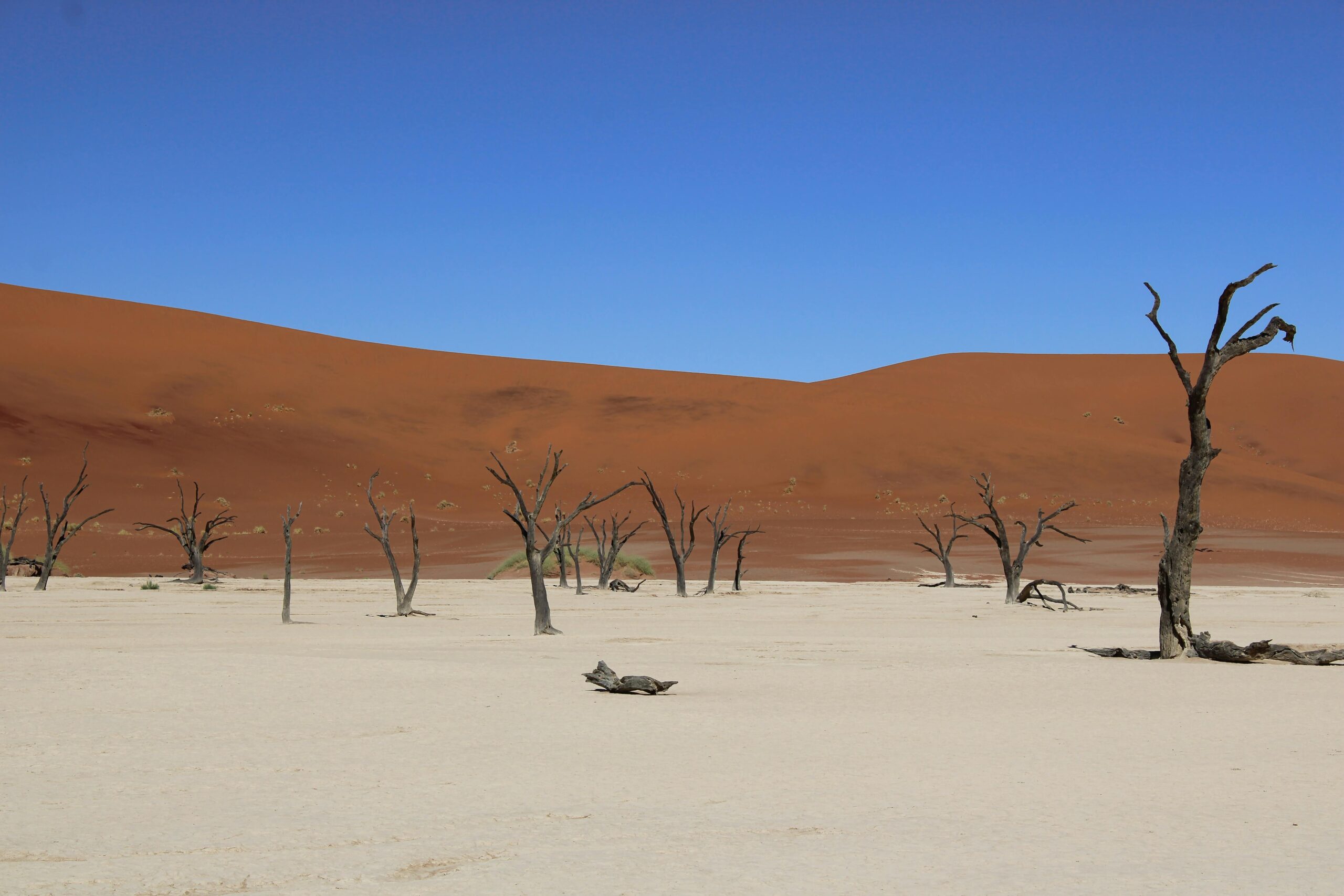
Sossusvlei is a clay pan in the Namib-Naukluft National Park — surrounded by star dunes that reach 325 metres in height, the highest sand dunes accessible to visitors anywhere in the world. Deadvlei is a smaller pan 1km from Sossusvlei — a white clay floor on which dead camel thorn trees have been standing for approximately 900 years, the trees killed when the Tsauchab River changed course and cut off their water supply, the dry desert air preserving the blackened wood since.
The photographs of both sites are among the most reproduced landscape images from Africa. The dunes at Deadvlei are orange-red from the iron oxide in the sand; the pan floor is white from the evaporated salt and clay; the dead trees are black from 900 years of sun; the sky is blue. The palette is the most saturated naturally occurring landscape in Namibia, and the geometry (the vertical trees, the horizontal pan, the curved dune faces above) is the most compositionally specific.
Both photographs are real. Both require the same thing: arriving before the tour buses.
The Two Sites Compared
Deadvlei: The photograph location. The dead trees on the white pan, the dune faces above. The visual experience requires no physical effort — you walk from the 4WD drop-off point to the pan (15 minutes) and the trees are there. The light on the pan changes dramatically: at 6-7am, the dune faces above are in direct sun (orange) while the pan floor is still in shadow (white). This is the image. By 9am the pan is in full sun and the contrast disappears.
Sossusvlei: The dune climb location. The pan at Sossusvlei is less dramatic than Deadvlei (no dead trees, the clay pan less perfectly white), but the surrounding dunes — particularly Dune 45 (45km from the park entrance, the most accessible significant dune) and Big Daddy (the highest dune adjacent to Deadvlei) — offer the physical experience of the Namib sand sea.
The strategy: Do both. The Deadvlei visit (for the photograph) requires arriving first, at dawn, before the tour groups. Big Daddy (the dune climb) takes 45 minutes to ascend and is best done after Deadvlei when the light is less critical.
The Dawn Strategy
The Sesriem Gate (the park entrance) opens at sunrise. In summer (October-February): approximately 5:30am. In winter (April-August): approximately 6:30am.
The 4WD track from Sesriem to the Sossusvlei-Deadvlei area is 65km — approximately 1 hour at the permitted speed. To reach Deadvlei at dawn (before the first direct sun hits the pan floor), you need to be at the Sesriem Gate when it opens.
The 4am alarm: This is not metaphorical. Arriving at the Sesriem Gate at opening time requires a 4am departure from camp or from Sesriem Lodge (which is immediately outside the gate). The camp inside the park (Desert Camp) allows gate access from an hour before sunrise — book the in-park accommodation if the dawn timing is the priority.
The public 4WD transfer: The final 5km from the 4WD parking area to the Deadvlei and Sossusvlei pans requires a 4WD vehicle (the deep sand track is impassable in a standard 2WD car). A shuttle service runs from the 4WD parking area to the Deadvlei drop-off: N$200 / £8.45 return. The shuttles start at sunrise; the first shuttle gives access to Deadvlei in the dawn light window.
Alternatively, hire a high-clearance 4WD from Windhoek (the standard hire car in Namibia — essential for the full country circuit).
The Dune Climbs
Dune 45: 45km from the Sesriem Gate on the main road to Sossusvlei — a star dune of approximately 170 metres, the most climbed dune in the Namib. The ascent on the main ridge (the sand firm near the ridge crest, the slope gentler than it appears from below) takes 20-30 minutes. The view from the summit: the surrounding dune sea, the road visible below, the gravel plains beyond the dunes. Climb at dawn before the sun makes the descent sand too hot for bare feet.
Big Daddy: The largest dune adjacent to Deadvlei — 325 metres, the highest accessible dune in Namibia and one of the highest in the world. The ascent from the Deadvlei pan side: 45-60 minutes on sand that gives underfoot with each step (the specific exhaustion of dune climbing, where progress feels slower than it is). The summit: the full Deadvlei pan visible directly below, the other dunes extending to the horizon in every direction, the scale of the Namib sand sea comprehensible from above in a way it isn’t from the pan floor.
The descent from Big Daddy: down the steep face on the far side from the summit (not the ascent route — the steeper face allows the direct descent by running and sliding in the sand, the conventional Namib dune descent method). 10-15 minutes to reach the pan from the summit.
The Night Sky
Namibia has the largest area of pristine dark sky in the southern hemisphere — the country has almost no significant light pollution, the desert air has minimal moisture and dust (outside the duststorm season), and the Milky Way is visible from any point in the Namib on a clear night.
The NamibRand Nature Reserve (adjacent to the Sossusvlei area) is an International Dark Sky Reserve — the reserve specifically manages development to prevent light pollution, and the stargazing from the NamibRand lodges or from the Sossusvlei camp is consistently ranked among the finest in the world.
Facilities: the Sosruskette camp, the Desert Camp, and the surrounding private reserves offer telescope access and guided stargazing sessions. The Milky Way from a Namibian desert camp in June (when the galactic core is at its highest): one of the clearest views of it available on Earth.
The Full Namibia Circuit
Deadvlei and Sossusvlei sit within a logical Namibia circuit:
Windhoek → Fish River Canyon (the second-largest canyon in the world, southern Namibia, 3 days) → Sossusvlei/Deadvlei (2 nights) → Swakopmund (the coastal desert town, the place where the Namib Desert meets the South Atlantic, 2 nights) → Damaraland (the desert-adapted elephant, the Twyfelfontein rock engravings, 2 nights) → Etosha (3 nights) → Windhoek.
14 days. The complete southern African desert circuit. The finest self-drive safari available in Africa.
Essentials
Getting to Sossusvlei: Windhoek to Sesriem Gate: 350km south on the B1 then west on the C19 — 4-5 hours by car. The road is good tarmac to Sesriem. A high-clearance 4WD is recommended but not essential for a 2WD car if taking the shuttle from the 4WD parking area. Budget hire car to Sesriem, 4WD shuttle for the final section: the most cost-effective combination.
Park fees: N$180 / £7.60 per person per day + N$80 / £3.40 per vehicle per day.
Where to stay: Sesriem Camp (inside the gate, access from one hour before sunrise): N$200-350 / £8.45-14.80/person (camping) or N$950-1,400 / £40-59 (chalets). Book through Namibia Wildlife Resorts (nwr.com.na) — fills months ahead in peak season (July-September). The lodges outside the gate (Sossus Dune Lodge, Agama River Camp) give later access but better facilities.
The Closing Moment
I was at the Deadvlei pan at 6:20am. The tour group shuttle hadn’t yet arrived. There were four other people on the pan.
The dune faces above the pan were orange — the direct sun had reached them at 6:10am. The pan floor was still in shadow: white clay, the dead trees black against the orange above.
900 years those trees have been standing. They died when the river moved. The desert preserved them. The specific colour palette — black, white, orange — is not produced by any filter or any editing. It is the Namib at 6:20am in the first week of July.
The first tour shuttle arrived at 6:45am. By 7am there were 60 people on the pan.
Be there at 6:20am.