
The 5th-century CE rock fortress 200 metres above the surrounding forest, the frescoes of the cloud maidens halfway up the climb that are among the finest surviving examples of Sri Lankan classical art, the mirror wall with its 1,000 years of visitor inscriptions, the water gardens at the base that still function after 1,500 years, and why Sigiriya is the finest single day in Sri Lanka.
Reading time: 7 minutes | Last updated: 2026
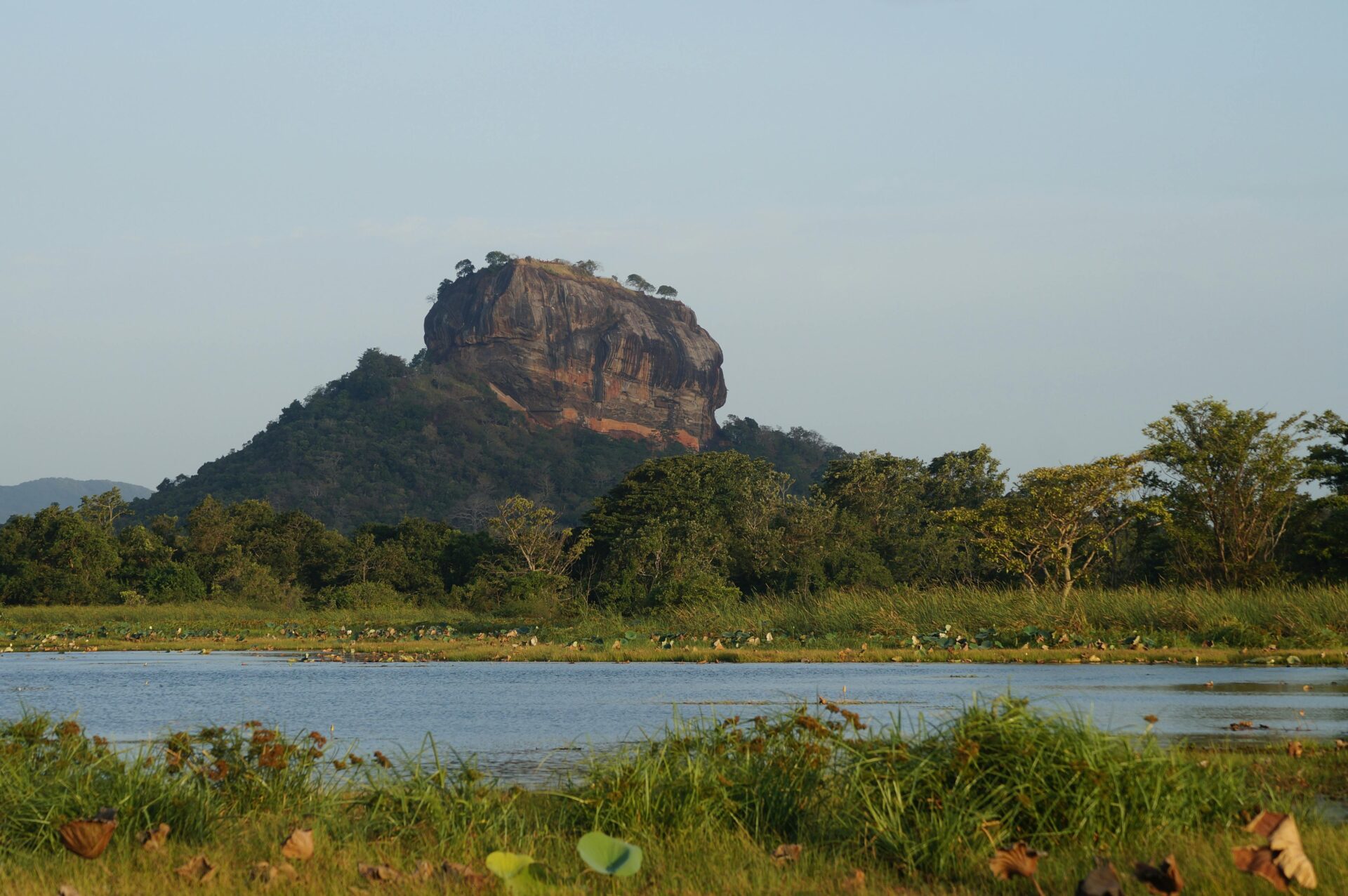
Sigiriya is a 200-metre granite monolith rising from the forest of the Sri Lankan Cultural Triangle — a sheer-sided rock on whose summit the Sinhala king Kashyapa I built his palace in 477-495 CE.
The story: Kashyapa killed his father (King Dhatusena, who was walled up alive in the rock of the city of Anuradhapura) to seize the throne, then retreated to Sigiriya — the most defensible position available in the central plains — expecting his brother Mogallana to return from exile in India with an army. Mogallana arrived in 495 CE. Kashyapa rode out to meet him, his elephant stepped into a swamp, Kashyapa’s army interpreted this as a retreat and scattered. Kashyapa killed himself on the rock. Mogallana converted the summit palace to a Buddhist monastery and moved the capital back to Anuradhapura.
The palace is gone — only the foundations and the cisterns remain on the summit. The water gardens, the boulder gardens, and the fresco gallery in the cliff face survive.
The Ascent
The climb to the Sigiriya summit takes 45-90 minutes depending on pace — the path ascends through the lower boulder gardens, past the Lion’s Paw (the carved granite paws of a gigantic lion figure that formed the entrance gate to the final ascent, the lion’s body and head having collapsed in antiquity), then up the iron staircase on the vertical rock face to the summit.
The frescoes:
Halfway up the ascent, a sheltered gallery in the cliff face contains the Sigiriya frescoes — painted in the 5th century CE, depicting approximately 22 surviving female figures (of an original number estimated between 100 and 500) in rich reds, yellows, and greens. The figures are variously interpreted as apsaras (divine nymphs), women of the royal court, or cloud maidens. The colours, painted directly onto the smooth rock with pigments derived from minerals and plants, have survived 1,500 years with remarkable intensity.
Photography is permitted; flash is not. The gallery is accessed via a spiral metal staircase from the main ascent path. The frescoes are the finest surviving Sri Lankan classical painting.
The mirror wall:
Below the frescoes — a polished plaster wall that was originally so smooth that the king could see his reflection (hence the name). The surface is now covered with inscriptions in Sinhala, Sanskrit, and Tamil left by visitors from the 8th to 14th centuries — 1,000 years of graffiti by literate visitors commenting on the frescoes, the weather, and the experience of the climb. Some of the oldest Sinhala poetry is inscribed here.
The summit:
The foundations of the palace, the throne rock (a natural granite formation used as a throne), and the cisterns (water tanks carved into the summit rock and still functional — they were designed to collect rainwater and were the palace’s water supply 1,500 years ago). The view from the summit: the Sri Lankan forest extending to the horizon in every direction, the Pidurangala rock visible to the north (a similar formation from which the finest aerial view of Sigiriya is available).
The Pidurangala alternative:
Pidurangala Rock — 2km north of Sigiriya, a 45-minute ascent — is the correct viewpoint for the Sigiriya photograph that shows the full monolith rising from the forest. From Pidurangala at dawn, with the sun behind you and Sigiriya lit from the east: the definitive Sigiriya image. Entry: LKR 500 / £1.40 (fraction of the Sigiriya entry fee).
Essentials
Entry: USD 30 / £24 per person — the most expensive single site in Sri Lanka and worth every rupee. Buy the ticket at the Sigiriya Cultural Triangle Office.
Timing: Open from 7am. The first tour buses from Colombo arrive at approximately 9:30am. The 7am-9:30am window: the ascent in the early morning, the frescoes in the first light, the summit before the tour groups.
Pidurangala for the dawn photograph: The ascent of Pidurangala takes 45 minutes — depart by 5:30am for a dawn summit arrival. The descent returns you to the base by 7am, which gives time to then visit Sigiriya itself from 7am.
Combine with: Sigiriya is in the Cultural Triangle, 30km from Dambulla (the cave temple complex — 5 cave temples with the finest Buddhist cave paintings in Sri Lanka, entry USD 15 / £12) and 170km from Kandy.
The Closing Moment
I was on the summit of Sigiriya at 7:45am. The forest below was still in morning haze. The king who built this place had been dead for 1,520 years.
The cisterns carved into the rock were still holding water — the rainwater collection system of a 5th-century palace, still functioning because the engineering was correct.
That is the specific Sigiriya quality: something built by a man who killed his father to survive, who retreated to the most unassailable rock he could find, who decorated it with paintings of cloud maidens, and who died on the plain below when his elephant misjudged its footing. Everything he built to survive is still here. He is not.