
The gulet sailing the Bozburun Peninsula where the pine forest meets the Aegean at water level, the lycian tombs carved into the cliff face above Dalyan and accessible only by flat-bottomed river boat, Kaş as the diving capital of the Turkish Mediterranean, the sunken city of Kekova visible through the hull of a glass-bottomed boat, Ölüdeniz and the reason the photographs look too good, Patara’s 18km beach where Lycian ruins sit in the sand, and why the Turkish Aegean and Mediterranean coast rewards the boat version over the resort version.
Reading time: 13 minutes | Last updated: 2026
The Turkish Mediterranean coast between Bodrum and Antalya — the Turquoise Coast, the Aegean and Mediterranean Riviera of Turkey — is one of the least understood major destinations available from the UK.
The misunderstanding runs in two directions simultaneously. The traveller who has been to Marmaris or Alanya on a package holiday thinks they know what the coast is: the resort infrastructure, the all-inclusive, the beach bar economy. The traveller who has heard about the “authentic Turkey” thinks the coast has been too developed to deliver it.
Both are wrong, in the specific way that destinations are always more complex than their reputation.
The coast between Bodrum and Antalya contains: the finest gulet (traditional wooden sailing boat) charter waters in the Mediterranean, the most significant concentration of Lycian archaeological sites in the world (the Lycians were a Bronze Age Anatolian civilisation, their rock-cut tombs visible on the cliff faces above every major coastal town from Fethiye to Demre), one of the finest diving environments in the eastern Mediterranean, and a food culture that is specifically Aegean-Turkish (the meze tradition, the fresh fish, the specific combination of olive oil and lemon and fresh herbs) rather than the generic Turkish tourist menu.
The route: Bodrum → Marmaris → Gökova → Bozburun → Dalyan → Göcek → Ölüdeniz/Fethiye → Kaş → Kekova → Demre → Antalya. A 400km coastline with no two sections the same, best navigated by boat (gulet), hire car, or a combination of both.
Quick Navigation
- The Gulet — Why the Boat Is the Point
- When to Go — The Season and the Wind
- Getting There — Bodrum, Dalaman, and Antalya
- Bodrum — The Peninsula Base
- Marmaris and the Bozburun Peninsula
- Dalyan and the Lycian Tombs
- Göcek and the Gulf of Fethiye
- Ölüdeniz — The Blue Lagoon
- Kaş — Diving Capital
- Kekova — The Sunken City
- Patara — The Longest Beach in Turkey
- Demre and the Church of St. Nicholas
- The Lycian Way — Walking the Coast
- Hidden Turquoise Coast
- What It Costs — Gulet vs Land-Based
- Eating on the Turquoise Coast
- Practical Notes
- Two Itineraries — Boat and Land
The Gulet — Why the Boat Is the Point
The gulet is a traditional Turkish wooden sailing boat — the specific design originating in the Bodrum boatyards, a two-masted vessel with a broad beam, a shaded deck, and cabins below. The gulet became the standard vessel for the “Blue Voyage” (Mavi Yolculuk) after the Turkish poet Cevat Şakir Kabaağaçlı (known as Halikarnas Balıkçısı — the Fisherman of Halicarnassus) wrote about the experience in the 1940s. By the 1960s the Blue Voyage was established as a specific Turkish cultural institution.
Why the gulet matters:
The Turkish Turquoise Coast is not a beach coast in the conventional sense. The finest coves — the anchorages where the pine forest meets the turquoise water, the islands with no permanent population, the bays accessible only from the sea — are not visible from the road and not accessible by foot. The gulet reaches them. The land-based version of the coast accesses the main towns and the accessible beaches; the boat version accesses the coast.
The charter options:
Cabin charter: Individual cabins on a gulet operated by a tour company, with other cabin charterers sharing the boat. This is the most affordable gulet experience — cabin prices from £600-1,200/person for a week, depending on season and operator quality. The social dynamic: you share the boat with 10-20 strangers. Some people prefer this; others find it uncomfortably intimate.
Private charter: The entire gulet chartered by a group (typically 6-12 people, though gulets range from 4 to 20+ cabin capacity). The boat is entirely yours — the route, the pace, the anchorages, the meals. Private charter: £3,000-8,000/week for the boat (split between the group). With a group of 8: £375-1,000/person per week, a significant value improvement over cabin charter for a social group.
Day boat: Day trips by local boat from the main towns (Marmaris, Fethiye, Kaş) — the compromise option that gives boat access to specific bays and coves without the live-aboard commitment.
The route:
The classic Blue Voyage covers Bodrum to Fethiye (or the reverse) in 7-8 days — the Gökova Gulf, the Bozburun Peninsula, the Datça Peninsula, and the Gulf of Fethiye. The Fethiye to Kaş section (Days 9-14 of the longer circuit) covers the Göcek anchorages, Ölüdeniz, the Butterfly Valley, Kaş, and Kekova.
When to Go — The Season and the Wind
May and June — The Opening Season
The finest months for the gulet. Sea temperature reaches 22-24°C by June. The meltemi (the northerly wind that blows across the Aegean from July through August) hasn’t yet established its summer dominance. The pine forests are green, the wildflowers on the headlands still visible. The anchorages are not yet at peak summer occupancy.
September and October — The Return
The meltemi has eased. The sea is at its warmest (26-27°C in September). The Lycian archaeological sites are accessible in cooler temperatures. The tourist season is ending — many of the coastal restaurants and gulet operations are still fully open through October, the towns quieter, the anchorages less crowded.
July and August — Peak Season
The meltemi blows consistently — the sailing conditions are actually good (consistent wind for a sailing vessel) but the anchorages in the most popular bays (the Göcek islands, the bays around Ölüdeniz) are full of gulets at anchor. The heat (35-40°C at anchor in sheltered bays) is significant. The coastal towns are at maximum tourist density.
The BGGD recommendation: June or September. Both give the coast without the meltemi at its most aggressive and without the peak anchorage density.
Getting There — Bodrum, Dalaman, and Antalya
Bodrum Milas Airport (BJV): Turkish Airlines, easyJet, and Jet2 from UK airports. Return: £100-250. The correct entry for a Bodrum-start gulet or land circuit.
Dalaman Airport (DLM): The airport serving Fethiye, Ölüdeniz, Marmaris, and Göcek — the central coast. easyJet, Ryanair, Jet2, TUI from UK airports. Return: £80-200. The most convenient entry for the middle section of the coast.
Antalya Airport (AYT): The largest airport on the Turkish Mediterranean — serving the eastern coast and the Cappadocia connection. easyJet, Jet2, TUI, British Airways from UK airports. Return: £80-220.
The open-jaw: Fly into Bodrum, fly home from Antalya — the full coast in one direction, no backtracking.
Getting around (land-based): The D400 coastal highway connects Bodrum to Antalya — well-maintained, the coastal sections giving sea views. Car hire from any of the three airports: £20-35/day. The dolmuş (shared minibus) network connects all towns along the coast for £1-3 per journey.
Bodrum — The Peninsula Base
Bodrum is the most cosmopolitan town on the Turquoise Coast — a city of 40,000 permanent residents that becomes the yachting and nightlife capital of the Turkish Aegean in summer. The specific Bodrum character: the whitewashed buildings, the windmills on the hill above the town, the Crusader castle at the harbour entrance, and a specific café and restaurant culture more sophisticated than most comparable Mediterranean resort towns.
The Bodrum Castle (Castle of St. Peter):
Built by the Knights Hospitaller in the early 15th century using marble from the Mausoleum of Halicarnassus (the tomb of King Mausolus, one of the Seven Wonders of the Ancient World, which was on this site — the word “mausoleum” comes from this specific building) as building material. The castle now houses the Museum of Underwater Archaeology — the finest collection of Bronze Age and classical shipwreck artefacts in the world, the result of decades of underwater excavation in the Aegean and eastern Mediterranean. The Uluburun shipwreck (a Late Bronze Age vessel carrying cargo from Cyprus, the Levant, Egypt, and Mycenae — the most significant single Bronze Age commercial shipwreck ever found) is represented here with its full cargo displayed.
Entry: TRY 300 / £8.20. Budget 2-3 hours.
The Mausoleum site:
The foundations of the original Mausoleum of Halicarnassus — one of the Seven Wonders of the Ancient World, the tomb of King Mausolus of Caria (died 353 BCE). Most of the marble was used to build the Castle of St. Peter; the foundations and the archaeological museum on site cover the original structure and its significance. Entry: TRY 100 / £2.75.
Marmaris and the Bozburun Peninsula
Marmaris is the largest resort town on the coast — a city of 40,000 people with a significant marina, a busy nightlife strip, and the bay that gives the gulet trade much of its Aegean-based charter business. The town itself is heavily touristic; the surrounding Bozburun Peninsula is not.
The Bozburun Peninsula:
The peninsula south of Marmaris — 60km of mountain-and-sea coastline with no significant resort development. The village of Bozburun (a traditional boatbuilding village where the gulets are still constructed by hand) is the most characterful destination on the peninsula. The anchorages at Selimiye and Söğüt: the specific combination of pine forest above and turquoise water below that gives the gulet experience its character.
By car from Marmaris: 90 minutes to Bozburun on the narrow mountain road (the road is an event in itself — the views across the Gökova Gulf and the Greek island of Symi visible from the ridge section).
Datça and the Cnidus ruins:
The Datça peninsula (the narrowest peninsula in the Aegean — 75km long, at its narrowest only 800 metres wide) leads to the ancient city of Cnidus at the tip. Cnidus was the site of the Aphrodite of Cnidus (the first nude female sculpture in Greek art, created by Praxiteles in the 4th century BCE — the original is lost, Roman copies in museums). The ruins at the tip of the peninsula: the theatre, the temple site, the circular structure traditionally attributed to the Aphrodite sanctuary. Accessible by boat or by road (2.5 hours from Datça town, the last section on a dirt road).
Dalyan and the Lycian Tombs
Dalyan is inland — a river town on the Dalyan River, connected to the sea by a channel through the Sülüngür Lake (a protected freshwater lake and loggerhead sea turtle nesting habitat). The specific Dalyan experience is a combination of river boat navigation and Lycian archaeology.
The Lycian rock tombs:
Above the west bank of the Dalyan River — the most dramatic accessible Lycian tombs on the coast, carved into a sheer cliff face 50-100 metres above the water. The tombs (4th-2nd century BCE) are cut in the form of temple facades — the Ionic columns, the decorated friezes, and the doorway all carved from the living rock. From the flat-bottomed river boats (the only way to access this view — the cliff face is not approachable from land), the tombs appear at eye level from the water, the scale comprehensible in a way that the photographs from boats below don’t convey.
River boat from Dalyan town quay: £5-8 per person for the full day trip (tombs, Iztuzu Beach, the hot springs at Köyceğiz Lake). The tours run throughout the day; the morning light on the tombs is the best.
Kaunos:
The ancient city behind the cliff tombs — accessible by river and a short walk. The Kaunos theatre (2nd century BCE, the seating carved into the hillside, the stage buildings largely intact), the acropolis above, and the Kaunos Stoa (the covered walkway connecting the civic buildings). Kaunos was a city on the cultural frontier between Lycia and Caria — the tombs are Lycian in style; the city plan is Greek. Entry: TRY 60 / £1.65.
Iztuzu Beach (Turtle Beach):
A 4.5km sand spit separating the Dalyan River from the Mediterranean — one of the most significant loggerhead turtle nesting beaches in the Mediterranean. The beach is managed by the Dalyan Conservation Association: no development, no sunbeds in the nesting zones (marked with stakes from June through October), access restricted at night during the nesting season. The turtles are visible occasionally in the river and in the surf during the day.
Göcek and the Gulf of Fethiye
Göcek is a small marina town that serves as the base for the Gulf of Fethiye gulet charter — the gulf contains 12 islands and a series of protected bays that are among the finest gulet anchorages in the Mediterranean.
The Göcek islands:
Yassıca Islands (a cluster of small islands with clear anchorages), Tersane Island (the ruins of a Byzantine dockyard — the covered boat sheds cut into the hillside, accessible by swimming from anchor), and Cleopatra’s Bay (a specific anchorage, named for the traditional claim that Cleopatra and Antony anchored here — not verified, but plausible given the historical overlap of the Mediterranean power base and this specific coast).
The islands from a gulet at anchor in August: 50-80 other gulets visible in every direction. The same anchorage in June or September: 5-10 boats. The difference in the experience is categorical.
Ölüdeniz — The Blue Lagoon
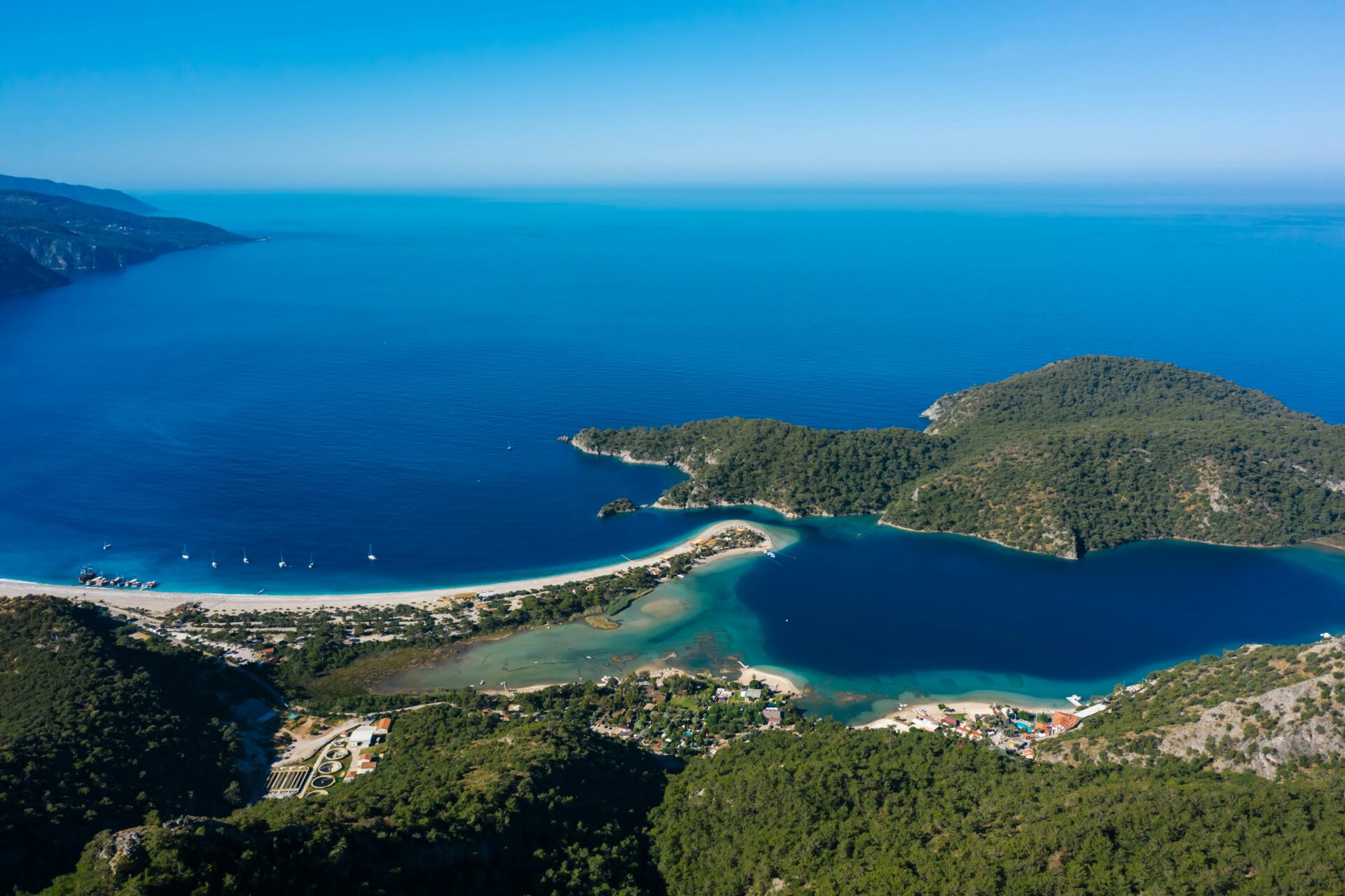
Ölüdeniz is the most photographed location on the Turquoise Coast — a lagoon of turquoise water enclosed by a spit, the mountain above the lagoon the launch point for the paragliding that has made Ölüdeniz internationally known.
The honest assessment:
The lagoon is as turquoise as the photographs. The setting — the mountain, the pine forest, the enclosed water — is genuinely extraordinary. The beach is organised, the lagoon access controlled (entry to the lagoon area: TRY 40 / £1.10), and the tourist infrastructure dense.
The paragliding:
Babadag Mountain (1,969m) above Ölüdeniz is the most accessible significant paragliding site in the Mediterranean — the tandem flights (passenger with an experienced pilot) take off from 1,969m and land on the beach 45 minutes later. The experience: the full coast visible from above, the lagoon below, the Greek islands on the horizon. Cost: £60-90 for a tandem flight. Multiple operators on the Ölüdeniz beach promenade.
The Butterfly Valley:
3km south of Ölüdeniz by boat (day trips from the Ölüdeniz waterfront, £5-8) — a valley accessible only from the sea, its name from the Jersey Tiger moth that colonises the valley in summer. The beach at the valley entrance, the waterfall visible at the back of the valley, the walk up the valley (1.5 hours to the cliff-top view) give the most specifically coastal-to-inland transition available near Ölüdeniz.
Kaş — Diving Capital
Kaş is a small town (6,000 permanent residents) on a rocky promontory above a harbour, the Greek island of Meis (Castellorizo) visible 3km across the water. The town is characterful in a way that the larger coastal towns aren’t — the old Greek quarter (the Greek population left in the 1923 population exchange), the Lycian sarcophagi embedded in the hillside above the town, and the diving industry that has made Kaş one of the Mediterranean’s most significant dive destinations.
The diving:
The waters around Kaş contain: multiple Lycian underwater ruins (the sunken buildings and walls of the ancient city, visible from the surface in some sections), World War II aircraft wrecks (a Junkers 88 bomber lies intact in 25 metres of water north of Kaş), Byzantine shipwrecks, and the specific clear-water Mediterranean ecology that the Aegean and eastern Mediterranean’s low turbidity produces.
Dive operators: Bougainville Travel, Kas Diving Centre, Sun Diving. Full PADI Open Water certification: 4 days, £250-320. Single dives for certified divers: £30-45 with equipment.
The Antiphellos theatre:
The Hellenistic theatre above Kaş town — cut into the hillside above the harbour, seating 4,000, the view over the harbour and Meis from the upper seats. Free access. The theatre in the afternoon, with the sun on the stage area and the harbour below: a specifically Kaş moment.
Kekova — The Sunken City
Kekova is an island — 7km long, 1km wide — in a protected bay east of Kaş. The Lycian city of Dolichiste (ancient Simena) was partially submerged by a series of earthquakes in the 2nd century CE, the ruins visible below the water’s surface along the island’s northern shore.
The experience:
The glass-bottomed boat from Üçağız village (the mainland village adjacent to the island): the ruins visible through the glass floor — the stairs descending into the water, the building foundations, the amphora on the seafloor. The boat passes the length of the Kekova shoreline at low speed, the ruins visible throughout. Cost: £8-12 per person for the standard glass-bottom tour.
Swimming and snorkelling above the ruins is prohibited (the site is protected), but the visibility (15-25 metres) makes the glass-bottom view adequate.
Simena Castle (Kale):
On the headland above Üçağız, accessible by water taxi — a small Crusader castle with a theatre carved into the rock below it (12 rows of seating, the smallest ancient theatre in Turkey, now used as a storage area). The view from the castle over Kekova island and the bay: the most complete Lycian coastal landscape visible from a single point.
Patara — The Longest Beach in Turkey
Patara is an ancient city on the coast between Kaş and Fethiye — the ruins include a Lycian harbour (now silted, the sand encroaching on the theatre and the triumphal arch), a Lycian lighthouse, a 2nd-century CE granary, and a 1st-century CE Roman baths complex. The site is one of the least-visited major Lycian ruins on the coast, partly because the beach immediately adjacent to the ruins is 18km long and the beach infrastructure keeps visitors on the sand rather than in the ruins.
The beach:
18km of wide, flat sand on the open Mediterranean. No development beyond a car park and a beach café. The sea turtle nesting zones marked with stakes from June through October. In June or September: almost empty for long sections. The dune system behind the beach (the Patara dunes, the highest in Turkey) visible from the sea.
The ruins:
The Patara ruins are within the protected national park area — the theatre (partially excavated, the seating intact, the proscenium façade partially standing), the arch of Modestus (the triumphal arch at the city entrance, 1st century CE, partially collapsed), and the Lycian harbour basin (now a reed-filled wetland, the outline of the ancient harbour still visible from the arch). Entry: TRY 100 / £2.75.
The Lycian Way — Walking the Coast
The Lycian Way (Likya Yolu) is a 540km marked long-distance footpath between Fethiye and Antalya — crossing the coastal mountains, descending to the sea, passing through Lycian ruins, and giving access to sections of the coast inaccessible by road.
The full route takes approximately 25-30 days to walk. Individual sections can be walked as day hikes from the coastal towns. The most celebrated sections:
Kabak to Alınca: A 15km coastal walk from the Butterfly Valley south to Alınca — the most dramatic section near Ölüdeniz, the path crossing headlands with 200m drops to the sea.
Kaş to Kalkan: 15km along the cliff above the sea, the view of Kaş and the Greek island of Meis giving way to the Kaş-Kalkan bay. One of the finest coastal walks in Turkey.
Adrasan to Olympos: 14km through the Bey Dağları Coastal National Park — the pine forest, the Chimaera (the natural eternal flame on the mountainside above Olympos, methane gas escaping through the limestone and igniting — visible at night from several kilometres), the descent to Olympos beach.
Hidden Turquoise Coast
Datça:
The town at the base of the Datça peninsula — too far from Marmaris to be a day trip destination, too isolated to receive significant independent tourism. The specific character of a coastal town that functions primarily for its own population of 13,000. The almond groves and the olive oil producers of the peninsula interior. The fish restaurants on the Datça harbour serving the morning catch. The most un-touristic town on the Turquoise Coast with a genuine harbour.
Akyaka:
A small town at the head of the Gökova Gulf — the architecture standardised by a single architect (Nail Çakırhan, who won the Aga Khan Award for Architecture for his design of Akyaka, the town’s buildings in a specific Ottoman-influenced style that gives it a visual coherence most Turkish coastal towns lack). The Azmak River (a spring-fed crystal-clear river entering the sea at Akyaka — the river at the town’s edge, the underwater vegetation visible through 3 metres of clear water, the river otters). Kitesurfing capital of the Gökova Gulf.
Olympos and the Chimaera:
The ancient Lycian city of Olympos in a canyon south of Antalya — the ruins partly visible through the dense vegetation that has overgrown the site since its abandonment (the specific atmosphere of ruins claimed back by forest, unlike the cleared and managed sites of most Lycian cities). The Chimaera (Yanartaş — “burning rock” in Turkish): on the hillside 7km from Olympos, approximately 20 flames of different sizes emerging from cracks in the limestone, the methane gas burning continuously. The flames visible by day but most atmospheric by night — the walk up from the road in the dark, the flames appearing on the hillside above, the smell of gas, the absence of any other human infrastructure.
What It Costs — Gulet vs Land-Based
Gulet Charter Costs
| Option | Cost per Person |
|---|---|
| Cabin charter (shared gulet, 7 nights) | £600–1,200 |
| Private charter (8 people sharing, 7 nights) | £375–1,000 |
| Day boat (one day) | £20–40 |
Land-Based Daily Budget
Budget (£35-50/day)
- Accommodation: pension or small hotel (£15-28/night)
- Food: local restaurants, market, meze (£10-14/day)
- Dolmuş transport: £2-4/day
Mid-range (£55-80/day)
- Accommodation: boutique hotel or marina hotel (£32-55/night)
- Food: quality restaurants, fresh fish (£18-28/day)
What 10 Days Costs from the UK
| Category | Budget (Land) | Mid-Range (Land) | Gulet (Cabin Charter) |
|---|---|---|---|
| Return flights (Dalaman) | £80–180 | £100–220 | £100–220 |
| 10 nights accommodation | £165–310 | £380–620 | Included (gulet) |
| Food (10 days) | £110–165 | £200–320 | Partly included |
| Transport | £30–55 | £45–80 | Included |
| Diving, site entries, boat trips | £60–100 | £80–140 | Partly included |
| Gulet charter | — | — | £600–1,200 |
| Total | £445–810 | £805–1,380 | £820–1,570 |
Eating on the Turquoise Coast
Meze:
The Turkish meze tradition on the Turquoise Coast reflects the Aegean-Anatolian kitchen — the cold meze (the zeytinyağlılar, the olive-oil-cooked vegetables) that are the defining experience of a Turkish seafood restaurant. The classic meze selection: tarator (walnut and bread sauce with garlic), haydari (thick strained yoghurt with mint and garlic), acılı ezme (the spiced tomato and pepper relish), patlıcan salatası (roasted aubergine salad), and the midye dolma (stuffed mussels) from the street vendors.
The fresh fish:
The Aegean and Mediterranean catch changes by season. Summer: sea bass (levrek), bream (çipura), and red mullet (tekir — the finest small fish of the Turkish Mediterranean). Autumn: the bonito (palamut) run and the various mackerel species. Winter: the turbot (kalkan) and the bluefish (lüfer).
The fish restaurant ordering: the fish is displayed on ice at the entrance, you select by pointing, the price is by weight (ask the price per kilo before confirming — the price-by-weight system can produce surprises at settling time). A whole sea bass for two at a good Kaş restaurant: approximately £20-30.
The Aegean-Turkish breakfast:
The most elaborate breakfast tradition in Turkey (significantly more developed than the southeastern or inland Turkish breakfast) — the menemen (eggs scrambled with tomato and pepper), the white cheeses of the Ege region, the olives of the Aegean olive oil culture, the honey from the wild thyme of the Taurus Mountains, and the börek (the flaky pastry of the Aegean kitchen). At a Bodrum or Fethiye breakfast restaurant (kahvaltı salonu): £6-10 per person for the full spread.
Practical Notes
Getting there: easyJet, Ryanair, Jet2, TUI from UK airports to Bodrum (BJV), Dalaman (DLM), and Antalya (AYT). Return: £80-250 depending on airport and season.
Currency: Turkish Lira. The Turkish Lira has depreciated significantly in recent years — the Turquoise Coast has become exceptional value for UK visitors as a result. Exchange at ATMs rather than at exchange bureaux; the ATM rate is better. USD and Euros widely accepted at tourist-facing businesses.
Language: Turkish. English spoken at tourist-facing businesses throughout the coast. Basic Turkish (“Teşekkürler” — thank you, “Günaydın” — good morning) is appreciated.
Gulet booking: Multiple operators in Bodrum, Marmaris, and Fethiye. The established operators (Göcek Sailing, Bougainville, Caicco Blue Voyage) have well-maintained fleets and English-speaking crew. Book 4-8 weeks ahead in summer for cabin charter, 2-4 months ahead for private charter in July-August.
Two Itineraries — Boat and Land
10 Days — Land-Based (Central and Eastern Coast)
Days 1-2: Fly Dalaman. Dalyan river boat to Lycian tombs and Iztuzu Beach. Overnight Dalyan.
Days 3-4: Drive to Fethiye. Göcek harbour and the Gulf islands by day boat. Ölüdeniz afternoon (paragliding or lagoon swim). Butterfly Valley boat trip.
Days 5-6: Drive to Kaş (2 hours). Dive or snorkel day. Antiphellos theatre evening. Kekova glass-bottom boat day trip.
Day 7: Drive Demre (Church of St. Nicholas — the original Santa Claus, buried here in the 4th century). Patara ruins and beach.
Days 8-9: Drive Antalya (2 hours from Patara). The Antalya Archaeological Museum (the finest Roman sculpture collection in Turkey, the Perge and Aspendos material). Aspendos theatre (the best-preserved Roman theatre in the world — still used for opera performances, the 2nd-century CE orchestra and stage building intact).
Day 10: Fly Antalya.
10 Days — Gulet (Blue Voyage, Marmaris to Fethiye)
Day 1: Fly Dalaman. Transfer to Marmaris. Board gulet.
Days 2-3: Sail Gökova Gulf. Bozburun Peninsula anchorages. English Harbour.
Days 4-5: Datça Peninsula. Cnidus ruins at the tip. Anchor at Palamutbükü (the finest sandy anchorage on the Datça Peninsula).
Days 6-7: Cross to Göcek. The Göcek islands. Tersane island Byzantine dockyard. Cleopatra’s Bay.
Days 8-9: Ölüdeniz from the sea. Butterfly Valley from the sea (swim in). Anchor off Kaş.
Day 10: Return to Fethiye. Disembark. Fly home from Dalaman.
Final Thought
I was on the gulet at anchor in a bay south of the Bozburun Peninsula at 6am. The pine forest came down to the water. The water was the specific turquoise that makes people distrust their own photographs.
The captain was on deck making tea — the Turkish çay, the small glass, the sugar on the side. Everyone else was still asleep below.
I swam from the stern ladder to the rocks 50 metres away and back. The water temperature was 24°C. The pine forest reflected in it.
This is the specific thing about the Turkish coast that the resort version doesn’t deliver: the private relationship with the water. The boat at anchor in a bay with no road and no other development — the forest, the water, the swimming, the tea — is an experience that requires a boat to access and that is unavailable by any other means.
The gulet is not a luxury. It is the correct technology for this coast.