
The trulli of Alberobello that look imaginary but have been housing people since the 14th century, Lecce’s Baroque so dense it becomes its own weather system, the Salento coast where the Adriatic and Ionian meet and the water is the specific turquoise that makes people argue about whether the photographs have been edited, the masserie (farmhouse estates) where the olive oil is pressed from trees older than most European nations, the orecchiette made by hand on a marble slab in the old city, and why September is the month that changes everything.
Reading time: 13 minutes | Last updated: 2025
Puglia is the heel of Italy’s boot — a long, narrow peninsula of 19,000 square kilometres, the flattest and most agricultural region in southern Italy, bordered by the Adriatic to the east and the Ionian to the south. It produces more olive oil than the rest of Italy combined. Its coastline — 800km of it — has the clearest water in the Italian peninsula. Its capital Lecce is called “the Florence of the south” for a Baroque architectural tradition so exuberant that the city appears to have been designed by someone who had access to unlimited limestone and unlimited enthusiasm for ornamentation.
September is when Puglia becomes the thing it always was. The summer crowds from the Adriatic beach resorts have thinned. The olive harvest is beginning in the masserie of the Salento plain. The wine harvest is underway in the Primitivo vineyards of Manduria. The sea is still 26°C — warmer than August in most of Europe — with a fraction of the July crowds.
The Alberobello trulli in September, early morning: the conical stone rooftops in the mist from the valley, the tourists not yet arrived from the coastal hotels. The Lecce Baroque at 6pm, when the October-approaching low sun comes in from the west and the pietra leccese stone turns from cream to gold to amber over the course of 40 minutes. The Salento coast at the Grotta della Poesia: the sea in the grotto, the Messapian inscriptions on the cave walls, nobody else.
This guide covers Puglia in September specifically and in every other month accurately.
Quick Navigation
- When to Go — The September Argument
- Getting There and Around
- Lecce — The Baroque Capital
- Alberobello — The Trulli
- The Itria Valley — Beyond Alberobello
- Ostuni — The White City
- The Salento Peninsula — The Two Seas
- The Adriatic Coast — Polignano and the Caves
- The Masserie — Olive Oil and the Farmhouse Estate
- Matera from Puglia
- Hidden Puglia
- What It Costs
- Eating in Puglia — The Cucina Povera That Became World-Famous
- Practical Notes
- The 7-Day Itinerary
When to Go — The September Argument
September and October — The Best Months
The case for September: sea temperature peaks in August but stays above 25°C through September and into October. The beach crowds (primarily Italian domestic tourism — the Puglia resorts are popular with Romans and Milanese) reduce dramatically after the August 15th Ferragosto holiday. Accommodation prices drop 30-40% in the first week of September and continue falling through October.
The olive harvest begins in October in most of the region — pressing season in the masserie means the new oil is available, the harvest is visible from the road, and the estate agriturismo operate at full capacity.
The Primitivo grape harvest (the indigenous Pugliese red wine variety, related to Zinfandel) runs September through October in the Manduria and Salice Salentino zones — winery visits are at their most active.
April to June — The Spring Window
The alternative. The wildflowers on the Salento plains (March-April), the almond blossoms, the Puglian morning light in May. Sea not yet warm enough for extended swimming (18-20°C in June — possible but brisk). The masserie and the hill towns at their most atmospheric.
July and August — Peak Season
The Adriatic coast resorts (Gallipoli on the Ionian, Otranto, Torre dell’Orso on the Adriatic) at maximum capacity. Alberobello with coach tour volume. Lecce in August afternoon heat (36-40°C). All of this is still Puglia — still extraordinary — but the specific pleasures of the region (the early mornings, the empty coast roads, the masseria dinner without a reservation fight) are less available.
The BGGD recommendation: September 1-20, immediately after the Italian summer disperses but before the autumn chill arrives.
Getting There and Around
Bari (BRI): The primary Puglia airport — Ryanair, easyJet, and Wizz Air from multiple UK airports. Return flights: £40-130. Flight time: 2.5 hours. Bari is the correct entry for the northern circuit (Alberobello, Ostuni, Matera).
Brindisi (BDS): The secondary airport, better for the Salento (Lecce is 35 minutes away). Ryanair from UK airports. Return: £40-120.
The open-jaw strategy: Fly into Bari (northern Puglia), circuit south through the Itria Valley and Salento, fly home from Brindisi. Eliminates backtracking.
Getting around: Car hire is essential. Puglia’s attractions are distributed across a large region — the public bus network connects the main towns but not the masserie, the isolated coast, or the Itria Valley trullo farms. Car hire from Bari or Brindisi: £18-30/day. The roads are excellent; the speed limits are strictly enforced on the main SS and SP roads.
The drive south: The SS16 Adriatica coastal road from Bari to Brindisi — not the fastest route but the most scenic, the Adriatic visible for much of the southern section. Budget an extra hour for the coast road versus the inland motorway.
Lecce — The Baroque Capital
Lecce is a city of 95,000 people in the deep south of Puglia — and one of the most architecturally coherent cities in Italy. The pietra leccese (Lecce stone, a soft golden limestone quarried locally) was so workable that the Baroque architects and sculptors of the 17th-18th centuries treated it essentially as carved clay — producing a city of facades so ornamentally dense that first-time visitors frequently stop in the middle of a street to process what they’re looking at.
The Florence of the south comparison is approximately correct in ambition and entirely wrong in character. Florence’s Renaissance is rational, geometric, humanist. Lecce’s Baroque is exuberant, theatrical, almost competitive — as though each church facade was trying to outdo the previous one in the quantity of saints, putti, grotesque faces, floral swags, and animal figures carved into the available stone surface.
The essential Lecce:
Piazza del Duomo: The cathedral square, enclosed on three sides by Baroque facades — the Cathedral (the full facade carved between 1659-1682, the bell tower separate and plainer, the contrast deliberate), the Bishop’s Palace, and the Seminary. The square is entered through a single archway — the effect of passing through the arch and finding the full piazza on the other side is one of the finest architectural reveals in southern Italy.
Basilica di Santa Croce: The masterpiece of Lecce Baroque — the facade of the Basilica di Santa Croce (built 1549-1695, the 146-year construction period explaining why the upper and lower sections are in different but related Baroque styles) is the densest ornamental surface in the city. The carved frieze above the portal — a continuous band of grotesque figures, animals, and plant forms in the manner of a Roman triumphal arch reinterpreted for the Baroque — is the most referenced element. The interior: cool, quieter than the facade, the carved stone continuing throughout.
The Roman Amphitheatre (Anfiteatro Romano): In the Piazza Sant’Oronzo — a 2nd-century CE Roman amphitheatre discovered during construction works in 1901, the seating partially visible below the current piazza level, the arena floor exposed. Entry free (the excavated section is visible from the piazza without entering). The specific quality: the Roman amphitheatre in the centre of a Baroque city, the column of Sant’Oronzo (the patron saint of Lecce, the column topped by his statue, the column base salvaged from the Roman Via Appia) adjacent — 2,000 years of urbanism in a single view.
The orecchiette makers: On the Via dei Monasteri in the old city — women making orecchiette by hand on marble slabs in the doorways of their houses, the small ear-shaped pasta formed by pushing a knife edge across a small piece of dough and curling it off the blade in a single motion. The technique, learned from mothers and grandmothers, visible in the street at 8am. The pasta sold directly to passers-by: £4-6 for a portion.
The Lecce light:
The pietra leccese changes colour through the day and through the season. The 5-6pm light in September (when the low sun comes from the west and the facade of the Santa Croce receives it at an angle) turns the stone from cream to gold to amber over 40 minutes. Plan specifically for this. The Lecce evening is the finest daily event in Puglia.
Alberobello — The Trulli
The trulli of Alberobello are a UNESCO World Heritage Site — a neighbourhood of approximately 1,500 trulli (conical limestone buildings, the construction technique dating from the 14th century, the conical roof formed from concentric rings of locally quarried limestone without mortar) built on the slopes of two hills divided by the Via Indipendenza.
The origin of the dry-stone mortarless construction technique: the Acquaviva family (the feudal lords of the area in the 15th century) wanted to avoid paying taxes to the Kingdom of Naples, which levied taxes on permanently constructed settlements. The agreement: build without mortar, so the buildings could be quickly disassembled when the tax collectors arrived. The communities complied for 300 years. The tax was abolished in 1797; the trulli stayed.
The two zones:
The Rione Monti (the larger zone, the main tourist circuit) and the Aia Piccola (the smaller zone, quieter, the trulli here more likely to be inhabited residences than souvenir shops). Walk the Rione Monti for the density; walk the Aia Piccola for the atmosphere.
The timing:
Alberobello in September at 7:30am: the tourist buses from Bari and the coastal hotels haven’t arrived. The valley mist from the Itria Valley sometimes fills the lower lanes while the trullo rooftops are visible above it. The single best image of Alberobello — the conical rooftops in layers against the morning sky — is available for about 90 minutes before the tours arrive.
By 10am: full. The main street (Via Monte Nero) is a continuous tourist circuit. The souvenir shops are open. The atmospheric Alberobello has become the processed version.
The rooftop symbols:
The whitewashed trullo rooftops often carry painted symbols — crosses, moons, stars, hearts, pagan and Christian symbols mixed. The symbols were applied by the peasant inhabitants as protective talismans. Their specific meaning in each case was known to the household; the general tradition of marking the roof is specific to the Alberobello tradition.
The Itria Valley — Beyond Alberobello
The Itria Valley (Valle d’Itria) surrounds Alberobello — a rural landscape of trulli farmhouses, vineyards, olive groves, and the whitewashed hill towns that characterise the masseria culture of central Puglia.
Locorotondo:
A perfectly circular hill town (the name means “round place”) above the valley — the whitewashed houses, the circular via Nardelli (the road that rings the old town), and the view from the belvedere over the valley of trulli below. The Locorotondo DOC white wine (produced from the Verdeca and Bianco d’Alessano grapes in the surrounding vineyards) is the lightest and most mineral wine in Puglia — available at every bar in the town for £2-3/glass.
Cisternino:
A hilltop village above the Itria Valley — the butcher’s shops (macellerie) that also serve as restaurants (the fornello, or grill, at the back of the shop grills the meat you select from the counter — you choose the cut, they cook it, you eat at the tables in the back or at tables set up in the lane). The Cisternino fornello experience: the most specifically Puglian eating experience outside the masseria table.
Martina Franca:
The largest town in the Itria Valley — the finest Baroque architecture outside Lecce, the historic centre centred on the Piazza Roma (the Ducal Palace, the Collegiate Church of San Martino). The Primitivo di Manduria vineyards begin south of Martina Franca — the transition from the Itria Valley wine culture to the Salento wine culture is visible in the landscape as the valley opens south.
Ostuni — The White City
On a hilltop 8km from the Adriatic coast — the città bianca, the white city, the most photographed hill town in Puglia. The whitewashed buildings have been painted white since the 15th century (the lime wash a disinfectant against plague, maintained as aesthetic tradition ever since), the walls of the old city visible from the coast road below as a white crown on the hilltop.
The view:
From the belvedere above the old city — the olive groves of the coastal plain extending to the Adriatic, the blue water visible on clear days, the endless silver-grey of the ancient olive trees covering the landscape between the hill and the sea. The Puglia olive oil landscape is the largest in the world — trees dating to 1,500 years old, some of the oldest living organisms in Europe, covered by specific Italian national heritage protection since 2019.
The coast below:
The Ostuni coast (Torre Canne, Rosa Marina) is the most accessible Adriatic beach from the Itria Valley — 15 minutes from the hill town, the water calm and clear. In September: the beach clubs still operational, the crowds reduced, the sea at peak temperature.
The Salento Peninsula — The Two Seas
The Salento is the southernmost section of Puglia — the toe of the heel of the boot, where the Adriatic meets the Ionian at the Capo di Leuca. The two seas produce different water character: the Adriatic coast (east) is rockier, wilder, the water a darker blue; the Ionian coast (west) is flatter, calmer, the water the specific lighter turquoise that produces the most intense colour arguments about photograph editing.
Otranto:
The easternmost city in Italy — a walled Aragonese city on the Adriatic with a cathedral containing the most remarkable floor mosaic in Italy (a 12th-century Tree of Life mosaic by the monk Pantaleone, covering the entire cathedral floor, depicting the months of the year, the signs of the zodiac, Alexander the Great ascending to heaven on two griffins, and the Biblical and mythological history of the world in a continuous narrative — the most ambitious floor mosaic programme of the medieval period). Entry to the cathedral: free. The Aragonese castle walls: walkable for free, the view over the Adriatic and toward Albania on clear days.
Gallipoli:
On the Ionian side — an island old city connected to the mainland by a bridge, the Baroque cathedral on the seafront, the fish market below the walls (the finest and most theatrical fish market in Puglia, the morning catch from the Ionian visible in the iced displays from 6am). The beaches of Baia Verde immediately south of the town: the most celebrated Ionian beaches in Puglia, the water genuinely turquoise in the mid-morning light.
The Grotta della Poesia:
Near Roca Vecchia, 15km north of Otranto — a sea cave in the Adriatic cliffs, accessible by steps from the road above. The walls of the cave contain approximately 2,000 inscriptions in Messapian, Greek, Latin, and other scripts dating from the 12th century BCE to the Roman period — the largest concentration of ancient graffiti in Europe, left by travellers and sailors who stopped at this coastal landmark across 1,500 years. The specific quality: entirely unmanaged, no entry fee, no interpretive panels, just the inscriptions on the cave wall and the sea below.
Santa Maria di Leuca:
The southernmost point of Puglia — the Capo di Leuca, where a plaque marks the meeting point of the Adriatic and Ionian seas. The Sanctuary of Santa Maria de Finibus Terrae (the end of the earth — the Romans considered this the southern limit of their known world) on the headland above the port. The port itself: small, quiet, the terminus of the Via Traiana Calabra (the Roman road from Benevento) marked by a Roman column in the harbour.
The Adriatic Coast — Polignano and the Caves
Polignano a Mare:
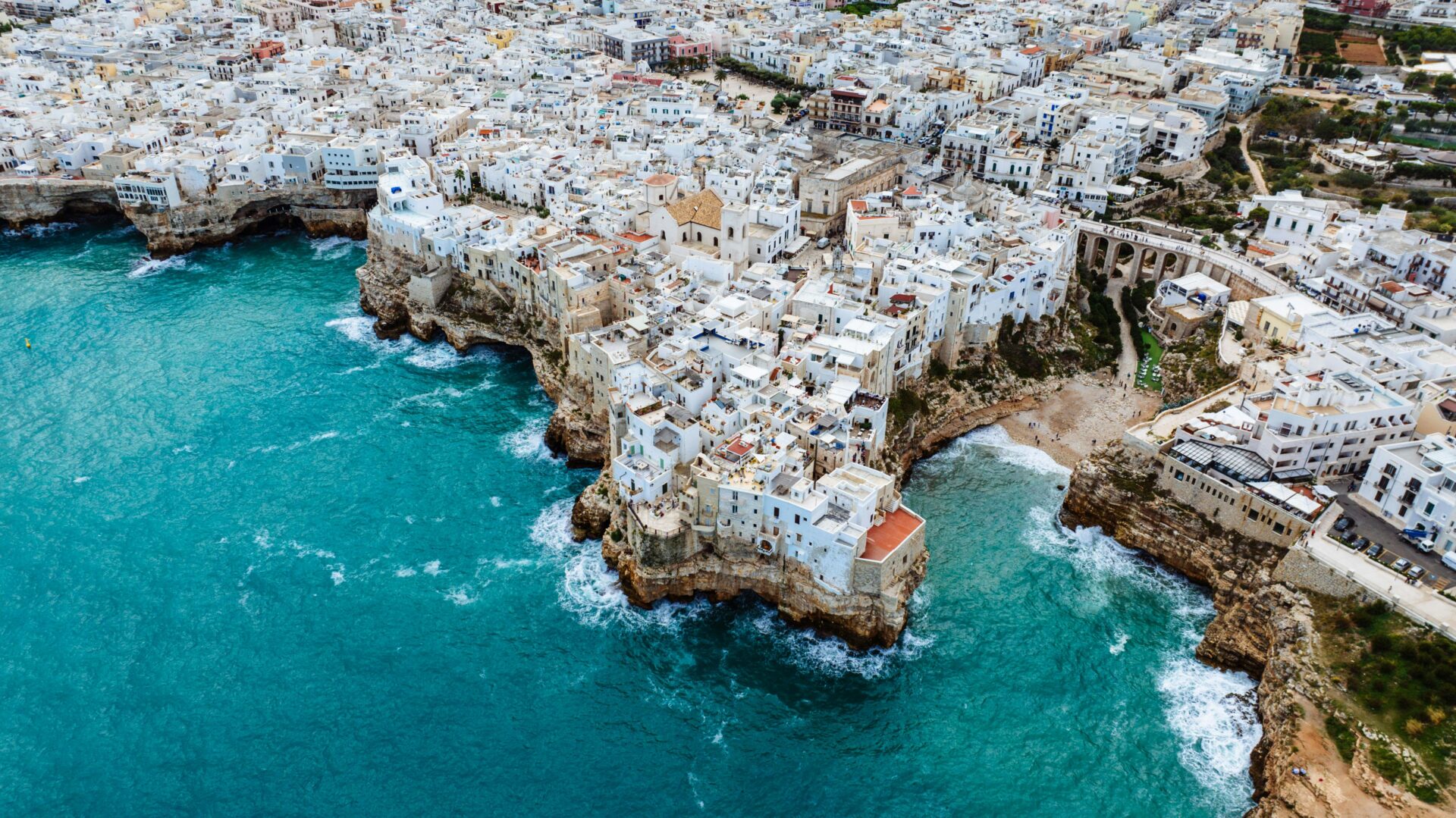
A small city 35km south of Bari, built on a cliff promontory above the Adriatic — the old city rising directly from the cliff edge, the sea visible through the lanes and between the buildings. The main beach (accessible by steps from the town) is in a cove below the cliff, the water clear and the cliff walls providing a natural amphitheatre. The view from the clifftop belvedere: the cave entrances visible in the limestone cliff face below the town, the Adriatic extending to the horizon.
The birthplace of Domenico Modugno, who wrote and performed Volare (1958) — a plaque and a statue mark the connection, the song playing from the seafront bar speakers through the tourist season.
The sea caves:
The Puglia Adriatic coast is limestone — the same geological process that produced Matera’s canyon has produced a coastline of sea caves, arches, and grottos. The caves accessible by kayak or small boat from Polignano: the Grotta Palazzese (the famous cave restaurant — dining inside a sea cave above the Adriatic, the most photographed restaurant in Italy, booking required months ahead, expensive), the Grotta delle Rondinelle (the swallows’ cave, the colony returning each September from their summer range). Kayak hire from Polignano port: £15-20/hour.
The Masserie — Olive Oil and the Farmhouse Estate
The masseria is the defining agricultural unit of Puglia — a fortified farmhouse estate built around a central courtyard, originally designed for defence against the raids that characterised the medieval and early modern period. The walls are thick limestone, the courtyard self-contained, the chapel, olive press, and accommodation all within the same enclosure.
The conversion of masserie to agriturismo (farm stays and restaurants) is the primary accommodation and food model of rural Puglia. The finest masserie grow their own olive oil (pressed in October-November from trees on the estate), produce their own wine, and serve the estate’s produce at the dinner table.
The olive oil:
Puglia produces approximately 40% of Italy’s olive oil — the quantity is staggering, the quality variable. The masseria oil (cold-pressed from the estate’s own trees, the pressing visible during the October-November harvest) is in a different category from the commercial Puglia oil: single-estate, often from specific century-old tree varieties (Coratina in the north, Ogliarola and Cellina in the south), with a bitterness and pungency at harvest that mellows over months in the bottle.
The October olive harvest visit: arrive at a masseria during pressing season, watch the olives being separated from the leaves in the centrifuge, collect the oil as it emerges from the press — green-gold, thick, intensely bitter. On bread: one of the finest £0.80 combinations available in Europe.
Accommodation:
Masseria accommodation ranges from £40/night (a simple room in a working farm agriturismo) to £250/night (a luxury estate with a pool and a chef). The mid-range (£70-120/night, typically including breakfast with estate products) is the most rewarding — the dinner at the masseria table (the fixed menu of Puglian dishes, the wine from the estate or the local cooperative) justifying the stay.
Matera from Puglia
Matera is 65km from Bari across the regional border into Basilicata — accessible as a day trip (2 hours including the bus from Bari, or 45 minutes by hire car) or as a 2-night extension from the Puglia circuit. The Matera — The Cave City Guide covers it in full. The natural pairing: Bari arrival, Matera extension, then south through Puglia.
Hidden Puglia
Trani:
A port city on the northern Adriatic coast — the Romanesque Cathedral of San Nicola Pellegrino (built 1099-1186, the finest Romanesque cathedral in Puglia, positioned directly above the sea on a promontory, the facade visible from the water), the Jewish quarter (Trani had the largest Jewish community in medieval Puglia, the former synagogues visible in the street plan and some buildings), the Castello Svevo (the Hohenstaufen castle above the port). Receives far fewer visitors than the Itria Valley and the Salento despite equivalent historical significance.
Taranto and Magna Graecia:
The southern industrial city that most Puglia itineraries skip — the Taranto Archaeological Museum (the finest Greek colonial archaeology museum in Italy, covering the Tarentine civilisation that was one of the most significant Greek colonies in the western Mediterranean) and the old city on the small island between the Mar Piccolo and the Mar Grande. The combination of heavy industry (the Ilva steel plant visible from the waterfront) and Magna Graecia archaeology gives Taranto the most complex character in Puglia.
The Foresta Umbra:
The primeval beech forest in the Gargano peninsula (the spur of Italy’s boot) — 10,000 hectares of ancient forest at 800-1,000m altitude, the highest and most isolated section of Puglia. The forest contains trees 400-500 years old, a specific flora adapted to the limestone soil, and a wildlife population (the white-tailed eagle, the honey buzzard, the roe deer) not found in the rest of the region. Accessible from Vieste or Monte Sant’Angelo on the Gargano coast.
Lecce orecchiette, differently:
The most authentic orecchiette experience in Lecce is not at the tourist-facing restaurants of the centro storico. It is at a masseria lunch (the fixed menu, the pasta made by the casa that morning, the tomato sauce from the estate tomatoes dried in August sun) or at the worker’s trattoria on the Via Merine (the industrial road south of the old city, the trattorie serving construction workers and artisans, the orecchiette with cime di rapa — turnip tops — at £5 for a full plate).
What It Costs
Puglia is exceptional value — significantly cheaper than Tuscany or the Amalfi Coast, comparable to southern Sicily, with the specific advantage that the masseria accommodation model often includes meals (breakfast always, dinner frequently) in the room price.
Daily Budgets
Budget (£40-55/day)
- Accommodation: B&B or basic agriturismo (£20-32/night)
- Food: street food, trattoria lunches, masseria dinner (£12-17/day)
- Car hire: amortised at £5-8/day per person (two sharing)
Mid-range (£65-90/day)
- Accommodation: mid-range masseria or boutique hotel (£40-65/night)
- Food: quality trattoria dinners, olive oil experiences (£20-30/day)
What 7 Days in Puglia Costs from the UK
| Category | Budget | Mid-Range |
|---|---|---|
| Return flights (Bari or Brindisi) | £40–120 | £60–160 |
| Car hire 7 days | £130–200 | £160–230 |
| 7 nights accommodation (incl. breakfast) | £175–285 | £385–580 |
| Food (7 days — many meals included) | £90–140 | £160–240 |
| Site entries (Lecce churches, Otranto cathedral) | £15–25 | £15–25 |
| Total | £450–770 | £780–1,235 |
Eating in Puglia — The Cucina Povera That Became World-Famous
Puglia’s food is the most studied and most imitated regional Italian cuisine of the past decade — the cucina povera (peasant food, the cooking of poverty and scarcity) that has become internationally fashionable for its simplicity, its vegetable focus, and its reliance on extraordinarily good raw materials.
Orecchiette con Cime di Rapa:
The defining Puglia pasta dish — orecchiette (the ear-shaped pasta, formed by hand from semolina dough) with cime di rapa (the flowering shoots of the turnip plant, slightly bitter, the bitterness essential to the dish). The pasta is cooked in the same water as the turnip shoots, the cooking water used to finish the sauce with garlic, anchovy (dissolved in olive oil), and a scattering of breadcrumbs (a Puglia tradition replacing the Parmesan that the cucina povera couldn’t afford). The specific combination: the chewy orecchiette, the bitter greens, the salty anchovy, the toasted breadcrumb. £7-10 at a good trattoria.
Fave e Cicorie:
Puréed fava beans with wild chicory — the simplest and most ancient dish in the Puglia tradition. The fava beans (dried, soaked, slow-cooked to a thick purée) dressed with olive oil and served alongside boiled wild chicory (bitter, slightly coarse, from the fields of the Salento plain). The two elements together: the specific Puglia balance of richness and bitterness that runs through the whole cuisine.
Bombette:
The Cisternino fornello preparation — a small roll of pork (or horse, or goat in some versions) stuffed with caciocavallo cheese and parsley, then threaded on a skewer and grilled over wood fire. The cheese inside melts and runs as the outside chars. Available at the Cisternino butcher-restaurants from noon: £1.50-2 each, three is a portion.
Burrata:
The cheese that Puglia gave to the world and that the world has since produced in inferior versions everywhere. The Andria burrata (the original, from the Murge plateau city of Andria) — a shell of fresh mozzarella curd enclosing stracciatella (mozzarella shreds in fresh cream). The correct burrata is consumed within 24-48 hours of production, slightly warm, torn open rather than cut, dressed with only olive oil and sea salt. At a Puglia dairy cooperative or masseria: £2-3 for a full burrata. The burrata in London, Paris, or New York: a different product with the same name.
Primitivo and Negroamaro:
The two great red wine grapes of Puglia. Primitivo (related to Zinfandel, producing deep, warm, high-alcohol reds from the Manduria and Gioia del Colle zones — the most internationally known Puglia wine). Negroamaro (the “black bitter” grape of the Salento — producing reds of significant depth and a specific dried-fruit quality from the Salice Salentino and Copertino zones). At a Salento enoteca: £3-5/glass, £8-14/bottle of wine from a producer you’ve never heard of and which is better than wines costing four times as much from regions you have.
Practical Notes
Getting there: Ryanair, easyJet, Wizz Air from UK airports to Bari (BRI) and Brindisi (BDS). Return flights: £40-130. Flight time: 2.5 hours. Bari for the northern circuit; Brindisi for the Salento.
Car hire: Essential. Bari airport operators (Europcar, Hertz, Avis, local operators) are competitive — book in advance online for better rates. Driving in Puglia is the most pleasant in Italy: straight roads, light traffic outside the coastal resorts, the olive grove landscape on both sides.
Currency: Euro. Cards widely accepted. Cash useful at masserie, market stalls, and the Cisternino fornello.
Language: Italian (and the Griko dialect in some Salento villages — a Greek dialect surviving from the Greek colonial period, still spoken by a few hundred elderly people in the nine Greko villages of the Salento, the most specific linguistic survival in Italy).
The masseria booking: The finest masserie (Masseria Torre Coccaro, Masseria Il Frantoio, Masseria Montenapoleone) book out 4-6 weeks ahead in September. Book ahead.
The 7-Day Itinerary
Day 1: Bari + Polignano a Mare Arrive Bari. Collect hire car. Polignano a Mare afternoon (the clifftop old city, the sea caves by kayak). Night Polignano or continue south.
Day 2: Alberobello + Itria Valley 7am: Alberobello. The trulli before the tour buses. Locorotondo coffee and white wine. Cisternino fornello lunch. Afternoon: Martina Franca old city. Night in the Itria Valley (masseria or agriturismo).
Day 3: Ostuni + Adriatic Coast Ostuni old city morning. The olive groves below. Adriatic coast afternoon (Torre Canne or the beaches south of Ostuni). Night Ostuni area.
Day 4: Drive South to Lecce Morning: the coastal road or inland through the olive groves. Arrive Lecce by noon. Piazza del Duomo. Santa Croce facade at 5:30pm (wait for the light). Night Lecce.
Day 5: Lecce + Otranto Morning Lecce: the Roman amphitheatre, the Baroque streets, orecchiette making on Via dei Monasteri. Afternoon: Otranto (1 hour south) — the cathedral mosaic, the castle walls, the Adriatic. Night Otranto or return Lecce.
Day 6: Salento — The Two Coasts Morning: Gallipoli on the Ionian (the fish market at 7am, the old city, Baia Verde beach). Capo di Leuca afternoon (the southernmost point). The Grotta della Poesia (north of Otranto on the return — the Messapian inscriptions). Night Lecce area.
Day 7: Departure Brindisi (35 minutes from Lecce). Morning market or final pastry at a Lecce bar. Return car. Flight home.
Final Thought
I was at the Santa Croce at 5:50pm on a September evening. The sun was 40 minutes from the western horizon, coming in from the via that runs west from the facade. The pietra leccese was cream.
Then the light hit it.
The change takes approximately 4 minutes to complete — the stone moving from cream to gold to a specific amber that exists between the two, the carved figures on the facade acquiring depth as the shadows lengthen, the grotesque faces on the frieze becoming more alive as the light angle increases.
I had read about this. I had seen photographs of it. Neither prepared me for the specific quality of standing in front of a 17th-century limestone facade in southern Italy while it changed colour in front of me.
Puglia does this repeatedly — produces moments that are more than the sum of what you were told to expect. The trulli in the morning mist. The burrata torn open with the cream running onto the plate. The olive oil, green-gold and intensely bitter, on bread still warm from the masseria kitchen.
September is when all of it is available without negotiating a crowd for it.
That is the season. Go then.