
The complete guide for travellers: the volcanic caldera that will rearrange your understanding of scale, whale watching from a converted watchtower that tracked sperm whales for the 19th-century industry, swimming in geothermally heated ocean lagoons, the world’s only tea plantation outside Asia, a lake inside a volcano crater that changes colour with the weather, and why the Azores are the finest mid-Atlantic stop on Earth.
Reading time: 13 minutes | Last updated: 2026
The Azores sit in the middle of the Atlantic Ocean — 1,500km from Lisbon, 3,900km from New York — on the boundary where the North American, Eurasian, and African tectonic plates meet. The islands are volcanically active. The landscape is a direct product of this: calderas large enough to contain lakes, geothermal pools where the sea is heated by volcanic activity below, black basalt coastal cliffs above the Atlantic, and the specific vivid green of pastures that receive rain 150 days a year fed by the moisture of the ocean surrounding them.
There are nine islands. Most visitors go to São Miguel. This guide covers São Miguel properly — including the things most day-tour itineraries miss — and makes the case for the other islands that deserve more than a footnote.
The Azores are Portuguese territory and have been since their discovery in the 15th century. Flying time from London: 3 hours. No visa required. The EU guarantee of mobile data roaming. Hotels and guesthouses at prices that reflect the relatively modest Portuguese tourism economy rather than the international luxury positioning that the landscape would command if this were more famous.
The window for visiting the Azores before the prices fully adjust to international awareness is shorter than for Albania — the Azores are already known, already on the lists. But the infrastructure growth hasn’t yet absorbed all the landscapes. The western islands (Flores, Corvo) still have almost no tourist infrastructure. The central islands (Faial, Pico, São Jorge) still feel like the Azores of 20 years ago.
Go to São Miguel first. Then go back for the others.
Quick Navigation
- The Case for the Azores
- When to Go — Atlantic Weather Realities
- Getting There — The Mid-Atlantic Routing
- São Miguel — The Green Island
- Sete Cidades — The Twin Lakes in the Caldera
- Furnas — Geothermal Cooking and the Hot Springs
- Nordeste — The Forgotten Corner
- Whale Watching — The Atlantic Sperm Whales
- Pico — The Volcano and the Wine
- Faial — The Blue Island
- São Jorge — The Cheese and the Fajãs
- Flores — The Western Island
- What It Costs — Real Numbers
- Eating in the Azores — Volcanic Stew and Atlantic Fish
- Practical Notes
- The 7-Day Itinerary — São Miguel
The Case for the Azores
The Azores are not a standard European destination in any sense. The landscape is not Mediterranean (no olive trees, no cypress, no terracotta roofs). It is North Atlantic — the vivid green of permanent rain-fed pastures, the black basalt walls that divide the fields, the hydrangeas along every road that bloom blue from July through September, the mist that descends from the volcanic peaks at any time of year and gives every landscape a quality that is hard to photograph adequately.
The islands produce: dairy (the finest butter in Portugal, the finest cheese in the Azores — specifically the São Jorge cheese, aged in the humid sea air of the island, a semi-hard cheese of great character), tea (the world’s only tea plantation outside Asia operates on the slopes of São Miguel, planted by the Portuguese in the 19th century and still producing), and the cetaceans that the 19th-century whaling industry came specifically to find. The sperm whales that were hunted from these islands are now watched from the same observation towers that the whalers used — the vigia, or lookout, positioned on the clifftops to spot the spouts.
The Azores are the closest piece of land to the Mid-Atlantic Ridge — the underwater mountain range where the tectonic plates create new ocean floor. You can stand on the boundary of two tectonic plates at Sintra das Furnas, 200km off the coast of São Miguel, where the African and North American plates meet above the ocean surface for the first time.
This is genuinely extraordinary geology made accessible within a 3-hour flight.
When to Go — Atlantic Weather Realities
The Azores have an Atlantic climate — mild year-round (15-25°C across the island group regardless of season), but variable. Rain can arrive on any day of any month. The joke: if you don’t like the weather in the Azores, wait 20 minutes.
June to September — The Best Chance of Sustained Good Weather
The most reliable period for clear skies, though still variable. Sea temperatures reach 22-24°C in August — swimmable without a wetsuit. Whale watching is most productive from April through October (sperm whales are present year-round, but the peak season for variety — blue whales, fin whales, sei whales in addition to the resident sperm whales — is May through September).
October to May — The Other Azores
Quieter, greener, cheaper. The hydrangeas are not in bloom (July-September for those). The whale watching continues through winter for sperm whales. The calderas are more frequently in cloud. The geothermal sites (Furnas, Caldeira das Sete Cidades) are more atmospheric in the mist. Accommodation prices drop 20-30%.
The BGGD recommendation: May for the best combination of the whale variety, reasonable weather, and shoulder-season prices. September for the hydrangeas and the warm sea.
Getting There — The Mid-Atlantic Routing
To São Miguel (Ponta Delgada, PDL):
SATA Air Azores and Ryanair serve Ponta Delgada from London (Stansted). easyJet flies seasonally from several UK airports. TAP Air Portugal flies via Lisbon (adding 2 hours total but with better availability). Return flights: £100-200 in shoulder season, £150-280 in peak.
Flight time from London: 3 hours.
Getting to the other islands:
SATA operates inter-island flights (30-45 minutes to most islands, from £30-80 one way). The inter-island ferry (Atlânticoline) connects the central group (São Miguel, Terceira, Faial, Pico, São Jorge, Graciosa, Santa Maria) — slower (2-9 hours depending on route) but the experience of approaching the volcanic peaks from the sea is significant.
Car hire on São Miguel:
Essential. The island’s volcanic landscape is navigable without a car using the local bus network but the routes to Sete Cidades, Nordeste, and Furnas require either a hire car or an organised day tour. Car hire from Ponta Delgada: £25-40/day.
São Miguel — The Green Island
São Miguel is the largest island in the Azores — 65km long, 16km wide, a volcanic island with two active calderas (Sete Cidades to the west, Furnas to the east), a central mountain range, and the capital city of Ponta Delgada on the southern coast.
The island’s colour is the specific vivid green of permanent rainfall on volcanic soil — every hillside, every valley wall, every field is a different shade of green. Against this, the black basalt walls and the blue hydrangeas in summer give the landscape a palette that photographs consistently and looks unlike anywhere else in Europe.
Ponta Delgada:
The capital — a city of 70,000 people on the southern coast with the finest 18th-19th century Portuguese architecture in the Azores. The Portas da Cidade (the baroque city gates, the most photographed single object in the Azores — three connected arches of whitewashed limestone in the main square), the Church of São Sebastião, and the Carlos Machado Museum (natural history and Azorean art, the finest collection on the island) are the city’s primary attractions.
The Mercado da Graça: the city market, open daily, selling the Azorean produce — the São Miguel tea (the island’s own production from the Gorreana and Porto Formoso plantations), the local cheeses, the Azorean pineapple (a small, intensely sweet greenhouse-grown pineapple, entirely different from the tropical varieties — a 19th-century cultivation that has become an Azorean specialty).
Sete Cidades — The Twin Lakes in the Caldera
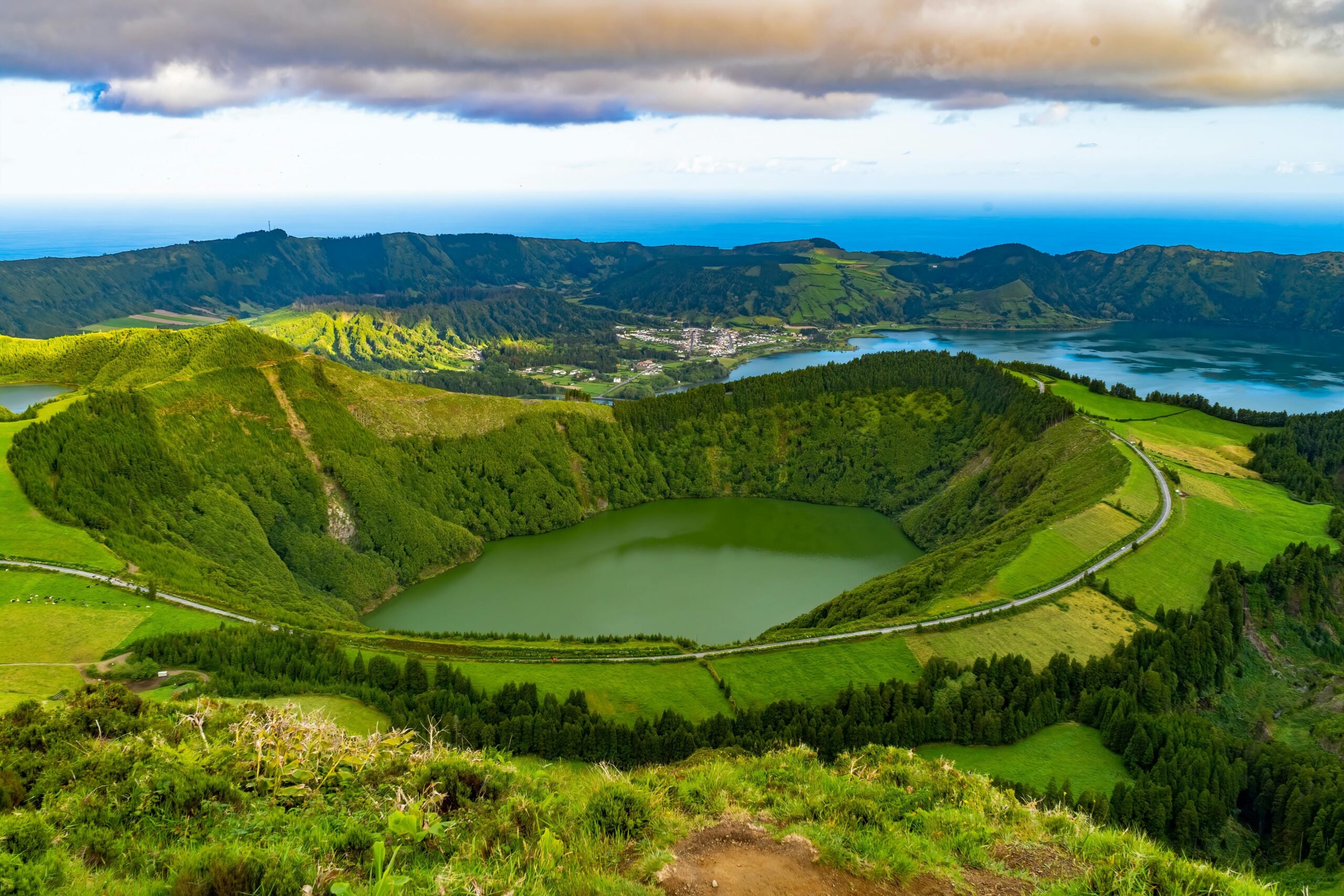
Sete Cidades is a volcanic caldera 10km across in the western end of São Miguel — containing two lakes (the Lagoa Verde and the Lagoa Azul — the Green Lake and the Blue Lake, named for the different algae concentrations that give them different colours in different lights) at 217m above sea level.
The lakes are connected by a bridge. From the bridge: the green lake on one side, the blue lake on the other, the caldera walls rising 300m above both. The explanation for the colour difference is meteorological (the two lakes face different directions and receive different amounts of light and rainfall) and mineral (slight differences in the mineral composition of the caldera water). The visual effect is extraordinary.
The Vista do Rei viewpoint:
On the caldera rim above the lakes — the most famous single viewpoint in the Azores, accessible by road from the village of Sete Cidades. The view from the rim gives the full scale of the caldera: the twin lakes below, the village between them, the Atlantic visible through the western gap in the caldera walls.
At dawn, before the cloud arrives in the caldera: the view is clear for approximately 30-45 minutes. After that, cloud fills the caldera from the ocean side and the lakes disappear. Go early.
Walking the caldera rim:
A 12km circular walk around the caldera rim, accessible from Sete Cidades village. The walk gives alternating views of the lake interior and the Atlantic coast below the outer caldera walls. No technical difficulty; the path is well-marked. 4-5 hours. Views continuously.
Furnas — Geothermal Cooking and the Hot Springs
Furnas is the active geothermal area in the eastern caldera of São Miguel — a village in a volcanic depression where fumaroles (steam vents), boiling mud pools, and hot springs are accessible within the village limits.
The Caldeiras (Fumarole Field):
A walkway through the active geothermal area — sulphur fumaroles releasing steam continuously, mud pools bubbling at 100°C, the smell of hydrogen sulphide that is specific to active volcanic areas. Entry: free. The specific experience: standing 2 metres from boiling mud at a temperature that would cook food within it.
Which is exactly what happens.
Cozido das Furnas:
The specific Furnas dish — a meat and vegetable stew (cozido, the Portuguese national stew) cooked in sealed ceramic pots lowered into the volcanic ground at the fumarole field, cooking at 100°C for 6-8 hours in the geothermal heat. The pots are lowered in the morning; the stew is served for lunch at the restaurants adjacent to the caldeiras. The flavour: a slow-cooked stew from volcanic heat, served in a volcanic landscape. One of the most geographically specific meals available in the Atlantic. At any Furnas restaurant serving the volcanic stew: £8-14/person.
The Thermal Pools:
Several thermal swimming areas in and around Furnas. The Terra Nostra Garden (entry £9): a thermal pool fed by naturally heated water (39°C, iron-rich, the water an amber-orange from the mineral content) within a botanical garden of remarkable quality — tropical and subtropical plants from across the Portuguese colonial world, the largest collection of tree ferns in Europe. Swimming in the iron-rich orange water surrounded by 200-year-old cycads and tree ferns: the most specific spa experience available in the North Atlantic.
Nordeste — The Forgotten Corner
The northeastern corner of São Miguel — the oldest geological section of the island (volcanic activity has been absent here for 20,000 years) and the most vegetated, the most remote, and the least visited by the day-tour circuits from Ponta Delgada.
The landscape: the Nordeste coast is a series of cliffs and headlands covered in hydrangeas in summer, the Atlantic visible 300m below. The Miradouro da Ponta do Sossego (the finest viewpoint on the eastern coast — hydrangea-covered cliffs, the ocean, the peace that the absence of tour buses creates) and the Miradouro da Madrugada are the centrepieces.
The village of Nordeste: the easternmost village of São Miguel, with a small church, the municipal market open on Saturdays, and the specific quietness of a town at the far end of an island that is not the main attraction. Driving to Nordeste from Ponta Delgada along the northern coast: 45 minutes, one of the finest coastal drives in the Azores.
Whale Watching — The Atlantic Sperm Whales
The Azores are one of the finest whale-watching destinations in the world — the deep Atlantic waters around the islands sustain year-round populations of sperm whales (the resident cetacean, present 12 months a year), with migratory species (blue whale, fin whale, sei whale, humpback whale, common dolphin, striped dolphin, Risso’s dolphin, and bottlenose dolphin) passing through seasonally.
The specific Azorean context: the whale-watching operations use the same clifftop vigias (lookout stations) that the whaling industry used in the 19th century. The lookouts — positioned on headlands above the ocean to spot the spouts of surfacing whales — gave the whaling boats time to row out to intercept. Now they give the whale-watching boats time to position for the encounter.
The encounter:
A typical sperm whale encounter involves the whale spending 45-60 minutes at depth, then surfacing for 8-12 minutes before diving again. The surface interval: the whale breathing continuously, the distinctive angled blow, the muscular back rolling through the surface, the fluke lifting as the animal re-enters the deep dive. A 12-metre sperm whale weighs approximately 11 tonnes — the scale of the animal at 10 metres from the boat is categorically different from photographs.
Operators:
Futurismo (futurismo.pt) and Whale Watch Azores (whalewatchazores.com) are the most established operators from Ponta Delgada. Half-day trips: £50-65/person including binoculars, hydrophone (underwater microphone to hear the whale’s sonar clicks), and a biologist on board. Guarantee policy: most operators offer a free return trip if no cetaceans are sighted.
The sighting probability:
Sperm whales: 95%+ on most trips from April through October. Blue whales: highest probability May-June. The specific combination of deep Atlantic water close to the islands and the upwelling of nutrients at the Mid-Atlantic Ridge creates one of the most reliable cetacean watching environments in the world.
Pico — The Volcano and the Wine
Pico is the second-largest island of the Azores and home to the highest peak in Portugal — Ponta do Pico at 2,351m, a dormant but geologically young (the last eruption was approximately 1,000 years ago) volcano that rises directly from the sea to its full height in a single slope.
Climbing Pico:
The ascent from the base of the cone (accessed by a road from Madalena, the main town) takes 3-4 hours. The final section — the summit caldera and the Piquinho (the secondary peak within the caldera) — requires scrambling over volcanic rock. A guide is mandatory for the upper mountain above the first cone (book through the Mountain Group of Pico, available at registration — £15/person for the guided summit section).
The view from the summit: on clear days, five of the other Azorean islands visible simultaneously, the Atlantic in every other direction.
The Pico Wine Landscape:
The basalt landscape of the Pico coastline — walls of black volcanic rock dividing the land into small plots (currais), within which vines are grown low to the ground to be protected from the Atlantic wind — is a UNESCO Cultural Landscape since 2004. The Verdelho grape produces the most distinctive Pico wines: dry white wines of mineral character, the volcanic soil giving a specific salinity. The Pico wine co-operative (Cooperativa Vitivinícola da Ilha do Pico) offers tastings.
Faial — The Blue Island
Faial is named for the Portuguese beech tree (faia) and nicknamed the Blue Island for the hydrangeas that cover every road and hillside in summer. The capital, Horta, is the famous waypoint for transatlantic sailors — the Café Sport (Peter’s Bar) in the harbour has been the meeting point for Atlantic sailors since 1918, the walls covered in yacht club flags from expeditions across two centuries.
The Capelinhos Volcano:
The westernmost point of Faial — a volcano that erupted from the sea between 1957 and 1958, adding 2.4 square kilometres of new land to the island and burying the Capelinhos Lighthouse in ash and lava. The landscape: black volcanic ash and basalt, the lighthouse still buried to the top of its tower, the new land eroding slowly back into the sea since the eruption ended. The Capelinhos Interpretation Centre (underground, built into the volcanic deposits) covers the eruption and its impact. Entry: £7.
The eruption happened living memory ago. The landscape looks like it happened last week.
São Jorge — The Cheese and the Fajãs
São Jorge is a long, thin island (55km by 8km) in the central group — a volcanic ridge rising to 1,053m, the sides falling steeply to the sea. The specific geological feature: the fajãs — flat coastal platforms created by ancient lava flows and rockfalls at the base of the coastal cliffs. Many of these fajãs are inhabited by small communities accessible only by foot (a 2-hour descent from the road above) or by boat.
The São Jorge Cheese:
A semi-hard cheese of Protected Designation of Origin status, made from the raw whole milk of the island’s cows, aged for 3-12 months in the humid sea air. The character: grassy, slightly acidic, becoming spicier and more complex with age. The 12-month cured version is among the finest cheeses in Portugal. Available from cheesemakers on the island and from every market in the Azores. Buy it on São Jorge, where the prices reflect production rather than distribution.
The Fajã dos Cubres:
The most accessible of the São Jorge fajãs — a lagoon formed between the lava platform and the ocean, with a freshwater and saltwater interface where endemic species have evolved. The path descends 300m from the road to the fajã floor (45 minutes). At the bottom: the lagoon, the volcanic black sand, the community of a handful of families who have lived on the fajã for generations.
Flores — The Western Island
Flores is the westernmost island of the Azores — 250km west of the central group, 400km east of the Mid-Atlantic Ridge. The most remote and least visited of the main inhabited islands.
The island: the wettest in the Azores (the western exposure to the Atlantic brings more rainfall), with waterfalls falling directly into the sea at multiple points around the coast, volcanic lake calderas in the interior, and the specific atmospheric quality of a place that sees perhaps 15,000 visitors per year.
The Fajã Grande waterfall (accessible by a short path from the western coast road) falls 80 metres directly onto a black sand beach. No tourist infrastructure. Almost no visitors. The sound of the waterfall and the Atlantic simultaneously.
Getting to Flores: SATA flight from São Miguel (45 minutes, from £40 one way) or inter-island ferry (9 hours from Faial). The effort is the point.
What It Costs — Real Numbers
The Azores are mid-range for a European island destination — more expensive than mainland Portugal, cheaper than the Canary Islands resorts, broadly comparable to Madeira.
Daily Budgets
Budget (£40-55/day)
- Accommodation: guesthouse or guest house (£25-38/night)
- Food: local restaurants, market purchases (£10-15/day)
- Car hire essential (£8-12/day per person for two sharing)
Mid-range (£65-90/day)
- Accommodation: boutique hotel or rural house (£40-60/night)
- Food: restaurant dinners (£18-28/day)
- Whale watching tour (amortised across the trip)
What 7 Days in the Azores Actually Costs from the UK
| Category | Budget | Mid-Range |
|---|---|---|
| Return flights (direct, London-PDL) | £100–200 | £130–240 |
| Car hire 7 days | £175–250 | £200–280 |
| 7 nights accommodation | £195–300 | £320–490 |
| Food (7 days) | £80–120 | £135–210 |
| Whale watching | £55–65 | £65–80 |
| Terra Nostra Garden | £9 | £9 |
| Total | £614–944 | £850–1,309 |
Eating in the Azores — Volcanic Stew and Atlantic Fish
Azorean cuisine reflects two things: the volcanic landscape (the geothermal cooking, the mineral-rich produce) and the Atlantic (the fish, the seafood, the dairy from cattle that graze on rain-fed pastures).
Cozido das Furnas: Already described above — the definitive Azorean dish, cooked geothermally. £8-14/person.
Lapas (Limpets):
Limpets grilled on a lava rock griddle with garlic and butter — the most ubiquitous appetiser in the Azores. The limpets are collected from the black basalt coastal rocks, grilled open-side-up until the flesh is just cooked, doused with garlic butter and lemon. The Atlantic limpet is larger, meatier, and more intensely flavoured than anything sold in UK shops. At any Azorean restaurant: £4-7 for a full plate.
Alcatra:
A beef stew from Terceira island — beef slow-cooked in red wine with blood sausage (chouriço de sangue), lard, and spices, served in the clay pot it was cooked in. The wine gives a depth to the broth; the clay pot maintains the heat at table. Available on Terceira and increasingly in São Miguel restaurants.
Azorean Pineapple (Ananas dos Açores):
A small, greenhouse-grown pineapple cultivated in São Miguel since the 19th century. The specific character: intensely sweet, aromatic, significantly more complex than the large tropical pineapples of the commercial trade. Available from the market in Ponta Delgada. One whole pineapple: £3-5.
Gorreana and Porto Formoso Tea:
The only tea plantations in Europe — established in São Miguel in 1883. Gorreana (the larger plantation, with a visitor centre and shop) produces green, black, and orange pekoe teas from plants grown on the volcanic hillsides. The tea has a specific mineral quality from the volcanic soil. A box of Gorreana green tea at the plantation shop: £3-5. The plantation walk: free.
Practical Notes
Visa: No visa required for UK passport holders. The Azores are Portuguese territory and EU member state territory. Portuguese passport control.
Getting there: SATA Air Azores and Ryanair direct from London Stansted to Ponta Delgada. easyJet seasonal service from various UK airports. TAP via Lisbon. Return flights: £100-280.
Currency: Euro. ATMs in all island capitals. Card acceptance good in hotels and restaurants; cash useful in smaller village restaurants and markets.
Car hire: Essential on São Miguel and most other islands. Roads are good; the caldera viewpoint roads can be narrow. Left-hand driving (Portuguese system).
Inter-island transport: SATA flights (30-45 minutes between most islands, £30-80 one way). Atlânticoline ferry (2-9 hours depending on route). Ferry is the more atmospheric but significantly slower option.
Weather: Variable at all times of year. Pack waterproofs regardless of the season. The mist on Sete Cidades can arrive in 15 minutes. Both layers of weather — clear and misty — produce extraordinary landscapes.
The 7-Day Itinerary — São Miguel
Day 1: Arrive Ponta Delgada Land, car hire. Afternoon: the city — Portas da Cidade, the Mercado da Graça. Evening: first Azorean dinner in the Rua do Aljube restaurant area.
Day 2: Sete Cidades 5:30am: Vista do Rei viewpoint before the cloud arrives. Walk down into the caldera to the bridge between the lakes. Caldera rim walk (4-5 hours). Return Ponta Delgada.
Day 3: Furnas Drive east to Furnas (45 minutes). Terra Nostra Garden (thermal pool and botanical garden). Caldeiras fumarole field walk. Lunch: Cozido das Furnas at Tony’s restaurant or O Miroma. Afternoon: Lagoa das Furnas (the caldera lake, fumaroles visible at the lake edge).
Day 4: Whale Watching Morning departure (8am) from Ponta Delgada. Half-day whale watching (returns by 1pm). Afternoon: Gorreana tea plantation (30 minutes northeast of Ponta Delgada). Tea tasting.
Day 5: Nordeste Circuit Drive the northern coast to Nordeste (1 hour). Miradouro da Ponta do Sossego. Miradouro da Madrugada. Lunch in Nordeste village. Return via the southeastern coast.
Day 6: Free Day Options: Lagoa do Fogo (a volcanic lake in the interior, 45-minute walk from the road), the Ribeira Grande thermal pools (north coast, free public pools), or a full day around Ponta Delgada.
Day 7: Departure Morning: any remaining items. Return car. Flight home.
Final Thought
I was at the Vista do Rei at 6am. The caldera below was still in darkness — the sun hadn’t cleared the eastern rim. Then, gradually, the lakes appeared as the light dropped from the rim to the water. Green on one side, blue on the other, the village between them on the connecting bridge.
Then the cloud arrived. In 10 minutes the lakes were gone.
This is the Azores in full: the extraordinary view available for exactly as long as the Atlantic weather permits, and not a moment longer. You have to be there at the right time and you have to be paying attention and you have to be willing to get up before the sun does.
The reward when the timing is right: one of the finest landscapes in the Atlantic world, in the middle of the ocean, 3 hours from London, inside a volcanic caldera that was erupting 10,000 years ago and will erupt again.
Set the alarm. Drive up before dawn. Wait.
Question about the Azores this guide doesn’t cover? Drop it in the comments.