
The complete guide for travellers: Lake Bled at 6am before the boats go out, the Soča River’s turquoise that you will attempt to photograph and fail to capture, Triglav National Park and the Bohinj Valley that most visitors drive past on the way to somewhere more famous, Piran’s Venetian coastline, the cave salamander that has been living in the dark for 100 years, Ljubljana’s old city in two days without rushing, and how Slovenia does all of this for £45/day.
Reading time: 14 minutes | Last updated: 2026
Slovenia is the size of Wales.
In that area: the Julian Alps (the southernmost range of the Eastern Alps, peaks above 2,800m), two UNESCO World Heritage Sites, Europe’s most turquoise river, a coastal city that was Venetian for 500 years and looks it, a cave system 24km long with a blind salamander that is the longest-living cave animal in the world, and a capital city with a restored medieval quarter, a castle on a hill, a covered market designed by Jože Plečnik (the Slovenian architect who is to Ljubljana what Gaudí is to Barcelona), and more outdoor café tables per resident than anywhere else in Europe.
It is also — and this is the point that converts most travellers from “interested” to “booked” — almost entirely unknown to UK visitors who aren’t specifically seeking it. The Bled photograph is famous; the rest of Slovenia isn’t. The Bohinj Valley (5km from Bled, a longer lake, fewer tourists, mountains that look the same) receives a fraction of the visitors. The Soča Valley — widely considered by the travellers who reach it to be among the most extraordinary natural landscapes in the Alps — appears in almost no mainstream UK travel content.
Slovenia is the best-value Alpine destination in Europe. The flights cost what budget European flights cost (£60-100 return from London). The accommodation costs what accommodation costs in the Western Balkans rather than Switzerland or Austria. The food is Mitteleuropean in quality and Slovenian in price. And the landscapes compete with anything in the Alps at a fraction of the visitor density.
This guide covers it all — the famous and the overlooked, in the right order.
Quick Navigation
- The Case for Slovenia — The Alps You Don’t Know
- When to Go — Four Seasons, Four Slovenias
- Getting There — Multiple Options
- Ljubljana — The Capital in Two Days
- Lake Bled — The Photograph Earns Itself
- The Bohinj Valley — Bled Without the Crowds
- Triglav National Park — The National Symbol
- The Soča Valley — The Turquoise River
- Kobarid and the World War I History
- Postojna Cave — The Underground World
- Predjama Castle — The Cliff Face Fortress
- Piran — The Venetian Coast
- The Karst Region — Wine and Underground Rivers
- Hidden Slovenia — The Places Most Guides Don’t Reach
- What It Costs — Real Numbers
- Eating in Slovenia — The Mitteleuropean Kitchen
- Practical Notes
- The 7-Day Itinerary — Ljubljana, Alps, Soča, Coast
The Case for Slovenia — The Alps You Don’t Know
The comparison that most accurately frames Slovenia’s position is this: Switzerland and Austria are the Alps most UK travellers know. Slovenia is the Alps with similar natural beauty, better cuisine at lower prices, a more walkable capital city, and 80% fewer tourists.
The specific numbers: Austria receives approximately 32 million tourists per year. Switzerland receives 22 million. Slovenia receives approximately 4 million — and half of those are day-trippers from Italy, Croatia, and Austria. The international visitor count is tiny relative to the country’s attractions.
Slovenia was designated the first country in the world to be a “green destination” — in 2016, the country was awarded the European Commission’s European Destinations of Excellence for sustainability across its entire national territory, not just specific sites. 90% of the country is covered by green tourism accreditation. The national park, the rivers, the forests, and the coastline are all managed under conservation frameworks that have maintained their quality across decades of gradual tourism growth.
The practical case: direct and indirect flights from the UK, a country where English is spoken almost universally by the under-50 population (Slovenia was part of Yugoslavia; the educational shift to English came early), and a road network that makes the entire country navigable in 3-4 hours at most.
When to Go — Four Seasons, Four Slovenias
June to September — Summer
The Alpine lakes (Bled and Bohinj) are swimmable — the water temperature reaches 22-24°C in July-August. The Soča River for white water rafting is at its best flow. All hiking trails in Triglav are open. Piran and the coast are at their Mediterranean best. Peak season for accommodation — book ahead, particularly for Bled.
October to November — Autumn
The finest season for Ljubljana and the inland areas. The Bohinj Valley turns vivid orange and gold as the beech forests change. The tourist density drops to a fraction of summer. The mountain huts close after October; the higher Triglav routes require equipment.
December to March — Winter
The Slovenian ski season — Kranjska Gora and Vogel (above Bohinj) are the main ski areas. The Julian Alps under snow produce a landscape entirely different from the summer version. Lake Bled in winter: occasionally frozen, always quieter than summer, the Bled Castle’s view over the snowy landscape is extraordinary. Christmas markets in Ljubljana from late November.
April to May — Spring
Waterfalls at their most powerful (the snowmelt running through the limestone terrain). The Soča River at its highest water volume (magnificent visually; the white water is stronger than summer). Ljubljana in spring — the outdoor terraces opening, the food market on the riverbank at its freshest.
The BGGD recommendation: June for the lakes and the full hiking range. October for the autumn colour and the empty roads. Both are peak Slovenia in different registers.
Getting There — Multiple Options
Direct to Ljubljana:
easyJet flies London Stansted to Ljubljana (LJU) — return flights from £60-120 booked 4-8 weeks ahead. Flight time: 2 hours 15 minutes. The most direct option for a Slovenia-only trip.
Ryanair serves Ljubljana from various UK airports seasonally. Check the current schedule — routes are added and removed.
Via Venice, Trieste, or Klagenfurt:
Ryanair and easyJet serve Venice Treviso airport from multiple UK airports, with Ljubljana 2.5 hours by bus or car hire from Venice. This routing often produces cheaper total travel costs and allows a Venice day.
Ryanair serves Trieste airport — 1.5 hours by car from Ljubljana, and a logical starting point for the Piran/Karst section of the itinerary before heading north.
Klagenfurt airport (Austria) is 1 hour from the Slovenian border and close to Bled — accessible via Vienna connections.
Car hire:
Essential if covering the Soča Valley, Triglav National Park, and the Karst region in the same trip. Ljubljana’s old city, Bled, and the basic circuit can be covered by public bus (the FlixBus-style local services), but the Soča Valley specifically requires either a hire car or an organised day tour. Car hire from Ljubljana airport: £25-40/day from the major operators.
Ljubljana — The Capital in Two Days
Ljubljana (pronounced lyoob-LYAH-nah) is a city of 295,000 people — genuinely small by capital standards, with a historic centre navigable on foot in 20 minutes, a castle on a hill above it, the Ljubljanica River winding through the centre with bridges at every block, and a café terrace culture that Slovenians maintain from April to October regardless of the actual temperature.
The city was shaped by the architect Jože Plečnik (1872-1957) in the period between the two World Wars — after decades in Vienna and Prague, he returned to Ljubljana and spent 40 years redesigning the city in a style that combines classical forms with vernacular Slovenian elements in a way that is entirely his own. The Triple Bridge, the covered market, the National and University Library, the cemetery at Žale, the Cathedral of St. Nicholas columns — all bear his specific touch, making Ljubljana one of the most architecturally coherent small capitals in Europe.
The Castle (Ljubljanski Grad):
On a hill directly above the old city — funicular access (£3 return) or a 15-minute walk up the path from the Stari Trg (Old Square). The castle dates from the 12th century, significantly expanded and rebuilt over the following centuries, and now houses a museum of Slovenian history, a watchtower (the finest view over the city and the surrounding Ljubljana Basin, with the Alps visible on clear days to the north and northwest), and several restaurants and event spaces.
The view at dawn, when Ljubljana wakes below the castle and the Julian Alps are still lit pink from the east: the reason to stay in Ljubljana rather than rushing straight to Bled.
The Plečnik Market and the Triple Bridge:
The covered market along the river — designed by Plečnik in the 1940s, a colonnade of stone pillars forming a walkway between the market stalls and the Ljubljanica River below. Fresh produce, cheese, bread, local honey, and the specific smell of a Central European market in the morning. The market operates every morning except Sunday.
The Triple Bridge (Tromostovje): three bridges crossing the Ljubljanica simultaneously — the original central bridge flanked by two additional pedestrian bridges added by Plečnik in 1929, all sharing the same stonework and lamp design. The point at the centre of the three bridges gives the finest urban photograph in Ljubljana — the Old Town to one side, the market colonnade to the other, the castle above, the river below. At golden hour it is one of the finest bridge photographs in Europe.
Stari Trg (Old Square) and Mestni Trg (Town Square):
The two connected squares that form the spine of Ljubljana’s old town — a sequence of Baroque buildings, courtyards glimpsed through archways, the Robba Fountain (a 1751 Baroque fountain by Francesco Robba, the original now in the National Gallery, the replica in the square), the Town Hall, and the Ljubljana Cathedral (St. Nicholas, the interior a Baroque interior of unexpected richness for a country of Slovenia’s size).
Metelkova:
A former Yugoslav military compound converted in the early 1990s, after independence, into an autonomous cultural zone — galleries, music venues, activist organisations, and the most concentrated alternative cultural space in Slovenia. The walls are covered in murals that have been accumulating since 1993. The evening here (from 9pm, when the music venues open) is the Ljubljana evening that doesn’t appear on the market-and-castle walking tour itinerary. Entirely free to enter, everything inside priced for a local audience.
Lake Bled — The Photograph Earns Itself
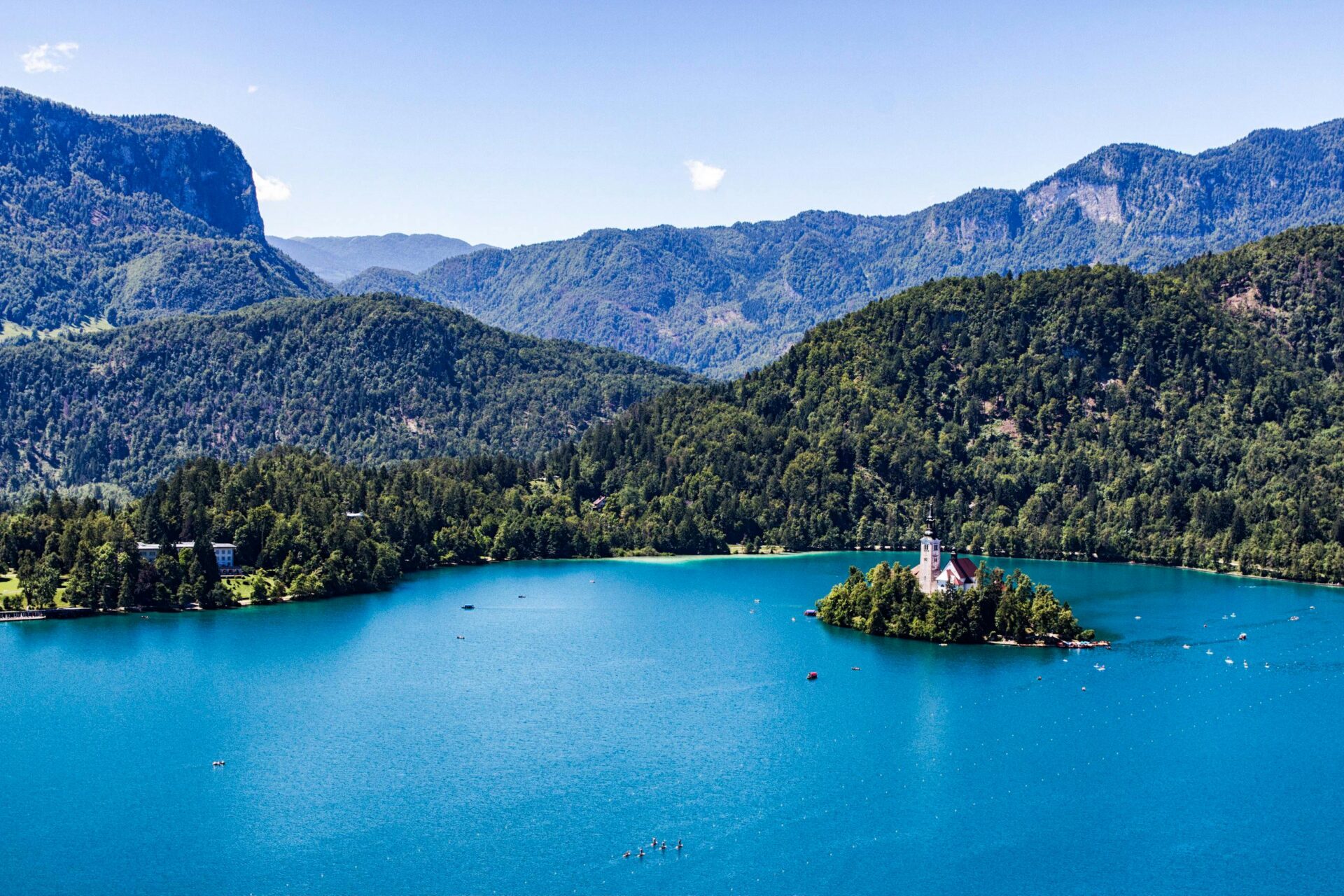
Lake Bled is on every travel account in Europe and the photograph is on every Ljubljana airport departure lounge and every Slovenian tourism brochure. The image: a small island with a Baroque church topped by a red-roofed belfry, a medieval castle on a cliff above the south shore, the Julian Alps rising behind. It looks exactly like this in every season, in every light, from every angle.
The photograph earns itself. This is the point.
Travel content often overcorrects against clichéd images — “skip the famous thing, the real thing is elsewhere.” Sometimes that’s right. In Bled’s case, it isn’t. The lake is genuinely beautiful. The church (Pilgrimage Church of the Assumption of Mary) on the island is genuinely atmospheric. The view from Bled Castle is genuinely extraordinary. These things are true regardless of how many Instagram posts have used them.
The question is not whether to go to Bled but how to see it without the crowds.
The 6am strategy:
The tour buses from Ljubljana begin arriving at Bled from approximately 9am. The lake before 8am belongs to early-rising travellers and the local joggers. The light at 6am on a June morning — the mist on the water, the castle catching the first sun, the Alps above not yet visible through the haze — is the version of Bled that the afternoon postcard doesn’t show.
The pletna boat:
The traditional Bled boat — a flat-bottomed wooden gondola propelled by the oarsman standing at the stern with two long oars. The pletna families have operated these boats on Bled for centuries; the right to row a pletna was historically hereditary. Cost: approximately £12-15/person return to the island. Duration: 15-20 minutes each way. The pletna is significantly slower than a motorboat and significantly more appropriate to the setting.
The island church: ring the wishing bell (the tradition is to ring it three times and make a wish — the bell is original from the 16th century, the tradition somewhat more recent). The Baroque interior. The 99 steps from the boat landing to the church entrance.
Bled Castle:
A 30-minute hike from the lake shore or a 5-minute walk from the south shore parking area. The castle is first mentioned in 1011 CE — it is the oldest castle in Slovenia. The interior: a museum of Slovenian history, a wine cellar producing the castle’s own wines, and the view. The view from the castle ramparts at sunset, with the lake below and the Alps behind, is the finest single photograph available in Bled and is not the one on the postcards (which shows the castle from the lake rather than the view from the castle).
The Bohinj Valley — Bled Without the Crowds
Lake Bohinj is 5km from Bled over a mountain pass — a larger lake (3.7km long versus Bled’s 2.1km), completely different in character (no island church, no castle — just the lake in a glacial valley with the Triglav massif rising to the south), and receiving approximately 20% of the visitors that Bled does.
The reason: Bohinj doesn’t have the famous postcard image. It’s “just” a beautiful alpine lake in one of the finest mountain settings in Slovenia. Which is, for the traveller who has reached Bled and wants to continue rather than turning back, more than enough.
The Savica Waterfall:
A 20-minute walk from the Ukanc car park at the western end of Lake Bohinj — the Savica waterfall drops 78 metres through a narrow gorge into a pool. Entry: £4. The waterfall is the headwaters of the Sava River — the same water that eventually reaches the Danube and the Black Sea has come from this specific cliff face in the Julian Alps. The walk to it, through the beech forest above the lake, is as significant as the waterfall itself.
The Voje Valley walk:
From the village of Stara Fužina (accessible by local bus from Bohinj or on foot from the lake) — a flat 1.5-hour walk each way along the Mostnica Gorge. The gorge is a narrow limestone slot with the Mostnica River below; the walk passes a series of natural pools, the Mostnica Gorge cascade (the Mostnica waterfalls), and opens into the Voje Valley above — an alpine meadow with a small shepherd’s hut and the Triglav peaks visible above. Completely free. Largely empty.
Bohinj as a base:
Staying in Bohinj (the village of Ribčev Laz, or the slightly smaller Ukanc at the western end) rather than Bled gives: the same Julian Alps backdrop, access to both lakes (Bled is 15 minutes by car), the Savica waterfall and the Voje Valley, and the Vogel cable car (ascent to 1,535m above the lake, the view of the full Triglav massif from the cable car summit platform is the finest readily accessible mountain panorama in Slovenia). Accommodation in Bohinj is significantly cheaper than Bled.
Triglav National Park — The National Symbol
Triglav National Park covers 880 square kilometres of the Julian Alps — the only national park in Slovenia, established in 1924 (one of the oldest national parks in Europe), and the only one in Europe that was also a national park during the socialist period (it was maintained throughout the Yugoslav era). The park is named for Triglav (2,864m) — the three-headed peak that appears on the Slovenian national flag and coat of arms and that every Slovenian is traditionally expected to climb at least once in their lifetime.
Climbing Triglav:
The two-day ascent is the defining Slovenian outdoor objective — not technically extreme (no glacier, no ropes required in summer conditions) but genuinely Alpine in character, with significant exposure on the final approach ridge and altitude enough to feel significant to those unaccustomed to it.
The standard route: first day to the Triglavski Dom hut at 2,515m (5-7 hours from the Pokljuka plateau trailhead). Second day: summit and descent (4-6 hours). Cost with a mountain guide: £80-120 for the two days — strongly recommended for travellers without Alpine experience.
The summit: the three-headed peak (the three headlands on the ridge giving the name), the Aljaž Tower (a small metal cylinder erected in 1895 that is registered as Slovenian national territory), and the view across the full Alps. On clear days: the Adriatic visible to the southwest, the Dolomites to the west, the Austrian Alps to the north.
The high mountain huts:
The network of mountain huts (planinska koča) in Triglav National Park is one of the most extensive in the Alps — 168 huts across the park, most accessible to non-technical walkers on the lower trails. Hut accommodation: £20-35/person including breakfast and dinner. The hut experience — arriving at dusk, eating communally with other walkers, sleeping in a dormitory, leaving at dawn — is the correct way to spend a night in the Slovenian Alps.
The Soča Valley — The Turquoise River
The Soča River runs 136km from its source near the Triglav massif to the Adriatic near Trieste (Italy). For the first 60km, it flows through the Soča Valley (Posočje) in Slovenia — a sequence of limestone gorges, emerald pools, stone bridges, and forested canyon walls that is the most visually distinctive river landscape in the Alps.
The colour: the Soča’s turquoise-to-emerald is produced by the specific mineral composition of the limestone terrain it flows through (calcium carbonate in solution gives the water a blue-green opacity) combined with the flow characteristics of a glacier-fed river that runs clear and cold year-round. You will photograph it repeatedly and none of the photographs will fully capture it.
The Great Soča Gorge (Velika Korita Soče):
Just downstream from the village of Bovec — a 750m gorge where the river has cut through limestone creating walls 15-20m high above a series of natural pools. A walkway runs along the canyon rim. The colour of the water in the narrow gorge, viewed from directly above: the most saturated and most extraordinary turquoise available in Europe. Free access. 1km walk from the small car park.
The Napoleon Bridge:
A stone bridge over the Soča at Kobarid (see next section) — built in 1750, the original bridge used by Napoleon’s troops during the Italian campaign. Below the bridge: a natural pool of turquoise water above a cascade, the stones of the riverbed visible through 3 metres of water. The photograph from the bridge is the single most reproduced image of the Soča River. It looks exactly like the photographs. Go in the morning before the cars park on the bridge for photographs.
White water rafting:
The Soča between Bovec and Kobarid offers Grade 2-4 white water depending on the season and water level. The half-day rafting tour (£30-45/person, equipment included) runs the best section of the river with a guide. The experience of paddling through turquoise water between limestone canyon walls — the colour visible through 2 metres of water, the spray from the rapids — is one of the finest outdoor activities in the Alps.
Multiple operators in Bovec: Soča Rafting, Positive Sport, Soča Outdoor. The quality is broadly consistent; the river is the product.
Kayaking:
The calmer sections of the Soča are accessible to kayakers of all abilities — the flat sections between rapids allow the colour and the scenery to be appreciated at a paddler’s pace. Half-day kayak hire: £20-30 with basic instruction.
Kobarid and the World War I History
Kobarid (known in Italian as Caporetto) is a small town on the Soča at the southern end of the Soča Valley. In October 1917, the Battle of Caporetto — one of the most significant battles of World War I — was fought in this valley. A combined Austro-Hungarian and German force broke through the Italian front line, routing 12 Italian divisions and capturing 300,000 prisoners. The defeat forced Italy to withdraw 150km in one week.
The Kobarid Museum (the Kobarid Historical Museum) covers the Soča Front — the 82km battle line that ran along the Soča River from 1915 to 1917, one of the most brutal mountain campaigns in European history. The museum was awarded the Council of Europe Museum Prize in 1993. Entry: £5. Ernest Hemingway, who drove an ambulance on the Italian front, set the retreat from Caporetto in A Farewell to Arms — the novel’s most famous sequence took place in this valley.
The Kobarid Historical Walk: a 5km circular trail above Kobarid connecting the WWI fortifications, trenches, and memorials on the ridges above the town. The walk gives the specific landscape context that makes the museum’s numbers comprehensible — the vertical terrain, the exposed ridgelines, the stone trenches that are still intact 100 years later. Free. Map available at the museum.
The Italian Charnel House (Kostnica): on the hill above Kobarid — an octagonal ossuary containing the bones of 7,000 Italian soldiers who died on the Soča Front. Built in 1938. The view from the ossuary over the Soča Valley to the Austrian Alps beyond is extraordinary and melancholy in equal measure.
Postojna Cave — The Underground World
Postojna Cave is the largest tourist cave in Europe and the second most visited tourist site in Slovenia after Lake Bled. The cave system extends 24km; approximately 5.7km is open to visitors.
The cave train:
The visit begins with a 2km journey on a narrow-gauge electric train through the cave passages — the train enters from the main entrance chamber and travels into the cave at 10km/h, the passages lit from the train as it passes. This is the correct introduction to the scale of the cave: the chambers are enormous (the Concert Hall is 50 metres high) and the train journey gives a sense of depth and extent that the walking section alone wouldn’t.
The formations:
The stalactite and stalagmite formations in Postojna are among the most varied and the most dense in any accessible cave system in the world. The specific Postojna formations: spaghetti stalactites (thin tubes extending from the ceiling without the widening typical of stalactites), cave coral (branching aragonite formations), curtains (translucent sheets of calcite), and the Great Column (a stalactite and stalagmite that have grown together over millions of years into a single column 5 metres tall).
The human fish (Proteus anguinus):
The most extraordinary inhabitant of the Postojna Cave system — the olm (locally called the človeška ribica, “human fish”). A blind cave salamander, 20-30cm long, entirely depigmented (hence the pale pink colour), with vestigial eyes covered by skin. The olm can live to 100 years and can survive 10 years without food. It is an endemic species of the Dinaric karst region and is considered the longest-living cave animal in the world.
The olm is kept in an aquarium within the cave (the Vivarium) where it is visible to visitors. The experience of seeing a 10cm pale salamander in a small tank, knowing it may be 100 years old and has never seen light, is one of the more genuinely strange wildlife encounters available in Slovenia.
Entry: £25. Pre-book online (postojnska-jama.eu) — the cave is popular and time slots fill ahead in peak season. Tours run hourly; the 90-minute visit gives the train journey and the walking section through the main chambers.
Predjama Castle — The Cliff Face Fortress
9km from Postojna — a castle built into a 123-metre cave mouth in a vertical cliff face, its rear sections extending into the cave system behind. The original structure dates from the 12th century; the current castle is primarily from the 16th century.
The specific story: the castle was the home of the knight Erasmus of Lueg (Erazem Predjamski) in the 15th century, who used the cave system behind the castle to receive supplies during a siege by the Habsburg forces — food and supplies were lowered through secret passages to the cave rear while the Habsburgs watched the front. Erasmus held out for over a year. He was eventually killed not by the siege but by a traitor who signalled to the Habsburgs when he was in a particular room.
The combination of Predjama Castle and Postojna Cave — 9km apart, covered in 2-3 hours total — is the standard day trip from Ljubljana (90 minutes each way) or from the Karst accommodation. Entry to Predjama: £12. The view of the castle from the valley below — embedded in the cliff face, the cave mouth behind it, the overhanging rock above — is one of the most extraordinary architectural photographs in Slovenia.
Piran — The Venetian Coast
Slovenia has 47km of Adriatic coastline — a small but specifically beautiful section of the northeastern Adriatic coast between the Italian and Croatian borders. The main town: Piran (Italian: Pirano), a medieval town on a narrow peninsula jutting into the Gulf of Piran.
Piran was Venetian from 1283 to 1797 — over 500 years, the city built its salt trade and fishing economy under Venetian administration, and the architecture reflects it completely. The bell tower of the Cathedral of St. George (modelled on the Campanile of San Marco in Venice), the Venetian Gothic windows on the main square buildings, the narrow lanes that connect the harbour to the upper town — all of it looks precisely like the smaller towns of the Venetian lagoon, arranged on a peninsula in Slovenia.
Tartinijev Trg (Tartini Square):
The main square — an oval plaza on the harbour, named for the composer Giuseppe Tartini, born in Piran in 1692 (best known for the Devil’s Trill Sonata). The square is lined with Venetian Gothic palazzi on the sea-facing side. The evening in the square — the outdoor tables, the sea visible through the gaps between the buildings, the last light on the bell tower — is the finest single evening in Slovenia.
The walls and the view:
The city walls of Piran climb the hill above the town to the church of St. George — a 15-minute walk giving the full panorama of the old town below, the gulf, and on clear days the Italian coast and the Croatian peninsula visible simultaneously. The light in the late afternoon from the west turns the Piran rooftops the specific honey-gold of Venetian limestone.
The salt pans of Sečovlje:
South of Piran — the Sečovlje Salina Nature Park, where traditional salt production has operated continuously for 700 years. The salt pans cover 700 hectares and are managed as a protected landscape; the traditional production method (using petola, the specific grey silt of the pans, to produce crystallised salt) is maintained by the remaining salt workers and is one of the last traditional salt production operations in the Mediterranean.
The salt museum within the park: the restored salt workers’ houses, the equipment, the production process explained. Entry to the park: £5. The landscape of the salt pans at low tide — the pink hues from the same algae as Lac Rose, the flamingos (a small population uses the pans in winter), the workers moving between the pan divisions — is one of the most unexpected landscapes in Slovenia.
The Karst Region — Wine and Underground Rivers
The Karst (Kras) region is the limestone plateau between Ljubljana and Trieste — the source of the geological term “karst” (the German form of the Slovenian “kras”) that describes the specific landscape formed by dissolving limestone. The plateau is studded with sinkholes, caves, and underground rivers; the surface landscape is dry scrubland above a complex underground hydrology.
The Karst has its own wine appellation: Teran (made from the Refosco grape, a deeply coloured, highly tannic red wine produced in the iron-rich terra rossa soil of the plateau) and Vitovska (a white grape producing light, mineral wines that reflect the limestone terrain). The wine can be tasted at cellars throughout the region.
The Lipica Stud Farm: founded 1580 by the Habsburg court for the breeding of the Lipizzan horse (the breed used in the Spanish Riding School in Vienna). The stud farm is on the Karst plateau, the horses still bred and trained here. Guided tours of the farm: £12. Performance shows with dressage: £18, held on specific dates — check the schedule.
Hidden Slovenia — The Places Most Guides Don’t Reach
The Logar Valley (Logarska Dolina):
A glacial valley in the Kamnik-Savinja Alps, northeast of Ljubljana — a U-shaped valley surrounded by 2,000m peaks, with the Rinka Waterfall (90m, Slovenia’s highest) at the head. A national park since 1987, the valley has almost no permanent tourist infrastructure — a handful of farm guesthouses, some simple restaurants. It is arguably the finest alpine valley in Slovenia that doesn’t have a famous lake at its bottom, and receives approximately 5% of Bled’s visitors.
Škocjan Caves:
The second major cave system of the Karst, UNESCO-listed, and in the view of most speleologists who have visited both, more extraordinary than Postojna. The Škocjan system has a collapsed underground gorge — a cave canyon 100 metres wide and 160 metres deep, through which the Reka River flows in an underground canyon. The scale is unlike anything in Postojna. Entry: £20. The human fish is at Postojna; the underground canyon is at Škocjan. Both deserve a visit; if only one is possible, the choice depends entirely on whether you prefer cave formations or geological scale.
Radovljica:
A medieval town 6km south of Bled — the best-preserved medieval town centre in Slovenia (better than Ljubljana’s, the argument can be made), the old town’s single main square flanked by manor houses with painted facades, a museum of beekeeping (Slovenians have one of the oldest and most sophisticated beekeeping traditions in Europe — the hand-painted panels of the traditional Slovenian hive are the only artistic form specific to the country), and the Linhart Museum of Radovljica covering regional history. Almost entirely unknown to international visitors. 15 minutes from Bled.
The Tolmin Gorges:
At the confluence of the Tolminka and Zadlaščica rivers, south of Most na Soči — two river gorges with a walking route through them, the narrowest sections crossed by stone bridges at the canyon floor. The Tolminka Bear’s Head (a natural rock formation where the canyon narrows to 5 metres) is the most dramatic section. Entry: £5. 45 minutes from Kobarid.
What It Costs — Real Numbers
Slovenia is the finest value Alpine destination in Europe. It is more expensive than the Western Balkans (Albania, North Macedonia) but significantly cheaper than Austria, Switzerland, or northern Italy.
Daily Budgets
Budget (£35-50/day)
- Accommodation: hostel or guesthouse (£15-22/night in Ljubljana, £18-28/night in Bled)
- Food: local restaurants, the outdoor markets (£10-16/day)
- Transport: local buses, walking
Mid-range (£55-75/day)
- Accommodation: mid-range hotel or boutique guesthouse (£35-55/night)
- Food: restaurant dinners, market lunches (£14-22/day)
- Car hire (amortised across the group): adds £8-15/day per person
Comfortable (£90-130/day)
- Accommodation: boutique hotel or alpine lodge (£55-90/night)
- Food: quality restaurants, Slovenian wine with dinner (£25-38/day)
- Activities without constraint
What 7 Days in Slovenia Actually Costs from the UK
| Category | Budget | Mid-Range |
|---|---|---|
| Return flights (Ljubljana, easyJet) | £60–120 | £80–150 |
| Car hire 7 days | £180–250 | £200–270 |
| 7 nights accommodation | £150–220 | £290–440 |
| Food (7 days) | £85–130 | £130–200 |
| Postojna Cave + Predjama | £37 | £37 |
| Soča rafting | £35–45 | £40–50 |
| Triglav hut (1 night) | — | £30–40 |
| Miscellaneous (Bled pletna, Jozani, parks) | £25–40 | £40–60 |
| Total | £572–842 | £811–1,247 |
Slovenia is one of the best-value complete Alpine destinations accessible from the UK. A mid-range 7-day trip with car hire, comfortable accommodation, and the full circuit (Ljubljana, Bled, Bohinj, Soča, Postojna, Piran) costs under £1,250.
Eating in Slovenia — The Mitteleuropean Kitchen
Slovenian cuisine is the intersection of four culinary traditions: Austrian (the Habsburg inheritance — schnitzel, strudel, coffee culture), Italian (the influence of the Venetian coast and the proximity of Friuli), Hungarian (the pannonial plain of eastern Slovenia), and the indigenous Slovenian traditions of the Alpine and Karst regions. The result is a cuisine of considerable depth that is almost entirely unknown internationally.
Kranjska Klobasa
The Slovenian sausage — a PGI-protected (Protected Geographical Indication) cooked sausage made from pork and bacon with garlic and salt, the casing twisted and both ends tied, giving a distinctive shape. Boiled or grilled, served with mustard, horseradish, and sauerkraut. The most specifically Slovenian food preparation and the correct first meal on arrival. Available at butchers, markets, and traditional restaurants throughout the country. At the Ljubljana Central Market (Plečnik’s covered market, along the Ljubljanica River): £2-3 for a full sausage from the butchers.
Žlikrofi
A filled pasta specific to the Idrija region — a small pasta parcel filled with potato, lard, onion, and marjoram, boiled and served with a lamb or pork sauce. The dough is rolled paper-thin; the filling is dense and savory. The žlikrofi of Idrija have PGI protection, making them one of the few traditional Slovenian dishes recognised at the European level. At a traditional restaurant in Idrija (1 hour from Ljubljana): £6-10 for a full portion. Worth the detour.
Štruklji
Slovenian rolled dumplings — a rolled dough wrapped around sweet or savory fillings (cottage cheese and tarragon in the savory version; nuts, walnut, and poppy seed in the sweet version), boiled or baked. Available at the Ljubljana market food stalls and at traditional restaurants across the country. The tarragon cottage cheese version is the most specifically Slovenian and the most difficult to approximate outside the country.
Potica
The Slovenian celebration cake — a rolled pastry with walnut filling (the most traditional version), poppy seed, tarragon, or other fillings, baked in a circular mold. Every Slovenian family has a specific potica recipe and a specific occasion on which it’s made. Available at bakeries throughout the country; the best is always the homemade version at a mountain hut or an alpine guesthouse.
Jota
A thick soup of beans, sauerkraut, potatoes, and smoked meat — the daily winter meal of the Karst and coastal region, available year-round at traditional restaurants. The specific fermented-vegetable and smoked meat combination of jota is the nearest thing to a definitive Slovenian peasant flavour. At any traditional gostilna (inn): £4-7.
Wine:
Slovenia produces wine from three distinct regions: Primorska (the Karst and Vipava Valley, where the Teran and Vitovska grapes produce the finest Slovenian reds and whites), Podravje (the northeast, producing Laški Riesling and Sipon — the Slovenian equivalent of Furmint), and Posavje (the southeast). The orange wines produced in the Goriška Brda region (the Slovenian Collio — the hills above the Italian border) are among the finest in Europe, and the region’s producers (Movia, Kabaj, Edi Simčič) are referenced by natural wine writers internationally.
A glass of house wine at any Slovenian restaurant: £2-3.50. A bottle of Movia’s Lunar (the reference Goriška Brda orange wine): £12-18 at the cellar door.
Bica (Coffee):
The espresso culture in Slovenia reflects the Italian and Viennese double influence — the single espresso (kavica) is closer to the Italian style (short, intense, drunk standing at the counter), while the coffee houses of Ljubljana (particularly the Kavarna Tromostovje at the Triple Bridge and the Zvezda in Kongresni Trg) maintain the Viennese coffeehouse tradition of sitting for hours over a single coffee with no pressure to move.
Practical Notes
Visa: No visa required for UK passport holders. Slovenia is in the EU and Schengen Area. Passport valid at time of travel required.
Getting there: easyJet direct from London Stansted to Ljubljana. Ryanair seasonally. Alternatively via Venice Treviso, Trieste, or Vienna with a connecting bus or car hire. Return flights: £60-120 on direct routes.
Currency: Euro. Slovenia was the first former Yugoslav republic to adopt the Euro (2007). Card acceptance is very high throughout the country. ATMs widely available.
Getting around: Car hire is strongly recommended for the Soča Valley, Triglav National Park, and the Karst. Ljubljana, Bled, and Bohinj are accessible by public bus (FlixBus-style Slovenian services, affordable and reasonably frequent). Within Ljubljana: walking. The city is small enough that a car is a hindrance rather than a help inside the city limits.
Language: Slovenian. English is spoken almost universally by the under-50 urban population — Slovenia’s English proficiency rates are among the highest in Central Europe. German and Italian are common in the border regions. “Hvala” (thank you), “Prosim” (please/you’re welcome), “Dober dan” (good day) — the basics are appreciated and correctly interpreted as genuine rather than performative.
National Park rules: No camping outside designated areas in Triglav National Park. No picking of plants or disturbing wildlife. The trails are well-marked; a 1:25,000 map is recommended for the higher routes.
The 7-Day Itinerary — Ljubljana, Alps, Soča, Coast
This route covers the essential Slovenia in a logical geographic sequence — picking up the car at Ljubljana airport and returning it at Ljubljana before the flight home.
Day 1: Ljubljana
Pick up hire car at Ljubljana airport. Check into accommodation in the old town (park the car and leave it — you won’t need it in the city). Afternoon walk: the Triple Bridge, Plečnik Market, the castle funicular. Evening: Stari Trg for dinner.
Day 2: Ljubljana + Departure to Bled
Morning: Ljubljana Castle at dawn (walk up before the funicular opens). Central Market breakfast. National Gallery (the Robba Fountain original, the Slovenian Impressionists — Rihard Jakopič, Ivan Grohar). Drive to Bled (55 minutes). Afternoon: pletna boat to the island. Evening: Bled Castle sunset.
Day 3: Bled + Bohinj
5:30am: Bled lakeside walk before the boats go out. Breakfast in the town. Drive to Bohinj (20 minutes). Voje Valley walk (3 hours return). Savica Waterfall (20 minutes from the car park). Return to Bled or overnight in Bohinj.
Day 4: Soča Valley
Drive from Bled/Bohinj to Bovec via the Vršič Pass (the highest mountain pass in Slovenia at 1,611m — a series of 50 numbered hairpin bends on a road built by Russian POWs in WWI, extraordinary). Stop at the Russian Chapel (a small wooden chapel built by the Russian prisoners in memory of those who died building the road). Arrive Bovec midday. Afternoon: Great Soča Gorge walk. Evening: Bovec.
Day 5: Soča Valley + Kobarid
Morning: white water rafting on the Soča (half day, book the day before). Afternoon: drive to Kobarid (30 minutes). Kobarid Historical Walk. Kobarid Museum. Dinner in Kobarid — the Hiša Franko restaurant (one of the finest restaurants in Slovenia, Michelin-starred, using ingredients from the Soča Valley and the surrounding farms — book months ahead) or the more accessible restaurants in the town.
Day 6: Postojna + Piran
Morning: drive Kobarid to Postojna (2 hours via the toll motorway). Postojna Cave (arrive at opening, 9am). Predjama Castle (9km, 30 minutes after Postojna). Drive to Piran (45 minutes from Predjama). Afternoon on the Piran waterfront. Tartinijev Trg at sunset.
Day 7: Piran + Return Ljubljana
Morning: walk the Piran walls. Sečovlje salt pans if time allows (30 minutes south of Piran). Drive to Ljubljana airport (2 hours). Return car. Departure.
Final Thought
I was on the Napoleon Bridge over the Soča at 7am. The river was running below me in the specific turquoise that nobody who has tried to photograph it ever captures adequately. The water was moving but the colour seemed still — the same saturated hue from the surface to the riverbed 4 metres below.
A kingfisher crossed the river 10 metres upstream and landed on a stone.
This is the Soča Valley’s particular quality: the landscape is so visually extraordinary that it produces the same stillness in most visitors that you get in a place of worship. Not quiet exactly — the river makes a constant sound — but an absence of urgency. The need to be somewhere else that travel sometimes produces instead of removes.
Slovenia is the country that gives you this repeatedly. The turquoise river. The mountain lake before the boats. The blind salamander in the cave. The Venetian bell tower above the Adriatic.
Four landscapes, completely distinct, in a country the size of Wales.
Go before someone makes it famous.
Question about Slovenia this guide doesn’t cover? Drop it in the comments.