
The complete guide for UK travellers: Angkor Wat at sunrise before the crowds arrive, the 72 temples most visitors walk past, Phnom Penh and the history that has to be faced, the pink sandstone temple most Angkor tours omit, the bioluminescent bay, the Kampot river town and the finest pepper on Earth, and what Cambodia actually costs in 2025.
Reading time: 15 minutes | Last updated: 2026
Cambodia is the most emotionally complex country in Southeast Asia.
It contains the largest religious monument ever built — a 12th-century temple complex of such ambition and such beauty that even people who have spent the better part of a career visiting extraordinary places struggle to contextualise it. And two hours away by road is the Tuol Sleng Genocide Museum, housed in a former high school that the Khmer Rouge converted to a detention and torture facility — where 17,000 people were processed between 1975 and 1979, and the photographic record of what happened to them is on the walls in every room.
Both of these things are Cambodia. You don’t get to choose between them.
This matters because the most common approach to Cambodia — Siem Reap and the temples, then the beach islands, then home — is a completely valid trip that leaves out the thing that makes Cambodia fully comprehensible. Phnom Penh is not a pleasant stop between Siem Reap and the coast. It’s the city without which Cambodia’s present doesn’t make sense. The Killing Fields are not optional tourism. They’re the reason the country looks the way it does — the demographic collapse of the educated professional class, the economic reset, the missing generation that explains so much about modern Cambodia.
Go to Phnom Penh. Go to the museum. Then go to the beach and eat the seafood and watch the bioluminescent plankton at night.
Both are Cambodia.
Quick Navigation
- The Case for Cambodia — And the Full Picture
- When to Go — Monsoon and Dry Season Divided by Region
- Siem Reap — Base for the Temples
- Angkor Wat — The Sunrise and the Strategy
- The Angkor Complex — Beyond the Main Temple
- Banteay Srei — The Temple Most Tours Skip
- Kbal Spean — The River of a Thousand Lingas
- Phnom Penh — The Capital and the History
- The Killing Fields and Tuol Sleng — Why You Go
- Kampot — The River Town and the Pepper
- Kep — The Ghost Town on the Coast
- The Islands — Koh Rong Samloem and Beyond
- Battambang — Cambodia’s Second City
- What It Costs — Real Numbers
- Eating in Cambodia — Khmer Cuisine and Where to Find It
- Practical Notes
- The 10-Day Itinerary — Temples, Capital, Coast
The Case for Cambodia — And the Full Picture
The standard SE Asia route — Thailand, Vietnam, maybe Laos — skips Cambodia or adds it as a brief detour to Angkor Wat. This is understandable and leaves out the country that most travellers, in retrospect, say had the most impact.
Not because Cambodia is the most beautiful (Laos is quieter, Vietnam more varied, Thailand more polished). But because Cambodia is the most honest. The gap between what the country is going through and what the surface suggests is smallest here. You can see the rebuilding happening in real time.
Cambodia’s recent history is not ancient. The Khmer Rouge regime of 1975-1979 killed between 1.5 and 2 million people — estimates range from 25% to 40% of the total population. The regime specifically targeted the educated, the professional, the urban — doctors, teachers, engineers, anyone who wore glasses (associated with literacy and therefore counter-revolution). The demographic consequences are visible in the present country: a workforce missing a generation, institutions rebuilt from almost nothing, the average age consistently younger than neighbouring countries.
The Angkor temples were built by an empire at the peak of its power between the 9th and 15th centuries. The country surrounding those temples today is one of the youngest, least-developed, and most resilient in Asia. Understanding both of those things simultaneously is what makes Cambodia more than a temple visit.
When to Go — Monsoon and Dry Season Divided by Region
November to April — Dry Season
The main tourist season. Clear skies across the country. Siem Reap is most comfortable: 25-30°C, minimal rain, the Tonle Sap Lake at lower level (but the waterbird colonies on the lake are most accessible). Phnom Penh hot but manageable. The coast and islands (Koh Rong, Kampot) are at their best.
The specific peaks: Christmas and New Year (Siem Reap accommodation books out months ahead, prices triple) and Khmer New Year (mid-April — the country closes for 3 days, bus and accommodation availability tightens, the water festival in Siem Reap is extraordinary to witness).
May to October — Wet Season
Significant rain throughout the country, typically afternoon and evening downpours rather than all-day rain. The landscape turns vivid green. The Tonle Sap Lake floods dramatically — by August it’s 5-6 times its dry-season size, and the stilted villages on its banks are entirely surrounded by water. The temples have fewer visitors (25-40% fewer than peak season). Accommodation prices drop 30-40%.
The south coast (Kep, Kampot) gets the most consistent rain and some operators close guesthouses in October.
The BGGD recommendation: November-February for the full circuit. Late October to early November for a sweet spot — the rains are ending, the landscape is still green, prices are still low, and the temples are below peak-season capacity.
Siem Reap — Base for the Temples
Siem Reap is the gateway city for the Angkor complex — a fast-growing town of 250,000 people, 6km from the main Angkor entrance, transformed by the temple tourism economy from a small market town into a city with an international airport, several hundred guesthouses and hotels, and the highest concentration of restaurants per capita in Cambodia.
The city itself is not the reason to be here. Pub Street (the tourist strip) is functional and forgettable. The Old Market area has reasonable food stalls and the crafts market. The Cambodian Cultural Village on the outskirts is staged and skippable.
What Siem Reap provides: excellent accommodation at every price point (guesthouses from £12/night, boutique hotels from £40, luxury resorts for the specific traveller), reliable tuk-tuk networks for temple access, and good food at reasonable prices in the surrounding streets.
Where to stay: The neighbourhood between the Old Market and the Pub Street area for budget to mid-range. The road toward Angkor (Route 6 area) for quieter guesthouses with easy temple access. Boutique hotels in the French Quarter for a more atmospheric stay.
The tuk-tuk arrangement: Hire a tuk-tuk driver for your entire Siem Reap stay. The daily rate (£10-15 for a full day, negotiated in advance) is more economical than individual trips and gives you a driver who knows the temple timings, the quiet entrances, and the roads to the less-visited sites. Ask at your guesthouse — they’ll have reliable contacts.
Angkor Wat — The Sunrise and the Strategy
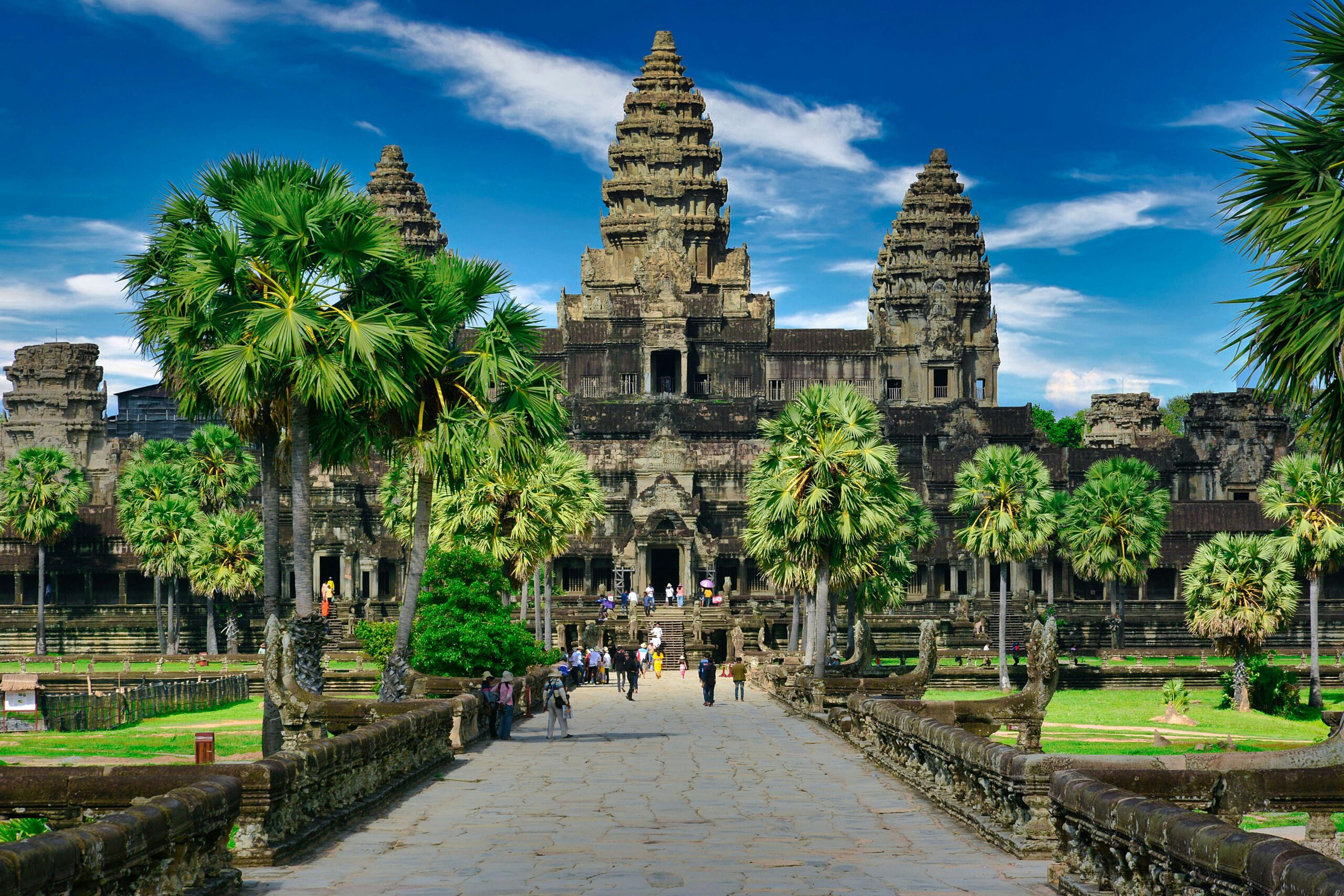
Angkor Wat is the largest religious monument ever built — 400 acres of temple, moat, and gardens constructed between 1113 and 1150 CE by the Khmer Emperor Suryavarman II as a Hindu temple and royal mausoleum, later converted to Buddhist use. The temple represents Mount Meru (the centre of the Hindu universe) in stone — the five towers represent the five peaks of Meru, the moat the cosmic ocean around it.
This context matters for understanding what you’re looking at. Angkor Wat is not a ruin. It is a functioning cosmological statement in stone, built by an empire that understood exactly what it was doing architecturally, spiritually, and politically. The scale (the outer wall is 3.6km in perimeter), the precision (the towers are astronomically aligned to the equinox), and the detail (the bas-reliefs covering every available surface depict 49 metres of the Battle of Kurukshetra from the Mahabharata) are all intentional.
The Sunrise Strategy:
Leave Siem Reap at 4:30am. Reach the west gate of Angkor Wat by 5am. This gives you time to walk the main causeway, cross the moat bridge, and position at the reflection pond in front of the first gallery before the sky begins to lighten — approximately 5:30am.
The sunrise reflection: the western facade of Angkor Wat, reflected in the ponds on either side of the main causeway, as the sky behind turns from dark to pink to gold. The image is familiar from a thousand photographs and more powerful in person than any of them.
What the photographs don’t show: the full procession of visitors arriving at the same time. By 5:30am on a peak season morning (November-February), the reflection pond area has 500+ people. By 6am, 1,500. The solution is to arrive early enough to claim a position at the pond edge before the majority.
Or: attend the sunrise once for the spectacle, then return to Angkor Wat at 4pm on your last afternoon when the tour groups have gone and the temple is yours in the late light.
The Main Temple:
The inner sanctuary of Angkor Wat — the galleries, the central tower, the bas-reliefs — is where the visit requires the most time and attention. Budget 2-3 hours minimum for the interior. The Churning of the Sea of Milk bas-relief (the largest single bas-relief panel, depicting a Hindu creation myth with 92 asuras and 88 gods churning the ocean to produce amrita, the elixir of immortality) runs for 49 metres and rewards close reading — individual figures, narrative detail, the expressive faces of the churning figures pulling the serpent.
The Angkor Pass:
The entry system for the Angkor complex. Prices: £37 for 1 day, £62 for 3 days, £72 for 7 days. The 3-day pass is the correct choice for most travellers — enough time to see Angkor Wat properly, the major subsidiary temples, and two or three of the quieter sites.
Buy the pass at the official ticket office (on the road to Angkor, 1.5km before the main gate). The pass requires a passport photo taken at the counter. Open from 5am.
The Angkor Complex — Beyond the Main Temple
The Angkor Archaeological Park covers 400 square kilometres. Within it: 72 major temples and thousands of minor structures. Most visitors see three: Angkor Wat, the Bayon, and Ta Prohm. The remaining 69 are rarely crowded.
The Bayon (Angkor Thom)
The second most visited temple — a 12th-century state temple at the centre of Angkor Thom (the last great capital of the Khmer Empire, built by Jayavarman VII). The Bayon is a mass of stone towers, each bearing four carved faces — believed to represent Jayavarman VII or the Bodhisattva Avalokitesvara — looking in the four cardinal directions. At close range (walking between the towers rather than viewing from outside), the faces appear and disappear as you move — a deliberate architectural effect. 216 faces total. Early morning (7am) before tour groups.
Ta Prohm
The jungle temple — a 12th-century monastery where the trees were deliberately left during the 20th-century restoration work to demonstrate the state of the site before excavation. The roots of giant fig and silk-cotton trees engulf the gallery walls, push through the stone floors, and lift the lintel stones with a slow, geological patience. The trees are not consuming the temple — they’re in a state of co-existence, each supporting the other structurally in several places.
The famous Tomb Raider location (the courtyard filmed for the original Angelina Jolie film in 2001) is well-signposted and always crowded. Arrive at 7am and move beyond the main courtyard into the less-visited eastern galleries, where the tree-root formations are as dramatic and the crowds are absent.
Preah Khan
A 12th-century complex built by Jayavarman VII to honour his father — a large, sprawling temple that feels more like a navigable city than a single building. The central cruciform corridor, the two-storey colonnaded building (a unique structure in the Angkor complex — the only pillared two-storey building in the entire park), the trees growing through the outer wall galleries. Receives a fraction of Ta Prohm’s visitors. Go in the afternoon when the light enters the east-west corridor.
Neak Pean
An island temple in the middle of a large reservoir — a circular island with a central sanctuary surrounded by four smaller pools connected to the central pool by stone gargoyle heads. Accessed by an elevated wooden walkway across the reservoir. The reservoir at sunrise, with the walkway extending from the shore, is one of the finest Angkor images most visitors never see.
Pre Rup
A 10th-century state temple — a five-tiered sandstone pyramid with three towers at the summit. Less visited than the 12th-century temples. The view from the top at sunset: the forest of the Angkor park extending to every horizon, the distant spires of Angkor Wat visible on clear evenings. Free access with the Angkor pass. Often quiet at sunset when the main Phnom Bakheng viewpoint (the standard “sunset temple”) is crowded.
The Quiet Strategy:
The least-visited temples receive a fraction of the attention of the three main sites. Ask your tuk-tuk driver for Beng Mealea (a 12th-century temple 40km east of Siem Reap — partially excavated, heavily jungle-covered, accessible on dirt roads), East Mebon (an island temple on the reservoir, the naga-bordered causeway), or Thommanon (a small 12th-century temple just north of the Victory Gate of Angkor Thom, almost never visited and containing some of the finest devata figures in the park). These require specific routing from your driver and reward the traveller who asks for them.
Banteay Srei — The Temple Most Tours Skip
25km north of Siem Reap by road (45 minutes). Most half-day Angkor tours omit it. This is a significant omission.
Banteay Srei (“Citadel of Women” — though the name is modern; the Khmer name was Isvarapura) is a 10th-century temple built from pink sandstone, dedicated to the Hindu deity Shiva. The sandstone is softer than the grey sandstone and laterite of the main Angkor complex — the carvers worked with a material that allowed finer detail, and they used every millimetre of that capability.
The result: the most intricately carved temple in the Angkor complex. Every surface — the pediments, the pilasters, the lintels, the wall panels — is covered in carvings of a fineness that the larger temples physically couldn’t achieve with harder stone. The false doors in particular (carved doors that will never open, decorated to the same standard as functional ones) contain such elaborate detail that the Archaeological Survey of India, during the 1930s restoration, identified them as the jewel of Khmer art.
Entry: included in the Angkor pass. Go early (the site opens at 7:30am) or late afternoon. The pink sandstone takes the golden light at either end of the day and turns a deeper rose than it appears at noon.
Take the time to look at individual panels rather than the temple as a whole. The narrative scenes above the doorways (depicting the Ramayana and the Mahabharata) are readable as stories — the figures’ expressions and postures are genuinely distinctive in a way that mass-produced temple decoration rarely is.
Kbal Spean — The River of a Thousand Lingas
45km northeast of Siem Reap, beyond Banteay Srei, up the Kulen Hills: a river where the bedrock has been carved with Hindu sacred images — primarily lingas (representations of Shiva), but also depictions of Vishnu, Lakshmi, and other deities — cut directly into the riverbed. The water flows over them continuously; the sacred geometry channels and consecrates the water before it flows downstream.
The carvings date from the 11th-12th centuries. The Kbal Spean site was discovered (by the outside world — local people knew of it) in 1969 by Jean Boulbet, a French anthropologist. The site is reached by a 1.5km forest trail above the river (40 minutes each way). At the top: a waterfall fed by the consecrated river, with the carvings visible in the clear water below.
Entry: included in the Angkor pass. The access road is good; the trail is moderately steep but manageable in dry-season footwear. Carry water.
Combine with Banteay Srei for a full day in the northern Angkor region — leave Siem Reap at 7am, Banteay Srei for 90 minutes, Kbal Spean for 90 minutes, lunch at a local restaurant on the road back to Siem Reap.
Almost nobody does this. The carvings in the river are among the most extraordinary things in the Angkor complex.
Phnom Penh — The Capital and the History
Phnom Penh sits at the confluence of the Mekong, Tonle Sap, and Bassac rivers — a capital city with a Mekong riverfront, French colonial architecture in the former European quarter, and the most significant and difficult modern history of any capital in Southeast Asia.
Most Cambodia itineraries allocate one night in Phnom Penh — arriving from Siem Reap, attending the Tuol Sleng museum, continuing to the coast. This is the minimum. Two nights allows the city’s other dimensions — the Royal Palace, the riverfront, the markets, the restaurant scene that has developed significantly in recent years — to register alongside the history.
The Royal Palace and the Silver Pagoda
The Royal Palace complex — still the official residence of King Norodom Sihamoni — occupies a prime position on the Mekong riverfront. The public areas (the Throne Hall, the Chan Chaya Pavilion, the Silver Pagoda) are open to visitors during daylight hours.
The Silver Pagoda: named for the 5,000 silver tiles covering its floor (visible at the base of the altar and around the edges — the majority are covered by a carpet to protect them). The pagoda houses the Emerald Buddha (a 17th-century figure of unclear provenance, said to be carved from bactrite) and a life-size gold Buddha encrusted with 9,584 diamonds — a coronation gift to King Norodom. Entry: £9 for the full palace complex.
The National Museum
Adjacent to the Royal Palace, a Khmer-style colonial building housing the finest collection of Khmer sculpture in the world — the pieces removed from the Angkor temples during the French protectorate period and again during and after the Khmer Rouge era. The Shiva Nataraja figure (12th-13th century, from the National Museum’s permanent collection), the pre-Angkor bronzes from the 6th-8th centuries, the Vishnu of Phnom Da — the collection gives the Angkor temples a context they don’t have when experienced without this pre-visit. Entry: £3. Go before Angkor, not after.
The Riverfront and the Markets
The Sisowath Quay: the Mekong riverfront road, lined with restaurants and guesthouses, good at dusk when the river is lit. The Central Market (Phsar Thmei) in the dome of a 1937 Art Deco pavilion — silverwork, textiles, electronics, the specific chaos of a Southeast Asian covered market. The Russian Market (Psah Tuol Tom Poung) for more local goods, less tourist pricing: the market where Phnom Penh locals actually shop.
The Killing Fields and Tuol Sleng — Why You Go
The Khmer Rouge regime seized power on 17 April 1975 and held Cambodia until the Vietnamese invasion of January 1979. In four years, the regime killed between 1.5 and 2 million people — between one quarter and one third of the country’s total population.
The policy was systematic: evacuate the cities, execute the “enemies of the revolution” (defined to include virtually the entire educated and professional class), abolish money, religion, and formal education, and create a rural agrarian utopia. The reality was a famine, mass graves, and the near-complete destruction of Cambodian civil society.
Two sites in Phnom Penh document this in direct, unflinching terms.
The Killing Fields (Choeung Ek):
15km south of Phnom Penh by tuk-tuk (30 minutes, £5 each way). A field where approximately 17,000 people were brought from the Tuol Sleng prison, killed, and buried in mass graves. The site is now a memorial — the mass graves are open pits, marked with information about who was buried in each. At the centre: a Buddhist stupa containing 8,000 skulls, arranged by age and gender.
The audio guide (included in the entry fee) gives oral testimony from survivors about what they witnessed. The voices are the most affecting part. Entry: £3.
Tuol Sleng Genocide Museum (S-21):
In the centre of Phnom Penh — a former high school that the Khmer Rouge converted to Security Prison 21 between 1975 and 1979. The classrooms were divided into cells; the outdoor sports equipment was converted to gallows and torture devices. The Khmer Rouge photographed every prisoner on arrival — the photographic records, covering an entire wall of the main building, show faces that are sometimes terrified and sometimes simply blank.
Of the approximately 17,000 people processed at S-21, 7 survived. The survivors have given testimony. Some still visit the museum to speak with visitors.
Entry: £4. The experience is 90 minutes minimum. It is not possible to prepare for it adequately in advance. The facts are known; the experience of being in the building is not the same as knowing the facts.
Why this section leads with “why you go” rather than “what you’ll see”:
Because the most common response to the recommendation to visit these sites is “I don’t think I can handle it.” The honest response to that is: you can, and you should. The history is not comfortable. It is recent — the Khmer Rouge leadership were not fully brought to justice until 2014. The survivors are still alive. The country these sites document is the country you are standing in. Understanding it is not optional tourism; it’s the minimum respect owed to Cambodia.
Kampot — The River Town and the Pepper
Five hours south of Phnom Penh by bus (£7-9), Kampot is a French colonial town on the Kampot River — an hour from the coast, surrounded by the Bokor Hills, and the home of the finest pepper in the world.
Kampot pepper (Piper nigrum, grown in the specific red laterite soil of the Kampot and Kep provinces with a specific mineral composition and microclimate) is the most prized culinary pepper available — chefs in Paris, London, and Tokyo pay premium prices for it, and the first president of the Kampot Pepper Promotion Association, who worked to re-establish the geographical indication after the Khmer Rouge destroyed the industry, is the kind of figure who deserves to be known beyond the food world.
The Pepper Farms:
Two kilometres from the town centre, the pepper farms offer visits. La Plantation is the most visitor-ready (English-speaking guides, clear explanations of the growing and processing, direct sales at farm prices: £4-6 for 100g of fresh-harvest white or black pepper — compare to £15-20 at London specialty food shops). Ring Farm runs a smaller but equally excellent operation. The specific instruction: buy it here, carry it carefully, use it with something simple that lets it be the point.
The Town:
The French colonial architecture along the river: cream and pastel facades, shuttered windows, the slow pace that the town has maintained through several decades of difficult history (Kampot’s pepper industry was destroyed by the Khmer Rouge; the town was evacuated and only re-inhabited after 1979). The morning market (6-9am) on the main square: fresh produce, river fish, the specific smell of lemongrass and fermented paste that marks every Cambodian market.
The Riverside:
Rent a bicycle (£2/day) and cycle the river road — 8km along the Kampot River through the French-period bridge, past the fishing communities, to the Old Market district. At sunset, the road back along the river catches the light on the water and the Bokor Hills behind the town.
The Bokor Mountain:
27km by road (hire a motorbike or tuk-tuk) to the Bokor Highland plateau at 1,079m — where the French built a casino-hotel in 1925 as a highland retreat from the Phnom Penh heat. The casino (now Bokor Palace Hotel, restored and operating) stands surrounded by ruins of the original French hill station — the church, the post office, the housing blocks abandoned during the Khmer Rouge years and slowly reclaimed by jungle. The plateau is frequently in cloud; on clear mornings the view over the Gulf of Thailand is extraordinary.
Kep — The Ghost Town on the Coast
30 minutes east of Kampot by tuk-tuk (£5-7) or bicycle (1.5 hours): Kep, a French colonial beach resort that was evacuated by the Khmer Rouge and never quite returned to its pre-1975 form.
The ruins of the French villas are scattered through the forest above the coast — some partially restored, some actively used as guesthouses, some completely overgrown. Walking the road behind the main beach (Kep sur Mer Road) past the ruins gives a specific sense of a place that time disrupted and then resumed, imperfectly, without fully reconstructing what had been there.
The Crab Market:
The Kep crab is famous throughout Cambodia — blue swimming crab cooked fresh, available from the market stalls along the beach from 6am. A plate of steamed or stir-fried crab with Kampot pepper (the pepper from the farms 30 minutes away): £4-6. This combination — the crab from the bay, the pepper from the hillside behind it — is one of the finest single dishes in Cambodia and one of the most specific of place.
Koh Tonsay (Rabbit Island):
20 minutes by boat from the Kep pier (£5 return). A small island with four or five beach bungalow guesthouses (from £12-18/night), a couple of restaurants, and a beach of grey sand. No cars, no ATM, no nightlife. The island exists entirely as a place to be on a beach in Cambodia without the development that has accompanied similar proposals elsewhere in the region.
The Islands — Koh Rong Samloem and Beyond
The Cambodian coast’s islands are accessible from Sihanoukville (2.5 hours south of Phnom Penh by bus). Sihanoukville itself is not recommended for a tourist stay — it was extensively developed in 2017-2019 by Chinese investment in casinos and entertainment infrastructure, changing its character significantly and not for the better. Take the ferry from Sihanoukville directly to the islands.
Koh Rong Samloem:
The quieter of the two main islands (Koh Rong being the larger, more developed, more nightlife-oriented sibling). Samloem has a handful of beach areas — Saracen Bay (the main accommodation area, guesthouses and restaurants on a 3km beach of calm turquoise water, accessible to families and couples, occasional Wi-Fi), M’Pai Bay (the quieter western bay, accessible by a 45-minute walk across the island, accommodation from £12/night), and several more remote beaches accessible only by boat.
The Bioluminescence:
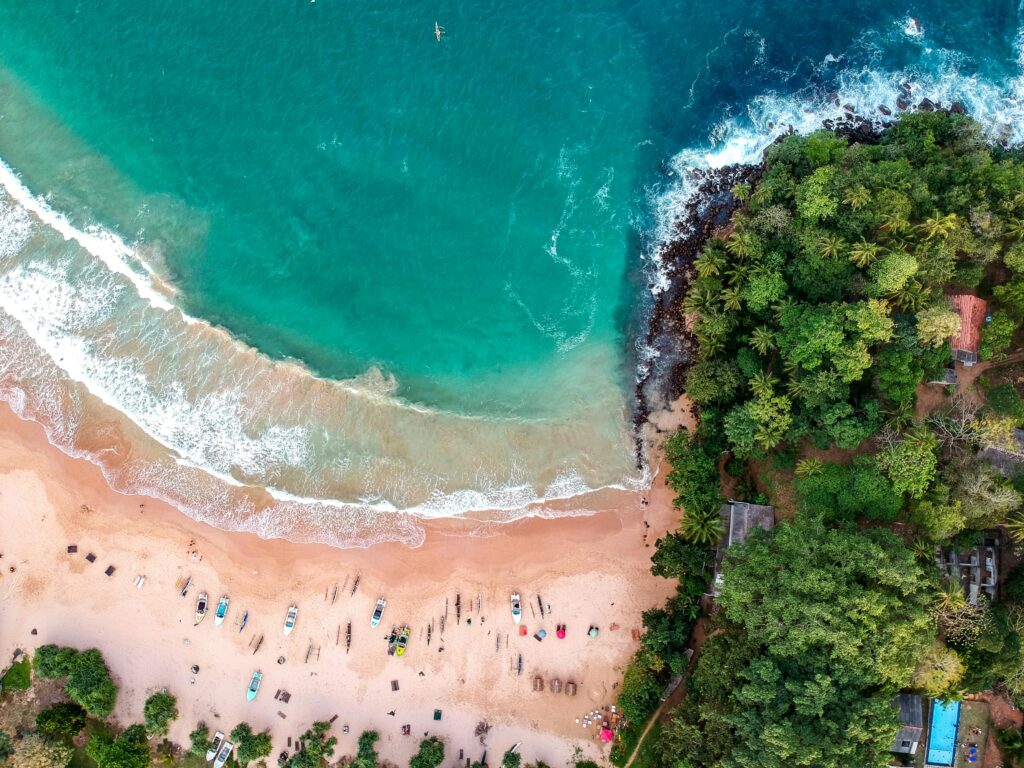
The bay at Saracen, and the bay at M’Pai, exhibits bioluminescent plankton (Noctiluca scintillans) that produces visible blue-green light in the water when disturbed. At night, swimming produces trails of light from your movement. Kayaking through a bioluminescent bay at midnight produces the specific feeling that you are doing something impossible and it is actually happening.
The bioluminescence is most intense in the darker months (October-January) and most visible at depths — the light is more vivid when you’re underwater than when you’re at the surface. Snorkelling masks at night, on a clear-sky dark evening, in a bay of bioluminescent plankton: this is one of the genuinely extraordinary free experiences available in Southeast Asia.
Ferry from Sihanoukville: £5-8 one way. The GTVC and Speed Ferry Cambodia both operate regular services. The crossing takes 45 minutes.
Koh Rong:
The larger island. More development, more infrastructure, more nightlife — Klong Kleang Beach and Long Beach on the northwest have the best sand and some of the island’s better guesthouses. The southeast coast (accessible by boat from the pier) has quieter beaches and the dive sites around the southern tip are worth the boat trip.
Other Islands:
Koh Sdach (King Island): a small fishing community island 3 hours north of Sihanoukville with almost no tourism infrastructure. Visit specifically to see a Cambodian island that hasn’t been optimised for visitors. Koh Tang and Koh Prins: dive site islands accessible by liveaboard from Sihanoukville.
Battambang — Cambodia’s Second City
Battambang is the second-largest city in Cambodia — a French colonial town in the northwest, 3 hours from Siem Reap by road or by the slow boat on the Sangker River (6-8 hours, increasingly a tourist attraction in its own right — the slow boat passes through the Tonle Sap and along a river system through rice paddies and floating villages).
Most Cambodia itineraries don’t include Battambang. It rewards the traveller who has time for it.
The Bamboo Train (Norry):
A single-plank bamboo platform on two modified railway bogies, powered by a small engine, running along a section of single-track railway at 40km/h. When two norry meet going opposite directions, the convention is that the less-loaded one is dismantled and stacked to the side to let the heavier one pass. This is not tourism infrastructure — it is the actual transport system of the rural communities along the route, occasionally supplemented by tourist fees that help maintain it.
The norry circuit runs 10km from Battambang to the village of O Dambong: £5-8 per vehicle (typically 2-3 passengers), bookable through guesthouses in Battambang.
The Killing Cave and the Bat Cave:
Phnom Sampeau, 12km from Battambang: a limestone hill with a Buddhist pagoda at the top. Inside one of the caves: a killing cave used by the Khmer Rouge — prisoners were thrown from the cliff above onto the rock floor of the cave below. A glass case near the cave entrance contains the bones. Adjacent: every evening at sunset, 3-5 million wrinkled free-tailed bats stream from the cave mouth in a continuous column that takes 20 minutes to exhaust — the bats visible as a ribbon against the darkening sky, the hawks waiting below.
Artisan Workshops:
Battambang has a developing artisan economy — silk weaving, pottery, rice wine production, and the Sangker Belle, a locally-produced rice wine that has won international competitions. Several workshops are open for visits. The Phare Circus (a social enterprise teaching circus arts to at-risk youth) performs in Battambang and in Siem Reap — book ahead.
What It Costs — Real Numbers
Cambodia uses US dollars alongside the Cambodian riel. US dollars are accepted everywhere; riel is used for change below $1. Most prices are quoted in dollars.
Daily Budgets
Budget ($25-35/day, approximately £20-28)
- Accommodation: guesthouse private room ($8-15/night)
- Food: local restaurants, markets, street food ($5-8/day)
- Transport: tuk-tuks for local trips, shared buses between cities
Mid-range ($50-70/day, approximately £40-56)
- Accommodation: mid-range guesthouse or small hotel ($20-35/night)
- Food: mix of local and tourist restaurants ($12-18/day)
- Activities: Angkor pass amortised, tuk-tuk hire, temple entry fees
Comfortable ($90-130/day, approximately £72-104)
- Accommodation: boutique hotel ($45-70/night)
- Food: quality restaurants ($25-40/day)
- Activities: private tuk-tuk hire, boat transfers, guided visits
The Angkor Pass — The Cost That Changes Everything
| Pass Type | Cost | Best For |
|---|---|---|
| 1-day | $37 (£30) | Angkor Wat + Bayon + Ta Prohm |
| 3-day | $62 (£50) | Full Angkor complex, multiple approaches |
| 7-day | $72 (£58) | Extended temple exploration |
The 3-day pass is almost always the right choice — it allows a proper dawn visit to Angkor Wat, a full Bayon/Ta Prohm day, a northern temple day (Banteay Srei, Kbal Spean), and time for the quiet temples.
What 10 Days in Cambodia Actually Costs from the UK
| Category | Budget | Mid-Range |
|---|---|---|
| Return flights (via Bangkok or Singapore) | £500–700 | £600–800 |
| 10 nights accommodation | £100–180 | £220–380 |
| Angkor 3-day pass | £50 | £50 |
| Food (10 days) | £65–100 | £120–190 |
| Transport (buses, tuk-tuks, boat transfers) | £40–70 | £60–100 |
| Islands ferry | £10–16 | £10–16 |
| Activities (Killing Fields, National Museum, pepper farm) | £20–35 | £30–50 |
| Total | £785–1,151 | £1,090–1,586 |
Cambodia is one of the most affordable destinations in Southeast Asia. The total cost is competitive with Thailand and significantly below Vietnam at equivalent quality levels.
Eating in Cambodia — Khmer Cuisine and Where to Find It
Khmer cuisine is the least internationally known of the mainland Southeast Asian cuisines — less familiar than Thai, Vietnamese, or even Lao food — and one of the most subtly distinguished. The flavours are gentler than Thai cooking (less chilli heat), the fermented fish paste (prahok) is the flavour base rather than fish sauce, and the fresh herb palette (banana blossom, fresh turmeric, wild ginger, lemongrass) creates a distinctly Khmer aromatic profile.
The Dishes Worth Seeking
Amok Trey
The national dish — fish steamed in banana leaf with a coconut cream, lemongrass, galangal, and kaffir lime curry paste (kroeung). The fish is typically freshwater fish from the Tonle Sap (catfish or snakehead). The cooking method: the fish and curry paste are placed in a banana leaf cup, coconut cream poured over, and the whole thing steamed until the coconut cream has set to a creamy custard around the fish. The flavour: delicate, aromatic, the banana leaf contributing a subtle grassy note. At a proper Khmer restaurant: £3.50-5.50.
Lok Lak
Stir-fried beef with oyster sauce, served on a bed of lettuce and tomato, with a lime and black pepper dipping sauce on the side and a fried egg on top. The lime-pepper sauce (tik marij) is the specific Khmer element — the pepper from Kampot, the lime local, the combination much sharper and more aromatic than any equivalent in Thai or Vietnamese cooking. This is Khmer-Chinese fusion cooking that has been entirely absorbed into the local food culture. At any local restaurant: £2.20-3.50.
Bai Sach Chrouk
The Cambodian breakfast — thin slices of pork, marinated in coconut milk and garlic, grilled over charcoal, served over broken rice (bai sach means “rice with meat”) with pickled vegetables and a clear ginger broth. Available only until about 9am when the morning market vendors pack up. At the market in Siem Reap near the Old Market area or at Phsar Leu market in Siem Reap: £1.20-1.80 for a full plate.
Nom Banh Chok (Khmer Noodles)
The Cambodian breakfast noodle — rice noodles with a green fish curry sauce (made from lemongrass, kaffir lime, and fresh turmeric), topped with fresh bean sprouts, banana blossom, and cucumber. Available from market vendors from 6-9am only — these vendors typically sell out by mid-morning. The consistency and freshness of the noodles (made fresh daily) and the brightness of the green curry sauce are completely unlike any restaurant version.
Prahok Ktiss
A dipping sauce/condiment made from fermented fish paste (prahok) cooked with pork belly, coconut milk, and kroeung (the Khmer spice paste). Served with raw vegetables for dipping — baby eggplant, long beans, cucumber. The prahok gives an intense, salty, almost Stilton-like funk that is either immediately appealing or requires one or two encounters to appreciate. The correct approach: try it at a local restaurant with the vegetable accompaniment, not at a tourist restaurant where the recipe may be adjusted for international palates.
Kep Crab with Kampot Pepper
Described in the Kep section. The combination of the bay crab and the local pepper is the finest single dish of Cambodian regional cooking. The crab can also be found in Phnom Penh (several restaurants source from Kep directly) but the market stalls in Kep itself remain the reference.
Haven Restaurant, Siem Reap
A social enterprise restaurant training disadvantaged youth in culinary and hospitality skills — the food is excellent (amok trey, lok lak, Khmer set menus), the prices are mid-range (£4-8/dish), and the restaurant’s purpose means spending here goes directly to the community. The most consistently recommended restaurant in Siem Reap for visitors who want both quality food and meaningful spending.
Practical Notes
Visa: E-visa required for UK passport holders. Apply at evisa.gov.kh at least 5 business days before travel. Cost: $36 (approximately £28). 30 days single entry. Also available on arrival at the main international airports and land border crossings from Thailand and Vietnam.
Getting there: No direct flights from the UK. Phnom Penh (PNH) and Siem Reap (REP) airports both serve the country. Best routing: via Bangkok (Thai Airways, British Airways to BKK, then short connection), via Kuala Lumpur (Malaysia Airlines via KUL), or via Singapore. Total journey time: 13-16 hours. Return flights from £500-750 booked 6-10 weeks ahead.
Alternatively and ideally: enter Cambodia overland from Thailand (the Poipet/Aranyaprathet border crossing, bus connection to Siem Reap) or from Vietnam (multiple crossings — the most used is at Moc Bai/Bavet for the Phnom Penh connection). Overland entry from Laos at the Stung Treng crossing from the 4,000 Islands side is also possible.
Getting around: Bus between major cities is the standard: Siem Reap to Phnom Penh (7 hours, £7-10 by Mekong Express or Giant Ibis), Phnom Penh to Kampot (3 hours, £5-8), Phnom Penh to Sihanoukville (3 hours, £5-8). Giant Ibis is the most reliable operator for the main routes — book online. Within cities: tuk-tuks (negotiate before getting in) or PassApp/Grab (the ride-hailing apps that work in Phnom Penh and Siem Reap).
Currency: US Dollar ($) for most transactions. Cambodian Riel (KHR) for change below $1 (4,000 riel ≈ $1). ATMs throughout major cities. No ATMs on the islands or in very rural areas. US dollars from ATMs (the default output). Bring $20 bills rather than $100s for smaller transactions.
Language: Khmer. English is spoken in tourist-facing businesses throughout Siem Reap and in Phnom Penh. In rural areas and smaller towns: limited. “Arkoun” (thank you), “Chhnam leuy” (how much?), “Ot te” (no, thanks) — the basics.
Getting a SIM: Smart and Metfone both sell tourist SIMs at Phnom Penh and Siem Reap airports. A 30-day SIM with 10GB data: £5-8. Good coverage in cities and along major routes; limited on remote islands.
Health: Hepatitis A and Typhoid vaccinations recommended. Malaria prophylaxis for rural areas and the islands — consult a travel clinic. Dengue fever is present throughout Cambodia — mosquito repellent, particularly in the early morning and evening. Food and water: the same standard precautions as all of mainland SE Asia.
The 10-Day Itinerary — Temples, Capital, Coast
This route covers the essential Cambodia — Siem Reap and Angkor, Phnom Penh and the history, Kampot and the pepper, Koh Rong Samloem — in 10 days, using buses and ferries rather than domestic flights (Cambodia is small enough to make flying unnecessary).
Days 1-4: Siem Reap and the Angkor Complex
Day 1: Arrive Siem Reap. Arrange tuk-tuk driver for the temple days. Evening: Old Market area for the night market and dinner.
Day 2: Angkor Wat sunrise (4:30am departure). Main temple interior. Bayon mid-morning. Ta Prohm afternoon. Return to Siem Reap.
Day 3: Northern route with your tuk-tuk driver — Banteay Srei and Kbal Spean (full day). Neak Pean on the return.
Day 4: Quiet temples circuit — Preah Khan, Pre Rup at sunset. Siem Reap evening, National Museum if not yet visited (go to the Phnom Penh one but the SR branch is good context).
Day 5: Siem Reap to Phnom Penh (bus)
Giant Ibis bus (7 hours, £10). Arrive Phnom Penh afternoon. Hotel check-in. Mekong riverfront walk. Dinner at a riverside restaurant.
Day 6: Phnom Penh — The History
Morning: Choeung Ek Killing Fields (9am, allow 2 hours, take a tuk-tuk from the hotel — 30 minutes each way). Return to the city. Lunch. Tuol Sleng Genocide Museum (afternoon, allow 90 minutes).
Day 7: Phnom Penh — The City
National Museum (morning — go before Angkor was the recommendation; going after gives different context). Royal Palace and Silver Pagoda (afternoon). Russian Market. Dinner in the Tonle Bassac restaurant district.
Day 8: Phnom Penh to Kampot (bus)
Bus to Kampot (3 hours, £6). Check in. Afternoon: pepper farm visit (La Plantation, book the day before). Riverside bicycle circuit at dusk.
Day 9: Kampot, Kep, and Departure to Islands
Morning: Kep crab market (8am, crabs at their freshest). Return to Kampot. Lunch. Afternoon bus or tuk-tuk to Sihanoukville (3 hours). Ferry to Koh Rong Samloem (45 minutes). Check in. Swim in bioluminescent water after dark.
Day 10: Koh Rong Samloem to Sihanoukville, Onward
Morning on the island. Afternoon ferry to Sihanoukville. Bus connection to Bangkok (crossing at Poipet, 8-9 hours total), or overnight bus to Phnom Penh for a connection flight home.
Final Thought
I was at the Killing Fields at 10am on a Tuesday in December. The audio guide was playing testimony. I had reached a section where the speaker, a survivor, described the night the facility processed the people who were brought from the prison.
I stood at the edge of one of the mass graves for a long time. The children at the adjacent primary school were visible over the low wall. The sounds of a school morning — the bell, the voices, the running — were audible across the garden.
Cambodia holds its most difficult history in public, not in archives. The decision to make Tuol Sleng and Choeung Ek permanent memorials rather than demolished or forgiven sites is a national choice that says something profound about a country that needs the world to understand what happened and why it matters.
I don’t know what to say about that. I only know that going is more important than not going, and that the morning after the museum I went back to Angkor Wat for the sunrise and understood what I was looking at differently.
Go to both. The country deserves both your awe and your attention.
Have a question about Cambodia this guide doesn’t answer? Drop it in the comments.