
The complete guide for UK travellers: Petra at 6:30am before anyone else arrives, Wadi Rum’s silence under an unobstructed Milky Way, the Roman city better preserved than anything in Italy, the body of water you physically cannot sink in, the gorge where you wade chest-deep through crimson sandstone, and why the Jordan Pass is the single most important thing to buy before you fly.
Reading time: 16 minutes | Last updated: 2026
Jordan surprises people.
Not in the way that destinations surprise you when you had no expectations. In the specific way that somewhere surprises you when you thought you knew what it was — Petra, desert, sand — and then the Siq narrows to two metres wide and the Treasury appears at the end of it and your understanding of what stone and time can produce together requires immediate revision.
Jordan is a small country. Roughly the size of Portugal, with a population of 10 million and a landscape that shifts from the fertile hill country of the north to the Wadi Rum desert in the south in the space of a three-hour drive. What it contains per square kilometre is extraordinary: the most famous single carved stone facade in the world, a Roman city more intact than anything in Italy, a body of water so saline that sitting on the surface reading a newspaper is a practical rather than photographic act, a sandstone gorge where you swim through chest-deep water between walls that glow red in the light, and a desert where four major films were shot because no location team could find anywhere else on Earth that looked adequately alien.
It’s also one of the warmest countries in the world for solo travellers. Jordanians have a reputation for hospitality that operates at a level genuinely different from most of the region. The cup of tea offered in a shop you’re passing is not commercial — it’s a greeting. The directions given by someone who walks you to the corner rather than pointing are the norm rather than the exception. You will be asked where you’re from, how you find Jordan, and whether you want tea, in that order.
This guide covers Jordan properly. That means Petra done right rather than rushed, Wadi Rum with overnight context rather than a day trip, and the sites most Jordan itineraries skip because there isn’t time — which is the primary planning error in a country this compact.
Quick Navigation
- The Case for Jordan — Direct Flights, Jordan Pass, No Visa
- When to Go — The Temperature and the Light
- The Jordan Pass — Buy This Before Anything Else
- Amman — Why You Should Stay Two Days
- Jerash — The Roman City Most Visitors Skip
- The Dead Sea — The Lowest Point on Earth
- Wadi Mujib — The Gorge Nobody Expects
- Petra — The Treasury at Dawn and Everything After
- Little Petra and the Siq al-Barid
- Wadi Rum — The Valley of the Moon
- Aqaba — The Red Sea Coast
- Hidden Jordan — The Places Worth the Detour
- What It Costs — Real Numbers
- Eating in Jordan — The Food Most Guides Ignore
- Practical Notes
- The 7-Day Itinerary — The Route That Works
The Case for Jordan — Direct Flights, Jordan Pass, No Visa
The practical case is compelling before anything else.
Direct flights from London Heathrow and Gatwick to Amman on Royal Jordanian from £130-200 return. Flight time: 5 hours. No visa required for UK passport holders — stamp on arrival. The Jordan Pass (£85, see dedicated section below) covers the visa fee plus entry to 40 sites including Petra, which at £56/day solo entry makes the pass pay for itself with Petra alone.
Jordan is also politically stable in a region where that requires saying. The Foreign Office does not advise against travel to the main tourist areas (Amman, Petra, Wadi Rum, the Dead Sea, Aqaba). The country has hosted millions of visitors annually for decades and has a well-developed tourism infrastructure — guides, transport links, accommodation across all price points — built to handle independent travellers without requiring packages or tours.
The experiential case: Jordan is the most historically dense small country in the Middle East for UK travellers interested in archaeology and landscape. Petra alone warrants a dedicated trip. The additional hours required to add Jerash, Wadi Mujib, and Wadi Rum to that trip are small relative to the return.
The honest note on cost: Petra’s entry fee (£56/day, £65 for two days) is among the most expensive single site entries in the world. The Jordan Pass makes this significantly more manageable. Plan the pass before planning anything else.
When to Go — The Temperature and the Light
Jordan’s climate divides into distinct zones that affect the optimal visit window for each region.
March to May — The First Sweet Spot
Wildflowers on the hillsides around Petra and Jerash. Comfortable temperatures throughout the country (18-26°C in Petra and the highlands, 25-32°C at the Dead Sea and Aqaba). Wadi Rum warm in the day, cool at night — the ideal desert camping temperature. The light in April is the finest of the year for photography.
March brings the best wildflowers — the black iris (Jordan’s national flower), red poppies, and anemones covering the hillsides around Petra and the Dana Biosphere Reserve.
September to November — The Second Sweet Spot
The heat of summer breaks in September. Petra and Wadi Rum return to comfortable hiking temperatures. The Dead Sea is still warm. The light shifts to its golden autumn register. Crowds drop from the summer peak. Accommodation prices fall 20-30% from the July-August high.
October is the month most experienced Jordan travellers choose: post-summer crowds, pre-winter chill, the landscape lit by autumn light.
June to August — Hot and Busy
Petra and Aqaba are genuinely hot (35-40°C). Wadi Rum in August can exceed 45°C at midday. Hiking Petra in the middle of the day in August is physically demanding and not recommended. The approach: start everything before 8am, rest 11am-4pm, resume in the afternoon. The desert camps at night are still extraordinary.
December to February — Cool and Quiet
Petra in winter: cold mornings (sometimes below 5°C), frost on the Treasury steps occasionally, the site dramatically less crowded. The Siq in winter rain can be hauntingly beautiful. Wadi Rum at night in January: cold enough to require serious sleeping bag rating. The Dead Sea in December: still warm from summer solar gain (28-30°C water temperature).
The BGGD recommendation: March-April for wildflowers and photography. October for the best combination of comfortable weather, light, and thin crowds.
The Jordan Pass — Buy This Before Anything Else
The Jordan Pass is the single most important planning decision for any Jordan trip and the one most often discovered too late.
What it is: A pre-purchased pass (bought online at jordanpass.jo before travel) covering the Jordan visitor visa plus entry to 40 tourist sites, including Petra.
What it costs: £85 (Jordan Explorer, covers 1-day Petra entry). £91 (Jordan Insider, covers 2-day Petra entry — the right choice for most visitors). £97 (Jordan Expert, covers 3-day Petra entry).
Why it’s essential:
The Jordan visitor visa alone costs approximately £35-40 on arrival. Petra entry alone costs £56 for one day, £65 for two days. Combined: £91-105 without the pass for just the visa and Petra. The Jordan Insider pass at £91 covers both, plus 38 additional sites including Jerash (£8 separately), Wadi Mujib (£25 separately), Ajloun Castle (£3), Kerak Castle (£2), Madaba (£1), the Roman theatre in Amman (£3), and more.
The conditions: The pass must be purchased before arrival in Jordan. It must be registered online with your passport number before travel. It’s activated on first use and valid for the duration of your Jordan trip.
If you purchase it at home and arrive in Jordan with the pass registered: you skip the visa queue at immigration and proceed with a stamp. The saving in time at Queen Alia International Airport at 11pm after a 5-hour flight is an additional quiet benefit.
Amman — Why You Should Stay Two Days
Most Jordan itineraries allocate one night in Amman and move to Petra on day two. This is understandable and incorrect.
Amman is not a transit hub. It’s a city of 4 million people spread across 19 hills (jabals), built from the distinctive pale grey limestone of the Jordanian highlands, where the Roman ruins of the 2nd century CE sit in the middle of the contemporary city and the contemporary city organises itself around them with complete equanimity.
The city has an energy — a combination of Palestinian, Iraqi, Syrian, and traditional Jordanian culture, filtered through a coffee shop scene and a contemporary arts presence and a food culture — that is unlike any other Arab capital. It also has the finest hummus accessible from the UK.
The Citadel (Jabal al-Qal’a)
Amman’s highest hill, with the ruins of a Roman temple, a Byzantine basilica, and an Umayyad palace occupying the same plateau — three civilisations on one hilltop, each building directly on what the previous one left. The Temple of Hercules (2nd century CE) has two standing Corinthian columns and a giant hand fragment from the statue of Hercules that once stood here — the scale of the hand fragment gives a sense of the scale of the statue. Entry: included in the Jordan Pass.
The view from the Citadel over Amman is the best in the city — the white limestone buildings cascading down the surrounding hills, the Roman Theatre visible directly below, the minarets and water towers and satellite dishes of the modern city in every direction.
The Roman Theatre
Directly below the Citadel, in the middle of the downtown area: a 2nd-century Roman theatre with a capacity of 6,000, still used for concerts and cultural events. The cavea (seating area) climbs the hillside behind the stage. Entry: included in Jordan Pass.
The neighbourhood surrounding the theatre — Wasat al-Balad, downtown Amman — is the most characterful area in the city: old merchant shops selling spices and fabrics, the Abu Darwish mosque with its distinctive black-and-white striped stonework on the hill above, the vendors selling ka’ak (sesame-crusted bread rings) from carts.
Rainbow Street
The main street of the Jabal Amman neighbourhood — the most interesting street in the city for food and coffee. Hashem Restaurant, open since 1952, serves the finest hummus in Amman: a simple room, plastic tables, hummus and falafel and ful medames and fresh pita for under £2, cash only, always a queue of local office workers at lunch, always worth joining. The queue moves quickly. The hummus is worth the entire neighbourhood.
Wild Jordan Café above Hashem: a rooftop restaurant run by the Royal Society for the Conservation of Nature, organic food using ingredients from Jordan’s protected areas, the view over the cityscape from the terrace. £5-8 for lunch. Book ahead for dinner.
Darat al Funun
An arts foundation in a 1920s villa in the Jabal al-Weibdeh neighbourhood — a series of historic houses converted into gallery spaces, surrounded by terraced gardens on the hill above downtown. The permanent collection changes but the building and the garden are worth visiting regardless of what’s showing. Free entry. One of the finest contemporary arts spaces in the Arab world.
The Jabal al-Weibdeh neighbourhood itself: the most atmospheric in Amman — the French cultural centre, independent galleries, the murals painted on every available wall since 2011, the café culture that developed here specifically because of the art scene.
The Food Evening
A Jordan food evening in Amman:
- Knafeh at Habibah Sweets (Al-Quds Street, downtown): the finest knafeh in Amman — shredded kataifi pastry over soft white cheese, soaked in orange blossom syrup, the thin layer of semolina underneath giving it structure. Queue at the counter. Eat it warm and immediately from the paper plate.
- Mansaf at Al Quds Restaurant: the national dish, served communally on a large platter — lamb in a fermented goat yoghurt sauce (jameed) over rice and flatbread, topped with almonds and pine nuts. Eaten standing or sitting, tearing bread and gathering lamb with the right hand. One of the most specifically and proudly Jordanian meals available.
- End at a rooftop bar in Jabal al-Weibdeh with mint tea and the city lights below.
Jerash — The Roman City Most Visitors Skip
Jerash is 48km north of Amman — 1 hour by JETT bus from Abdali station (£2) or 45 minutes by shared taxi (£3). Most Jordan itineraries don’t include it because the Petra-Wadi Rum route runs south rather than north.
This is a significant omission.
Jerash is the best-preserved Roman provincial city in the world outside Italy. A city of 250,000 people at its 2nd-century peak, it was abandoned following the great earthquake of 749 CE and buried under silt and sand until excavations began in the 1920s. The result is a Roman city where the street paving is largely intact, the column bases are in their original positions, and the sense of standing in a functioning urban environment rather than a scattered ruin is more complete than anywhere except Pompeii.
The Forum (Oval Plaza): an unusual oval shape rather than the standard rectangular Roman forum, surrounded by 56 Ionic columns. At the southern end: the Arch of Hadrian, built in 129 CE for the emperor’s visit. At the northern end: the Temple of Zeus. The oval space between them is the finest Roman plaza in the Middle East.
The Cardo Maximus (Colonnaded Street): the main north-south street, still paved with the original limestone slabs, the wheel-ruts from Roman carts still visible. Lined with 500 columns — half still standing, half toppled by the earthquake and lying as they fell, preserved by the silt. Walking the length of it (600 metres) gives the most complete sense of a Roman colonnaded city available outside Italy.
The North Theatre: a smaller theatre than the South Theatre (capacity 1,600 versus 3,000), almost completely preserved, used for cultural performances throughout the year. The acoustics work without amplification in a way that modern theatres spend millions trying to replicate.
The South Theatre: the main performance space, seats 3,000, the original stage building largely intact. The Roman Jerash festival (usually July) stages performances here — open-air events in a 2nd-century theatre, a specific experience.
The Temple of Artemis: Jerash’s patron deity, a temple built in the 2nd century CE on the city’s highest point. The six standing Corinthian columns are the tallest surviving Roman columns in Jordan. The precinct around them gives the finest view of the site.
Entry: included in the Jordan Pass. Allow 3 hours minimum for a thorough visit.
A note on what’s not in Jerash: tourists. On a typical weekday, a few dozen visitors share the entire site. Compare this to the Colosseum or Pompeii at any time of year. The absence of crowds at a site of comparable historical significance is one of the most striking things about Jordan generally and Jerash specifically.
The Dead Sea — The Lowest Point on Earth
The Dead Sea surface sits at 430 metres below sea level — the lowest land surface on Earth. The sea is 34% saline (the ocean averages 3.5%), a concentration high enough that no fish survive and the water is dense enough that a human body in it cannot submerge. You float. Not metaphorically — you cannot help floating, cannot force yourself under, cannot swim in any conventional direction because there’s nothing to push against. The standard floating-on-the-surface-reading-a-newspaper-with-your-feet-crossed photograph is not a performance. It’s just what happens.
The black mineral mud on the shoreline — applied to the skin, left for 10-15 minutes in the sun, washed off in the sea — has been used cosmetically since Cleopatra allegedly had it sourced specifically. The magnesium and potassium and bromide concentrations are real. Your skin afterwards is genuinely different from your skin before.
The Dead Sea is accessed from Amman by: rental car (45 minutes), shared taxi (£15-20 return from downtown Amman), or a day tour (from £25, includes transport and beach access). Most resorts along the Jordanian side charge an entry or beach access fee (£8-20) for non-guests — book directly with a resort for a day-use rate that includes towels, changing rooms, and shower facilities.
The level drops approximately 1 metre per year due to extraction of water from the Jordan River and industrial mineral extraction. The shoreline has receded significantly from historical levels. The floating experience is unchanged; the geographic context is worth knowing.
What to do:
Float. Apply the mud. Photograph it. Wash off thoroughly — the salt concentration in your eyes or any cut is genuinely painful.
What not to do: submerge your face or splash water near your eyes. The salt burn is immediate and severe. Most resorts provide goggles for precisely this reason.
Where to stay: The Kempinski Hotel Ishtar and the Movenpick Resort have the finest beach facilities on the Jordanian shore. Both offer day-use packages (£35-60/person including access to the private beach, pools, changing rooms, and shower). Worth the price over the public beaches for the shower facilities alone.
Wadi Mujib — The Gorge Nobody Expects
Wadi Mujib is a canyon gorge that runs from the highlands east of the Dead Sea down to the water level, cut through sandstone over millennia by the Mujib River. The RSCN (Royal Society for the Conservation of Nature) manages it as a nature reserve and runs guided hiking trails through the canyon.
The Siq Trail: the core experience. You enter the canyon on foot from the Dead Sea shore, wade into the river at the mouth, and proceed upstream through the gorge for 2km — wading through water ranging from ankle-deep to chest-deep, scrambling over boulders, squeezing through narrow rock slots, passing a waterfall at the end. The canyon walls are rust-red and orange sandstone, rising 100 metres on both sides, the sky a narrow strip above. At the waterfall: a rope to climb up through the falls, a pool above it, the roar of the water.
Practical details: April through October only (flash flood risk closes the trail November-March). Entry and guide: £25 (included in Jordan Pass). The guide accompanies the group and manages safety at the waterfall section. Bring nothing you can’t get wet. Leave shoes you don’t mind soaking. Do not bring your phone without a waterproof case.
The trail takes approximately 3-4 hours return. It is physically demanding (the waterfall climb and the upstream wading) but not technically difficult. People of moderate fitness complete it regularly.
It is one of the most genuinely surprising experiences in Jordan — a canyon that appears on relatively few Jordan itineraries and delivers, consistently, something nobody quite expected.
Petra — The Treasury at Dawn and Everything After
Petra was the capital of the Nabataean Kingdom from approximately the 4th century BC until Roman annexation in 106 CE. The Nabataeans were the masters of the ancient Arabian trade routes — frankincense, myrrh, spices, silks — and they used their wealth to carve an entire city from the rose-red sandstone of the Jordan highlands. The Treasury (Al-Khazneh), the Monastery (Al-Deir), the Royal Tombs, the colonnaded street, the Great Temple — all carved from the rock face rather than constructed from assembled stone.
The site covers 264 square kilometres. Most visitors see perhaps 10% of it in a one-day visit. Two days is the correct allocation. Three is better.
The Timing Question
The single most consequential decision in a Petra visit is when to arrive.
The site opens at 6am. The first tour groups from Aqaba and Amman arrive by bus at approximately 8:30-9am. Between 6am and 8:30am, the Treasury — the most famous façade in the world — belongs to a handful of early risers.
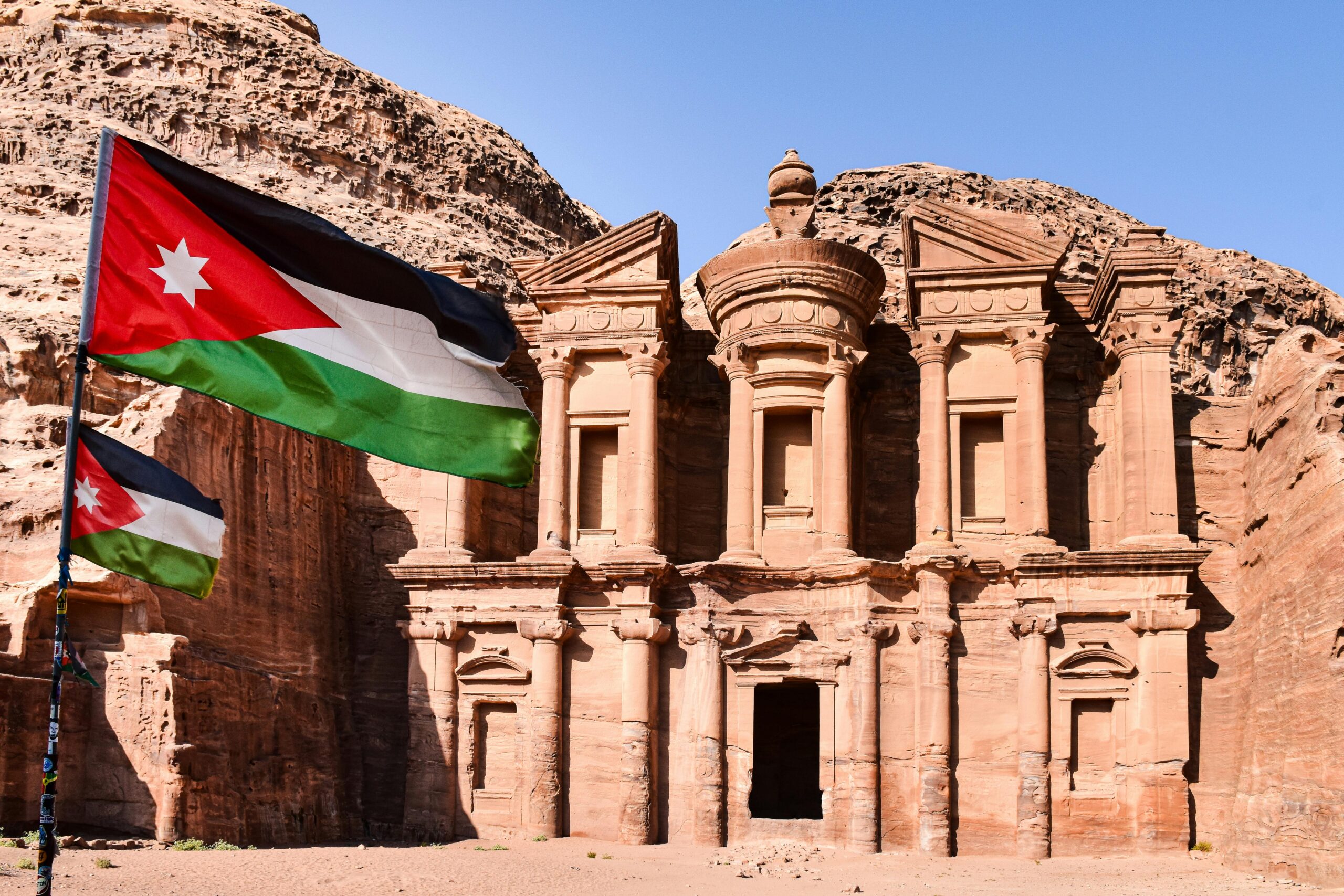
The Siq at dawn: a 1.2km canyon that narrows to 2 metres at its tightest, the walls 182 metres high, lit by the first light filtering from above, the sound of your own footsteps. At 6:30am, the Treasury appears at the end of the Siq in a vertical shaft of rose-gold sandstone. Nobody in the photograph. No queues. The silence of a place that has been here for 2,300 years, indifferent to whether anyone is watching.
At 10am, this scene contains dozens of tourists and several horses.
Set the alarm. Walk the Siq in the dark if necessary. Be at the Treasury for the light.
The Treasury (Al-Khazneh)
45 metres high. Two-storey Hellenistic facade carved directly into the rose-red sandstone. The upper storey centred on a tholos (circular temple) — the urn at its top was believed by locals to contain a pharaoh’s treasure (hence “Treasury”) and has bullet marks from Bedouin attempting to release it. The interior: a single large chamber, three alcoves, nothing else. The outside is the entire point.
Entry: included in Jordan Pass. Photography from the front plaza: free and unlimited.
The light on the Treasury changes character through the day. The morning direct light (6-8am) is warmest and most golden. Afternoon shade on the facade produces a different, cooler image. Both are extraordinary.
Beyond the Treasury — Day One
Most visitors turn around at the Treasury. This is a mistake that misses 90% of Petra.
Continue past the Treasury north through the main Petra basin. The Street of Facades: dozens of carved tomb facades on both sides of the path. The Roman Theatre (a theatre carved from the rock face, seating 8,500 — the Romans had colonised the trade route by this point). The Royal Tombs: four large tomb facades on the hillside east of the main path — the Urn Tomb, the Corinthian Tomb, the Palace Tomb, the Silk Tomb — each in a different Nabataean-Roman hybrid style.
The Petra Basin colonnaded street: the remains of a Roman-era main street, the column bases still in position, the markets and temples on either side accessible on foot. The Qasr al-Bint temple (one of the few freestanding structures in Petra, 30 BCE, partially standing) at the western end.
The Monastery (Al-Deir) — Day Two
The reason to stay two days.
The Monastery is larger than the Treasury — 47 metres wide, 48 metres high — and sees a fraction of the visitors. Getting there requires a 45-minute hike from the main Petra basin: 800 rock-carved steps ascending the cliff above the colonnaded street. The steps are manageable in the morning. In the midday heat they’re less so.
The path at the top opens onto the Monastery plaza. The facade is similar in structure to the Treasury but without the Hellenistic detail — later in date, grander in scale, used as a Byzantine church (hence the name, from the cross carved inside). The plateau above the Monastery extends toward the High Place of Sacrifice and gives the finest views of the Petra landscape available anywhere in the site.
The High Place of Sacrifice: a processional altar on the plateau above the Monastery path — two obelisks carved from the rock and a drainage channel for the blood of sacrificed animals. The view from the High Place over the Petra basin is the one that gives the scale of the city. Allow a full morning for the Monastery and High Place combined.
The Siq by Night (Petra by Night)
Monday, Wednesday, and Thursday evenings: the Siq and Treasury are lit by 1,500 candles. The walk through the illuminated Siq to the candlelit Treasury, with Bedouin music playing from the plaza, is entirely theatrical and entirely effective. Entry: £12, separate from the day entry and included in the Jordan Pass (check current terms). Be at the entrance at 8:30pm for the 9pm start.
Little Petra and the Siq al-Barid
Eight kilometres north of the main Petra entrance: a smaller Nabataean site, entirely free to enter, almost never crowded, and in some ways more rewarding than the main site for its intimacy.
The Siq al-Barid (Cold Canyon) is a miniature version of the main Petra Siq — narrow, carved, with Nabataean tomb facades and water channels visible — but accessible without a ticket. The site was believed to be a caravanserai — a stopping point for the trade caravans approaching the main city — and the large dining chambers carved into the rock face, with Nabataean frescos still faintly visible on the walls, give a sense of commercial life that the tomb-heavy main site doesn’t.
Go late afternoon from Wadi Musa (the town adjacent to the main Petra entrance) — the light in the canyon at 5pm is excellent and the site is almost empty. The walk through the full canyon takes 30 minutes.
Wadi Rum — The Valley of the Moon
Wadi Rum is a protected desert in the south of Jordan — a landscape of red sand plains interrupted by massive sandstone and granite mountains, the geology exposed by millennia of wind erosion into arches, gorges, and mushroom-shaped formations. The colour at sunset: the sand turns from pale orange to deep crimson to purple as the sun drops, the mountains shadowing themselves against each other.
It has been used as a film location for: Lawrence of Arabia (1962), The Martian (2015), Rogue One: A Star Wars Story (2016), Dune (2021). The Mars mission coordination scene in The Martian used Wadi Rum directly because nowhere on Earth is more convincingly Martian.
Staying in Wadi Rum
The overnight camp is the correct choice. Day trips from Petra or Aqaba see the landscape but not the night.
Wadi Rum at night: no light pollution for 100 kilometres in any direction. The Milky Way visible in its entirety from 9pm. The temperature dropping from 30°C to 15°C in the space of two hours. The silence — absolute, complete, the only desert silence I’ve experienced that produces a physical sensation rather than merely an absence of sound.
Camp options range from basic Bedouin tents (£35/night full board, eating around a fire, sleeping on a mat) to “luxury” bubble tents with transparent roofs for stargazing (£120-180/night). The bubble tents have their committed advocates. The traditional camp with a campfire and Bedouin tea and the full star canopy above a canvas is the version I’d take without hesitation.
All camps include dinner (a zarb — meat and vegetables slow-cooked in a pit oven in the sand, dug out ceremonially at dinner time) and breakfast. Transportation within the desert by jeep is arranged through the camp.
What to do in Wadi Rum:
Jeep tour: most camps include a sunset jeep tour on the first day. The driver navigates the desert tracks between rock formations — Jebel Khazali (a canyon with Nabataean inscriptions), the Lawrence of Arabia rock bridge (a natural arch named for Lawrence’s probable passage), the red sand dunes (climbable, the view from the top across the sand plain is the one from The Martian).
Camel ride at sunset: available through most camps (£15-25/hour). The pace is right for the light.
Rock climbing: several natural routes on the sandstone formations, accessible through local Bedouin guides who’ve been climbing these rocks since childhood.
Doing nothing: sitting outside the tent at 9pm watching the stars arrive is an entirely legitimate use of time in Wadi Rum.
Getting to Wadi Rum
From Petra (Wadi Musa): 1.5 hours by car or shared taxi (£15-20 for the whole taxi, splittable). Your camp will often arrange a pickup. From Aqaba: 1 hour by car.
A JETT bus runs from Amman to the Wadi Rum visitor centre (4 hours, £8) with connections from Petra available by taxi.
The visitor centre is at the entry point of the protected area. From here, only 4WD vehicles can enter the desert — your camp’s driver collects you at the visitor centre. Do not attempt to enter the desert in a standard car.
Aqaba — The Red Sea Coast
Jordan’s only coastal city, at the northern tip of the Red Sea — 4km of coastline squeezed between Saudi Arabia to the south, Israel to the west (the lights of Eilat are visible across the Gulf of Aqaba), and Wadi Rum to the north.
The Red Sea at Aqaba: excellent snorkelling and diving directly from the shore or by boat. The Gulf of Aqaba has one of the finest reef systems in the Red Sea — the Japanese Garden reef (15 minutes by boat), the Cedar Pride wreck (a deliberately scuttled cargo ship, now a dive site colonised by coral), and a shallow coral garden accessible directly from the public beach.
Dive operators run from the main dive centre strip on the South Beach road. PADI Open Water certification in Aqaba takes 3 days and costs £250-320 (significantly cheaper than most European dive training). Day dives: £30-45 with equipment.
Aqaba’s actual town is small and unpretentious — the port infrastructure, the duty-free shopping zone (a feature of the Economic Zone status that makes Aqaba prices for electronics and alcohol notably lower than the rest of Jordan), and the seafood restaurants along the waterfront. One or two nights is the right allocation — enough for a full day’s diving or snorkelling.
Hidden Jordan — The Places Worth the Detour
Dana Biosphere Reserve
The largest nature reserve in Jordan — 308 square kilometres of terrain ranging from the sandstone mountains of the Jordanian highlands (1,500m) down through Mediterranean, desert, and Saharo-Arabian vegetation zones to the bottom of the Wadi Araba (50m below sea level). The biodiversity is extraordinary: 800 plant species, 449 bird species, 37 mammal species.
The Dana Village — a stone settlement on the rim of the reserve, largely abandoned and now partially restored as guesthouses — is the base. The Rummana campsite in the heart of the reserve (seasonal, spring and autumn) is the finest base for the interior trails.
Dana to Petra via the Shaq al-Rais trail: a 3-day wilderness trek through the reserve, descending from the highlands to the Wadi Feynan, crossing to Petra via the ancient trade route. One of the finest multi-day hikes in the Middle East. Arrange through the RSCN (Royal Society for the Conservation of Nature) with a guide. Not well-publicised. Entirely worth the planning.
Kerak Castle
A Crusader castle on a hill above the King’s Highway, 2 hours south of Amman. Built by the Crusaders in 1142 CE as a strategic point on the trade route between Egypt and Syria, besieged repeatedly by Saladin from 1183 onward, finally taken in 1188. The castle covers the entire hilltop — underground corridors, towers, a Crusader great hall, a Byzantine church incorporated into the Crusader structure. Entry: included in Jordan Pass.
The King’s Highway running through Kerak is one of the oldest trade routes in the world — used by Moses, by the Romans, by the Crusaders, and by the Nabataeans. Driving it between Amman and Petra (slower than the Desert Highway, significantly more scenic, passing Kerak and the Dana Reserve) is the correct choice for any traveller with an extra day.
Ajloun Castle
A Muslim castle built in 1184 CE by Saladin’s nephew as a counterpoint to the Crusader castles in the region — the only Islamic castle in northern Jordan. 90km north of Amman, near the biblical Gilead. Partially restored, with good views over the Ajloun Forest Reserve (the largest oak and pine forest in Jordan). Entry: included in Jordan Pass.
Umm Qais (Gadara)
In the far northwest of Jordan, on the border with Syria and overlooking Lake Tiberias (the Sea of Galilee) and the Golan Heights: the ruins of the ancient Decapolis city of Gadara. Black basalt colonnaded streets, two theatres, a mausoleum — and the view, which takes in three countries simultaneously on clear days. The site is almost entirely unvisited by international tourists. Entry: included in Jordan Pass.
Azraq Wetland Reserve
120km east of Amman in the desert: an oasis wetland — the only permanent body of water in 12,000 square kilometres of eastern desert. The wetland was nearly destroyed in the 1970s and 1980s by groundwater extraction for Amman’s growing population. A conservation project has partially restored it. Lawrence of Arabia wintered here in 1917. The Azraq Castle (a Roman, Byzantine, and Islamic fortress) adjacent. The migrating birds in spring and autumn include species seen nowhere else in Jordan.
What It Costs — Real Numbers
Jordan is mid-range by Middle Eastern standards and more expensive than Southeast Asia or Eastern Europe, but significantly cheaper than Western Europe. The Jordan Pass substantially changes the effective cost by covering the visa and Petra entry.
The Jordan Pass Calculation
Without Jordan Pass:
- Visa on arrival: £35-40
- Petra (1 day): £56, or Petra (2 days): £65
- Jerash: £8
- Wadi Mujib: £25
- Other sites: £10-15
- Total site entry: £134-153
With Jordan Explorer Pass (£85): visa + 1-day Petra + all other sites = equivalent to £134+ without. Saving: £49+.
With Jordan Insider Pass (£91): visa + 2-day Petra + all other sites = equivalent to £143+ without. Saving: £52+.
Buy the Insider. It’s correct for anyone doing Jordan for 7-10 days.
Daily Budgets
Budget (£45-60/day including Jordan Pass amortised)
- Accommodation: budget guesthouse in Wadi Musa, hostel in Amman (£15-25/night)
- Food: local restaurants, falafel, hummus, local shawarma (£6-10/day)
- Transport: JETT buses, shared taxis (cheaper than private)
Mid-range (£70-95/day)
- Accommodation: mid-range hotel in Amman, boutique guesthouse near Petra (£35-55/night)
- Food: mix of local and restaurant meals, one good dinner (£15-22/day)
- Transport: private taxis for the Petra-Wadi Rum leg, buses elsewhere
Comfortable (£120-160/day)
- Accommodation: Petra Moon Hotel, luxury desert camp in Wadi Rum, Dead Sea resort day-use (£60-110/night or day-use)
- Food: quality restaurants, one mansaf dinner (£25-40/day)
What 7 Days in Jordan Actually Costs from the UK
| Category | Budget | Mid-Range |
|---|---|---|
| Return flights (Amman, 6 weeks ahead) | £130–200 | £160–250 |
| Jordan Insider Pass (visa + sites) | £91 | £91 |
| 7 nights accommodation | £105–195 | £245–385 |
| Wadi Rum overnight camp (1 night, full board) | £35–50 | £60–120 |
| Dead Sea day access | £10–20 | £35–60 |
| Food (7 days) | £55–85 | £110–175 |
| Internal transport (buses, taxis) | £35–55 | £55–90 |
| Total | £461–696 | £756–1,171 |
Jordan delivers one of the most historically extraordinary trips accessible from the UK at a total cost comparable to a week in Greece or Portugal.
Eating in Jordan — The Food Most Guides Ignore
Jordanian food is one of the great undiscovered Middle Eastern cuisines — not undiscovered by Jordanians, who eat it with evident pride and pleasure, but by the international travel conversation, which has given significantly more attention to Lebanese, Turkish, and Israeli food while Jordan’s culinary identity has been subsumed into the general category of “Middle Eastern.”
The food is Levantine in character — mezze culture, flatbread, legumes, olive oil, slow-cooked meats — but with specific Jordanian preparations that are genuinely distinct and worth seeking.
The Dishes Worth Seeking
Mansaf
The national dish of Jordan, and an important cultural marker. Lamb slowly cooked in a sauce of jameed (a fermented, dried goat or sheep yoghurt reconstituted in water into a rich, tangy broth) and served on a communal platter of flatbread and rice, garnished with toasted almonds and pine nuts. The jameed gives a specific flavour — simultaneously sour and rich, unlike any dairy preparation in European cooking.
Mansaf is eaten at celebrations, weddings, and funerals — it’s the dish of significant occasions. It’s also available in restaurants, where the communal experience is replicated for smaller groups. The correct technique: use your right hand, form the rice and lamb into a small ball, eat it. It is not wrong to use a fork. It is less Jordanian.
Al Quds Restaurant in East Amman does the most authentic restaurant version. Family restaurants outside the tourist circuit in Aqaba and Madaba often do it better, if you can find them.
Falafel and Hummus
The Levantine staple — better in Jordan than most places. Hashem Restaurant in Amman is the reference hummus: made fresh throughout the day, the consistency and flavour calibrated over 70 years of daily production, served with olive oil pooled on the surface and a sprinkle of sumac and paprika. Eat it with fresh pita and nothing else.
The falafel: a Jordan falafel uses more herbs (parsley, coriander) than the Egyptian version, resulting in a greener interior. Fresh from the oil, still crackling, eaten wrapped in pita with tomato and tahini. The falafel stands along the Rainbow Street area in Amman at 7am serve the finest available — made for the morning crowd before any tourist is awake.
Knafeh
A Levantine pastry of shredded kataifi (wheat dough) and soft white cheese, baked in a large round tray and soaked with orange blossom sugar syrup. The finest version is served warm, cut into squares, the contrast of the crispy exterior, soft cheese interior, and fragrant syrup producing a combination that has been compared by multiple cultures to a religious experience.
Habibah Sweets on Al-Quds Street in downtown Amman: the most famous knafeh shop in Jordan. Queue. It moves. Eat immediately. The knafeh hardens as it cools and is excellent either way, but the fresh version is the intended version.
Zarb
The Bedouin underground oven preparation — meat and vegetables layered in a metal frame, lowered into a pit oven in the sand, covered with coals and left for 2-3 hours. The result is extraordinarily tender, smoke-flavoured, the vegetables collapsed to sweetness. Every Wadi Rum camp cooks zarb for dinner. The ceremony of uncovering it — the pit dug open, the steam released, the tray carried to the table — is as much the point as the eating.
Musakhan
Roasted chicken on flatbread with caramelised onions, olive oil, sumac (the dark red sour spice used throughout Levantine cooking), and toasted pine nuts. A Palestinian-Jordanian dish that originated as a harvest celebration meal. Available at most traditional restaurants. The combination of sweet onion, tart sumac, and rich chicken is one of the most specifically Levantine flavours in the regional repertoire.
Shakshuka
Eggs poached in a spiced tomato and pepper sauce, the shakshuka in Jordan tends toward more spice than the North African version and less cheese than the Israeli. Served with bread for breakfast or lunch. At the Wild Jordan Café in Amman: the finest version I’ve had in the country, the tomatoes from the protected reserves of the Dana Biosphere.
Practical Notes
Visa: No visa required for UK passport holders with the Jordan Pass. Without the pass, a visa on arrival is available at Queen Alia International Airport (Amman) and at all land borders. Cost without the pass: approximately £35-40 for a single entry. Strongly recommend the Jordan Pass — buy online at jordanpass.jo at least 48 hours before departure.
Getting there: Royal Jordanian operates direct flights from London Heathrow and Gatwick to Amman (Queen Alia International, AMM). Ryanair also serves Amman from some UK airports. Flight time: 5 hours. Return flights from £130-250 depending on advance booking and season. No other major British or Middle Eastern airlines cover the route directly; connections through Dubai (Emirates), Doha (Qatar Airways), or Istanbul (Turkish Airlines) are available at sometimes lower prices.
Getting around Jordan: Jordan has limited public bus infrastructure outside of the JETT tourist bus service (which connects Amman, Petra, Aqaba, and some historical sites). Practical options:
- JETT buses: book online at jett.com.jo. Amman to Petra: £10, 3.5 hours. Amman to Aqaba: £12, 4.5 hours. Reliable, air-conditioned, on-time.
- Shared taxis (service taxis): cheaper than JETT but fill before departing. From the Wahadat bus station in South Amman. Amman to Petra: £12 per seat.
- Hire car: the most flexible option for the King’s Highway route and visiting Dana and Kerak. Hire from Amman airport, £25-40/day. An international driving licence in addition to UK licence is technically required; enforcement is variable.
- Private taxis: negotiate a fixed price for the whole journey before departure. Amman to Petra: £60-80 for the vehicle. Petra to Wadi Rum: £20-30 per person shared.
Currency: Jordanian Dinar (JOD). £1 ≈ 0.92 JOD at time of writing — the dinar is one of the world’s highest-valued currencies and is pegged to the US dollar. In practical terms: 1 JOD ≈ £1.10. ATMs are widely available in Amman, Petra (Wadi Musa town), and Aqaba. Carry cash for smaller transactions, local restaurants, and Bedouin camps (card facilities in the desert are absent).
Language: Arabic. English is spoken widely in Amman, Petra, and the tourist circuit. The Bedouin guides in Wadi Rum are often multilingual in English, French, and German. Outside tourist areas: basic Arabic phrases — “shukran” (thank you), “min fadlak” (please), “kam?” (how much?) — are appreciated. The Jordanian Arabic dialect is considered one of the most clearly pronounced in the Arab world, making it more approachable for learners than Egyptian or Moroccan Arabic.
Safety: Jordan is consistently rated the safest country in the Middle East for international visitors. The main tourist areas have no significant security concerns for UK travellers. Check the current Foreign Office travel advice before departure — the advice for specific border regions may differ from the main tourist circuit.
Dress code: Jordan is a Muslim country. In cities and local markets, covered shoulders and knees are appropriate — more relevant for women than men but observed by both in mosques and more conservative areas. At tourist sites (Petra, Jerash, Wadi Rum), dress code is relaxed. At Wadi Mujib: swimwear or shorts are entirely appropriate given the water-wading nature of the trail.
The 7-Day Itinerary — The Route That Works
This itinerary runs south from Amman, covering the essential Jordan without backtracking and building the Jordan Pass to its full value.
Day 1: Amman
Land at Queen Alia International (11pm, the Royal Jordanian schedule). Hotel near Jabal Amman. Sleep.
Day 2: Amman and Jerash
Morning: Citadel and Roman Theatre in Amman (Jordan Pass activated). Noon: Hashem Restaurant (hummus, falafel, cash). Afternoon: JETT bus or shared taxi to Jerash (1 hour), 2-3 hours in the site, return to Amman by taxi (45 minutes). Evening: Rainbow Street, Habibah Sweets for knafeh, rooftop in Jabal al-Weibdeh.
Day 3: Dead Sea and Wadi Mujib
Morning: taxi from Amman to the Dead Sea (45 minutes). Day-use at a resort beach (£35-60). Float. Mud. Afternoon: taxi from Dead Sea to Wadi Mujib visitor centre (30 minutes). Wadi Mujib Siq Trail (3-4 hours, wet, extraordinary). Return to the Dead Sea resort for the night, or continue to Petra overnight by car (2.5 hours).
Day 4: Petra — Day One
Alarm at 5:30am. At the Siq gate by 6am. Treasury at 6:30am. Walk the main Petra basin: Street of Facades, Roman Theatre, Royal Tombs, colonnaded street, Qasr al-Bint. Lunch in Wadi Musa. Afternoon rest. Optional: Petra by Night if it falls on Monday, Wednesday, or Thursday.
Day 5: Petra — Day Two and Little Petra
Morning: Monastery hike (45 minutes up, worth every step). High Place of Sacrifice. Late morning return to town. Afternoon: taxi to Little Petra/Siq al-Barid (8km north, 15 minutes). Walk the Siq al-Barid as the afternoon light comes in. Return to Wadi Musa.
Day 6: Wadi Rum
Check out of Petra accommodation. Taxi to Wadi Rum visitor centre (1.5 hours, arrange through hotel, £20-25/person). Meet camp driver. Jeep tour of the desert afternoon. Zarb dinner around the camp fire. Milky Way above the tent.
Day 7: Aqaba and Departure
Early morning in the desert at sunrise. Jeep back to the visitor centre. Taxi to Aqaba (1 hour). Morning snorkelling off South Beach (hire mask and fins, £5-8). Shower and lunch in Aqaba. JETT bus to Amman (4.5 hours, £12) for evening flight home.
Total cost estimate (mid-range):
| Category | Cost |
|---|---|
| Return flights | £160–250 |
| Jordan Insider Pass | £91 |
| 7 nights accommodation (mix Amman/Petra/Dead Sea/Wadi Rum) | £300–450 |
| Food + activities (7 days) | £120–190 |
| Transport (buses, taxis, jeep) | £80–130 |
| Total | £751–1,111 |
Final Thought
The Siq at 6am is 1.2 kilometres long. It takes 20 minutes to walk at an unhurried pace. The walls narrow to two metres at the tightest point — two metres of space between sandstone walls that rise 182 metres above you. The light at that hour is not yet direct; it comes down from the strip of sky above in a diffused, shifting quality that turns the red and white and honey-coloured stone to something without a precise colour name.
You hear the Treasury before you see it. Not literally — it makes no sound. But there’s a quality of space that changes at the end of the Siq, a sense of enlargement in the air, before the pink sandstone facade appears in the gap between the walls.
And then it’s there. Forty-five metres of it. Carved from the rock by people who had no cranes, no pneumatic tools, no way to scaffold that height except from below. They started at the top and worked down, removing the scaffolding as they descended, the face appearing from above as the work progressed.
Two thousand three hundred years have not diminished it. The light will not either.
Question about Jordan this guide doesn’t cover? Drop it in the comments.
Combining Jordan with Israel and Palestine? The Allenby Bridge crossing connects the Jordanian and Palestinian sides — the Israel and Palestine — The BGGD Planning Guide covers the onward journey.