
The complete guide for UK travellers: Istanbul done properly, Cappadocia beyond the balloon photograph, the Turquoise Coast by sea kayak, Pamukkale at dawn before the tour buses arrive, the 12,000-year-old temple that rewrites human history, and why Turkey is one of the most extraordinary-value trips available from the UK right now.
Reading time: 17 minutes | Last updated: 2026
Turkey is not one trip. It’s four.
There’s Istanbul — a city built on two continents where the call to prayer from 3,000 mosques mixes with the screech of seagulls and the foghorns of tankers navigating the Bosphorus, and where the Grand Bazaar has been in continuous operation for 570 years. There’s Cappadocia — a landscape of volcanic fairy chimneys and underground cities in the high Anatolian plateau where the light at sunrise turns everything orange and a hundred hot air balloons rise into it simultaneously. There’s the Turquoise Coast — the Aegean and Mediterranean shoreline where ancient Lycian cities half-submerged by the sea are accessible only by sea kayak, and the water is the specific shade of blue that makes photography seem inadequate. And there’s the east — the part almost nobody goes, where Göbekli Tepe sits on a limestone plateau in southeastern Anatolia, 12,000 years old, the oldest known religious site on Earth, still only 5% excavated, receiving a fraction of the visitors who queue for Stonehenge despite being older by 7,000 years.
Most visitors to Turkey see one or two of these. This guide covers all four and explains why each one is worth the time it requires — including the fourth, which requires the most time and delivers the most enduring surprise.
Turkey is also, since the significant currency depreciation of recent years, one of the most extraordinary value destinations accessible from the UK. A mid-range 10-day trip — boutique Istanbul hotel, Cappadocia cave room, coastal guesthouse — costs £700-1,000 all in. The food, the accommodation, the activities, the wine — all priced at Turkish Lira rates that translate to significant purchasing power for anyone arriving with pounds.
Quick Navigation
- The Case for Turkey — The Honest One
- When to Go — The Seasonal Logic
- Istanbul — Three Days in the City on Two Continents
- Cappadocia — Beyond the Balloon Photo
- The Turquoise Coast — Kaş, Ölüdeniz, Kekova
- Pamukkale — The Cotton Castle, Done Right
- The Aegean Coast — Ephesus, Selçuk, Bodrum
- Eastern Turkey — The Part That Changes Everything
- The Hidden Turkey — Places Most Guides Don’t Reach
- What It Costs — Real Numbers
- Eating in Turkey — The Actual Food
- Practical Notes
- The 10-Day Itinerary — The Route That Works
The Case for Turkey — The Honest One
Turkey sits at the intersection of more civilisations than almost anywhere else on earth. The Hittites, Greeks, Romans, Byzantines, Seljuk Turks, and Ottomans all built here — often directly on top of each other, which is why you can stand in a Byzantine mosaic floor in a building that was a Greek temple before it was a Christian church before it was converted to a mosque. The Hagia Sophia in Istanbul has been all three of those things. It is still standing.
The landscape is equally varied: the Mediterranean coast where the mountains drop almost vertically into turquoise water. The Anatolian plateau, high and dry and strange, with its volcanic rock formations. The Black Sea coast, humid and forested, unlike the Mediterranean south. The eastern mountains, where the headwaters of the Tigris and Euphrates rise within a day’s drive of each other and the landscape hasn’t changed much since the Bronze Age.
The food is extraordinary — not the Turkish restaurant version you know from the UK, but the regional cuisine of a country where each city has its own kebab, its own bread, its own breakfast culture, and where the fish market in Istanbul’s Galata neighbourhood and the spice market in the Grand Bazaar and the köfte shops of Bursa all represent genuinely distinct culinary traditions.
The practical case: direct flights from London to Istanbul in 3.5 hours. Significant currency advantage for UK visitors. Visa available as a simple e-visa (£12, applied online before travel). English spoken widely in tourist areas.
The honest caveat: Turkey is a politically complex country and the Foreign Office travel advice should be checked before departure, particularly for eastern and border regions. The main tourist circuit (Istanbul, Cappadocia, the Aegean and Mediterranean coasts) is safe and well-established for UK visitors. The eastern regions require more research and some areas are not recommended for independent travel.
When to Go — The Seasonal Logic
April to June — The First Sweet Spot
Spring. The Aegean coast is warm but not hot (22-26°C). The Turquoise Coast is perfect for sea kayaking and coastal hiking. Istanbul is at its most comfortable — blue skies, clear light, the city before the summer heat arrives. Cappadocia is warm in the day, cool at night, the balloon flights running on most mornings. The landscape is green from winter rains.
May is the single finest month in Turkey for a traveller covering multiple regions. The coast and the plateau are both excellent, crowds are below peak, prices are 20-30% lower than July-August.
July to August — Peak and Hot
The Mediterranean and Aegean coasts are at full beach capacity. Bodrum, Ölüdeniz, and the tourist centres fill significantly. The heat inland (Ankara, Konya) is intense. Cappadocia is busy and balloon flights book out weeks ahead. Istanbul is hot and crowded at the major sites.
If this is your window: the coast rewards early mornings and late afternoons, with a midday rest. Cappadocia is still extraordinary but requires early planning.
September to October — The Better Window
The most experienced Turkey travellers choose October. The sea is still warm (24-25°C). The summer crowds have thinned dramatically. Cappadocia has the clearest balloon mornings of the year as the summer haze lifts. The Aegean coast in late September is quiet in a way that July never is. Accommodation prices drop 25-35%.
The vendange (grape harvest) runs through October in the Aegean wine regions around Selçuk and Çanakkale — local wineries open for visits during this window.
November to March — Off-Season
Istanbul is entirely functional and considerably more atmospheric in winter — fewer tourists, the city doing its own thing, the Bosphorus in fog, the heating on in the teahouses. Pamukkale in November sees the thermal pools in cooler air that makes the steam more visible and the crowds entirely absent.
Cappadocia in winter: the fairy chimneys under snow, the underground cities accessible without queues, the cave hotels at their most cosy. Some balloon flights are cancelled by wind, but the ones that run give a landscape unlike the summer version.
The BGGD recommendation: May for a first visit covering Istanbul, Cappadocia, and the coast. October for a return visit prioritising the coast and Cappadocia.
Istanbul — Three Days in the City on Two Continents
Istanbul is one of the greatest cities in the world. I mean that without qualification and without the caveats that usually accompany that kind of claim.
It is the only city on earth built on two continents. The Bosphorus Strait runs through the middle — Europe to the west, Asia to the east — and the city has grown on both sides simultaneously since the 7th century BC. The result is a city of extraordinary visual drama: the minarets of the Old City on the European side visible from the Asian shore, the tankers moving through the strait between Black Sea and Mediterranean, the ferries crossing every 20 minutes in both directions while seagulls follow them screaming.
It also contains, within walking distance of each other on the European shore, some of the finest buildings erected in any era of human civilisation.
The Old City — Sultanahmet
Hagia Sophia — built as a Byzantine Christian cathedral in 537 CE, converted to a mosque by Mehmed II after the Ottoman conquest in 1453, secularised as a museum in 1934, reconverted to an active mosque in 2020. It has been all four of these things and the physical evidence of each transition is present in the building simultaneously: the Christian mosaics partially visible beneath the Islamic calligraphic roundels, the altar space oriented toward Jerusalem overlapping with the mihrab oriented toward Mecca, the Byzantine dome covering it all.
The scale makes it difficult to process: 55 metres high at the dome, 31 metres across. When Justinian completed it in 537 CE, it was the largest enclosed space on Earth and remained so for nearly a thousand years. Visit at opening time (entry is now free as an active mosque; modest dress required). The mosaics in the upper galleries — Christ Pantocrator, the Virgin and Child, the Deësis — are among the finest works of Byzantine art in existence.
The Blue Mosque (Sultan Ahmed Mosque) — built between 1609 and 1616, directly opposite the Hagia Sophia, six minarets (controversial at the time, as Mecca had only six). The interior: 20,000 hand-painted İznik tiles in blue and white, covering every surface above the marble columns. The domes nest inside each other, each smaller than the last. The light through the 260 windows, the blue of the tiles, the sound of prayer — one of the finest interior spaces in Islamic architecture. Free entry (closed during prayer times — check timings before visiting). Modest dress strictly required.
The Topkapı Palace — the administrative centre of the Ottoman Empire for 400 years, on the headland above the Bosphorus. The palace complex contains: the Treasury (with the Topkapı Dagger and the 86-carat Spoonmaker’s Diamond), the Harem (a separate ticketed entry), the kitchens (now ceramic and porcelain collections), and the gardens with views over the Bosphorus, Golden Horn, and Marmara simultaneously. Entry: £14 (Harem additional £8). The views from the palace gardens at dusk are among the finest in the city.
The Basilica Cistern — a 6th-century underground reservoir built by Justinian, supported by 336 columns, the ceiling reflected in the shallow water below. Two Medusa heads at the base of two columns — one inverted, one on its side — placed to neutralise the evil eye. The atmospheric lighting was installed for the 1963 James Bond film “From Russia With Love.” Entry: £12. 30 minutes.
The Grand Bazaar and the Egyptian Bazaar
The Grand Bazaar — open since 1461, 61 covered streets, 4,000 shops, 250,000-400,000 visitors daily — is the largest and oldest covered market in the world. It is also a working market used by the city’s residents, not merely a tourist attraction, though the tourist economy has compressed the outer sections toward leather goods and carpet shops.
Go into the interior, away from the main streets. The inner hans (commercial courtyards) where wholesale trade occurs, the bedestens (lockable inner halls) where the finest goods were historically kept, the side lanes where the actual daily commerce of Istanbul operates — jewellers, fabric merchants, tool vendors — is still the working market underneath the tourism.
The Egyptian Bazaar (Spice Bazaar) near the ferry terminal: smaller, more manageable, genuinely fragrant. The spice and dried fruit vendors at the entrance are the tourist-facing economy. Walk through to the back sections where the practical trade — dried herbs, teas, lokum, Turkish coffee — is conducted at reasonable prices.
Beyoğlu and Karaköy — The Real Istanbul
Cross the Galata Bridge (15 minutes on foot from Sultanahmet) to the Galata Tower (medieval Genoese watchtower, 14th century, the view from the top gives the full Golden Horn panorama — entry £10). Continue north up İstiklal Avenue to Taksim Square.
İstiklal Avenue: 1.4km of pedestrian boulevard running from Galata to Taksim, lined with 19th-century European-style architecture, bookshops, music shops, galleries, restaurants, the vintage tram. The side streets running off it — particularly toward Cihangir and Çukurcuma — contain the neighbourhood Istanbul of antique dealers, coffee houses, and the meyhane (Turkish tavern) culture that is the city’s authentic evening social life.
Karaköy: the neighbourhood below the Galata Tower, now the most interesting 30 minutes of walking in Istanbul — small galleries, the best coffee in the city (Karabatak, Kronotrop), the fish restaurants along the waterfront. The morning fish market at the Karaköy pier where the Bosphorus fishermen sell their catch directly.
The Bosphorus Ferry
The most important journey in Istanbul and the cheapest: take the regular Şehir Hatları ferry from Eminönü or Karaköy pier to Üsküdar or Kadıköy on the Asian side. Cost: £0.60 with an Istanbulkart. Duration: 20 minutes. The experience: standing on the upper deck as the minarets of the European city shrink behind you and the Asian suburbs grow in front, the tankers moving in both directions on the strait around you. In 20 minutes you cross from Europe to Asia.
Kadıköy on the Asian shore: the most characterful neighbourhood in Istanbul for food and daily life. The Kadıköy market (produce, fish, meats, spices) is the real Istanbul market rather than the tourist version. The bars and restaurants of the Moda neighbourhood in the evening.
The Galata Bridge at Dusk
Standing on the Galata Bridge at the junction of the Golden Horn and the Bosphorus at dusk: the fishermen with their lines in the water above, the meyhane restaurants below (the bridge is built over a restaurant level), the minarets of Sultanahmet lit to the south, the Galata Tower to the north, the seagulls. The evening light on the water. The city continuing around you entirely indifferent to your presence.
This costs nothing. It takes 20 minutes. It is the finest single moment available in Istanbul.
Cappadocia — Beyond the Balloon Photo
Cappadocia is the volcanic plateau of central Anatolia — a landscape of fairy chimneys (tall cones of soft volcanic tuff capped with harder rock), cave valleys, and underground cities carved by the civilisations that used them as refuge, dwelling, and worship space over three millennia.
The hot air balloon at sunrise is the image on every Turkey mood board and it is earned: a hundred balloons rising simultaneously over the fairy chimney valleys in the golden light, the shadows of the balloons moving across the rock below. It is one of the most extraordinary natural-meets-human spectacles available in travel.
It is also not the only thing Cappadocia offers.
The Balloon
Book 2-3 weeks ahead in peak season (June-September). Reputable operators: Royal Balloon, Butterfly Balloons, Voyager. The flight costs £130-180 and takes 45-60 minutes. Champagne and certificate at the end. The operator picks you up before dawn and drives you to the launch field.
The honest note on balloons: flights are subject to weather cancellation — wind speed above the threshold means no flight. Most operators reschedule or refund. If weather is your primary concern, build flexibility into your Cappadocia stay (2 nights minimum, 3 is better) to allow for rescheduling.
If the balloon is outside your budget: the Göreme viewpoint above the town at dawn, with the balloons rising from the valley below, is free and extraordinary in its own right. Different experience, genuinely worth it.
The Göreme Open Air Museum
A complex of Byzantine cave churches in the valley immediately east of Göreme town, carved into the soft tuff and decorated with 10th-12th century frescoes. Entry: £8. The Dark Church (Karanlık Kilise) — additional entry £5 — has the finest and best-preserved fresco cycle, the colour still vivid because the darkness protected it from sunlight for centuries.
Allow 90 minutes. Go at opening (8am) before the tour buses arrive.
The Underground Cities — Derinkuyu and Kaymakli
The Cappadocian underground cities were carved by early Christian communities as refuges from Arab raids between the 7th and 10th centuries. Derinkuyu — the deepest, reaching 85 metres underground and capable of accommodating 20,000 people — has eight accessible floors with ventilation shafts, wells, cellars, chapels, and stables all carved from the soft volcanic rock.
Entry: £6 each. 30 minutes by bus from Göreme. Derinkuyu is deeper and more impressive than Kaymakli but both are worth visiting if you have the time. Go on a weekday morning — the tunnels are narrow and crowded when tour groups converge.
The underground city at Derinkuyu with a powerful torch and some imagination gives an extraordinary sense of what it was to seal the entrance stones and wait in the dark for an army to pass above you.
The Rose and Red Valleys — Hiking
The valleys south and east of Göreme contain the finest hiking in Cappadocia: trails through fairy chimney formations, past cave churches still decorated with frescoes, through the vine terraces of the Göreme plateau.
The Rose Valley — Güllüdere — is the most beautiful: 4km of trail through pink-tinted tuff formations, cave chapels with carved facades, the landscape changing colour as the sun moves across it. The trail from Çavuşin at the north end to the junction with the Red Valley takes 2.5 hours at a comfortable pace. Combine with the Red Valley return (1.5 hours) for a half-day circuit.
The Devrent Valley (Imagination Valley): isolated fairy chimneys in shapes that have been named by tour guides (the camel, the seal, Napoleon’s hat). More interesting than it sounds, worth an hour if you’re passing.
The Cave Hotels
Staying in a cave hotel in Cappadocia is not a gimmick. The cave rooms — carved from the same soft tuff as the fairy chimneys, maintaining a natural temperature year-round — range from simple (stone walls, a good bed, small windows carved in the rock, £45-70/night) to extraordinary (terrace above the valley, private jacuzzi, fireplace, the sound of the wind through the chimney, £120-200/night). At any price point, waking up in a cave and walking onto a terrace above a fairy chimney valley in the morning light is a specific experience with no equivalent anywhere else.
Book a hotel in Göreme or Uçhisar rather than Nevşehir (the main city) — being in the fairy chimney landscape rather than 20 minutes from it is the whole point.
The Turquoise Coast — Kaş, Ölüdeniz, Kekova
The Turkish Aegean and Mediterranean coastline — the Turquoise Coast, or Sahil — runs from Çeşme near İzmir south to the Syrian border, with the most dramatic sections between Bodrum and Antalya. The coast is named for the specific colour of the water: a blue-turquoise that shifts through multiple registers depending on depth and light and has been making people rearrange their priorities since at least the time of the ancient Lycians who built cities on these cliffs.
Kaş
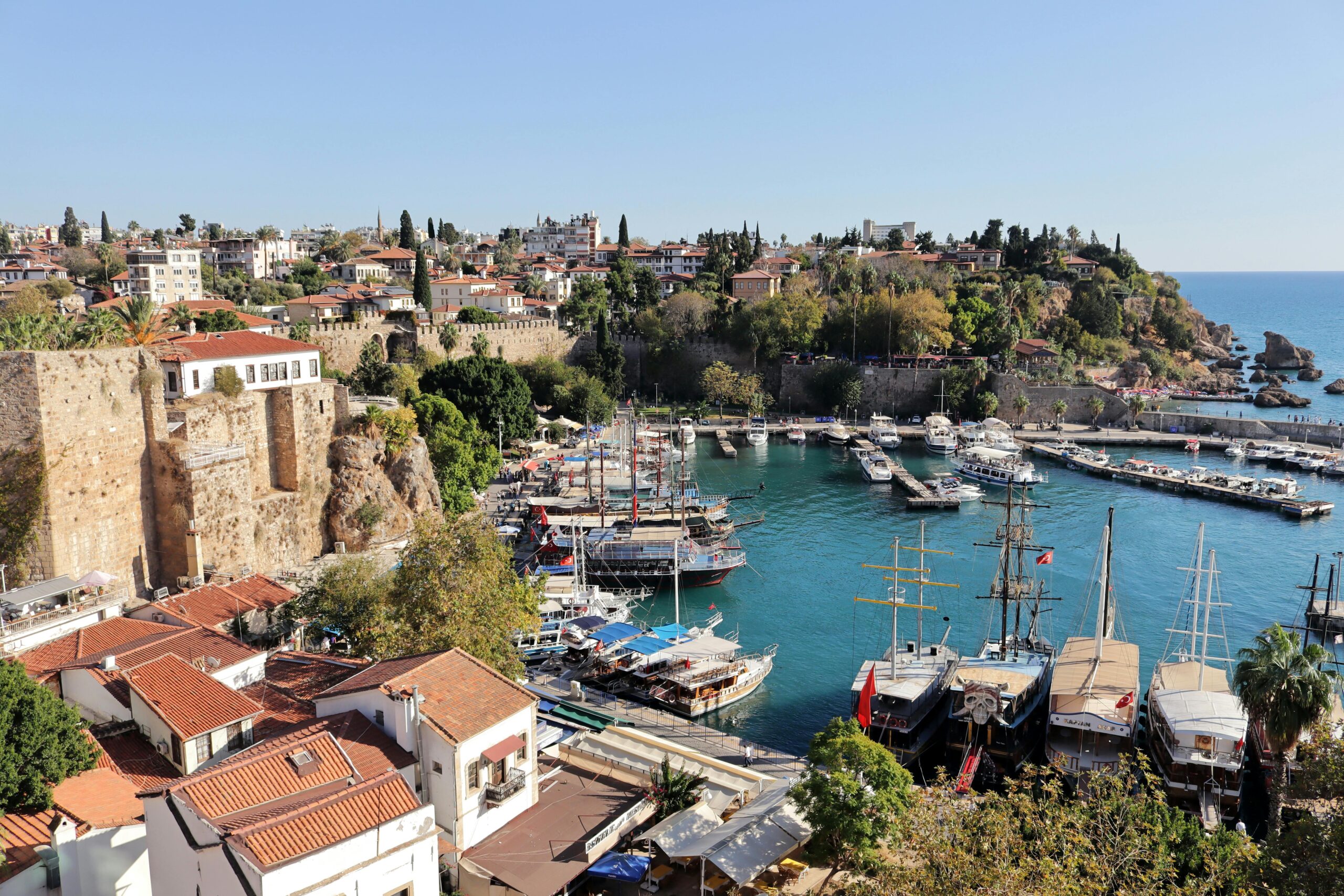
A small harbour town on the Lycian coast — 4 hours from Antalya airport by bus — where the mountains drop to the sea and the streets are narrow enough to touch both walls simultaneously. No high-rises. Bougainvillea on every wall. The harbour full of gulets (traditional wooden sailing boats) rather than superyachts.
Kaş is the best base for the Turquoise Coast because it retains a character that Bodrum and Marmaris have diluted through overdevelopment. From Kaş:
Sea kayaking over the sunken city of Kekova — the ancient Lycian city of Simena was partially submerged by an earthquake in the 2nd century CE. The ruins are visible through the clear water from a kayak or glass-bottomed boat. The coastline paddled is spectacular in itself — caves, rock arches, sea-carved formations. Day trip from Kaş: £25-35/person including equipment.
The Lycian Way coastal trek — a 540km walking route running the full length of the Turquoise Coast, one of the finest long-distance walks in Europe. The section between Kaş and Kalkan (1.5 days, 22km) gives the best combination of coastal cliffs, ancient ruins, and sea views. Day hike from Kaş to the Patara ruins (18km, 5 hours) is achievable independently.
Kekova Island — accessible by boat from Kaş or Üçağız village (45 minutes). The island itself: no permanent residents, walking trails along the northern shore above the submerged ruins. The village of Kaleköy (accessible only by boat or on foot) with its Crusader castle above the fishing harbour — the most beautiful small harbour on the Turkish coast.
Ölüdeniz — The Blue Lagoon
The lagoon that appears on every Turquoise Coast photograph: a curved bay of flat water separated from the Mediterranean by a narrow sand spit, the water shifting from pale turquoise in the shallows to deep blue at the entrance. The famous image from the air — the lagoon, the spit, the Baba Dağ mountain behind — is available as a paragliding flight (Baba Dağ at 1,969m is the finest tandem paragliding site in Europe; £55-75 for the flight, 30-40 minutes in the air above the lagoon).
The lagoon entry area is managed as a national park (£3 entry in summer). Arrive early for the morning light on the water and before the beach fills. Ölüdeniz village behind the beach is overtly tourist-facing — eat at Kayaköy (the ghost village 8km inland, abandoned by its Greek population in the 1923 population exchange with Greece) instead.
Butterfly Valley — accessible only by boat from Ölüdeniz (£8 return, boats every hour in summer) or by a steep and loose-rock descent. A canyon beach enclosed by 350-metre cliffs, with a waterfall at the back. Named for the Jersey Tiger moth population that inhabits the canyon. One restaurant. Basic camping. No development. The boat from Ölüdeniz at 10am, spending 3 hours in the canyon, returning in the afternoon: a perfect Ölüdeniz day.
The Blue Cruise (Gulet)
The classic Turkish sailing experience: renting a gulet (traditional wooden sailing boat with a crew of 2-3) for a multi-day cruise along the coast from Bodrum, Marmaris, Fethiye, or Göcek. Prices range from budget (sharing a 12-person gulet, £60-80/person/day all-inclusive) to private charter (£1,200-2,500/day for the whole boat).
The 4-night route from Fethiye to Olympos — through the Göcek bays, past the Twelve Islands, along the Lycian coast to the ancient city of Olympos above its beach — is the finest Blue Cruise itinerary. Days spent anchoring in secluded bays, swimming off the back of the boat, eating the crew’s cooking on deck. The coast accessible only by sea: coves, ruins, the shoreline that the tour buses can’t reach.
Pamukkale — The Cotton Castle, Done Right
Pamukkale (Cotton Castle in Turkish) is a hillside in southwestern Turkey covered in white calcium carbonate terraces — natural formations created by thermal spring water flowing down the slope and depositing calcium as it cools. The terraces form shallow pools of warm water at each level. The whole formation is brilliant white, looking precisely like snow in a climate that doesn’t produce it.
The site is completely free to visit and the thermal pools in the terraces are walkable in bare feet (shoes must be removed at the entrance).
The timing issue: Pamukkale in the middle of the day, when the tour buses from Antalya and Izmir are there simultaneously, is crowded. The terraces are beautiful but the experience of navigating them alongside several hundred other visitors diminishes it.
The solution: Stay in Pamukkale village (not Denizli, the nearest city). The village guesthouses (from £20-35/night) are 10 minutes on foot from the site entrance. The site opens at sunrise. At 6:30am, the terraces are empty. The white calcium against the dawn sky, the steam rising from the warm pools in the cool morning air, the ancient city of Hierapolis above it — this is the Pamukkale that makes the visit worthwhile.
Hierapolis: the ancient Greco-Roman city at the top of the travertine hill — extensive ruins (theatre, colonnaded street, the Plutonium sacred cave where thermal gases killed animals sacrificed by priests while the priests themselves remained unaffected) and the finest necropolis in Turkey (1,200 tombs running the full length of the plateau edge). Entry: £8 for the Hierapolis/Pamukkale combined site. The theatre seats 12,000 and is in excellent condition. The view from the theatre over the travertine terraces and the valley beyond is one of the great views in the Turkish interior.
Antique Pool (Cleopatra’s Pool): a thermal pool at 36°C in the middle of the Hierapolis ruins, with ancient marble columns lying in the water around you — fallen by earthquake, left where they fell. Entry: £25 (expensive; decide based on the specific appeal of swimming in a pool surrounded by fallen Roman columns). Worth it once.
The Aegean Coast — Ephesus, Selçuk, Bodrum
Ephesus
The best-preserved classical city in the Mediterranean. 250,000 people lived here in the 1st century CE — the second-largest city in the Roman Empire after Rome itself. The ruins: the marble-paved colonnaded street (Curetes Street), the Library of Celsus (a 2nd-century tomb-library with a facade that has been reconstructed and is the most photographed building in Turkey after the Hagia Sophia), the Great Theatre (seats 25,000, still used for concerts), the Temple of Hadrian, the public latrines (17 marble toilet seats arranged in a circle over a water channel, communal and social in a way the modern world has moved away from).
Entry: £20. Book online ahead to avoid the ticket queue. Arrive at opening time (8am in summer) — the site is vast and the morning temperature is manageable where midday is not.
The site has two entrances: the upper gate (start here, walk downhill toward the Library) and the lower gate (for the return, near the Great Theatre). Going downhill is more comfortable and the sequence makes more historical sense.
The Terrace Houses — an additional £15 entry, and worth it. Six private residences of Ephesus’s wealthy class, excavated and covered by a protective structure, with mosaic floors, fresco-painted walls, and room furnishings showing the daily life of a 1st-3rd century Roman home. The best single thing in the Ephesus complex.
Selçuk — the modern town above Ephesus, 3km from the site, where the accommodation is better and cheaper than in the purpose-built tourist area at the site entrance. The Basilica of St. John — a 6th-century Byzantine basilica built over the traditional tomb of John the Apostle, partially standing, partially in restored ruins, with a view over the storks’ nests on the ancient aqueduct. The İsa Bey Mosque (1375) adjacent. All free.
The Ephesus Museum in the town centre: the finest collection of Ephesian artefacts, including the two 1st-century CE statue groups of Artemis that are the reference images for the Artemis of Ephesus iconography. Entry: £4.
Bodrum
The most famous resort town on the Aegean coast. The Bodrum Castle (Castle of St. Peter, built by the Crusading Knights of St. John in 1402) contains the world’s finest underwater archaeology museum — artefacts from Bronze Age and ancient Mediterranean shipwrecks found off the Turkish coast. Entry: £6. One of the most underrated museums in Turkey.
The marina and the White Town (the whitewashed neighbourhoods rising behind the castle) are genuinely beautiful. The nightlife in Bodrum is among the most active on the Turkish coast — the Halikarnas Disco has been one of Europe’s largest open-air clubs since 1979.
Bodrum in July and August: extremely crowded and extremely priced. In May or October: the castle, the museum, the marina, the sea, and the town largely to yourself.
Eastern Turkey — The Part That Changes Everything
The eastern part of Turkey — Anatolia east of Ankara, toward the Armenian border, the Kurdish regions, the Mesopotamian highlands — is the part that receives the fewest international visitors and contains some of the most historically significant and visually extraordinary landscapes in the world.
This section requires honest caveats: some areas in the southeast (near the Syrian border, in certain Kurdish-majority regions) are subject to Foreign Office travel advisories. Check the current advice before planning. The destinations below are in areas that are generally accessible for independent travel, but the region is more complex than the west coast and deserves careful research.
Göbekli Tepe
Near the city of Şanlıurfa in southeastern Turkey: the oldest known religious structure on Earth.
Göbekli Tepe was built approximately 12,000 years ago — in the pre-agricultural period, before pottery, before writing, before the wheel. The site consists of carved T-shaped limestone pillars arranged in circular enclosures, decorated with reliefs of animals and abstract symbols. The largest pillars are 5.5 metres tall and weigh 10-20 tonnes.
The implications are significant. The conventional understanding of human civilisation has been built on the sequence: agriculture → surplus → settlement → religion → monuments. Göbekli Tepe inverts this. Hunter-gatherers, without the surpluses of farming, built the world’s first known temple. The monument preceded the city, not the other way around.
Only 5% of the site has been excavated. The portions accessible to visitors are covered by a protective shelter. Entry: £4. A guide is available at the entrance (recommended — the site makes more sense with context). The city of Şanlıurfa (Urfa), an hour’s drive away, is one of the most atmospheric cities in eastern Turkey, with a covered bazaar of extraordinary authenticity and the Abraham Pool (Balıklıgöl) — a sacred carp pool where the legend of Abraham’s birth and fire is commemorated.
Getting there: fly from Istanbul to Şanlıurfa-GAP airport (1.5 hours, from £35 one way) or take the overnight train from Istanbul to Gaziantep (18 hours) and bus east. Hire a local guide and driver for the Göbekli Tepe visit (£30-50 for the half-day from Urfa).
Mount Nemrut
A mountain in southeastern Turkey with a summit at 2,150m where the Commagene king Antiochus I built his own funerary mound in the 1st century BC — surrounding the mound with enormous stone statues of himself seated among the Greek and Persian gods, four metres high, the heads fallen to the ground during earthquakes. The heads — Zeus-Oromasdes, Apollo-Mithras, Hercules-Artagnes, and Antiochus himself — sit on the ground among the statue bases, looking slightly baffled by their circumstance.
The sunrise and sunset at the summit, with the valleys of the Euphrates basin spreading below in every direction and the stone heads lit by the horizontal light, is one of the finest and most unusual views in Turkey. Cold at altitude — bring layers.
Getting there: fly from Istanbul to Adıyaman (nearest airport) or to Gaziantep and drive north. Guided day trips run from the nearest town, Kahta. The road to the summit (accessible by minibus or vehicle, last 300 metres on foot) opens in May when the snow clears.
Cappadocia’s Lesser-Known Valleys — Ihlara
Ihlara Valley, 90km from Göreme: a 14km canyon carved by the Melendiz River, the walls covered in rock-cut Byzantine churches dating from the 6th to 13th centuries. The valley floor is green and shaded — entirely different from the arid fairy chimney landscape of Göreme. Walking the full valley (4-5 hours, one way — arrange a taxi at the far end) gives access to 105 churches, most still decorated with frescoes. The valley is on the tour bus circuit but the full walk is done only by the most committed visitors.
Lake Van and the Armenian Church
Lake Van in eastern Anatolia — the largest lake in Turkey, 3,755 square kilometres, saline and alkaline — is remote, wild, and ringed by snow-capped mountains for much of the year. The Akdamar Church on an island in the lake (a 10th-century Armenian church with extraordinary relief carvings on the exterior — a narrative of Genesis and the life of Christ carved directly into the red volcanic stone) is accessible by ferry from the Van shore. The church is one of the finest examples of medieval Armenian architecture and one of the most unexpected sights in eastern Turkey.
Getting there: fly Istanbul to Van (1.5 hours, from £35). Hire a car or guide from Van city. The church is accessed by boat from Gevaş on the south shore (£4 return). The surrounding landscape — mountains, the lake, the distant peak of Mount Süphan — is extraordinary.
The Hidden Turkey — Places Most Guides Don’t Reach
Safranbolu
A UNESCO-listed Ottoman town in the Black Sea mountains, 3 hours from Ankara by bus. Timber-framed Ottoman houses in extraordinary preservation — some 1,000 buildings from the 17th-19th centuries, on the hills above a working town. The bazaar has been in continuous operation for centuries. The hamam (Turkish bath) in the town centre dates from the 17th century and operates still. Almost no international tourists — the visitors are Turkish families on weekend trips from Ankara.
Amasya
A city in the Pontic Mountains of northern Anatolia, built in a river gorge so narrow the Ottoman houses overhang the water on both sides. Pontian royal tombs carved into the cliff face above the city (rock-cut chambers, 4th-3rd century BC). The Beyazit Paşa Mosque, the Burmalı Minare. Genuinely off the international tourist circuit. The 3-hour train from Samsun on the Black Sea coast makes it accessible as an extension of a Black Sea itinerary.
Ani
A ghost city on the Armenian border — the medieval capital of the Armenian Bagratid kingdom (9th-11th centuries), with churches, palaces, and walls still standing across a windswept plateau above the Akhuryan River, which forms the Turkish-Armenian border. The cathedral of Ani (completed 1001 CE) stands roofless but structurally intact. The landscape — the plateau, the river gorge, the Armenian side visible across the water — is beautiful and melancholy in equal measure. 45km east of Kars by taxi.
The Black Sea Coast
The Turkish Black Sea coast — from Trabzon east toward the Georgian border — is subtropical, green, and entirely different from the Mediterranean south. The Hagia Sophia of Trabzon (a Byzantine church with original 13th-century frescoes, converted to a mosque — the frescoes are behind curtains during prayer times, revealed at other times), the Sümela Monastery (a 4th-century Greek Orthodox monastery clinging to a vertical cliff face in a national park, with the finest Byzantine frescoes in Turkey — 1,500m above sea level, accessible by a forest path), and the tea plantations of Rize (the Çay brand that supplies Turkish tea is grown here, on hillsides terraced into the mountains above the Black Sea).
What It Costs — Real Numbers
Turkey’s currency depreciation over recent years has created an extraordinary value proposition for UK visitors. The Turkish Lira (TRY) has weakened significantly against the pound — at the time of writing, £1 buys approximately 43 TRY. This translates directly to purchasing power: accommodation, food, and activities that cost significantly more in equivalent European destinations cost a fraction in Turkey.
Daily Budgets
Budget (£25-40/day)
- Accommodation: hostel or budget guesthouse (£10-20/night)
- Food: lokanta (local lunch restaurant), street food, kebab shops (£5-8/day)
- Transport: local buses and dolmuş (shared minibus)
- Activities: most historic sites under £10
Mid-range (£50-75/day)
- Accommodation: boutique guesthouse or cave hotel (£35-60/night)
- Food: restaurant lunches, good dinner at a meyhane (£15-22/day)
- Transport: intercity buses, occasional taxi
- Activities: Hagia Sophia, Ephesus, balloon flight (amortised), boat trip
Comfortable (£100-150/day)
- Accommodation: boutique hotel or full gulet charter (£65-110/night)
- Food: quality restaurants, fish by the Bosphorus (£30-45/day)
- Transport: private transfers for coastal sections
- Activities: without budget constraint
What 10 Days in Turkey Actually Costs from the UK
| Category | Budget | Mid-Range |
|---|---|---|
| Return flights (Istanbul, 6 weeks ahead) | £80–160 | £120–220 |
| 10 nights accommodation | £150–280 | £380–600 |
| Food (10 days) | £60–95 | £155–230 |
| Internal transport (buses, 1 domestic flight) | £50–90 | £80–140 |
| Balloon flight (Cappadocia) | £130–180 | £130–180 |
| Activities (Ephesus, Hagia Sophia, boat trip, etc.) | £60–100 | £90–150 |
| Total | £530–905 | £955–1,520 |
The balloon flight is a fixed cost regardless of budget level — it’s the one experience in Turkey where the price is standard across all travellers. Everything else scales significantly with the currency advantage.
Eating in Turkey — The Actual Food
Turkish food is one of the three great culinary traditions of the world — alongside Chinese and French cuisine — according to most culinary historians, and the reasoning holds up. The geography of the former Ottoman Empire encompassed an extraordinary range of ingredients and culinary traditions, all of which filtered through the imperial kitchens of the Topkapı Palace into a cuisine of extraordinary diversity and sophistication.
What the Turkish restaurant in the UK serves is a fraction of it, and the fraction that survived the emigration best.
The Dishes Worth Seeking
Menemen Scrambled eggs cooked with tomatoes, peppers, and onion in a copper pan, served with crusty bread. The Turkish breakfast dish. The best version is made in a single pan on a wood fire in a small kahvaltı salonu (breakfast house) and arrives still bubbling. Every city has its menemen variation — the Aegean version uses more olive oil, the eastern version more spice.
Pide The Turkish flatbread boat — an oblong of crispy dough, folded at the edges to create a vessel for various fillings: minced lamb (kıymalı), egg and cheese (yumurtalı peynirli), spinach and cheese (ıspanaklı). Baked in a wood-fired oven and served directly from it. The pide in Trabzon (the Black Sea city that claims to have invented it) is made slightly thicker than the Istanbul version and is the reference standard.
İskender Kebab Thin-sliced lamb doner laid over torn pide bread, covered in hot tomato sauce and clarified butter, served with yoghurt on the side. A dish from Bursa, named for its 19th-century inventor İskender Efendi. The version at the original Kebapçı İskender restaurant in Bursa (the brand is now franchised widely; the Bursa original is the reference) is still the finest. Do not ask for it in Istanbul and expect the same thing.
Baklava The layered filo pastry and nut confection — the original, from Gaziantep in southeastern Turkey, where the pistachios are grown — is a different thing from the versions available elsewhere. The filo is translucent and perfectly crisp. The filling uses fresh Antep pistachios (the finest in the world, smaller and more flavourful than the Californian alternatives). The sugar syrup is light and fragrant. Güllüoğlu in Istanbul (multiple branches) is the reference in the city; the original is in Gaziantep where a kilogram of fresh baklava costs £8.
Meze The small dish culture of the Turkish meyhane (tavern). A table of meze — haydari (strained yoghurt with herbs), tarama (fish roe dip), patlıcan salatası (smoked aubergine salad), fava (broad bean purée with dill), stuffed vine leaves, grilled halloumi-style hellim, various pickles — arrives before the fish or meat main, eaten slowly with rakı (the anise spirit, diluted with water and ice, turning milky-white — the Turkish national drink, drunk throughout the meal rather than as an aperitif).
A meyhane dinner in Istanbul’s Beyoğlu neighbourhood or Kadıköy — meze table, grilled fish, rakı, dessert, tea — costs £18-28/person. The finest and most characterful evening meal available in Turkey.
Simit The sesame-crusted circular bread, carried through the streets of every Turkish city on red carts by simit sellers. The simit is the Turkish breakfast bread — crispy on the outside, slightly chewy inside, the sesame deep-toasted. Cost: £0.20. Buy one from a cart and eat it with a glass of tea at the nearest çay bahçesi (tea garden). This costs less than £0.50 and is the most Turkish thing available in Turkey.
The Tea Culture
Çay (Turkish tea) is the national drink and the social infrastructure of the country. Every shop, every office, every transaction begins with tea offered in small tulip-shaped glasses. Refuse it only if you have a medical reason — accepting tea is accepting the interaction.
The tea is brewed strong in a double-boiled system (the çaydanlık): a small pot of concentrated tea above a larger pot of hot water, the drinker diluting to preference. Sugar on the side. The tea gardens (çay bahçesi) in Istanbul — in Gülhane Park, in the Bosphorus-side parks, along the İstiklal Avenue side streets — are the finest places to sit and observe the city for an hour for the price of a glass of tea (£0.25-0.50).
Turkish coffee (Türk kahvesi): prepared in a small copper pot (cezve), unfiltered, the grounds settling in the cup. The coffee is ordered by sweetness: sade (unsweetened), az şekerli (little sugar), orta (medium sugar), çok şekerli (very sweet). Drunk slowly, the grounds left at the bottom.
Practical Notes
Visa: UK passport holders require an e-Visa, applied online at evisa.gov.tr before travel. Cost: approximately £12. Processed immediately to within a few hours. Valid for 30 days, single entry (multiple entry also available at higher cost). Apply at least 48 hours before departure.
Getting there: Direct flights from London Heathrow, Gatwick, Stansted, and several regional UK airports to Istanbul (Atatürk and Sabiha Gökçen airports). Turkish Airlines, easyJet, and Pegasus Airways are the main carriers. Flight time: 3.5 hours. Return flights from £80-200 depending on season and advance booking.
Domestic flights within Turkey (Turkish Airlines, Pegasus, SunExpress) are extensive and cheap — Istanbul to Antalya (for the Turquoise Coast): from £20-40 one way. Istanbul to Cappadocia (Kayseri or Nevşehir airports): from £15-35. Book 2-3 weeks ahead for the best prices.
Currency: Turkish Lira (TRY). £1 ≈ 43 TRY at time of writing — verify before travel, the rate fluctuates significantly. ATMs are widely available in cities and tourist areas. Cards accepted in most hotels, restaurants, and shops in tourist areas; cash preferred in local markets and smaller towns. Carry cash in smaller denominations — exact change is appreciated.
Getting around: Long-distance buses (otobüs) are the backbone of Turkish domestic travel — comfortable, air-conditioned, on-time, and extensive. Companies: Metro Turizm, Pamukkale Turizm, Kamil Koç. Book at the otogar (bus terminal) in each city or online at obilet.com. Istanbul to Antalya: 12 hours (£12-18). Istanbul to Cappadocia via Ürgüp: 10-12 hours overnight (£10-15). Istanbul to Selçuk (for Ephesus): 9 hours (£8-12).
The overnight buses are the correct choice for long routes — you travel at night, save accommodation cost, and arrive early in the morning. The seats recline significantly (approaching lie-flat on VIP services), there’s a steward with drinks and snacks, and the Turkish highway network between major cities is good.
In Istanbul: the Istanbulkart (a rechargeable transit card, £1.50 to buy, loadable at machines throughout the city) covers metro, tram, bus, and ferry. Buy at the first metro station. The system is extensive and runs until midnight.
Getting a SIM: Turkcell and Vodafone Turkey both offer tourist SIMs at Istanbul airport. A 30-day SIM with 10-15GB data costs £15-20 (more expensive than some other destinations in this guide due to tax on tourist SIM purchases). Alternatively, Airalo eSIMs work on Turkish networks.
Language: Turkish. English is spoken in tourist-facing businesses in Istanbul, Cappadocia, and the coastal resorts. In smaller towns and the east, English is minimal. “Teşekkürler” (thank you), “Lütfen” (please), “Kaç lira?” (how much?), “Çok güzel” (very beautiful — useful for food, views, and general appreciation) — learning these makes every interaction warmer. Google Translate’s camera function handles menus and signs reliably.
The 10-Day Itinerary — The Route That Works
This route covers Istanbul, Cappadocia, and the Turquoise Coast — the essential Turkey — with internal flights making the distances manageable in 10 days.
Days 1-3: Istanbul
Day 1: Land. Hotel in Sultanahmet or Beyoğlu. Walk to the Galata Bridge at dusk. Meyhane dinner in Beyoğlu.
Day 2: Hagia Sophia at opening (8am). Blue Mosque after. Grand Bazaar midday. Bosphorus ferry to Kadıköy in the afternoon. Kadıköy market. Return by ferry at dusk with the minarets behind you.
Day 3: Topkapı Palace (book online, arrive early). Basilica Cistern after. Beyoğlu and İstiklal Avenue afternoon. Galata Tower for the sunset view. Karaköy evening.
Day 4: Fly Istanbul → Kayseri, transfer to Göreme (Cappadocia)
Morning flight (1.5 hours, from £20). Transfer by shuttle or taxi to Göreme (45 minutes, £8 per person). Check into cave hotel. Göreme Open Air Museum in the afternoon.
Day 5: Cappadocia — Balloon and Valley Hike
4am: balloon pickup if booked. Sunrise flight. Return to hotel for breakfast. Rose Valley hike in the afternoon. Sunset from the Göreme viewpoint.
Day 6: Cappadocia — Underground Cities
Derinkuyu underground city in the morning (1.5 hours). Kaymakli optional (adjacent, 30 minutes). Drive through the Ihlara Valley for lunch (arrange with a local guide or taxi). Return to Göreme.
Day 7: Fly Kayseri → Antalya, transfer to Kaş
Morning flight to Antalya (45 minutes, from £20). Bus from Antalya to Kaş (3.5 hours, £8-10). Check in. Harbour walk at dusk. Fish dinner.
Day 8: Sea Kayaking and Kekova
Full-day sea kayak tour from Kaş — paddling over the sunken city of Kekova, into sea caves, landing at Kaleköy village. Lunch on the boat. Return to Kaş by sunset. £35/person.
Day 9: Ölüdeniz or Free Day on the Coast
Option A: Bus to Ölüdeniz (2 hours), morning at the Blue Lagoon, afternoon paragliding from Baba Dağ (book ahead), return to Kaş. Option B: Free day in Kaş — local beach, the town, the Lycian rock tombs carved into the cliff above the harbour (visible from below, free), dinner by the harbour.
Day 10: Kaş → Antalya Airport
Morning bus or private transfer back to Antalya airport (3.5 hours). Allow 2 hours before flight. Fly home from Antalya direct to various UK airports, or connect through Istanbul.
Total cost estimate:
| Category | Mid-Range |
|---|---|
| Return flights (London → Istanbul, Antalya → London) | £120–220 |
| Istanbul → Kayseri domestic flight | £20–40 |
| Kayseri → Antalya domestic flight | £20–40 |
| 10 nights accommodation | £380–600 |
| Food + activities (10 days) | £220–350 |
| Balloon flight | £130–180 |
| Transport (buses, taxis, ferries) | £60–100 |
| Total | £950–1,530 |
Final Thought
I was in Şanlıurfa in April, at the edge of the excavation at Göbekli Tepe, standing on a platform above the oldest T-shaped pillar in the world. It was built 12,000 years ago by people who had not yet discovered farming, who could not write, who left no explanation for why they came to this specific limestone hill in what is now southeastern Turkey and arranged these enormous carved stones in circles and covered them with images of animals that were significant to them.
The archaeologist told me that they’ve found no evidence of dwellings near the site — no kitchen waste, no sleeping areas. The people didn’t live here. They came to build and to worship and to return to wherever they came from.
I kept thinking about that on the bus back to the city. A landscape of dry limestone hills and heat. 12,000 years ago, another group of people standing on the same hill and doing something they found important enough to organise hundreds of workers for and carve ten-tonne stones for.
Turkey gives you this. The feeling of an enormous amount of human time, most of it unrecorded, still present in the ground. You just have to go far enough east to find the oldest layer of it.
Question about Turkey this guide doesn’t cover? Drop it in the comments.