
The complete guide for UK travellers: the train you must book before anything else, Sigiriya at 7am before the heat arrives, the whale watching window, Galle Fort at dusk, the tea country that doesn’t look real, and why Sri Lanka rewards the traveller who already knows what they’re doing.
Reading time: 17 minutes | Last updated: 2026
Sri Lanka is the size of Scotland and contains roughly ten different countries.
That’s not marketing language. Within a two-week trip you can stand on a 200-metre volcanic rock fortress where a 5th-century king built his palace, watch a blue whale surface three kilometres off a southern beach, drink tea on a hillside where the plantation has been producing the same leaves since 1867, walk the ramparts of a Dutch colonial fort above the Indian Ocean, and spot a leopard in a national park that holds the highest density of them on Earth.
The island packs an improbable amount of landscape, history, wildlife, and food into a country that takes four hours to drive across at its widest point. The train that connects the hill country to the coast runs through scenery that makes the six-hour journey feel short. The food is extraordinary and almost entirely unknown outside South Asia.
The honest case for Sri Lanka is also the honest case against leading with it: it rewards the traveller who already knows how to navigate without handrails. The tourist infrastructure is thinner than Thailand, the tuk-tuk negotiations are real, the train tickets for the good carriages require forward planning, and the pace — slower, more considered, less packaged — is something to lean into rather than fight.
If Thailand is the best first SE Asia trip, Sri Lanka is the best second one. This guide is written for that traveller — the one who’s been somewhere and is ready for somewhere that gives a little more back for a little more effort.
Quick Navigation
- The Case for Sri Lanka — What This Island Actually Contains
- When to Go — The Coastal Split That Changes Everything
- The Train — Book This Before Anything Else
- Colombo — One Day, Properly
- The Cultural Triangle — Sigiriya, Polonnaruwa, Anuradhapura
- Kandy — The Hill Capital
- The Tea Country — Nuwara Eliya and the Hill Stations
- Ella — The Town Everyone Finds and Stays In
- The South Coast — Galle, Mirissa, Unawatuna, Arugam Bay
- Wildlife — Yala, Wilpattu, and the Whale Watching
- The North — Jaffna and the Forgotten Region
- What It Costs — Real Numbers
- Eating in Sri Lanka — The Food Nobody Talks About
- Practical Notes
- The 14-Day Itinerary — The Route That Works
The Case for Sri Lanka — What This Island Actually Contains
The conversation about Sri Lanka in UK travel circles has changed significantly in the past five years. It was always known — Colombo has been a stop on Asian shipping routes for two thousand years, the British built a functioning colony here, and Arthur C. Clarke lived in Colombo for the last fifty years of his life because he considered it the finest place on earth — but it wasn’t quite on the mainstream shortlist.
That’s shifted. The Nine Arch Bridge photograph spread. The whale watching became one of the most reliable blue whale encounters on the planet. Ella became a word that appeared on every list of towns you’d actually want to live in for a month. The food — kottu roti, hoppers, a fish curry that has been refined over centuries — started getting the attention it deserved.
What hasn’t changed is the texture of the place. Sri Lanka still requires you to show up and engage rather than have things arranged for you. The tuk-tuk is still the standard short-distance transport and the price is still something you settle before you get in. The train still runs on its own relationship with time, which is broadly approximate. The best beach restaurants are still the ones without a sign.
This is not a complaint. It’s the reason the experience is different from somewhere more comprehensively packaged.
When to Go — The Coastal Split That Changes Everything
Sri Lanka’s weather system is the most important planning consideration and the most frequently misunderstood. The island has two monsoons affecting opposite coasts at different times of year, which means the correct answer to “when should I go?” is almost always “it depends which coast.”
The Southwest Monsoon (May to September) Brings heavy rain to the west and south coasts — Colombo, Galle, Mirissa, Unawatuna. The beach season on the south coast effectively closes June through August. During the same period, the east coast (Trincomalee, Arugam Bay, Batticaloa) is at its finest — warm, dry, and largely empty of tourists.
The Northeast Monsoon (November to January) Brings rain to the east coast and the north. The south and west coast are at their best — Mirissa’s whale watching peaks December through April, Galle Fort glows in the dry heat, Unawatuna is calm and clear.
The Hill Country and Cultural Triangle The inland regions — Kandy, Nuwara Eliya, Ella, Sigiriya — have their own rainfall patterns and are broadly accessible year-round, though the wettest months in the hills are May through September. Even during the hill country wet season, mornings are usually clear; rain falls mainly in the afternoon.
The practical implications:
- December to March: South coast beaches + whale watching + cultural triangle + hill country. The classic circuit. Peak season prices. Most popular window for UK travellers.
- April to May: Shoulder season. South coast still good, hills lush from the coming rains, lower prices, manageable crowds. One of the better months to visit.
- June to September: Switch the circuit: east coast (Arugam Bay’s surf season peaks July-August, Trincomalee’s beaches are excellent) + cultural triangle + hill country. The south coast sits out.
- October to November: Transition months. Can be unpredictable. November sees the northeast monsoon beginning; some years clean and fine, others heavy.
The BGGD recommendation: January or April. January for the full south coast and whale watching package in dry season. April for the lower prices, emptier beaches, and the first flush of green on the hillsides before the main monsoon arrives.
The Train — Book This Before Anything Else
The train from Kandy to Ella is the finest railway journey in Asia. I make that claim in the knowledge that it appears on every Sri Lanka guide ever written and stand by it regardless, because the repetition doesn’t make it less true.
Six hours through the Sri Lankan hill country. The tracks wind through tea plantations so steep the terracing is visible on three levels at once. The valleys below appear and disappear in cloud. At stations like Nanu Oya and Haputale, the train pauses on a ridge with views in two directions simultaneously — rice paddies to one side, forest to the other. Between Nanu Oya and Ella, the landscape changes character every thirty minutes in a way that makes the six hours feel like two.
The observation car reality: The Sri Lankan railways introduced designated observation carriages on the Kandy-Ella route for tourists. These are worth booking and fill weeks ahead of popular travel dates. Two options:
Expo Rail observation car — air-conditioned, wide panoramic windows, reserved seating. Bookable online at www.exporail.lk. Around £10-12 one way. Book 2-4 weeks ahead in peak season.
Rajarata Rajini (First Class observation carriage) — the government railway’s premium carriage with observation windows. Bookable at Sri Lanka Railways’ official site or the GoTicket app. Around £4-6 one way. Fills quickly.
The open door reality: Locals (and travellers who know about it) ride in the regular third-class carriages and stand at the open carriage doors as the train moves through the hill country. Windy, occasionally cold in the early morning, and the most visceral version of the journey. No advance booking needed for second or third class — turn up and board. For the door-standing experience specifically, position yourself in the carriage with the best view direction: right side heading from Kandy to Ella.
Timing: The most photographed train moment in Sri Lanka is the Nine Arch Bridge at Ella, with a train crossing it against the valley backdrop. This requires being at the bridge (not on the train) at the right moment. The morning train crosses at approximately 9:05am; the afternoon around 3:40pm. Arrive 20 minutes before either and position on the hillside above the bridge — the viewpoint is a 10-minute walk from Ella town and marked on Google Maps.
Booking logistics: The online booking system (www.eticket.railway.gov.lk) works but can be temperamental with international cards. The GoTicket app is more reliable for foreigners. Both open 30 days in advance. Observation and first-class seats for the December-March peak window: book as soon as the 30-day window opens.
Colombo — One Day, Properly
Most Sri Lanka itineraries treat Colombo the way most Peru itineraries treat Lima — a transit point with a night attached. Colombo deserves one full day, and one full day done in the right neighbourhoods delivers something considerably more interesting than the transit hub reputation suggests.
Pettah Market
The oldest and densest market district in Colombo — a grid of streets where every block is dedicated to a different trade: electronics, fabrics, spices, fish, vegetables, wholesale goods. The kind of market that functions for the city rather than for tourists, which is the only kind worth spending time in. At 8am, before the heat builds, Pettah is one of the most energetic street environments in South Asia.
The Jami Ul-Alfar Mosque (the Red Mosque) sits in the middle of Pettah — a candy-striped red and white Indo-Saracenic building from 1909 that is simultaneously one of the most beautiful and most unlikely buildings in Sri Lanka. The exterior from the lane outside is the view.
Galle Face Green and Fort
Galle Face Green is a wide ocean-facing promenade south of the old fort — in the evening, the Colombo middle class comes here to eat the fried snacks sold from carts, walk, and watch the sun go down over the Indian Ocean. Kite flyers. Children. The specific peace of a city using its own coastline for itself rather than for tourism.
The Fort district (the colonial quarter north of Galle Face) contains the old Dutch and British administrative buildings now occupied by government offices, hotels, and the Galle Face Hotel — a colonial-era grande dame that opened in 1864 and serves afternoon tea to anyone who books a table on the ocean-facing terrace. Book ahead. Worth it once.
The Pettah Float Market and Beira Lake
Behind the fort, Beira Lake sits in the centre of the city — a freshwater lake with a float market operating from the southern shore on weekends. The lake walkway (developed in 2019, clean, well-maintained) circles the water and passes the Seema Malaka temple — a Buddhist meditation centre on a platform over the lake, designed by Geoffrey Bawa, the most influential Asian architect of the 20th century. The temple at dusk, with the city reflected in the water behind it, is the Colombo image most people don’t know exists.
Where to Eat in Colombo
Ministry of Crab (Dutch Hospital Precinct, Fort) — the finest crab restaurant in Sri Lanka, possibly in South Asia. The Sri Lankan crab (mud crab) at its best is one of the finest shellfish experiences available anywhere. The chilli crab, garlic butter crab, and pepper crab preparations are all extraordinary. Booking essential; a week ahead minimum. £20-35 per person. Worth the price entirely.
Upali’s by Nawaloka (Kollupitiya) — the best traditional Sri Lankan rice and curry in Colombo. A proper sit-down restaurant serving the full rice and curry spread: a mound of rice surrounded by six to eight small curries (dhal, beetroot, jackfruit, chicken or fish, pol sambol, papadam). £3-5 for a full meal. This is the actual food of Sri Lanka rather than the adapted version.
The Cultural Triangle — Sigiriya, Polonnaruwa, Anuradhapura
The Cultural Triangle is the UNESCO-dense interior of Sri Lanka — three ancient capitals spanning 2,000 years of history, arranged in a rough triangle in the north-central lowlands. Most visitors see Sigiriya. Fewer see Polonnaruwa. Very few see Anuradhapura. All three together form one of the finest concentrations of ancient sites in Asia.
Sigiriya — The Rock
A 200-metre volcanic rock plug rising from the surrounding jungle, on top of which a 5th-century king (Kashyapa I) built a palace fortress between 477 and 495 CE. He chose the summit, according to the chronicles, because he had killed his father to take the throne and needed a defensible position against his exiled brother’s inevitable return.
The palace didn’t save him — his brother returned, Kashyapa died in battle, the palace was abandoned — but what remains is extraordinary. The rock itself. The mirror wall (a plastered corridor on the approach path, so highly polished that Kashyapa could see his reflection, now covered in 1,200 years of visitors’ graffiti including poetry from the 8th century). The frescoes of the Cloud Maidens halfway up — 22 of what were originally 500 paintings, vibrant with red ochre and green, depicting women of the court in a style that has been debated for a century. The summit: the foundations of the palace, the lion’s paw gateway (only the paws survive, the lion’s head gone), and the view over the jungle that Kashyapa had every morning of his eighteen-year reign.
The timing reality: Sigiriya in the early morning (gates open at 7am) is a different experience to Sigiriya at 10am. The climb takes 45 minutes to the summit at a reasonable pace. By 7:45am on a weekday you’re near the top as the mist is clearing from the surrounding jungle. By 10am the sun is intense and the tour groups are numerous.
Entry: £20. The most expensive site in Sri Lanka and worth every pound of it.
Pidurangala Rock: The adjacent rock 500 metres north of Sigiriya. Entry £3. A 30-minute climb through jungle and past a reclining Buddha to a summit that gives the finest aerial view of Sigiriya — the rock seen from the side, the jungle spreading in every direction, the ancient reservoir system (still functional) visible below. Most tour groups don’t come here. Go at dawn.
Polonnaruwa — The Medieval Capital
Sri Lanka’s second ancient capital (9th-12th century CE), smaller and more coherent than the vast Anuradhapura complex. Bicycle through the ruins (hire from guesthouses in town for £2-3/day) over a half-day: the Royal Palace complex, the Gal Vihara (four Buddha figures carved directly into a single granite face — the standing figure at 7 metres is among the finest sculptures in Asia), the Lotus Pond, the Vatadage circular relic house.
The site is manageable and the bicycle gives it the right pace — slow enough to stop at everything, fast enough to cover the spread. Entry: £20 (combined cultural triangle ticket covers Sigiriya and Polonnaruwa).
Anuradhapura — The First Capital
Sri Lanka’s oldest city, the capital from the 4th century BC to the 11th century CE — making it one of the longest-inhabited cities in the ancient world. The scale is different from Polonnaruwa: this is a city spread across tens of square kilometres, with dagobas (the Sri Lankan form of Buddhist stupa) the size of the Giza pyramids rising from the jungle. The Sri Maha Bodhi — a sacred fig tree descended from the tree under which the Buddha attained enlightenment, planted here in 288 BC — is the oldest documented tree in the world and still worshipped.
Anuradhapura receives fewer tourists than Sigiriya because it requires more time to understand. A half-day on a bicycle gives a surface impression. A full day with a guide who explains the chronology and the significance begins to make sense of it. The scale and the religious continuity — this has been a place of active pilgrimage for 2,300 years without interruption — is unlike anything in the Cultural Triangle.
Kandy — The Hill Capital
Kandy is the last royal capital of Sri Lanka — the Kandyan Kingdom fell to the British in 1815, ending over 2,000 years of continuous monarchy. The city sits at 500m above sea level in the central hills, 115km from Colombo, and retains the character of a city that was a seat of power rather than a colonial construct.
The Temple of the Tooth (Sri Dalada Maligawa)
Sri Lanka’s most sacred Buddhist site — the left canine tooth of the Buddha, brought to the island in the 4th century CE in the hair of a princess. The tooth is not on public display; it’s held in a gold casket within a series of nested gold containers in the inner sanctuary. What you see is the processional: the outer sanctuaries, the museum of gifts from visiting heads of state over centuries, and the Puja ceremony.
The Puja happens three times daily: 6:30am, 9:30am, and 6:30pm. Drums and traditional instruments announce each ceremony. The doors of the inner sanctuary open; worshippers file past. The 6:30am Puja is the least crowded and most atmospheric. Dress code strictly observed: shoulders and knees covered, shoes removed. Entry: £8, including the museum.
The lake in front of the temple — Kandy Lake, built by the last Kandyan king in 1807 — provides the view that postcards use: the white-walled temple complex reflected in still water, the surrounding hills, the city arranged around the water’s edge. Walk the lakeside path at dusk.
The Kandy Esala Perahera
If your visit coincides with July or August: the Esala Perahera is the most significant Buddhist festival in Sri Lanka — a ten-day procession through Kandy’s streets featuring decorated elephants (100+), traditional dancers, fire-twirlers, and the casket containing the sacred tooth relic. The final night’s procession is one of the most spectacular ceremonial events in Asia.
Accommodation in Kandy during the Perahera books out months in advance and prices triple. Plan accordingly.
The Botanical Gardens (Royal Botanic Gardens, Peradeniya)
5km west of Kandy. 147 acres of meticulously maintained gardens established in 1821, containing one of the finest collections of tropical plants in Asia — the giant Java fig trees with aerial root systems large enough to shelter under, the palm avenue, the orchid house. Entry: £10. Best in the morning when the light is right and the crowds are thin. Half a day.
The Tea Country — Nuwara Eliya and the Hill Stations
The central highlands — the tea country — are Sri Lanka’s most visually distinctive landscape. The terracing starts as you gain altitude from Kandy: precise rows of tea bushes covering every available slope, broken by lines of windbreak trees and the occasional estate bungalow from the British colonial period. In the early morning, mist fills the valleys between the ridges and the landscape looks more like highland Scotland than tropical Asia — except the tea pickers, in bright saris, are moving through the rows picking with practiced speed.
Nuwara Eliya
The former British hill station at 1,868m, self-consciously English in its architecture — a gothic post office, a Victorian-era racetrack, manicured gardens, a golf course, a hotel (the Grand Hotel) that opened in 1891 and serves afternoon tea as though the empire never ended. The weather here: cool year-round, occasionally cold in the early morning, misty. Bring layers.
The tea estates surrounding the town are where you want to spend time. A visit to the Pedro Estate (2km from town, free entry, guided tour and tasting included) gives the full plantation experience — the plucking demonstration, the withering and rolling process, the oxidation room, the firing. The guide’s explanation of why the altitude and rainfall of these specific hills produces tea of a different character from the lowland estates is genuinely interesting if you’re paying attention.
The Tea Estate Bungalows
Some of the former British estate manager’s bungalows have been converted into guesthouses — Colonial-era buildings on working estates, surrounded by tea fields, with views of the valley at dawn and dinner served by candlelight in the drawing room. Mid-range from £55-90/night including meals.
Ceylon Tea Trails (four bungalows connected by hiking trails through working estates near Hatton) is the premium version — widely regarded as one of the finest accommodation experiences in South Asia. From £250/night full board, which sounds expensive and is genuinely worth saving for.
The Adam’s Peak Pilgrimage
A sacred mountain at 2,243m, the peak of which is marked by a large natural rock formation called the Sri Pada (Sacred Footprint) — interpreted as the footprint of the Buddha by Buddhists, of Adam by Muslims, of St. Thomas by Christians, and of Shiva by Hindus. The mountain has been a pilgrimage site for all four for over a thousand years.
The pilgrimage season runs December through May. The climb (7km, 5,500 steps, 3-5 hours) begins at midnight to reach the summit for sunrise. The chain of pilgrims’ lights ascending through the dark, the cold air at 2,243m, the dawn breaking over the surrounding hills and occasionally catching the mountain’s shadow cast across the morning mist — extraordinary for the prepared traveller and miserable for the unprepared one.
Wear warm layers. Bring a headtorch. The season matters — outside December-May the steps are unlit and the summit facilities are closed.
Ella — The Town Everyone Finds and Stays In
Ella is a small hill town at 1,041m, three hours by train from Nuwara Eliya, surrounded by tea plantations and accessible jungle walks. It has approximately 2,500 permanent residents and, during peak season, an approximately equal number of travellers who found it on Instagram and decided to come.
This has changed Ella’s character in the way that all such places are changed — the guesthouses have multiplied, the restaurants now serve avocado toast, the Nine Arch Bridge has photographers stationed at the viewpoint at all hours. And yet: the landscape hasn’t moved. The train still crosses the bridge. The Ella Rock hike still delivers the view over the valley in the early morning. The town is small enough that you can walk past all the tourist restaurants and find the local ones within ten minutes.
The Nine Arch Bridge
A colonial-era railway viaduct — nine arches of brick spanning a jungle valley, built during the British period without steel reinforcement. The most photographed image in Sri Lanka and earned: the bridge is genuinely beautiful, particularly when a blue train crosses it against the green of the valley.
The viewing point is a 15-minute walk from the town centre uphill through a tea estate. Arrive 20 minutes before the 9:05am or 3:40pm crossings. The light is better in the morning. The bridge is worth seeing without a train crossing it as well — the structure and the valley are the image, the train is the confirmation.
Ella Rock
A 3-hour hike from town to a summit at 1,411m, through tea estates, jungle, and a section of ridge that gives views in three directions. The path is partially marked and partially requires asking directions from tea estate workers, who always point the correct way. Go early — before 7am — to be on the summit as the mist clears from the valley below.
No guide required; basic navigation competence sufficient. Take water. The summit descent requires care — the path down the north side is steep and slippery in the wet.
Little Adam’s Peak
A shorter hike (1 hour) than Ella Rock, accessible from the town without a guide, popular and well-marked. The views are good and it’s the right option if time is limited or fitness is a concern. Named for its resemblance (loose) to Adam’s Peak from certain angles.
The South Coast — Galle, Mirissa, Unawatuna, Arugam Bay
Galle Fort
A Dutch colonial fort (1663, built on Portuguese foundations) on the southwestern tip of the island — the best-preserved colonial fort in Asia and a genuinely beautiful place to spend an afternoon. Inside the walls: cobblestone streets, boutique guesthouses in colonial buildings, jewellery workshops, independent cafes, and restaurants that feel like they’ve been placed here by a set designer and have actually been here for decades.
The ramparts: walk the full perimeter (45 minutes, free). The Indian Ocean to the south, the harbour and the town to the north. At sunset, the rampart facing west fills with locals and travellers watching the sun go into the sea. It’s one of those places that functions as both tourist attraction and genuine gathering point for the community — the stilt fishermen in the shallows below the walls are fishing, not performing.
The Lighthouse at the southwestern corner. The Dutch Reformed Church (1754). The National Maritime Museum. The Old Gate with its VOC (Dutch East India Company) crest. All worth the hour required to find them on the interior streets.
Stay inside the fort. The guesthouses inside the walls charge a premium but the experience of waking up inside a 400-year-old fort and walking to breakfast on cobblestones is not replicable from outside. Budget from £45/night for a simple room inside the walls; boutique hotels from £90-150.
Mirissa — The Whale Watching
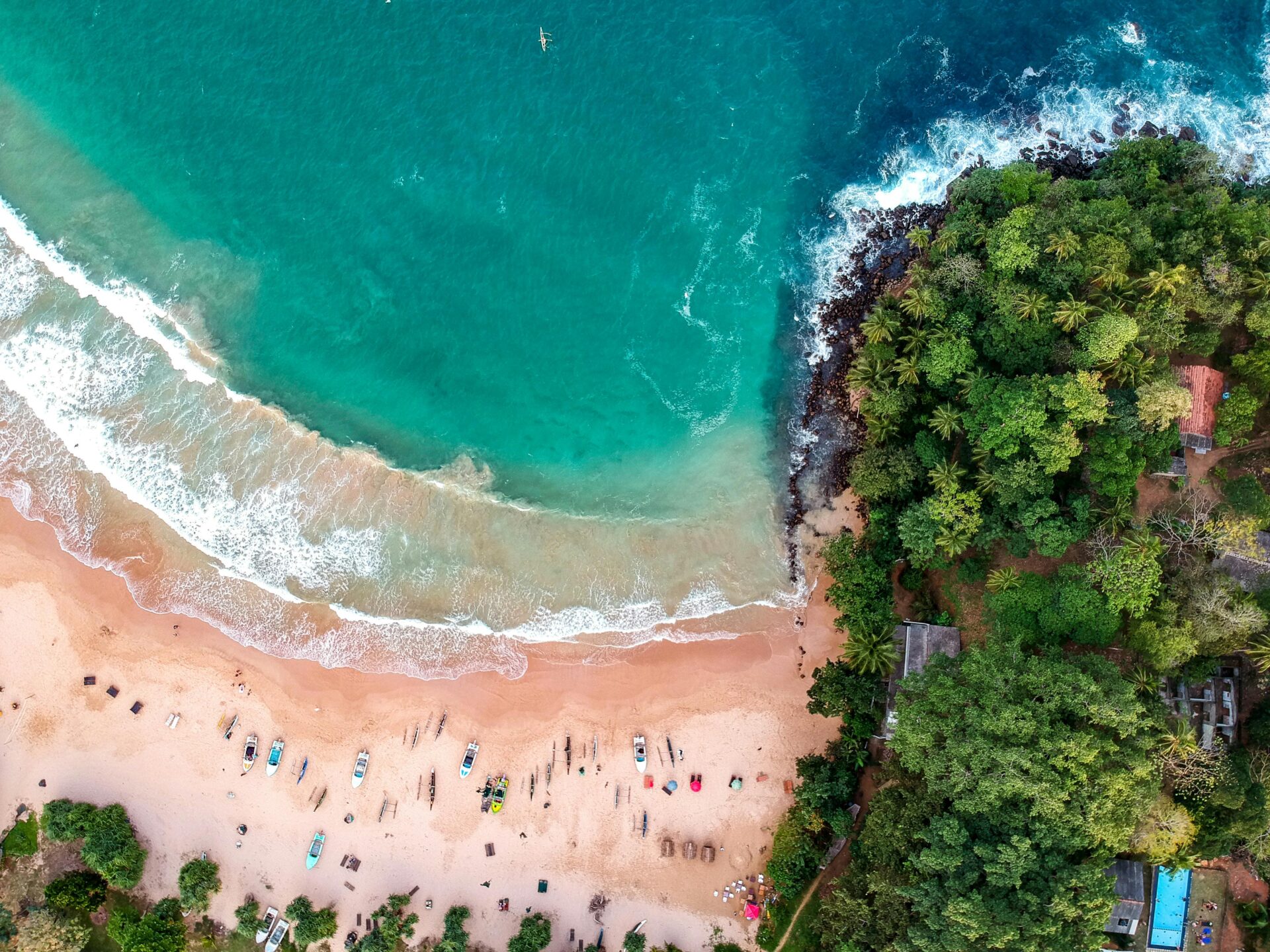
Mirissa is a beach town on the south coast, 40 minutes east of Galle, and the best whale watching base in Sri Lanka. Between November and April, blue whales (the largest animals on Earth) feed in the deep waters south of the coast, within 5-10km of shore.
The blue whale encounter at Mirissa is one of the most reliable in the world — a 90% sighting rate on most days in peak season (January-March). The whales surface to breathe and occasionally fluke (raise their tails as they dive), which is the image everyone comes for.
Which operator to book: Book with operators who follow the Sri Lanka whale watching code of conduct — maintaining a distance of 50 metres from cetaceans, not pursuing or encircling whales. Ask specifically before booking. Responsible operators include Raja & The Whales (the reference standard, book ahead) and several others recommended by your guesthouse. A half-day trip costs £18-25/person.
Spinner dolphins are extremely common year-round. Sperm whales appear occasionally December-April. Blue whales peak January-March. Whale sharks are occasionally encountered but are not reliably predictable.
The Mirissa beach itself: A curved bay with calm water in the season (November-April). Good for swimming. The restaurant strip along the beach is tourist-facing in pricing and reasonable in quality — eat one meal beachside and eat the others at the local places one street back.
Unawatuna
The most popular beach on the south coast — a sheltered bay 5km east of Galle with good snorkelling on the reef, calm water, and a beach strip that runs from budget guesthouses through mid-range to one or two resort properties. Slightly more developed than Mirissa, slightly less character. Good as a base for Galle day trips and for the combination of beach and fort.
Arugam Bay — The East Coast Surf
Arugam Bay on the east coast is the best surf beach in Sri Lanka and one of the finest point breaks in Asia. The A-Bay main break works June through September when the southwest monsoon doesn’t reach the east coast. International surfers come specifically for the point break; the town exists around surfing culture in a way that’s unpretentious and specific.
Even for non-surfers, Arugam Bay in July is compelling: a working fishing village with a surf economy grafted onto it, empty beaches north and south of the main break, fresh tuna at lunch that came off a boat two hours earlier. Getting there requires either flying Colombo-Batticaloa (connections) or a 6-7 hour bus journey from the south coast — the effort is exactly the price of entry into somewhere that hasn’t been fully optimised.
Wildlife — Yala, Wilpattu, and the Whale Watching
Yala National Park
Sri Lanka’s most visited national park, in the southeast corner of the island, and the site of the world’s highest density of leopards per square kilometre — a statistic that sounds like it should be an exaggeration and is genuinely supported by wildlife surveys.
Leopard sightings at Yala are not guaranteed — it’s a wild animal in a large park — but the sighting rates are high enough (70-80% on morning safaris in the main circuit) that most travellers who do a full-day safari encounter at least one. The leopards at Yala are habituated to safari vehicles and approach roads with indifference.
Safari structure: morning game drives (5-6am departure) and afternoon drives (3-6pm) are the best wildlife windows. Full-day safaris are available. Entry fees: £15/person/day. Vehicle and guide: £40-60/day shared between passengers. Stay in the buffer zone guesthouses around the park entrance (Tissamaharama is the nearest town) rather than commuting from the south coast.
Beyond leopards: elephants, sloth bears, crocodiles, peacocks, monitor lizards, and a significant bird diversity. Yala in the dry season (June-September) sees wildlife concentrating around remaining water sources, making sightings more frequent.
Wilpattu National Park
The largest national park in Sri Lanka — less visited than Yala and with lower infrastructure, which means fewer vehicles and a different atmosphere. Leopard density is lower than Yala but sightings are still reasonable. The park is famous for its villus — natural lakes formed in ancient river beds — where wildlife gathers. The sensation of being the only vehicle at a waterhole watching elephants drink at dawn is significantly more available here than in Yala.
Access: from Anuradhapura or Puttalam. Less convenient than Yala but worth considering for the second Sri Lanka trip when Yala has already been done.
Minneriya National Park — The Gathering
A phenomenon worth planning a trip around: between August and October, hundreds of elephants (the largest wild elephant gathering in Asia — up to 300 animals) converge on the receding Minneriya tank (reservoir) as the dry season shrinks the water. The gathering is a wildlife spectacle without parallel in South Asia. Evening game drives give the best light. Entry: £10. Safari vehicles from Habarana (45 minutes from Sigiriya).
The North — Jaffna and the Forgotten Region
The north of Sri Lanka — Jaffna and the Northern Province — was the heartland of the Tamil population and the centre of the civil war that ended in 2009. It was closed to tourists for most of three decades and has only been accessible without restriction since 2009.
The result is a region that feels genuinely different from the south — Tamil culture, Hindu temples rather than Buddhist dagobas, a distinct cuisine (Jaffna crab curry is different from the southern versions), and a landscape scarred by conflict that is in the process of recovery and reconstruction.
Jaffna is worth 2-3 days for the traveller who has seen the southern circuit and wants a different Sri Lanka. The Nallur Kandaswamy Kovil — the most important Hindu temple in Sri Lanka — is extraordinary at festival time (July-August, the Nallur Festival runs for 25 days). The Jaffna Fort (Dutch, 17th century, smaller than Galle) is being restored. The Dambakola Patuna coast road along the Jaffna Peninsula gives access to islands connected by causeways where time seems to have moved more slowly than anywhere else on the island.
Getting there: domestic flight from Colombo (45 minutes, from £35) or overnight train from Colombo (8 hours — the night train to Jaffna is comfortable and worth doing once for the experience of waking up in a different world).
What It Costs — Real Numbers
Sri Lanka sits in an interesting position: cheaper than Thailand in some respects, more expensive in others. The accommodation mid-range is strong (boutique guesthouses are abundant and well-run at £25-55/night for a private room), but the budget basement is thinner than SE Asia’s established backpacker infrastructure, and the national park and cultural site entry fees are significant by regional standards.
Daily Budgets
Budget (£35-50/day)
- Accommodation: guesthouse private room (£15-25/night)
- Food: local restaurants, rice and curry, street food (£6-10/day)
- Transport: tuk-tuks and local buses
- Sites: the cultural triangle entry fees amortised across the trip
Mid-range (£60-85/day)
- Accommodation: boutique guesthouse or mid-range hotel (£30-55/night)
- Food: mix of local restaurants and good sit-down meals (£12-20/day)
- Transport: tuk-tuks, occasional private driver for longer transfers
- Sites: all entry fees, whale watching, safari
Comfortable (£100-150/day)
- Accommodation: quality boutique hotel or colonial-era property (£55-100/night)
- Food: good restaurants, one splurge meal at Ministry of Crab (£30-45/day)
- Transport: private driver for the hill country sections, domestic flight
What 14 Days in Sri Lanka Actually Costs from the UK
| Category | Budget | Mid-Range |
|---|---|---|
| Return flights (Colombo, 3 months ahead) | £480–620 | £580–750 |
| 14 nights accommodation | £210–360 | £430–700 |
| Food (14 days) | £90–150 | £175–280 |
| Cultural Triangle entry (Sigiriya + Polonnaruwa) | £40 | £40 |
| Train (Kandy → Ella, observation class) | £10–12 | £10–12 |
| Whale watching tour | £18–25 | £25–35 |
| Yala safari (full day) | £55–75 | £75–100 |
| Internal transport (tuk-tuks, buses, one private transfer) | £50–80 | £80–130 |
| Total | £953–1,362 | £1,415–2,047 |
Eating in Sri Lanka — The Food Nobody Talks About
Sri Lankan food is one of the great undiscovered cuisines for UK travellers — genuinely distinct from Indian food despite sharing a subcontinent, shaped by centuries of Arab, Portuguese, Dutch, British, and South Indian influence into something that is entirely its own.
Rice and Curry
The national meal, eaten at least once a day by most Sri Lankans. A mound of rice surrounded by small portions of various curries — dhal (lentil), potato, jack fruit, beetroot, a protein (chicken, fish, or crab), and accompaniments (pol sambol — fresh coconut with chilli and lime — and papadam). The individual curries are mild by default; ask for more chilli if you want it. Cost at a local restaurant: £1.50-3 for the full spread. Cost at a tourist restaurant: £4-8 for a smaller and usually less interesting version.
The rice and curry at village restaurants — small, no menu, whatever was cooked that morning — is consistently the best version. Your guesthouse owner will know the right place within walking distance.
Hoppers (Appa)
A bowl-shaped crepe made from fermented rice flour and coconut milk, cooked in a small wok-shaped pan. The edges are thin and crispy; the centre is thicker and soft. Eaten with a range of sambols and curries for breakfast, or in the evening as a snack.
Egg hoppers — with an egg broken into the centre and cooked as the hopper sets — are the most satisfying breakfast available in Sri Lanka at any price. £0.30-0.60 per hopper at a local bakery or street stall. The egg hopper with a smear of pol sambol and a cup of sweet tea is the correct Sri Lankan morning.
String hoppers (Idiyappam) — thin rice noodles pressed into a round nest shape. Served with curry for breakfast or dinner. A different texture from rice but the same accompaniment system.
Kottu Roti
Chopped flatbread (roti) stir-fried on a hot griddle with vegetables, egg, and protein (chicken, beef, or crab), seasoned with curry spices. The preparation is audible — the two metal blades chopping rhythmically against the griddle create a sound that announces a kottu stall from 50 metres away. £1.50-3 from a street stall or local restaurant. The crab kottu at the right restaurant (Pillawoos in Colombo is the reference standard, open 24 hours) is one of the best things to eat in the country.
Sri Lankan Crab
The mud crab — Sri Lanka’s dominant coastal species — is significantly larger and richer than most European crab varieties. The preparation methods vary: chilli crab (a wet curry sauce, some heat), garlic butter (the finest delivery vehicle), black pepper. The crab at Ministry of Crab is the premium version; local restaurants near fishing harbours do credible versions for a fraction of the price.
Fish Ambul Thiyal
A dry fish curry from the south, specific to Sri Lanka — tuna cooked with goraka (a dried fruit similar to tamarind), black pepper, and spices until the sauce is almost completely reduced and the fish is coated in intensely flavoured paste. The texture is unlike any fish curry available elsewhere. Available at traditional southern restaurants; ask specifically if it’s on the menu rather than waiting to see it.
The Coconut Omnipresence
Sri Lanka produces 15% of the world’s coconut oil. The coconut is in everything — scraped into sambol, pressed into milk for the curries, distilled into arrack (the national spirit, made from coconut flower sap, drunk with ginger beer), drunk fresh from the husk (the king coconut — thambili — is bright orange, sweeter than the green, sold from roadside carts for £0.30-0.50). Drink a fresh king coconut at every opportunity. It’s one of the best things available for £0.30 anywhere on earth.
Practical Notes
Visa: UK passport holders require an ETA (Electronic Travel Authorisation) before arrival — apply at www.eta.gov.lk. Cost: £35. Processing: immediate to 24 hours. Valid for 30 days, extendable within Sri Lanka. Apply at least 48 hours before travel; the official site sometimes has processing delays.
Getting there: No direct flights from the UK. Colombo (Bandaranaike International, CMB) served by SriLankan Airlines (via Colombo), British Airways, Qatar Airways, Emirates, Etihad, Turkish Airlines — most routing via one connection. Flight time: 10-11 hours. Return flights from £480-750 booked 6-10 weeks ahead. Open-jaw routing (fly into Colombo, out of Colombo after a circuit) is standard — there’s no reason to fly in and out of different cities.
Getting around: The train is the correct choice for the Colombo-Kandy-hill country-Ella section. For everything else: tuk-tuks for short distances (negotiate before getting in — an approximate price per kilometre helps: £0.40-0.60/km is fair in tourist areas), local buses for longer distances (cheap, sometimes crowded, reliable schedules), private drivers for the cultural triangle and south coast (£35-60/day for a driver and vehicle, negotiated directly or via your guesthouse).
Currency: Sri Lankan Rupee (LKR). £1 ≈ 390 LKR at time of writing — verify before travel, the rate has been volatile following Sri Lanka’s 2022 economic crisis. ATMs are available in Colombo, Kandy, and larger towns; carry cash in smaller towns and rural areas. Many guesthouses and restaurants in tourist areas now take card; local restaurants and tuk-tuk drivers are cash-only.
Getting a SIM: Buy a tourist SIM at the airport on arrival. Dialog has the best data coverage nationwide. A 30-day SIM with 5-15GB data costs £3-7. Airalo eSIMs work on Sri Lankan networks for those who prefer to activate before landing.
Health: Vaccinations recommended: Hepatitis A, Typhoid. Rabies vaccination worth considering if you’ll be spending time in rural areas (stray dogs are common in smaller towns). Malaria prophylaxis is recommended for visits to national parks in the dry zone (Yala, Wilpattu, the east coast). Consult a travel clinic 4-6 weeks before departure.
Dengue fever is endemic in Sri Lanka — mosquito precautions (repellent containing DEET, long sleeves at dawn and dusk) are more important than malaria prophylaxis for most itineraries.
Language: Sinhala (south and central Sri Lanka) and Tamil (north and east). English is widely spoken in tourist areas, guesthouses, and restaurants throughout the south and cultural triangle. Less common in rural areas and the north. “Ayubowan” (Sinhala greeting, said with palms pressed together) and “Vanakkam” (Tamil equivalent) are appreciated and will make people smile.
The 14-Day Itinerary — The Route That Works
This itinerary runs south to north through the island’s main zones — coast, culture, hills, and coast again — in a circuit that avoids backtracking and covers the essential Sri Lanka without rushing any part of it.
Day 1: Colombo Land at Bandaranaike International. Transfer to Colombo (45 minutes by taxi, £8-10). Afternoon in Fort district and Galle Face Green. Ministry of Crab for dinner if booked. Sleep.
Day 2: Colombo → Sigiriya Morning: Pettah Market at 8am. Bus or private transfer north to Sigiriya (4-5 hours, £6 by bus, £35-45 by private transfer). Check in to guesthouse near the rock. Rest. Brief walk to the reservoir viewpoint at dusk.
Day 3: Sigiriya and Pidurangala 5:30am: walk to Pidurangala Rock base. Sunrise from the summit (6:45-7:15am), looking across at Sigiriya as the mist clears. Descend. Breakfast. Sigiriya Rock from 8am (buy tickets night before or online to avoid the morning queue). Summit by 9am. Back to guesthouse by midday. Afternoon: Polonnaruwa by bicycle (45 minutes from Sigiriya by tuk-tuk). Gal Vihara at late afternoon light.
Day 4: Cultural Triangle → Kandy Morning: Minneriya National Park (if August-October — the Gathering, 45 minutes from Sigiriya). Or Dambulla Cave Temple (30 minutes from Sigiriya) — 5 caves of Buddhist frescoes and 150 statues, entry £7. Transfer to Kandy by afternoon (2-2.5 hours). Temple of the Tooth evening Puja at 6:30pm.
Day 5: Kandy Royal Botanic Gardens at Peradeniya (morning). Kandy Lake walk. Spice and batik demonstration in the afternoon (arranged through guesthouse — genuinely informative rather than purely commercial when done with a good guide). Traditional Kandyan dance performance at 5pm (cultural show, £6 — worth doing once for the drumming and fire-dancing).
Day 6: Kandy → Nuwara Eliya (train) Morning train Kandy to Nanu Oya station (3.5 hours, book observation class in advance). Transfer by tuk-tuk to Nuwara Eliya (20 minutes). Afternoon: Pedro Tea Estate tour and tasting. Nuwara Eliya town walk — the post office, the racecourse, Victoria Park. Dinner at the guesthouse.
Day 7: Nuwara Eliya → Ella (train) Train from Nanu Oya to Ella (2.5 hours, the finest section of the journey). Observation class booked in advance. Arrive Ella by noon. Afternoon: Nine Arch Bridge viewpoint (15 minutes walk from town). Position for the 3:40pm train crossing.
Day 8: Ella 5:30am departure: Ella Rock hike. Summit by 8am. Mist clearing, valley below, the tea estates spreading in every direction. Back to town by 10:30am. Afternoon slow — the guesthouse hammock, the café, the town at its own pace. This is the day for rest and the hill country to land.
Day 9: Ella → Yala Bus or private transfer from Ella to Tissamaharama (3 hours, £5 bus or £35-45 private). Check into accommodation near the Yala park gate. Afternoon safari (3pm-6pm): first wildlife drive.
Day 10: Yala Morning safari (5:30am-8:30am): the prime leopard window. Return for breakfast and rest through the heat of the day. Afternoon safari (3:30pm-6:30pm): elephants and birds at the water’s edge at dusk.
Day 11: Yala → Galle Transfer from Tissamaharama to Galle (2.5-3 hours by private transfer or bus via Matara). Check into accommodation inside the fort. Afternoon: ramparts walk. Dinner inside the walls.
Day 12: Galle and Mirissa Morning: Galle Fort interior — the Dutch Reformed Church, the Lighthouse, the streets. Afternoon: tuk-tuk to Mirissa (40 minutes, £4). Mirissa beach. Sunset. Book whale watching tour for Day 13 morning.
Day 13: Whale Watching Whale watching boat departs 6-6:30am from Mirissa harbour. Return by 10-11am. Blue whales. Spinner dolphins. The Indian Ocean further than you can see. Return to Galle or Colombo by afternoon for flights.
Day 14: Colombo and Departure Transfer to Colombo (2 hours from Galle by express bus, £2). Morning free in Colombo (Seema Malaka temple on Beira Lake). Transfer to airport.
Final Thought
I was on the train between Nanu Oya and Ella on a morning in January when the mist was doing what it does in the Sri Lankan hills — appearing and disappearing between the tea estate ridges as the train curved around each contour, revealing and concealing the valley below in alternating seconds.
The woman in the seat across from me had been picking tea on this section of hill since she was sixteen. She was sixty-two now. She looked out the window at the same landscape I was looking at and I had no way to know what she was seeing.
That gap between what you look at and what you actually know about a place — Sri Lanka narrows it more than most destinations, if you let it. But it requires time. And slowness. And the willingness to be on a train going where the train goes.
Take the train.
Question about Sri Lanka this guide doesn’t cover? Drop it in the comments.