
The complete guide for UK travellers: the cities that rebuilt themselves, the coffee region nobody adequately describes, Cartagena at 6am, the river that runs in five colours, the Escobar question answered honestly, and what Colombia actually costs in 2025.
Reading time: 18 minutes | Last updated: 2026
Colombia was the trip that changed how I think about South America.
I went with expectations assembled from two decades of news coverage that had aged poorly and a vague sense that I should probably feel nervous. What I found was one of the most extraordinary countries I’ve visited in fifteen years of taking this seriously — a river that runs simultaneously in red, yellow, green, black, and blue; a cathedral 200 metres underground lit in blue; a city that was once the most dangerous in the world and is now one of the most interesting; and a coastline of colonial architecture in every colour sitting on the Caribbean.
The transformation of Colombia is real and it is recent enough that the outside perception hasn’t caught up. The travellers who’ve been in the last five years know this. The travellers who haven’t are still working from a reputation that hasn’t been accurate for the better part of two decades.
This guide is for both groups. It’s honest about what the transformation means in practical terms — where to be confident, where to stay attentive — and it goes deep on what the country actually contains, which is significantly more than the headlines ever covered.
Quick Navigation
- The Case for Colombia — The Reputation vs the Reality
- When to Go — The Dry Seasons and the Ones to Work Around
- Bogotá — More Than a Transit Hub
- Medellín — The City That Rebuilt Itself
- Cartagena — The Caribbean Walled City
- The Coffee Region — Salento and the Cocora Valley
- The Hidden Colombia — Places Worth the Extra Journey
- The Escobar Question — The BGGD Position
- The Food — What Colombian Cuisine Actually Is
- What It Costs — Real Numbers
- Safety — The Honest, Practical Guide
- Practical Notes
- The 10-Day Itinerary
The Case for Colombia — The Reputation vs the Reality
The reputation problem is worth addressing first because it shapes most people’s decisions about whether to go.
Colombia’s violence peaked in the 1980s and 1990s under Pablo Escobar and the cartel era. The murder rate in Medellín in 1991 was 381 per 100,000 people — the highest of any city on Earth. The country was genuinely dangerous in ways that made international travel inadvisable.
That was 30 years ago.
The murder rate in Medellín in 2024 is 19 per 100,000 — still higher than London’s (1.6) but comparable to several US cities and dramatically lower than the peak. Colombia’s total homicide rate has fallen by 90% from its highest point. The tourist infrastructure — particularly in Bogotá, Medellín, Cartagena, the coffee region, and Cartagena — is well-established, well-resourced, and actively maintained.
The Foreign Commonwealth & Development Office advises caution in specific border regions and certain rural areas, which is standard advice for most South American countries. The main tourist destinations are not in those regions.
The practical picture: Colombia is a safe destination for travellers who apply standard urban common sense — don’t flash expensive items, use registered taxis or Uber, be aware of your surroundings, particularly at night. The same framework applies in Barcelona, Lisbon, and Bangkok.
What Colombia has that most comparably-safe destinations don’t: a landscape and culture that has barely been packaged for international tourism yet, prices that reflect a local economy rather than a tourist one, food that is genuinely extraordinary and genuinely unknown outside the country, and a warmth from its people that consistently surprises visitors who arrived expecting wariness.
Colombia is one of the most rewarding trips available from the UK in 2025. The window between “being discovered” and “fully discovered” is open right now.
When to Go — The Dry Seasons and the Ones to Work Around
Colombia straddles the equator and doesn’t have summer and winter in the European sense. Instead, it has dry seasons (verano) and wet seasons (invierno) that vary significantly by region.
December to March — Dry Season
The drier months across most of Colombia. The best window for: the Caribbean coast (Cartagena, Tayrona National Park), the coffee region, and Bogotá. Temperatures on the Caribbean coast: 28–34°C. Altitude destinations (Bogotá at 2,600m, Medellín at 1,495m): mild year-round — 14–22°C regardless of season.
Peak for Christmas and New Year (Colombian Feria de Cali runs 25–30 December, Carnaval de Barranquilla in February/March — the second largest carnival in the world after Rio).
June to August — Second Dry Season
A shorter, less consistent dry period. Good for the Caribbean coast and the coffee region. Bogotá and Medellín are comfortable year-round regardless.
April to May and October to November — Wet Season
Heavier rain, particularly in the Pacific coast, the Amazon region, and parts of the interior. The Caribbean coast and altitude cities are less affected. These months see lower prices and fewer tourists, and for cities like Medellín the rain is typically afternoon showers rather than all-day downpours.
Caño Cristales: August to November only
The river of five colours is only visible during the window when the water level is right for the aquatic plant (Macarenia clavigera) that creates the red. Outside this window, the colours don’t appear. If Caño Cristales is the reason you’re going, August to November is non-negotiable.
The BGGD recommendation: December to March for the full Colombia experience. July for the Cartagena coast and coffee region without the peak-season prices of December.
Bogotá — More Than a Transit Hub
Most Colombia itineraries treat Bogotá as an arrival point — land, one night, head to Medellín or the coast. Bogotá deserves more than that and, with two full days, consistently surprises the travellers who give it time.
The city sits at 2,600m above sea level, which means it’s cool (14–19°C), often overcast, and requires a day of altitude acclimatisation if you’re heading higher. It’s also one of the most culturally rich capitals in South America, with a contemporary art scene, a food culture that punches significantly above its international profile, and a historic centre (La Candelaria) that contains the finest collection of pre-Columbian gold artefacts in the world.
Gold Museum (Museo del Oro)
55,000 pieces of pre-Columbian gold, spanning 2,000 years of indigenous metalwork from across Colombia. The Muisca ceremonial raft — a miniature gold boat carried in procession during the El Dorado ritual, which gave rise to the legend of the City of Gold — is the centrepiece. Entry: £5. Budget two hours. One of the finest museums in South America.
La Candelaria
The historic centre. Narrow colonial streets, the 17th-century Cathedral Primada, the Botero Museum (free entry — 123 works donated by the artist Fernando Botero, including paintings and sculptures of his characteristically rotund figures). The Bolívar Square at the intersection of governmental, religious, and cultural power. The market at Paloquemao (15 minutes by taxi) — the best produce market in Bogotá, selling tropical fruits you’ve never seen alongside the most affordable and best breakfast in the city.
Monserrate
A mountain directly behind the city centre, accessible by cable car or funicular (£8 return) or a steep 3km hike (free but strenuous at altitude). The summit church, the view over 10 million people spread across a high mountain basin, the Andean peaks beyond. Go in the late afternoon for the clearest air and the best light. The cable car runs until 11:45pm on weekends — the city at night from 3,152m is extraordinary.
The Zona Rosa and Usaquén
The wealthier northern neighbourhoods. Zona Rosa for restaurants and bars — the Parque de la 93 area has the highest concentration of good food and drink in the city. Usaquén for the Sunday flea market (antiques, handicrafts, food stalls) and the colonial village feel that feels completely separate from the megacity around it.
What to Skip in Bogotá
The Andrés Carne de Res restaurant in Chía (40 minutes north) is a Bogotá institution — an enormous, theatrical restaurant-club with 600 tables and a reputation for the wildest Saturday nights in Colombia. It’s extraordinary if that’s your thing and irrelevant if it’s not. The food is secondary to the experience.
Medellín — The City That Rebuilt Itself
Medellín is the most interesting city in South America. I make that claim knowing it’s contestable and standing by it.
The transformation narrative — from murder capital of the world (1991) to winner of the Urban Land Institute’s award for the world’s most innovative city (2013) — is real. The cable cars (Metrocable) that connect the hillside comunas to the city-centre metro weren’t built for tourism. They were built as urban infrastructure for communities that previously had no transport connection to the rest of the city. The library parks, built in the poorest comunas, weren’t built to photograph — they were built as community anchors. The fact that both are now highlights of a city tour doesn’t make them less real.
The Metrocable and the Comunas
Line K from Acevedo metro station to Santo Domingo and then the gondola to Parque Arví: the best urban journey in Colombia. From the cable car, the scale of Medellín’s hillside development becomes comprehensible — a city of 2.5 million people arranged up steep green slopes, the cable cars threading through.
The comunas — the hillside neighbourhoods — are safe to visit. Take the cable car, walk through the neighbourhood, eat lunch at a local place. A guided tour is worth doing on your first visit: the guides from the Real Colombia Foundation are residents of the comunas who provide context that you can’t get from a cable car window.
El Poblado
The neighbourhood where most visitors stay. Safe, walkable, the best restaurant scene in Medellín, Parque Lleras at its heart. The Laureles neighbourhood (15 minutes by taxi) is where Medellín’s middle class actually eats and socialises — cheaper, less tourist-facing, more representative of what the city is day to day.
Pergamino Café
The best cup of coffee in a country that produces some of the best coffee in the world. A geisha filter at Pergamino (Calle 10 in El Poblado) is one of the finest coffee experiences available anywhere. Colombia’s coffee region produces varietals that win international competitions; Pergamino sources and roasts them with the precision of a serious specialty operation. Budget £4–6 for a filter. Non-negotiable.
The Botero Plaza and Museum of Antioquia
Fernando Botero — the Colombian artist whose oversized figurative sculptures appear in cities across the world — donated 23 bronze sculptures to his home city, arranged in a plaza in the centre of Medellín adjacent to the Museum of Antioquia. The sculptures are free to approach, free to photograph, and invite a kind of interaction that museums generally discourage. The museum itself (entry £4) contains the largest Botero collection in the world including 100 paintings and drawings.
Mercado del Río
A food hall in the Barrio Colombia neighbourhood — 35+ food stalls across two floors, covering traditional Colombian, sushi, empanadas, craft beer, ceviche. Busy Thursday through Sunday. Prices: £3–8 per dish. The best introduction to the Medellín food scene in the shortest amount of time.
Cartagena — The Caribbean Walled City
Cartagena is the most beautiful city in South America. This claim is also contestable and I’m also standing by it.
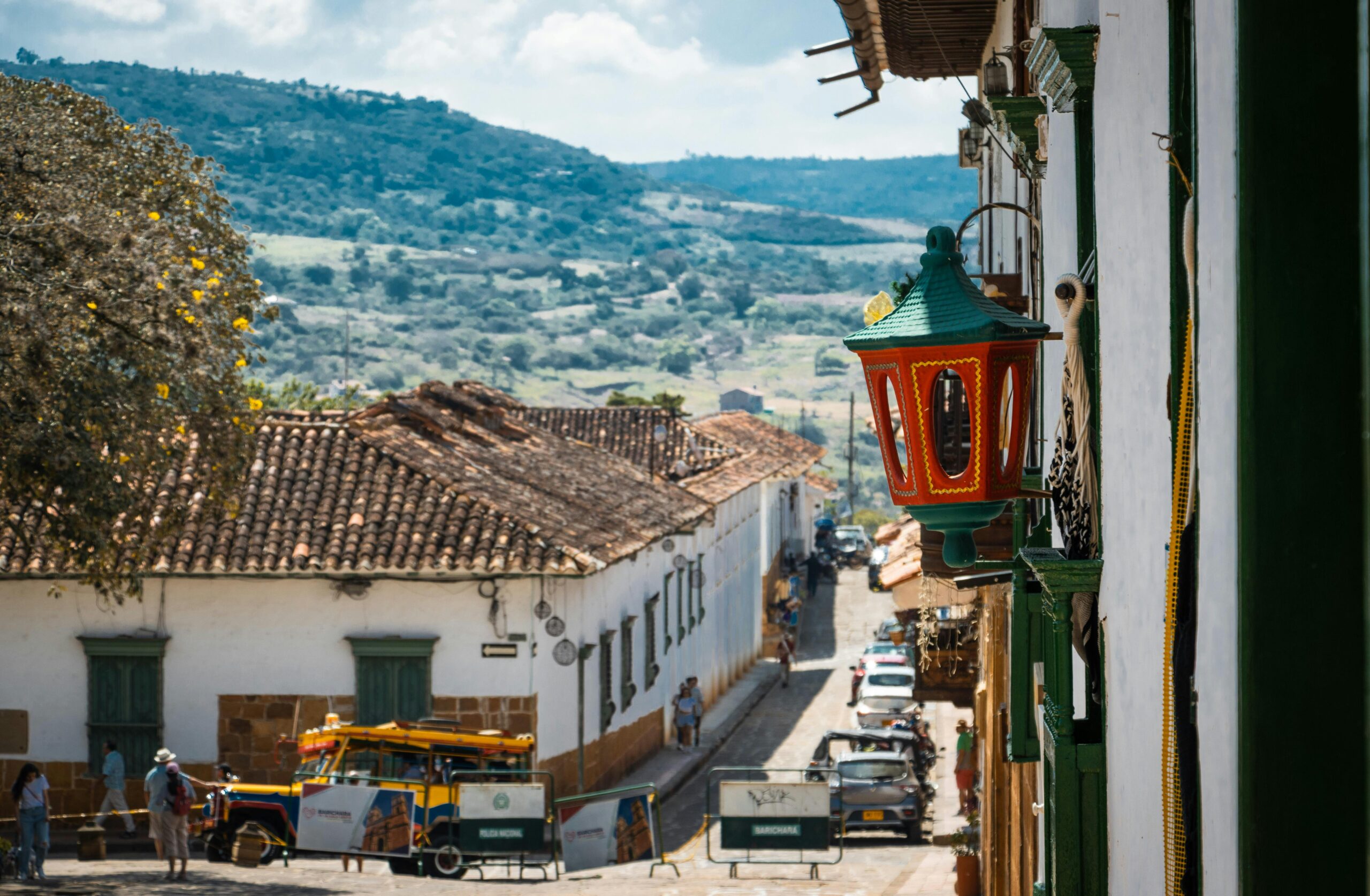
The Ciudad Amurallada (walled city) is a 16th-century Spanish colonial city on the Caribbean coast — 11km of walls built between 1586 and 1796 to protect the city from pirates and rival powers. Inside the walls: cobblestone streets, houses painted in every shade of yellow, ochre, terracotta, and pink, bougainvillea cascading from balconies, horse-drawn carriages. The ramparts at sunset, walked in full (90 minutes), with the Caribbean to one side and the city glowing below you on the other. One of the great urban walks in the world.
Getsemaní
The neighbourhood outside the walls — once considered dangerous, now one of the most vibrant areas in the city. The street art: every wall a canvas, commissioned from Colombian artists since 2010. The Plaza de la Trinidad: the social hub, populated from 7am with fruit sellers and from 9pm with locals and travellers who bring chairs into the square. The pulse of the city is here, not inside the walls.
The Walled City at 6am
The city that most visitors experience and the city that exists are different places. Inside the walls at 6am — before the tour groups, before the vendors, before the heat — is one of the most beautiful streets I’ve stood on. Pastel facades in the early light. A man selling arepas from a basket on his head. The sound of the city waking up. This requires only an alarm. It costs nothing. It is worth the entire trip.
The Rosario Islands
A national park archipelago 40 minutes by speedboat from the Cartagena marina. Translucent water, coral reef snorkelling, day beds on a beach that recedes into the sea. Day trip: £20–35 return by speedboat, national park entry £4, snorkelling gear hire £5. Return by 4pm to walk the ramparts at sunset. This is the ideal Cartagena day.
San Felipe de Barajas Castle
The largest Spanish colonial fortress in South America, built in 1657 on a hill above the old city. Underground tunnels, cannon emplacements, battlements with views over the Caribbean. Entry: £4. Arrive at 8am before the tour buses. Budget 90 minutes. The context it provides for the city below — built specifically to be defended, the castle the last line against sea attack — makes the walled city make sense in a way that a street-level walk doesn’t.
The Honest Note on Cartagena
Cartagena has become expensive by Colombian standards. Accommodation inside the walls starts at £60–80/night for a modest room and rises rapidly for anything with a courtyard and a plunge pool. Restaurants on the main tourist drag are priced accordingly. The solution: stay in Getsemaní (half the price, better atmosphere), eat from the Mercado de Bazurto (the real market, 20 minutes from the centre by taxi), and save the inside-the-walls restaurants for one proper dinner.
The Coffee Region — Salento and the Cocora Valley
The Eje Cafetero — the coffee region — is the least adequately described part of Colombia in any guide I’ve read. Every piece of writing about it mentions the coffee and the Cocora Valley and the wax palms. Very few of them convey what it’s actually like to stand in a valley of 60-metre palm trees in the mist of the Andes.
Salento
A small colonial town in the Valle del Cauca, at 1,895m above sea level, surrounded by coffee farms and cloud forest. The town itself: one main street (Calle Real) of brightly painted wooden houses, restaurants serving local trout, coffee shops serving the bean from farms you can see on the hillside. Population: 10,000. Atmosphere: completely disproportionate to the size.
Stay at least two nights. Three is better. The town rewards slowness.
The Cocora Valley
The reason Salento is on every Colombia itinerary, and it earns that position.
The wax palm (Ceroxylon quindiuense) is the national tree of Colombia and the world’s tallest palm tree — mature specimens reach 60 metres, the equivalent of a 20-storey building. They grow on the steep green hillsides of the Cocora Valley in clusters and singles, wreathed in cloud and surrounded by hummingbirds. The effect is genuinely surreal. The valley looks like a landscape from a Miyazaki film. It looks photoshopped. It isn’t.
The circular hike from Salento (4–5 hours, moderate difficulty) passes through cloud forest, across bamboo bridges over the Quindío River, through a hummingbird sanctuary, and then climbs above the treeline to look down on the palms from above. The palms from above are even more extraordinary than the palms from below because you can see how isolated each one is — individual giants rising from a green valley, visible for kilometres.
Jeeps leave from Salento’s main square in the morning to the trailhead (£2 each way, shared). The first jeep leaves at 7:30am. Take it.
Coffee Farm Tours
The Eje Cafetero produces some of the finest coffee in the world — the volcanic soil, altitude, and microclimate create growing conditions that coffee agronomists travel specifically to study. A farm tour (finca visit) takes 2–3 hours and covers: the plant cycle, the picking process, the wet processing method (Colombia uses washed process, which produces cleaner, brighter flavours), and the roasting. At the end, you taste the coffee you’ve just watched being made.
Tour cost: £12–18, bookable through your guesthouse in Salento or directly with farms in the surrounding hills. The Finca El Ocaso (30 minutes from Salento by jeep) is consistently recommended. Book a day ahead.
Armenia and the Coffee Triangle
Armenia is the nearest city (1 hour from Salento by bus) and the gateway to the broader coffee triangle. The Parque Nacional del Café near Montenegro (30 minutes from Armenia) is a theme park built around coffee culture — more family-oriented than the farm tour experience but covering the industrial side of the industry comprehensively. The botanical gardens around the park contain every significant variety of coffee plant in one accessible setting.
The Hidden Colombia — Places Worth the Extra Journey
Caño Cristales — The River of Five Colours
In the Los Llanos region of central Colombia, accessible only by light aircraft from Bogotá to La Macarena (45 minutes, £60 each way), the Caño Cristales river runs simultaneously in red, yellow, green, black, and blue.
The colours come from aquatic plants and algae: Macarenia clavigera (red), Podostemonaceae (green), the white sand of the riverbed (yellow), black volcanic rock, and the deep blue of the water itself. The combination only appears between August and November, when the water level drops to the point where sunlight reaches the riverbed plants.
This is not a mildly interesting natural colour variation. It is one of the most extraordinary natural phenomena on Earth. The photos do not adequately represent what it looks like in person.
Getting there requires planning: a guided tour from Bogotá (mandatory — the area is a national park with strict visitor limits), 2–3 nights in La Macarena village, and the budget for the domestic flight. Total cost for 3 days: £200–280/person including accommodation, guide, and park fees (flights additional). Worth every pound of it.
Tayrona National Park
On the Caribbean coast north of Santa Marta, Tayrona is the finest combination of jungle and Caribbean beach in South America. Jungle trails (1–3 hours) lead from the park entrance to a succession of bays — Cabo San Juan, Arrecifes, La Piscina — each with progressively clearer water and smaller crowds.
There are no roads inside the park. You walk or you ride a horse (£4 for the 45-minute horse ride to the main beach area). Camp on the beach (basic facilities, £12–15/person) or stay in the eco-huts with hammocks above the water (£25–35/person). Book ahead for December–January and during Colombian holidays — the park reaches capacity.
The park is 2 hours from Santa Marta by local bus or taxi (bus: £2.50, taxi: £12). Entry: £8. One of the finest national parks in South America.
The Salt Cathedral of Zipaquirá
45 minutes north of Bogotá by bus (£2) or taxi (£12), the Salt Cathedral is precisely what the name suggests — a functioning Roman Catholic cathedral built 200 metres underground inside a salt mine, with a nave the size of a medieval European cathedral, lit in deep blue.
It sounds like a tourist gimmick. It isn’t. The scale of the underground space is genuinely overwhelming — the mine tunnels extend for kilometres through the salt mountain, and the cathedral at the end of the descent has an architecture that makes the most of its setting in a way that above-ground churches don’t need to. Entry: £12.
Goes on almost nobody’s Colombia itinerary. It should go on yours.
Cartagena’s Islands — Beyond the Rosario
San Bernardo islands (4 hours south of Cartagena by speedboat, or closer by slower ferry): less visited than the Rosarios, with more intact coral, fewer day-trippers, and accommodation on the island of Múcura that feels genuinely remote. Worth the extra journey time if the Rosario islands feel too crowded.
The Amazon (Leticia)
The southernmost tip of Colombia, accessible only by air from Bogotá (2 hours, from £80 one way) or by boat from Brazil or Peru. The Colombian Amazon town of Leticia borders Brazil (Tabatinga) and is close to Peru. Jungle lodges offer: river dolphin sighting (both pink and grey freshwater dolphins are resident), canopy walks, local community visits, and the specific experience of being in the Amazon basin — which is unlike any other landscape in the world.
Requires 4–5 days minimum to justify the logistics. Contact Amazon Jungle Trips or Anaconda Lodge for reputable operators.
The Escobar Question — The BGGD Position
Pablo Escobar was the head of the Medellín Cartel and the most powerful drug trafficker in history. He was responsible for an estimated 4,000 deaths — police, politicians, judges, civilians — and the specific suffering of thousands more families during the cartel era. He was killed in 1993.
Tours exist in Medellín that visit his former properties and narrate his life. The city is officially divided on them.
The honest position: many of the people most directly affected by the cartel era — families of victims, survivors, residents of the comunas where the violence played out — find these tours disrespectful. The Medellín city government does not officially endorse them. Some tour operators treat the subject with genuine historical seriousness; others lean into a kind of gangster-tourism framing that reduces an era of genuine suffering to a thrill narrative.
If you want to understand the history: the Pablo Escobar Museum in El Poblado is run by Escobar’s former accountant and offers context rather than glorification. The Real Colombia Foundation runs tours that frame the cartel era within the broader story of Medellín’s transformation. Both of these are better options than the Instagram tour with a selfie at the bullet-hole house.
Medellín is genuinely more interesting than its most famous criminal. Spend the majority of your time finding that out.
The Food — What Colombian Cuisine Actually Is
Colombian food is one of the great undiscovered cuisines of the world — undiscovered because the country’s international profile for most of the past three decades was defined by things other than food. The cuisine is regional, substantial, and uses a range of ingredients (tropical fruits, highland grains, coastal seafood, Andean root vegetables) that produces something completely distinct from Mexican or Peruvian food despite sharing a continent.
The Dishes Worth Seeking
Bandeja Paisa — the dish of the Antioquian region (Medellín and the coffee country). A platter: red beans cooked with pork belly, white rice, chicharrón (crispy fried pork belly), ground meat, chorizo, fried egg, avocado, sweet plantain, and an arepa. The portion is designed for someone who has been working a farm since 5am. For a traveller who has been walking around a city, it lasts two meals. Costs £3–5 in any local restaurant. Entirely wonderful.
Menú del Día — the set lunch available at virtually every local restaurant in Colombia between noon and 3pm. A bowl of soup, a main course (protein + rice + beans + salad), a fruit juice, and sometimes dessert. Costs £2.50–4 depending on the city. The single best-value meal format available in South America.
Ajiaco Bogotano — the soup of Bogotá. Three varieties of potato (papa criolla, papa pastusa, papa común) cooked with chicken and guascas herb in a thick, cloudy broth, served with avocado, capers, and cream on the side. Available everywhere in Bogotá; barely available outside it. The restaurant La Puerta Falsa on Calle 11 in La Candelaria has been making it since 1816.
Empanadas de Pipián — small corn pastries filled with potato and a peanut-based sauce, fried until crispy. One of the great Colombian street snacks. Available from vendors throughout the coffee region and Bogotá. £0.40 each.
Ceviche Colombiano — different from Peruvian ceviche. The Colombian version: cooked shrimp or fish in a tomato-based sauce with lime, onion, and ají amarillo, served in a cup with crackers. Cartagena’s version is the reference standard. La Cevichería on Calle Stuart in the walled city is the most famous — worth booking or arriving at opening.
Obleas con Arequipe — two thin wafer discs sandwiched with arequipe (Colombia’s version of dulce de leche, slightly more caramelised and complex than the Argentine version), cheese, jam, or blackberries, or all of the above. Sold from street carts throughout the country. Costs £0.60–1.20. The correct choice whenever one appears.
Tinto — Colombian black coffee in a small cup, typically sweetened with panela (unrefined cane sugar). This is how most Colombians drink coffee — not an espresso, not a pour-over, but a strong, sweet, black cup offered at the start of every transaction, every visit, and most conversations. £0.20 anywhere. Drink it.
Where to Eat What
- Bogotá: La Puerta Falsa (ajiaco, the oldest restaurant in the city), Paloquemao Market (fruit, breakfast, the freshest produce in the country), Leo Restaurant (the finest tasting menu in Colombia, Leonor Espinosa’s kitchen — book weeks ahead)
- Medellín: Pergamino (coffee), Mercado del Río (food hall, everything), El Rancho (bandeja paisa, local institution), Bonuar (contemporary Colombian)
- Cartagena: La Cevichería (ceviche, book ahead), Alma (rooftop, excellent contemporary food), street vendors in Getsemaní for empanadas and arepas
- Salento: Restaurante Balcones de Ayer (bandeja paisa, the coffee-region version), any local café for trout
What It Costs — Real Numbers
Colombia is one of the best-value countries in South America. The exchange rate (£1 ≈ 5,200 Colombian Peso at time of writing — verify before travel) gives UK visitors significant purchasing power even at mid-range hotels and good restaurants.
Daily Budgets
Budget (£20–30/day)
- Accommodation: hostel dorm or budget guesthouse (£8–15/night)
- Food: menú del día, street food, local restaurants (£6–10/day)
- Transport: local buses and metro
- Activities: free or near-free attractions
Mid-range (£35–55/day)
- Accommodation: private room, boutique guesthouse (£20–35/night)
- Food: restaurant dinners, coffee shops, one good meal out (£12–20/day)
- Transport: Uber between neighbourhoods, occasional taxis
- Activities: coffee farm tour, Rosario Islands day trip, museum entries
Comfortable (£70–100/day)
- Accommodation: boutique hotel, interior courtyard (£40–65/night in Cartagena, less elsewhere)
- Food: quality restaurants, guided dining experiences (£25–40/day)
- Activities: without budget constraint
What 10 Days in Colombia Actually Costs from the UK
| Category | Budget | Mid-Range |
|---|---|---|
| Return flights (Bogotá or Cartagena, 3 months ahead) | £500–650 | £600–750 |
| 10 nights accommodation | £100–180 | £220–380 |
| Food (10 days) | £70–110 | £130–210 |
| Internal flights (Bogotá → Medellín → Cartagena, or similar) | £60–120 | £80–150 |
| Activities (coffee farm, Rosario Islands, museums, Zipaquirá) | £50–90 | £80–130 |
| Total | £780–1,150 | £1,110–1,620 |
The internal flights are the main variable. Bus between Bogotá and Medellín takes 8–9 hours (£15, overnight available); flying takes 50 minutes (£30–60). Most 10-day travellers fly at least one leg — the time saving is significant and the cost is low.
Safety — The Honest, Practical Guide
Colombia is safe for the traveller who applies sensible urban precautions. The things that actually matter:
Use Uber or InDrive, not street taxis. Express kidnapping — where victims are taken to ATMs and forced to withdraw money — has occurred in unregistered taxis in Bogotá and Medellín. Both are rare and declining, but the simplest prevention is using ride-sharing apps where the journey is tracked and the driver is registered. Uber operates in Colombia despite a legally ambiguous status — your driver will describe you as a friend to comply with local rules. This is normal.
Carry minimal cash and cards. Carry what you need for the day. Leave valuables in your accommodation safe. Pickpocketing is the most common issue in crowded tourist areas and local markets.
The scopolamine warning. Drug-facilitated robbery (using scopolamine, administered through physical contact or spiked drinks) is a specific risk in Colombia’s nightlife areas, particularly in Bogotá’s La Candelaria and parts of Medellín. The risk is highest in bars and clubs, particularly when accepting drinks from strangers. Travel with people you know. Don’t leave drinks unattended.
Know the neighbourhood structure. Every Colombian city has a neighbourhood rating system (estratos 1–6, with 6 being the highest income). Higher-stratum neighbourhoods in tourist areas are generally safe for walking at night. Lower-stratum areas have varying safety profiles — when in doubt, use Uber rather than walking.
The specific safe areas for tourists:
- Bogotá: Zona Rosa, Usaquén, Candelaria during daylight hours
- Medellín: El Poblado, Laureles, Envigado
- Cartagena: Walled city, Getsemaní (generally safe but more caution after midnight)
- Coffee region: Salento and surroundings — extremely safe
None of this is cause for anxiety. It’s cause for the same common-sense approach you’d apply in any large city. Millions of tourists visit Colombia annually, the vast majority without incident.
Practical Notes
Visa: UK passport holders receive a 90-day tourist visa on arrival. No prior application required. A reciprocity fee may apply (check current requirements before travel — policy has changed periodically).
Getting there: No direct flights from the UK to Colombia. Main routing: London → Bogotá via Madrid (Iberia, 14 hours), via Bogotá via Bogotá with Avianca (via connections), or via Miami on American Airlines. Cartagena and Medellín can be reached direct via connections. Return flights: £500–750 booked 2–4 months ahead.
Currency: Colombian Peso (COP). £1 ≈ 5,200 COP at time of writing. Bancolombia ATMs are the most reliable for foreign cards. Withdraw cash in cities — rural areas and smaller towns are often cash-only. Card acceptance is improving but not universal.
Internal transport: Avianca, LATAM, and Viva Air cover the main routes (Bogotá → Medellín, Bogotá → Cartagena, Medellín → Cartagena). Book 1–3 weeks ahead for the best prices. Long-distance buses are safe, cheap (£10–20 for most routes), and slower than flying but an authentic way to see the landscape between cities.
Getting a SIM: Claro and Movistar both offer tourist SIMs at Bogotá and Cartagena airports. A 30-day SIM with 20–30GB data costs £8–12. Alternatively, Airalo eSIMs work on Colombian networks.
Altitude: Bogotá sits at 2,600m above sea level. Some travellers experience altitude sickness — headache, fatigue, nausea — on arrival. Take the first day slowly, drink plenty of water, and avoid alcohol for 24 hours. Symptoms typically resolve within 24–48 hours. The coffee region (1,500–1,900m) and Medellín (1,495m) are at lower altitude and easier to adjust to.
Language: Spanish. English is spoken in tourist-facing businesses in Bogotá, Medellín, and Cartagena. Outside these areas and the coffee region, English is uncommon. Basic Spanish — “gracias,” “cuánto cuesta?” (how much?), “a dónde va?” (where are you going?), “la cuenta, por favor” (the bill, please) — covers most situations. Google Translate works well for Colombian Spanish.
The 10-Day Itinerary
This is the route that covers the essential Colombia without rushing any part of it. It includes one internal flight — Bogotá to Medellín — which is the right call for a 10-day trip where time is the constraint.
Days 1–2: Bogotá
Day 1: Land at El Dorado. Altitude acclimatisation. Walk Zona Rosa. Dinner at a local restaurant, sleep early.
Day 2: Gold Museum (2 hours). La Candelaria walking tour (self-guided or with a guide from the Museum steps). Monserrate by cable car in the late afternoon. Dinner in Usaquén.
Day 3: Bogotá + Zipaquirá
Morning: Paloquemao Market (breakfast, fruit, the best produce in the country). Day trip to the Salt Cathedral at Zipaquirá (45 minutes each way by bus, 90 minutes underground). Return to Bogotá. Fly Bogotá → Medellín in the early evening (50 minutes, book 2 weeks ahead).
Days 4–5: Medellín
Day 4: El Poblado in the morning (Pergamino for coffee, Parque Lleras). Metrocable Line K in the afternoon — all the way to the top, walk the neighbourhood, Parque Arví if time allows. Mercado del Río for dinner.
Day 5: Botero Plaza and Museum of Antioquia (morning). Guided tour of a comunas with Real Colombia Foundation (afternoon). Dinner in Laureles.
Day 6: Travel to Coffee Region
Bus from Medellín to Armenia (4 hours, £8) or to Pereira (3 hours, £6) then connection to Salento (1 hour). Check in. Walk Calle Real at dusk. Dinner with local trout.
Days 7–8: Salento and the Cocora Valley
Day 7: Jeep at 7:30am to the Cocora Valley. Full circular hike (4–5 hours, bring water and rain gear). Return to Salento. Recover. Coffee tasting at a local café.
Day 8: Coffee farm tour (morning, 3 hours, book the day before). Afternoon free in Salento — walk the hillside above town, sit in the plaza, eat obleas from a street cart. Evening: bus to Armenia for the flight or onward bus to Cartagena.
Days 9–10: Cartagena
Day 9: Fly Armenia or Pereira → Cartagena (1 hour, £35–60). Arrive afternoon. Walk the walled city. Ramparts at sunset. Dinner in Getsemaní.
Day 10: Set alarm for 5:30am. Walled city at 6am (the best hour in Cartagena). San Felipe de Barajas Castle (open from 8am, arrive early). Rosario Islands day trip or afternoon on the beach. Evening flight home or overnight for early morning departure.
Total cost estimate:
| Category | Mid-Range |
|---|---|
| Return flights UK → Bogotá, Cartagena → UK | £580–720 |
| Internal flight Bogotá → Medellín | £35–60 |
| Internal flight Armenia/Pereira → Cartagena | £35–60 |
| 10 nights accommodation | £220–350 |
| Food + activities (10 days) | £200–320 |
| Local transport (Uber, buses, jeep) | £50–80 |
| Total | £1,120–1,590 |
Final Thought
The moment that changed how I think about Colombia happened in Cartagena, not in any of the places I’d specifically planned to visit.
It was 6am. I’d set an alarm for the sole purpose of walking the walled city before anyone else arrived. A man was selling arepas from a basket on his head, moving through the empty streets in the low morning light. The walls of the buildings were the same colours they’d been painted for three centuries. No one else was on the street.
The city that exists and the city most people see are never quite the same place. Colombia rewards the people who get up early enough to find the version that isn’t performing for them.
Get up early. Walk before anyone else does.