
The complete guide for UK travellers: the slow boat on the Mekong that most people don’t take, Luang Prabang’s alms ceremony done with the respect it deserves, the ancient jar site that nobody can fully explain, the waterfall you can swim through, the river town that recalibrates your sense of pace, and why Laos is the country SE Asia travellers mention last and remember longest.
Reading time: 15 minutes | Last updated: 2026
Laos is the country that gets skipped.
The SE Asia circuit runs — for most UK travellers — Thailand, Vietnam, Cambodia, maybe a brief stop in Bali. Laos sits in the middle of that circuit, landlocked and quiet, connected by border crossings that require a bit more planning than a direct flight, and it gets omitted from itineraries not because it’s unappealing but because it requires a decision rather than a default.
Most people who skip it go home and put it on the next list. Most people who go find that it rewrites the order of their SE Asia memories.
The country has no beaches. No megacities. No Angkor Wat-scale site that demands a week of itinerary. What it has is a pace — genuinely, measurably slower than anywhere else in the region — and within that pace: a UNESCO town where the morning silence is broken only by monks and the sound of wooden spoons on alms bowls, a waterfall where turquoise water tumbles through three levels of natural pools you can swim in, a plateau scattered with ancient stone jars that nobody can fully explain, a river journey on the Mekong that takes two days and removes you from the 21st century for the duration.
Laos is for the traveller who has been to enough places to know that pace is as valuable as itinerary. It rewards the person who slows down far more than the person who doesn’t.
This guide covers it properly.
Quick Navigation
- The Case for Laos — The Pace Argument
- When to Go — Monsoon, Cool Season, and the Mekong Level
- Getting In — Borders and Entry Points
- Luang Prabang — The Town That Closes at 11pm
- The Alms Ceremony — How to Attend Without Being Part of the Problem
- Kuang Si Falls — The Three-Tier Turquoise
- The Slow Boat — Two Days on the Mekong
- Nong Khiaw and the Nam Ou River
- Vang Vieng — The Karst Town That Found Itself
- Vientiane — The Quietest Capital in SE Asia
- The Plain of Jars — The Site Nobody Can Explain
- 4,000 Islands (Si Phan Don) — Where the Mekong Spreads
- Hidden Laos — The Corners Worth the Detour
- What It Costs — Real Numbers
- Eating in Laos — The Food That Surprises
- Practical Notes
- The 14-Day Itinerary — The Route That Works
The Case for Laos — The Pace Argument
Every SE Asia destination has been shaped by its relationship with tourism. Thailand has been hosting international visitors for fifty years and the infrastructure reflects it — excellent transport, consistent food quality, options at every price point. Vietnam has its own version of this. Cambodia is developing its rapidly.
Laos has been developing its tourism infrastructure more slowly and the country’s character reflects it — not as a failure but as a feature. The guesthouses in Nong Khiaw are still family-run. The morning market in Luang Prabang is still primarily for locals rather than tourists. The slow boat on the Mekong still takes two days rather than having been replaced by a faster option. The 4,000 Islands in the south still has almost nothing in the way of commercialised development — you rent a bicycle, find a hammock above the river, and read for an afternoon.
This pace has economic consequences — Laos is significantly poorer than its neighbours and the development gap shows. It also means the tourism experience is less packaged and more genuine. The interaction in the market isn’t mediated by a tourist economy that has been optimised for 30 years of international visitors.
The practical case: Laos sits directly on the SE Asia overland route. The border from Thailand to Laos at the Mekong crossing (Huay Xai/Chiang Khong), the border from Vietnam at several crossing points, and the border from Cambodia (Stung Treng) all flow naturally into the north-south Laos route. Adding Laos to a Thailand-Vietnam circuit adds 5-7 days and removes the need for a return flight from Bangkok — you enter Laos from Thailand and exit into Vietnam, or vice versa.
When to Go — Monsoon, Cool Season, and the Mekong Level
November to February — The Cool Season
The finest window for visiting Laos. Temperatures are comfortable (22-28°C in the lowlands, cooler in the highlands of Xieng Khouang and the Bolaven Plateau). Rainfall is minimal. The Mekong is at a manageable level — the slow boat runs reliably. Luang Prabang is at its clearest and most atmospheric. This is peak season — accommodation in Luang Prabang books ahead and prices rise 20-30% in December and January.
March to May — The Hot and Dry Season
The hottest months, particularly April (the Lao New Year, Pi Mai, falls in mid-April — a three-day water festival that transforms every town in Laos). The heat is significant (35-40°C in Vientiane and the Mekong valley). Kuang Si Falls is at lower volume as the rains haven’t arrived. The uplands stay cooler.
June to October — The Monsoon
The wet season. Heavy rain throughout the country, particularly July and August. The Mekong rises dramatically — the slow boat runs but the river character changes (faster current, muddy water). Some rural roads become impassable. Kuang Si Falls is at its most dramatic and most full. The Bolaven Plateau waterfalls are at maximum volume. The rice paddies around Luang Prabang and Vang Vieng are vivid green.
The advantage of monsoon travel: significantly lower prices, fewer tourists, and the landscape at its greenest.
The BGGD recommendation: November to February for the core circuit (Luang Prabang, Vang Vieng, Vientiane). July to August for the waterfall country (Kuang Si, the Bolaven Plateau) if you’re comfortable with daily rain.
Getting In — Borders and Entry Points
Laos doesn’t have a direct flight from the UK. The entry options:
From Thailand:
The Chiang Khong/Huay Xai crossing: take the slow boat from Huay Xai on the Lao side south to Luang Prabang — this is the most popular entry and the slow boat itself (see dedicated section) is one of the finest journeys in SE Asia.
The Nong Khai/Vientiane crossing: bus or train across the Friendship Bridge from the Thai border town of Nong Khai to Vientiane. The train from Bangkok to Nong Khai runs overnight (10 hours, £10-18 in sleeper class) — the most comfortable crossing option.
From Vietnam:
Several crossing points connect Vietnam and Laos — the Nam Phao/Cau Treo crossing (central Vietnam to Vientiane) and the Dansavanh/Lao Bao crossing (south of Hue toward the 4,000 Islands). Both are served by direct buses from Hue, Hoi An, or Danang.
From Cambodia:
The Stung Treng crossing from northern Cambodia connects to the 4,000 Islands at the southern tip of Laos. Buses run from Siem Reap and Phnom Penh.
Visa:
Visa on arrival available at all international border crossings and Vientiane airport. Cost: £25-35 depending on nationality and current fees (check the Lao Embassy website before travel). 30-day single entry. E-visa also available online at laoevisa.gov.la — recommended to avoid queue at busy crossings.
Luang Prabang — The Town That Closes at 11pm
Luang Prabang is the most serene town in Southeast Asia. I make that claim knowing it’s contestable and standing by it.
A UNESCO World Heritage site since 1995, the town occupies a peninsula where the Nam Khan River meets the Mekong — a compact grid of French colonial architecture, ancient Buddhist temples, and gardens of frangipani and bougainvillea, surrounded by water on three sides and forested mountains on the fourth. The population is around 56,000. The town closes — genuinely, completely, with street lights off and restaurants shut — by 11pm. The government enforces this. It’s the right call.
The town’s character comes from this quiet. In a region where tourist infrastructure often operates 24 hours, Luang Prabang’s curfew creates a specific quality — a night walk on the Mekong riverbank at 9pm, with the river dark and the mountains darker behind it and the sound of nothing except water, is not a nature experience you expect to find in a UNESCO town of 50,000 people.
The Night Market
Every evening from 5pm, the main street (Sisavangvong Road) closes to traffic and the night market sets up — textiles, silverwork, carved wooden items, silk scarves in every colour, small paintings on rice paper. It’s the liveliest two hours in town and it ends by 9pm. The quality varies; the silverwork from the silversmith cooperatives and the hand-woven silk from the Ban Xang Khong village workshops (reachable by bicycle) are the items worth buying.
Wat Xieng Thong
The most beautiful temple in Laos, at the northern tip of the peninsula where the Nam Khan meets the Mekong. Built in 1560 by King Setthathirath, the sweeping rooflines extend almost to the ground — a specific Luang Prabang style found nowhere else in Laos. The interior: gold mosaics on dark red and black lacquer backgrounds, the chapel of the Reclining Buddha behind the main viharn. Entry: £1.50. Go at 6am when the monks are chanting the morning prayers — the sound carries across the compound and the early light through the doors is the light the temple was designed for.
Wat Mai Suwannaphumaham
Adjacent to the Royal Palace Museum — the most ornate facade in the city, gold bas-reliefs across the front wall depicting the last reincarnation of the Buddha and scenes from Lao mythology. The temple still functions as the residence of the Sangharaja (Supreme Patriarch of Lao Buddhism). Entry: included in the Royal Palace compound ticket.
The Royal Palace Museum
The former royal palace of the Lao monarchy (the kingdom lasted from 1353 to the communist takeover in 1975). The throne hall, the royal reception rooms, the gift hall of presents received from foreign states — a time capsule of a monarchy that ended abruptly. Entry: £3. Photography inside prohibited.
Mount Phousi
The hill in the centre of the peninsula, 100m above the town, topped with a stupa. The view from the top at sunset: the Mekong snaking through the valley below, the forested mountains above, the temples and colonial buildings of the town arranged on the peninsula. 328 steps up. Everyone goes at sunset. The sunrise version (arrive before 6am) gives the mountain entirely to yourself.
Phousi Market (Morning Market)
At 5:30-7am on Kitsalat Road — a local produce market where the town buys its daily food. Piles of fresh herbs, lemongrass, galangal, kaffir lime leaves, fermented fish paste (padek, the foundation of Lao cooking), live frogs, water insects for snacking, enormous bunches of vegetables. This market is not for tourists — it’s for the town. Go to understand what Lao people eat rather than to buy anything.
The Alms Ceremony — How to Attend Without Being Part of the Problem
The tak bat (alms-giving ceremony) happens every morning at 5:30am in Luang Prabang — saffron-robed monks from the 30+ temples in the town walk the main streets collecting sticky rice from devout Buddhist householders. The ceremony has existed in its current form for centuries. It is a genuine act of religious observance, not a performance.
It has also become one of the most tourist-photographed events in SE Asia, and the conduct of some visitors has made it necessary to address directly.
The honest situation: Tourism has changed the ceremony. The number of monks has increased (young men from surrounding villages come to Luang Prabang specifically because the alms ceremony provides reliable food). Commercial guesthouses sell sticky rice for tourists to offer. Some tour operators sell “tak bat experience” packages. The monks have learned to manage the presence of cameras with equanimity that must cost them something.
The respectful approach:
Do not touch the monks or their bowls. Do not step in front of the procession. Maintain at least 3 metres distance — preferably more. No flash photography. No raised voices. Dress modestly (covered shoulders and knees minimum). Do not buy the tourist sticky rice — it’s not appropriate for the ceremony and the monks can usually tell. Watch from a distance rather than crouching directly in the monks’ path for a closer photograph.
The ceremony at dawn in Luang Prabang — the saffron of the robes against the pale morning light, the silence, the rhythm of the wooden bowls and the footsteps — is one of the most beautiful things available in Southeast Asia when observed from a respectful position. It’s diminished when surrounded by tourists with cameras at close range.
Watch from the side streets. Stay still. The experience is complete from 10 metres away.
Kuang Si Falls — The Three-Tier Turquoise
29km south of Luang Prabang by tuk-tuk (£8-12 each way, 45 minutes) or bicycle (2.5 hours each way on a decent mountain bike — worth doing once as the rural road is beautiful).
The falls are three tiers of calcium-carbonate-rich water flowing down a limestone cliff face — the mineral content gives the pools the specific turquoise colour that looks artificially enhanced in photographs and is, in person, exactly that colour. The lowest tier is the largest and most swimmable — a deep pool at the base of the main falls. The middle tier: a series of smaller pools connected by channels, most swimmable, each a slightly different temperature. The upper tier: the source, accessible by a steep trail to the left of the main falls, requires footwear and some scrambling.
The timing: Arrive at 8am when the park opens. By 10am the first minivans from Luang Prabang arrive and the lower pool fills. By noon it’s crowded. The morning slot gives the falls and the pools with 20-30 other visitors rather than 200.
Entry: £3.50. Includes access to the Kuang Si butterfly centre (genuinely interesting — a collection of Lao butterfly species in a garden enclosure at the park entrance) and the bear rescue centre (moon bears rescued from bile farms, rehabilitated in a large enclosure adjacent to the falls path).
What to bring: Swimwear under your clothes, a towel. The water is cool (not cold) and refreshing against the midday heat. The walk between pool levels is wet — wearing sandals that can get wet is better than shoes.
The Slow Boat — Two Days on the Mekong
The Mekong slow boat from Huay Xai (the Lao border town across from Chiang Khong in Thailand) to Luang Prabang is two days on the river, stopping overnight at the village of Pak Beng.
It has a reputation that covers two extremes: travellers who describe it as the finest journey they’ve taken in SE Asia, and travellers who found it uncomfortable and boring. Both responses are accurate. The boat is wooden, the seats are what they are (most travellers bring a cushion or sarong from the Thai side), the journey covers 400km of river over two days. If you come for the scenery and the pace, it’s extraordinary. If you come expecting comfort, it delivers something different.
What the journey actually is:
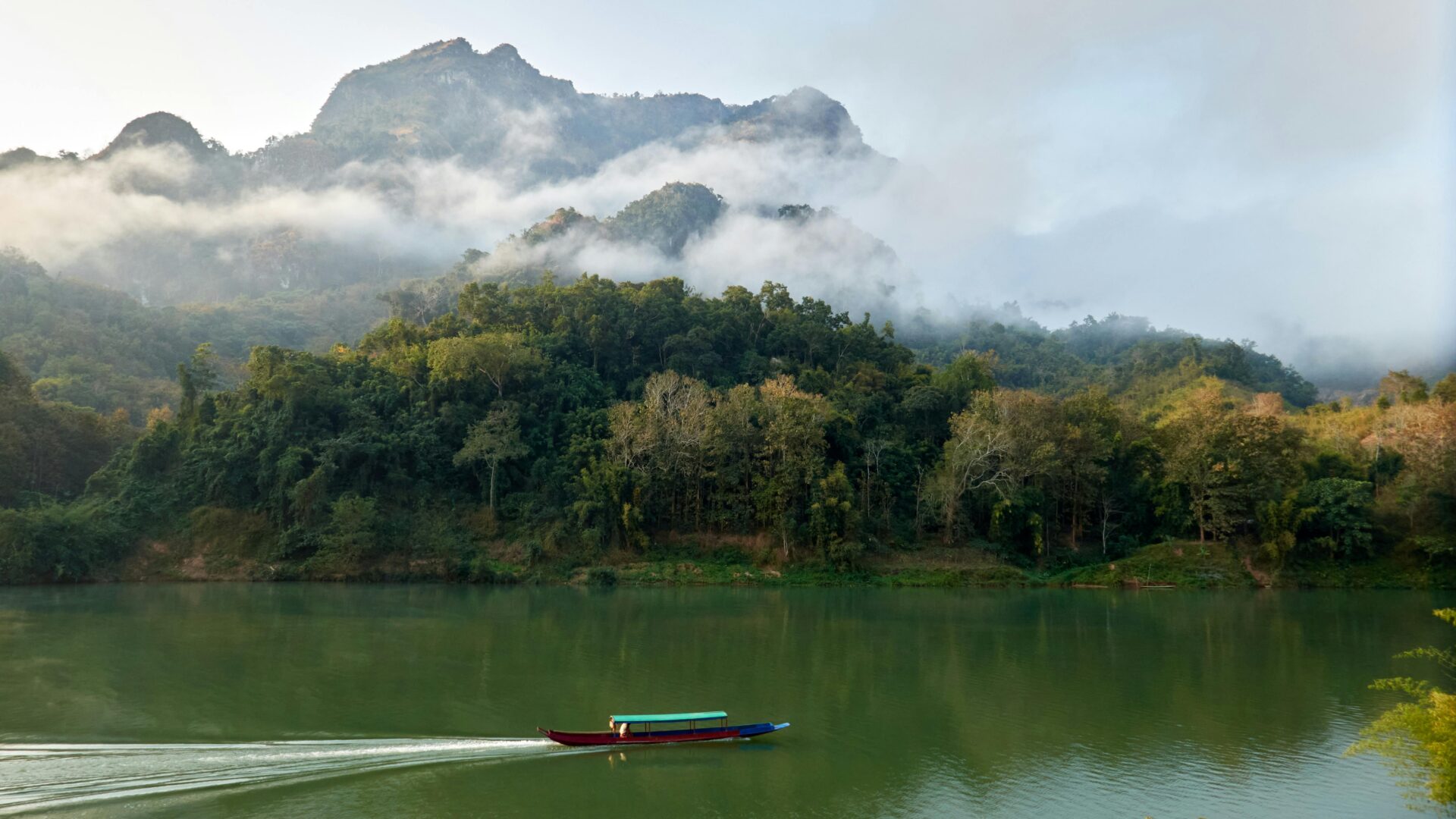
The Mekong in this section runs through forested limestone hills. Villages appear on the banks every hour or two — fishermen pulling nets, children waving from the steps, the occasional buffalo standing in the shallows. The forest comes to the water’s edge in the less settled sections. Monks in small wooden boats cross from one bank to the other. The light changes throughout the day — morning mist on the water, midday glare off the current, late afternoon gold that turns the river amber.
The other passengers are the company. The slow boat has been a backpacker rite of passage for 30 years. The Pak Beng guesthouses fill with the same people for one night — dinner, a few drinks, a 8am departure the following morning.
The practical guide:
From Chiang Khong (Thailand): cross the Mekong by the fourth Thai-Lao Friendship Bridge to Huay Xai on the Lao side. Get visa on arrival. Walk 5 minutes to the slow boat pier.
Tickets: from the ticket office in Huay Xai, directly to the pier, or through guesthouses in Chiang Khong. £20-25 for the two-day passage to Luang Prabang, including the overnight stop in Pak Beng (accommodation separate — £8-15/night at Pak Beng guesthouses, book at the pier on arrival).
Departs: 11am from Huay Xai (Day 1), arriving Pak Beng around 5-6pm. Departs Pak Beng 9-10am (Day 2), arriving Luang Prabang around 5-6pm.
The alternative: Speedboat from Huay Xai to Luang Prabang in 6-7 hours. Faster. Significantly less comfortable (the speedboats are narrow fibreglass crafts that bounce over the Mekong at 70km/h). The slow boat is better. Take the slow boat.
Nong Khiaw and the Nam Ou River
Four hours north of Luang Prabang by public bus (£4, departs from the Northern Bus Terminal), or accessible by speedboat on the Nam Ou River (3 hours upstream, more expensive but the river scenery justifies it once).
Nong Khiaw is a small town straddling the Nam Ou River beneath a dramatic cliff — the limestone peaks rise directly from both banks, the river between them turquoise-green, the bridge connecting the two sides of town a viewpoint in its own right.
The town has 3,000 residents, a handful of guesthouses (from £8-15/night), a few restaurants, and almost nothing to do except exactly what you need to do when you’ve been in motion for two weeks. Walk across the bridge at dawn. Rent a kayak and paddle 3km upstream to a village for lunch. Hike up to the viewpoint above the Pha Tok caves (the cliff-face caves where local people sheltered during the US bombing campaign of the Vietnam War era — the caves are real, the history is heavy, the climb is 20 minutes).
The Nam Ou downstream from Nong Khiaw to Luang Prabang is navigable by slow boat (4-5 hours, the finest river scenery in northern Laos — book the morning boat from the pier below the bridge). The river passes through forest, villages, and several river narrows where the current quickens and the cliff walls close in on both sides.
Muang Ngoi Neua: a village accessible only by boat (45 minutes north from Nong Khiaw, no road, no ATM, limited electricity). Three guesthouses, a handful of restaurants, rice paddies backed by limestone peaks. The village receives enough visitors to sustain its guesthouses and not enough to lose its character. Stay one or two nights. Hike to the surrounding villages in the morning and read by the river in the afternoon.
This is the Laos pace at its most complete.
Vang Vieng — The Karst Town That Found Itself
Vang Vieng had a bad decade. In the early 2000s it developed a reputation as the party town of SE Asia — tubing down the Nam Song River with attached bars dispensing buckets, a clientele seeking specifically that, and an associated casualty rate that made the Lao government eventually close the tube bars. The town that remains is still transitioning from that identity but it’s getting there.
The landscape was always extraordinary. Vang Vieng sits in a valley of karst limestone peaks — the Nam Song River running through the valley floor, the peaks rising dramatically on both sides. It looks, from the air, like the idealised version of every karst landscape photograph you’ve seen. In person it looks like that too.
What to do in Vang Vieng:
Kayaking the Nam Song: the river is best at moderate flow (November to April). Half-day kayak trips downstream from above Vang Vieng to the town take 3-4 hours and pass through the finest stretch of karst scenery accessible from the town. Several operators run these; book the day before.
The Blue Lagoon: 10km north of town by bicycle or tuk-tuk (the bicycle journey on the road along the river is worth doing). A swimming hole beneath a cliff face — the water is cold, clear, and the cliff has a rope swing. Multiple Blue Lagoons are labelled on maps; Blue Lagoon 1 is the main one with the swing, easiest access. Blue Lagoon 3 (further up the road) is less visited and more beautiful. Entry: £1.50.
Hot air balloon at dawn: the balloon launched from the fields south of town drifts across the karst landscape at sunrise. Views over the valley and the peaks that rival Cappadocia in visual impact. Cost: £55-70. Weather-dependent. Book through operators in town.
Rock climbing: the limestone karsts above the valley have been developed by climbing operators for sport climbing over the past decade. Half-day instruction and climb: £25-35. Several established routes on the cliff faces north and south of town.
Tham Jang Cave: a cave complex above the river south of town, the local people sheltered here in the 19th century from Chinese bandit raids. Entry: £1.50. The view from the cave entrance over the karst valley is the reason to make the climb.
Where to stay: The guesthouses on the river road (Vang Vieng’s main accommodation strip) give morning views of the karsts from the breakfast terrace. Budget from £12-20/night. The party culture is genuinely fading — the backpacker guesthouses that remain oriented toward it are identifiable by the music after dark; avoid those and you’ll sleep.
Vientiane — The Quietest Capital in SE Asia
Vientiane is the capital of Laos and, with a metropolitan population of 800,000, the smallest capital city in Southeast Asia by some margin. It is also the most relaxed — a city that functions at a pace somewhere between a provincial town and a capital, where the evening traffic eases by 9pm and the riverside is quiet enough for conversation at a normal volume.
Most travellers pass through Vientiane briefly — it’s the entry or exit point for the Nong Khai/Thailand crossing, it has the best transport connections for the Plain of Jars and the south, and it doesn’t compete with Luang Prabang for atmosphere. One or two days is the right allocation.
The Morning Market (Talat Sao):
The covered morning market near the Presidential Palace is the best overview of Lao commercial life — electronics, clothing, silver jewellery, silk, and food stalls serving baguette sandwiches (the French legacy in practical form), noodle soup, and sticky rice with grilled chicken for breakfast. Open 6am-5pm but liveliest before 10am.
Pha That Luang:
The national monument of Laos — a gold-painted Buddhist stupa from 1566 (rebuilt multiple times following destruction by Burmese and Siamese armies and the French). The stupa is the dominant symbol on the Lao national seal and the image most closely associated with Lao national identity. Entry: £2. The surrounding grounds at dawn, before the tourist coaches, are worth the early alarm.
Wat Sisaket:
The only temple in Vientiane that survived the Siamese sacking of the city in 1828 intact. The cloister walls contain 2,052 Buddha images in individual niches, ranging from large to miniature. The textures and patinas of 200 years of accumulated incense and candlewax give the walls a richness that newer temples don’t have. Entry: £2.
COPE Visitor Centre:
A museum and rehabilitation centre for unexploded ordnance (UXO) victims in Laos — the country was subjected to more bomb tonnage per capita than any other in history during the US bombing campaign of 1964-1973 (more than 2 million tonnes, roughly equivalent to one planeload of bombs every 8 minutes for 9 years). 30% of those bombs failed to detonate and remain active across the country. COPE provides prosthetics and rehabilitation for those injured by UXO. The visitor centre is free, educational, and important context for understanding modern Laos. Recommended for any visitor.
The Mekong at Sunset:
The riverfront road (Fa Ngum Road) along the Mekong, with Thailand visible on the opposite bank, is the social venue of Vientiane in the late afternoon. Street food vendors set up along the embankment from 4pm. Buy a Beerlao from a stall, find a plastic chair facing the river, watch the sun go down over Thailand. This costs £0.80 and is the finest hour available in Vientiane.
The Plain of Jars — The Site Nobody Can Explain
The Xieng Khouang Plateau in northeastern Laos is a highland plain at 1,200m above sea level, studded with thousands of large stone jars. The jars range from 0.5 to 3 metres in height, made from sandstone, granite, and limestone. They are between 2,000 and 2,500 years old. Their purpose remains debated.
The leading theory is mortuary — the jars are believed to have been used as cremation vessels, with the remains of the cremated person then placed in secondary burial pits. Supporting evidence: excavations around several jars have found human bone fragments, stone lids, and secondary burial offerings. The culture that made them was contemporary with the Dong Son bronze culture of Vietnam but appears distinct in its funerary practices.
What is certain: no equivalent site exists anywhere else in Southeast Asia. The scale and number of the jars (approximately 2,100 identified in 90 sites across the plateau) indicate an organised, technically sophisticated society that quarried and transported enormous stones across a highland landscape — a society about which almost nothing else is known.
The UXO context:
The Xieng Khouang Plateau was one of the most heavily bombed areas of Laos during the Vietnam War — the town of Phonsavan (the modern capital of the province, 2km from the main jar sites) was largely destroyed and rebuilt, and the surrounding countryside is still contaminated with UXO from cluster munitions. The MAG (Mines Advisory Group) has cleared the main jar sites and established marked visitor paths. Stay on these paths without exception.
The bomb craters around many of the jar sites are visible from the viewing areas — some jars have been displaced or cracked by the bombing. The combination of 2,000-year-old archaeology and 1960s-70s ordnance contamination is a specific feature of the Plain of Jars that exists nowhere else.
The sites:
Three sites are open to visitors near Phonsavan:
Site 1 — the largest, with over 300 jars including the biggest (1.8m high, 3 tonnes), a short walk from the car park. The most visited and the best introduction.
Site 2 — smaller, on two adjacent hillsides, accessible by a path through rice paddies. Less visited, more atmospheric — the jars are distributed across the hillside in a way that makes their scale and arrangement clearer than Site 1’s flat field.
Site 3 — the remotest of the three, requiring a 20-minute walk across rice paddies from the nearest road. Often empty. The jars here are less numerous but the setting — a hillside above a working rice farming landscape, the Laos highlands spreading below — is the finest of the three.
Entry: £3.50 for all three sites combined. Most travellers visit with a tuk-tuk or hired driver from Phonsavan (£20-30 for the half-day circuit).
Getting to Phonsavan:
Flight from Vientiane (1 hour, from £55 one way) or bus (11 hours from Luang Prabang, rough mountain road — the flight is worth it). Return flight to Luang Prabang: from £45.
4,000 Islands (Si Phan Don) — Where the Mekong Spreads
At the southern tip of Laos, near the Cambodian border, the Mekong spreads across a floodplain 14km wide, creating approximately 4,000 islands (the name is not hyperbole — it reflects the actual count during dry season). The water between the islands is the widest point of the Mekong in its entire length and during flooding season the whole plain is under water.
Two islands have guest houses and tourist infrastructure:
Don Det:
The backpacker island — connected to Don Khon by a French colonial railway bridge from 1902 (the train line that connected the two islands was built to bypass the Khone Phapheng falls, the largest waterfall by volume in Asia, which made the river impassable for cargo boats). Don Det has guesthouses in hammocks literally over the water, the cheapest beer in Laos, a handful of restaurants, and almost no mobile signal. The correct approach: rent a bicycle (£1.50/day), cycle the island circuit (2 hours at a relaxed pace), find the quietest river beach, stay two days.
Don Khon:
Quieter and slightly more characterful than Don Det. The French colonial infrastructure (the railway ruins, the bridge between the islands, the colonial-era administrator’s house turned guesthouse) gives it a different texture. The western shore gives the best views of the Khone Phapheng falls.
The Irrawaddy Dolphin:
A small pod of Irrawaddy dolphins (Orcaella brevirostris) lives in the deep-water channels between the islands — one of the last freshwater populations of this species on earth. The pod has approximately 10 individuals and is critically endangered. Boat trips to the dolphin viewing area depart from Don Khon’s southern shore (£5/boat, shared). The dolphins surface regularly to breathe and are visible at distance without approaching closely. Critically endangered means exactly that — this species may be gone from this stretch of river within a generation.
Khone Phapheng Falls:
The largest waterfall in Asia by volume — the Mekong drops approximately 21 metres across a width of several kilometres at the Cambodian border. The falls are accessible from Don Khon by bicycle (30 minutes along the southern shore) or from the eastern shore of the Mekong near Nakasong village (15 minutes by tuk-tuk from the mainland jetty). Entry: £2. The viewpoint gives the full width of the falls — impressive at any time of year, extraordinary during high water in August-September.
The Crossing to Cambodia:
From the Si Phan Don mainland port (Nakasong), regular boats cross to the Cambodian border village of Voen Kham — then a bus to Stung Treng and onward to Siem Reap or Phnom Penh. A shared minivan from Don Det to the border crossing: £8-12/person.
Hidden Laos — The Corners Worth the Detour
The Bolaven Plateau
A high volcanic plateau in southern Laos — the fertile region where most of Laos’s coffee, tea, and vegetables are grown. The plateau sits at 1,200m, making it cooler than the surrounding lowlands, and is scattered with waterfalls where the plateau edge drops away: Tad Fane (the most dramatic, a twin waterfall dropping 120m into a gorge), Tad Yuang (accessible and swimmable), Tad Lo (a village and guesthouse complex below a smaller falls). The coffee produced here — the Bolaven Plateau Arabica — is some of the finest in SE Asia.
The classic Bolaven circuit: rent a motorbike in Pakse (the nearest city, 5 hours by bus from Vientiane), cover the plateau circuit over 2-3 days (300km total), stopping at the falls and the coffee farms. The roads are good. The coffee is extremely good.
Luang Namtha and the Nam Ha NPA
The northern hill country near the Chinese border — the Nam Ha National Protected Area is one of the few places in Laos with functioning community ecotourism. The local Trek Operator Association organises 2-3 day trekking circuits through Akha, Khmu, and Lenten villages, sleeping in village guesthouses. The guides are community members. The income stays in the community.
The trek is not a luxury experience — it’s a genuine walk through working hill tribe territory, staying in simple wooden guesthouses and eating whatever the family cooks. It is also one of the more authentic community tourism experiences available in SE Asia.
Pak Ou Caves
25km north of Luang Prabang by boat (1 hour upstream, or by longtail from the main pier at £5-8 for the boat) — two caves at the mouth of the Nam Ou River, filled with thousands of Buddha images placed there over centuries by worshippers. The lower cave is entered from the river level; the upper cave requires a short climb. The images range from tiny figurines to life-size statues, some ancient and faded, some new and vivid. The setting — the cave mouths in a limestone cliff above the confluence of two rivers — is as affecting as the contents.
What It Costs — Real Numbers
Laos is one of the cheapest countries in SE Asia. The currency (Lao Kip) has very low individual value — you’ll carry large numbers that translate to small amounts in pounds.
Daily Budgets
Budget (£18-28/day)
- Accommodation: guesthouse private room (£7-15/night)
- Food: local restaurants, noodle soup, sticky rice with grilled meat (£4-7/day)
- Transport: tuk-tuks, local buses, bicycles
- Activities: temple entries, market visits, hiking
Mid-range (£35-50/day)
- Accommodation: boutique guesthouse or small hotel (£18-30/night)
- Food: mix of local restaurants and tourist cafes (£8-14/day)
- Transport: private tuk-tuks for day trips, internal flights where justified
- Activities: slow boat, kayaking, cooking class
Comfortable (£65-85/day)
- Accommodation: upmarket Luang Prabang guesthouses or river lodge (£40-60/night)
- Food: quality restaurants (£15-25/day)
- Activities: hot air balloon, guided treks, boat charters
What 14 Days in Laos Actually Costs from the UK
| Category | Budget | Mid-Range |
|---|---|---|
| Flights to Bangkok or Hanoi (nearest hub) | £450–650 | £550–750 |
| Visa on arrival | £25–35 | £25–35 |
| Slow boat (Huay Xai → Luang Prabang) | £22 | £22 |
| Internal flights (Luang Prabang → Phonsavan) | £55 | £55 |
| 14 nights accommodation | £100–210 | £280–420 |
| Food (14 days) | £60–105 | £115–200 |
| Activities and transport (tuk-tuks, kayaking, temple entries) | £45–80 | £80–130 |
| Total | £757–1,157 | £1,127–1,612 |
Laos is one of the most affordable international trips accessible from the UK. The total cost is competitive with a week in Greece.
Eating in Laos — The Food That Surprises
Lao food is the least known of the Mainland SE Asian cuisines internationally and one of the most interesting. It shares ingredients with Thai cooking (lemongrass, galangal, kaffir lime, fish sauce) but uses them differently — less sweet, more herb-forward, with a specific reliance on fermented fish paste (padek) as a flavour base that gives Lao food a depth and funk that Thai food typically avoids.
The Dishes Worth Seeking
Sticky Rice (Khao Niao)
The staple of Lao cuisine. Not a side dish or accompaniment — sticky rice is the carbohydrate foundation of every Lao meal, eaten from a woven bamboo basket (tiep khao), pinched off in small amounts, rolled into balls, used to scoop up other dishes. Lao people eat it three times a day. The variety grown in the Luang Prabang region is considered the finest in the country. In the morning at the Phousi market: sticky rice with grilled chicken (ping gai), which has been marinated in lemongrass and turmeric, is £0.80 and the finest breakfast available in northern Laos.
Laap
The national dish. Minced meat (chicken, pork, buffalo, fish — or raw in the traditional version) mixed with toasted rice powder, fresh herbs (mint, spring onion, coriander), lime juice, fish sauce, and dried chilli flakes. The texture is dense and the flavour intense — the toasted rice powder gives it a specific nuttiness that distinguishes it from Thai larb (the Thai version, slightly different in spice profile). Eaten at room temperature, scooped up with sticky rice. Available at any local restaurant; the version at roadside stalls tends to be more authentic than in tourist restaurants.
Or Lam
A slow-cooked stew from Luang Prabang — the most specifically Luang Prabang dish in the Lao repertoire. Vegetables, meat (often buffalo), dried wood ear mushroom, and sakhan pepper (a wild pepper from the forests around the city, with a slightly numbing quality similar to Sichuan pepper but distinct). The stew has an earthy, complex flavour that rewards the hour it takes to make. Several restaurants in Luang Prabang serve it as a lunch special.
Khao Piak Sen
Rice noodle soup — the Lao equivalent of pho, eaten for breakfast throughout the country. A clear broth with thick rice noodles, sliced meat, and fresh herbs. The broth is clear rather than the complex reduced stock of Vietnamese pho but deeply flavoured. At any noodle stall from 6-9am: £0.80-1.20 for a full bowl.
Mok Pa
Fish steamed in banana leaf with lemongrass, galangal, and kaffir lime — the Lao version of a technique used across SE Asia but specific here in the balance of herbs. The banana leaf imparts a faint green flavour to the steam. The fish comes out intact in the parcel. Available at restaurants throughout the country; the freshwater fish version (from the Mekong) is the traditional preparation.
Beerlao
Laos’s national beer, brewed in Vientiane since 1971 and consistently rated one of the finest lagers in SE Asia. The original lager (the green bottle) is the reference. The dark version (Beerlao Dark, a Munich dunkel-style) is available in Luang Prabang and Vientiane and is genuinely excellent. A large bottle at any restaurant: £0.80-1.20. On the slow boat: buy one at Pak Beng and drink it watching the river.
Lao Coffee
The Bolaven Plateau Arabica is a genuinely excellent single-origin coffee — grown at altitude in volcanic soil, distinctly fruity, available in most cafes in Luang Prabang and Vientiane. The traditional preparation (drip coffee through a muslin sock, served with sweetened condensed milk over ice) is the local version. Order it black if you want to taste the Arabica; order it with condensed milk if you want the classic Lao café experience.
Practical Notes
Visa: On arrival at all international airports and major land border crossings. 30 days. Cost: approximately £25-35 (varies by nationality — check the Lao Embassy website before travel). E-visa available at laoevisa.gov.la for £32, valid for 30 days — book online before crossing by land to avoid queues.
Getting there: No direct flights from the UK. Fly to Bangkok (Thai Airways, British Airways, EVA Air — from £450-650 return) and cross overland, or fly to Hanoi (Vietnam Airlines, Qatar Airways — from £480-680 return) and cross overland from Vietnam. Internal Lao Airlines flights connect Vientiane, Luang Prabang, Pakse (south), and Phonsavan (Plain of Jars).
Currency: Lao Kip (LAK). £1 ≈ 25,000 LAK at time of writing. The exchange rate means you carry large numbers — a £20 note exchanges to around 500,000 kip, which feels like a lot and is not. Thai Baht and USD are also widely accepted in tourist areas and at border crossings. ATMs in Luang Prabang and Vientiane are reliable; ATMs are absent in Nong Khiaw, Muang Ngoi Neua, and the 4,000 Islands — carry cash before heading to these areas.
Getting around: The public bus network connects major cities but journey times are long and the mountain roads can be rough. The main practical options: slow boat on the Mekong (Huay Xai to Luang Prabang), local buses for Luang Prabang to Vang Vieng (4 hours, £4-6) and Vang Vieng to Vientiane (4 hours, £4-6), and domestic flights for the Plain of Jars and the south. Minivan services connect tourist centres faster than public buses. Tuk-tuks for in-town transport: negotiate a price before getting in (£1-3 for most town trips).
Language: Lao — a tonal language of the Tai-Kadai family, related to Thai. English is spoken in tourist-facing businesses in Luang Prabang and Vang Vieng. Outside these areas and in the south, English is minimal. French is a second language for older Laotians (the colonial legacy). “Sabaidee” (hello), “Khob chai” (thank you), “Phet boh?” (spicy or not?) — the basics get you far.
Getting a SIM: Unitel and Lao Telecom both offer tourist SIMs at Vientiane airport. A 30-day SIM with 5-10GB data costs £4-7. Coverage is good in cities and along the Mekong route; absent in remote areas. Download offline maps before departure for the Bolaven circuit and northern hill country.
Health: Standard SE Asia precautions: mosquito repellent (dengue is present), bottled water, standard food hygiene awareness. The UXO contamination is the specific Lao consideration — stay on marked paths at the Plain of Jars and in all rural areas, do not touch any metal objects found in the ground or scrubland.
The 14-Day Itinerary — The Route That Works
This route runs north-to-south through the country, entering from Thailand via the slow boat and exiting to Cambodia or Vietnam at the southern border. It covers the essential Laos without backtracking and with the slow pace the country rewards.
Days 1-2: Slow Boat (Huay Xai → Pak Beng → Luang Prabang)
Day 1: Cross from Chiang Khong (Thailand) to Huay Xai. Board the slow boat by 11am. Arrive Pak Beng by 5:30pm. Dinner at the guesthouse. Night at Pak Beng.
Day 2: Slow boat departs 9am from Pak Beng. Arrive Luang Prabang by 5:30pm. Walk to the nearest riverside restaurant. Sleep.
Days 3-5: Luang Prabang
Day 3: 5:30am — alms ceremony (from a respectful distance). Phousi market 6:30am for breakfast. Wat Xieng Thong at 6am (second morning if preferred). Royal Palace Museum mid-morning. Night market evening.
Day 4: Kuang Si Falls (tuk-tuk at 8am, arrive 8:45am — beat the crowds to the lower pool). Return for lunch. Mount Phousi sunset.
Day 5: Bicycle to Ban Xang Khong (weaving village, 3km south). Pak Ou Caves by boat (morning trip upstream). Luang Prabang’s best dinner (Tamnak Lao restaurant for or lam and laap — book ahead).
Days 6-7: Nong Khiaw
Day 6: Morning bus to Nong Khiaw (4 hours, £4). Check in. Walk the bridge at dusk.
Day 7: Pha Tok caves morning hike (2 hours return). Afternoon: kayak upstream to the nearest village and back. Evening at the river.
Day 8: Nong Khiaw to Vang Vieng (via Luang Prabang)
Bus back to Luang Prabang (4 hours). Bus to Vang Vieng (4.5 hours). Arrive evening.
Days 9-10: Vang Vieng
Day 9: Blue Lagoon by bicycle (morning). Nam Song kayaking (afternoon).
Day 10: Hot air balloon at dawn (book the night before). Rest afternoon. Dinner with the karst views.
Day 11: Vang Vieng to Vientiane
Bus to Vientiane (4 hours, £4-6). Afternoon: Pha That Luang, Wat Sisaket. COPE Visitor Centre. Mekong riverfront at sunset.
Day 12: Vientiane to Phonsavan (fly)
Morning flight to Phonsavan (1 hour, £55). Afternoon: Plain of Jars Sites 1, 2, and 3 by tuk-tuk. Stay in Phonsavan.
Day 13: Phonsavan to Pakse (fly)
Morning: remaining jar sites or the UXO information centre in Phonsavan. Afternoon flight to Pakse (via Vientiane, 2.5 hours with connection). Arrive Pakse. Bolaven Plateau one-night extension option.
Day 14: Pakse to 4,000 Islands to Cambodia
Morning bus south to Nakasong pier (3 hours, £4). Ferry to Don Det. Half-day at the 4,000 Islands. Cross to Cambodia by evening boat and bus — arrive Stung Treng, Cambodia for the night. Or return north to Vientiane for an international flight.
Final Thought
I was on the slow boat on the second day, an hour from Luang Prabang. The river had narrowed slightly as the hills closed in from both sides. Someone further down the boat had put music on their speaker and someone else had politely asked them to stop, and they had.
The only sounds: the engine, the water against the hull, the occasional call of something in the forest on the bank.
A white egret landed on a sandbank 20 metres from the boat. It stood completely still as we passed, watching us watch it, then returned to whatever it had been doing.
Laos gives you this constantly. The space for things to be ordinary and extraordinary simultaneously. A bird on a sandbank. A river you’ve been on for two days. The sense that you could stay on this boat indefinitely and it would be fine.
Most people skip it. Most people go back.
Question about Laos this guide doesn’t cover? Drop it in the comments.