

The complete guide for UK travellers: El Nido’s enclosed lagoons, Batad’s 2,000-year-old rice terraces done properly, Siargao for non-surfers as well as surfers, Vigan’s cobbled colonial streets, the Chocolate Hills explained, the island-hopping routing question answered, and the honest truth about getting there from the UK.
Reading time: 16 minutes | Last updated: 2026
The Philippines has 7,641 islands. Most travel content covers four of them.
Those four are: Palawan (specifically El Nido and Coron), Boracay, Siargao, and Cebu. All of them deserve their profiles. None of them is the whole picture of a country that contains rice terraces carved into mountains 2,000 years ago, colonial cities from the 16th century that look like nowhere else in Asia, an active volcano with a symmetrical cone so perfect it appears in every textbook on volcanic geology, the world’s smallest primate, and a diving environment that includes one of the most biodiverse reef systems on Earth.
This guide covers the four famous ones properly. It also covers the rest — the Batad amphitheatre, the Vigan cobblestones, the Chocolate Hills from the right viewpoint at the right time, the underground river through limestone karst that extends 8.2km beneath the forest.
The honest opening note: the Philippines is not a short flight. There are no direct flights from the UK. The best routing is 16-20 hours via a Gulf hub or Singapore, and the country’s geography — islands spread across an area the size of Japan — means internal travel requires planning. This puts it in a different category from Thailand or Vietnam and it’s worth saying clearly: the Philippines rewards the traveller who plans ahead and gives it two weeks minimum. One week is too short to do it justice.
Two weeks is the beginning of understanding it.
Quick Navigation
- The Case for the Philippines — What the Country Actually Contains
- When to Go — The Regional Weather Splits
- Getting There and Getting Around
- Manila — The Transit Hub That Deserves More
- Palawan — El Nido, Coron, and the Underground River
- El Nido — The Lagoons and the Islands
- Coron — The Wrecks and the Lakes
- The Puerto Princesa Underground River
- Bohol — Chocolate Hills and Tarsiers
- Siargao — Cloud 9 and the Non-Surfers’ Island
- The Batad Rice Terraces — The Ifugao Amphitheatre
- Vigan — The Spanish Colonial City
- Cebu and Malapascua — Thresher Sharks at Dawn
- The Visayas — Leyte, Samar, and Camiguin
- What It Costs — Real Numbers
- Eating in the Philippines — The Actual Food
- Practical Notes
- Two Itineraries — Two Weeks and Three Weeks
The Case for the Philippines — What the Country Actually Contains
Seven thousand six hundred and forty-one islands. Seventeen regions. Three main island groups (Luzon in the north, Visayas in the centre, Mindanao in the south). The northernmost island is closer to Taiwan than to Mindanao. The easternmost islands are almost in the Pacific. The country spans 1,850km from north to south.
Within that geography:
Palawan — the Long Island, northwest of the main archipelago, running 450km from north to south with an interior of limestone karst, an underground river UNESCO-listed as a World Heritage Site, and the bay around El Nido where limestone towers rise from the South China Sea enclosing lagoons of completely clear water.
The Cordillera — the mountain spine of northern Luzon, where the Ifugao people carved rice terraces into the mountain hillsides over 2,000 years, creating an agricultural system of such engineering sophistication that UNESCO listed it as a World Heritage Landscape. The terraces at Batad are the most dramatic.
The Visayas — the central island group where Cebu, Bohol, and Leyte sit. Bohol’s Chocolate Hills (1,268 conical limestone mounds, turning brown in the dry season). The thresher shark dive at Malapascua (one of the most reliable encounters with these open-ocean sharks available anywhere in the world). The historical weight of Leyte, where the largest naval battle in history was fought in 1944.
Siargao — a teardrop-shaped island in the southeast with the finest surf break in the Philippines and, for non-surfers, lagoons and mangrove channels and the specific unhurried quality of an island whose infrastructure developed around surfing rather than mass tourism.
Mindanao and the far south — complex, parts subject to Foreign Office travel advisories, containing also some of the finest marine environments in the country (Tubbataha Reef, accessible only by liveaboard from Puerto Princesa, is one of the finest dive sites in the world). Research the current situation before planning.
When to Go — The Regional Weather Splits
The Philippines has a climate system that requires regional understanding. The country is large enough that the northeast monsoon and the southwest monsoon affect different parts differently.
The Simple Version:
The Philippines has a dry season (roughly November-May) and a wet season (June-October). This is true as a generalisation. The regional reality:
Palawan (El Nido, Coron): Best November to May. The dry season here is pronounced and reliable. El Nido in June-October gets the tail of the southwest monsoon — seas can be rough, boat tours are cancelled in storms. The underground river and Puerto Princesa are less affected. Go November-April.
The Visayas (Cebu, Bohol, Siargao): More complex. The Visayas are somewhat sheltered from the southwest monsoon by the main Luzon landmass, but typhoon season (June-November) brings occasional direct hits. Bohol and Cebu are driest February-May. Siargao’s best surf is August-November (typhoon swell). For non-surfers, March-June is calmer. Best: February-May for Bohol and Cebu; August-November for Siargao surf.
Northern Luzon (Batad rice terraces, Vigan): The Cordillera highlands have their own microclimate. The terraces are at their greenest June-August (planting season) and harvest gold in September-October. Vigan is accessible year-round. Go September-October for harvest gold terraces; June-August for green.
The Overall Recommendation:
November to April covers Palawan and the Visayas most reliably. If combining with Batad, aim for October (harvest terraces, Palawan still dry). The country is large enough that you’ll likely encounter variable weather regardless of when you go — the dry season is a probability, not a guarantee.
Typhoon Awareness:
The Philippines experiences 20 typhoons per year on average. The typhoon season (June-November) doesn’t mean constant typhoons but does mean higher probability. Most typhoons are tracked with several days warning. The eastern coast (Leyte, Samar, east Siargao) is statistically more typhoon-exposed than the western coast (Palawan). Check weather forecasts throughout your trip during typhoon season.
Getting There and Getting Around
From the UK:
No direct flights. The best routings:
Via the Gulf: Emirates via Dubai (£550-800 return to Manila, flight time approximately 16 hours total including connection), Qatar Airways via Doha, Etihad via Abu Dhabi. All offer good connection times and a reliable product.
Via Singapore: Singapore Airlines or Scoot (budget subsidiary) to Singapore, then Cebu Pacific or Philippine Airlines to Manila or Cebu directly. The Singapore stopover can be 2-3 hours (connection only) or 24-48 hours (a Singapore stopover trip). The latter is worth considering — Singapore is an extraordinary city and a natural break in a long journey.
Fly into Cebu (CEB) rather than Manila (MNL) if your itinerary begins in the Visayas or Siargao — it saves the Manila transit entirely. Fly into Manila if beginning in Palawan or northern Luzon.
Between Islands:
The Philippines is an archipelago. Getting between islands is either by domestic flight or by ferry, and the choice depends on distance and time.
Domestic flights: Cebu Pacific Air and AirAsia Philippines cover the main routes. Manila to Puerto Princesa (Palawan): 1 hour 20 minutes, from £25-50. Manila to Cebu: 1 hour 10 minutes, from £20-40. Manila to Siargao (via Cebu): 2 hours total including connection. Manila to Laoag (for Vigan): 1 hour, from £25-45. Book 3-4 weeks ahead in peak season.
Ferries: the 2GO Travel network connects Manila to Cebu, Iligan, Cagayan de Oro, and other southern ports. Overnight ferries (Manila to Cebu: 22 hours) are significantly cheaper than flights (£15-25 for a cabin berth) and give the experience of the sea crossing. Practical for budget travellers with time; less so for time-limited trips.
Island boats: between smaller islands (Coron to El Nido, island-hopping in the Visayas), speedboats and banca (outrigger canoes) are the standard transport. El Nido to Coron: 4-hour speedboat (the Epic Fast Ferry, from £22). El Nido to Puerto Princesa: 5-hour van, or 1-hour domestic flight.
The Open-Jaw Solution:
Fly into Manila (or Cebu), exit from a different city — Manila out and Cebu in, or Cebu out and Manila in. Open-jaw tickets from the UK (fly into one Philippine city, fly home from another) are often the same price or marginally more than returns and eliminate significant internal backtracking.
Manila — The Transit Hub That Deserves More
Manila has a reputation that is primarily deserved and should not be the whole story. The city of 14 million is chaotic, traffic-dense, and sprawling — the kind of megacity that overwhelms before it engages. The EDSA highway at rush hour is one of the finest arguments for public transport ever assembled in gridlock form.
Most travellers transit through Manila in a day and continue south or north. This is reasonable. One day done correctly gives the city enough time to present its better arguments.
Intramuros:
The Spanish colonial walled city — built from 1571, the original seat of Spanish colonial government, surrounded by 4.5km of stone walls that still stand. Fort Santiago at the northern end: a 16th-century fortress where José Rizal, the Philippine national hero, was imprisoned before his execution in 1896. The Rizal Shrine inside the fort has the execution garments and the final letters. The walls of the fort are walkable, the view over the Pasig River and Manila Bay beyond.
The San Agustin Church — the oldest stone church in the Philippines (1607), survived the earthquakes, the Dutch bombardment, the Japanese occupation, and the 1945 Battle of Manila. UNESCO-listed. Still an active parish. The interior has original ceiling frescoes from 1875 that are the finest in Manila.
Binondo (Chinatown):
The world’s oldest Chinatown, established 1594. The food here — specifically the morning dim sum at Estero de Binondo and the mami noodle soup at the hole-in-the-wall shops on Ongpin Street — is the finest cheap breakfast in Manila. Walk the area before 9am when the market vendors are setting up and the dim sum is fresh and the streets smell of sesame oil and jasmine garlands.
The Bay at Sunset:
Manila Bay’s sunset has been legendary since the Spanish colonial period — the bay faces west, the horizon unobstructed over the South China Sea, the sky turning orange and pink and occasionally purple as the sun goes into the water. The Roxas Boulevard promenade, the Manila Hotel terrace, or simply a plastic chair and a San Miguel from any of the bayfront vendors. Free, and better than the city’s reputation suggests.
Palawan — El Nido, Coron, and the Underground River
Palawan is the westernmost major island of the Philippines — a long, narrow island running northeast-southwest, forested, limestone-karst-dense, with the South China Sea on both sides in different configurations. It’s the least developed of the country’s major tourist islands and the most consistently cited by travellers as the finest. Both of these things are related.
El Nido — The Lagoons and the Islands
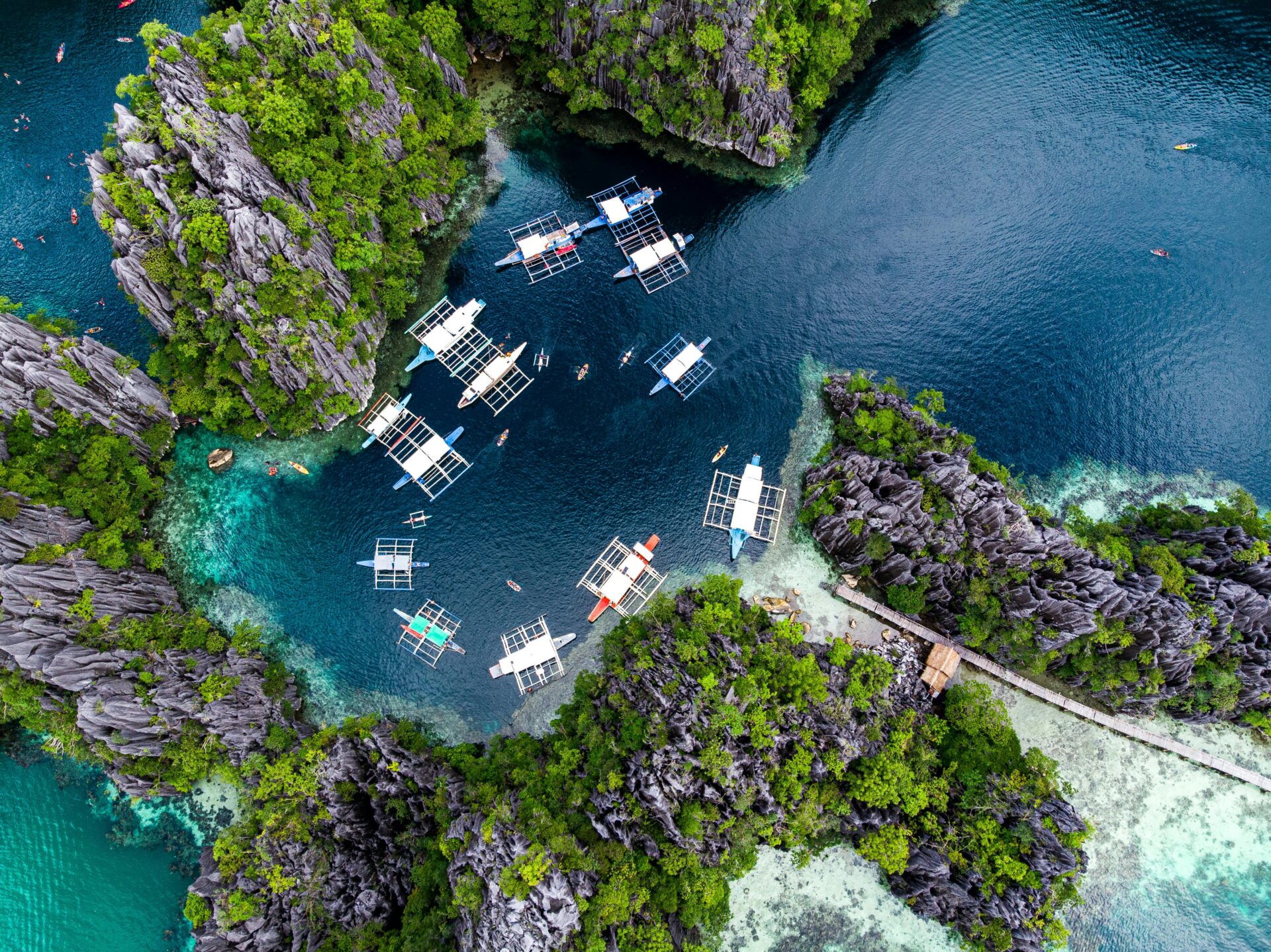
El Nido is a small town at the northern tip of Palawan, approximately 6 hours north of Puerto Princesa by van (£8-12) or 1 hour by domestic flight. The town sits in a bay of limestone karsts — towers of vertical rock rising from the water — with the Bacuit Archipelago spreading north and west.
The island-hopping tours:
The core El Nido experience is the island-hopping circuit. Four designated tours (A, B, C, D) cover different areas of the archipelago on half or full days. Each tour visits three to five stops: lagoons, beaches, snorkelling spots, mangrove areas. Boats are shared (typically 8-12 passengers) and run throughout the day.
Tour A — the most famous and most visited. Includes the Big and Small Lagoons (accessible only by kayak through a narrow gap in the limestone — the enclosed sea inside is the archetypal El Nido image), Shimizu Island (snorkelling), and Secret Lagoon (a small beach enclosed by a crack in the rock). The Big Lagoon at 7am, before the day-trip boats arrive from El Nido town, is one of the finest places in the Philippines. Entry to the lagoons: included in the tour.
Tour C — the best snorkelling tour. Covers Snake Island (a sandbar connecting two karsts at low tide), Matinloc Island (ruins of a shrine on a cliff, the most dramatic snorkelling in the archipelago — the coral and fish density is the highest of the four tours), and Helicopter Island.
The tours cost £15-22/person including lunch, booked directly from the operators on the main beach road in El Nido town the evening before. No need to book from the UK.
The crowds question:
El Nido has been on the “underrated” list long enough that it’s now simply “rated.” Peak season (December-March) sees significant boat traffic on the tour A route — the Big Lagoon can have 20 boats simultaneously during mid-morning. The solution: book the first boat of the day (depart 8am) rather than the standard 9am departure. At 8am, you arrive at the Big Lagoon 45 minutes ahead of the following boats.
Accommodation:
El Nido town (Sibaltan Road and the beach road): guesthouses from £12-25/night private room. The town has good food options, reasonable beach bars, and the typical traveller economy of a well-established beach destination. Nacpan Beach (25 minutes north by tricycle): quieter beach accommodation from £20-40/night — the right choice for travellers who want the El Nido experience without the town’s noise level.
Coron — The Wrecks and the Lakes
Coron is on the island of Busuanga, north of mainland Palawan and separate from El Nido. The journey between them: a 4-hour speedboat (from £22, operated by Epic Fast Ferry and others, runs daily in season) or a 5-6 hour bangka through the islands (cheaper, slower, more scenic).
Coron is primarily a diving destination — specifically for the Japanese WWII shipwrecks that were sunk by US aircraft in September 1944. The Coron wrecks include a gunboat, a supply ship, and several cargo vessels — all at depths between 10 and 40 metres, accessible to Open Water divers, covered in years of coral growth. The Olympia Maru is the most famous: a 132-metre cargo ship at 23 metres depth with intact machinery and cargo holds. A day of wreck diving from Coron: £60-90 including equipment.
For non-divers: the Kayangan Lake (the clearest lake in the Philippines, accessible by a 10-minute hike over a ridge from the bay below — entry £3), Barracuda Lake (a thermal lake with a halocline — a thermocline layer where warm saltwater sits beneath cooler fresh water, creating a visible optical boundary as you swim through it), and the Twin Lagoon (a mangrove lagoon connected to a hidden inner lagoon through a rock gap swimmable only at certain tide levels).
The island-hopping tours from Coron cover the lakes and lagoons and are bookable through the operators on the Coron town waterfront: £18-25/person.
The Puerto Princesa Underground River
UNESCO World Heritage Site and one of the New Seven Wonders of Nature: an 8.2km underground river navigated by paddle boat through limestone cave chambers. The river emerges into a bay on the west coast of Palawan, accessible 80km north of Puerto Princesa city by van (2 hours, included in most tour packages).
The caves contain stalactites and stalagmites of extraordinary scale — chambers large enough to fly a small aircraft through, formations that have been growing for millions of years. The river section open to tourists covers approximately 1.5km of the full underground length (the deeper sections require specialist equipment). The experience: sitting in a paddle boat in complete darkness except for the guide’s torch, the bat colony disturbed overhead, the sound of water and the echo of the caves.
Entry by permit only (total daily visitors capped to protect the ecosystem). Book through the Puerto Princesa Underground River Booking Office (sabang.ph) or through a Puerto Princesa tour operator at least 2-3 days ahead in peak season, more in December-January. Tours from Puerto Princesa: £25-35/person including transport and permit.
Bohol — Chocolate Hills and Tarsiers
Bohol is a circular island in the Visayas, 2 hours by fast ferry from Cebu (from £10) or 1 hour by domestic flight. The island has two UNESCO listings pending and two attractions that are genuinely unlike anything else in the Philippines.
The Chocolate Hills
1,268 conical limestone mounds, distributed across 50 square kilometres of the central Bohol interior. Each hill is between 30 and 120 metres high, covered in grass that turns brown in the dry season (March-May) — creating the “chocolate” appearance that gave them their name. In the wet season (June-November) they’re vivid green.
The geology: the hills were formed from marine limestone deposited in a shallow sea millions of years ago, then uplifted and shaped by weathering into their current conical forms. The regularity of the shape — remarkably consistent across 1,268 hills — is what makes them look artificial. They’re not.
The viewpoint: The main viewing area at Carmen (2.5 hours from Tagbilaran, the provincial capital). The viewpoint tower gives the panorama — hills to every horizon, the pattern repeating until it becomes abstract. Go at 7am before the tour buses. The afternoon light (4-5pm, from the eastern side) is better for photography than the morning light from the standard western viewpoint — a detail that requires some independent transport to execute.
The snail-paced route: Rent a motorbike in Tagbilaran (£10-15/day) and ride the Chocolate Hills circuit independently — stopping at the Carmen viewpoint, then continuing to the smaller viewpoints on the ridge roads beyond. The hills from the roads between them (rather than from the viewpoint above them) give a different sense of scale.
The Philippine Tarsier
The Philippine tarsier (Carlito syrichta) is one of the world’s smallest primates — about the size of a man’s fist, enormous round eyes (the largest relative to body size of any mammal), the ability to rotate its head 180 degrees. It’s nocturnal, weighs 80-160 grams, and clings to branches in forest undergrowth.
The welfare question: Tarsier sanctuaries vary in quality. The Philippine Tarsier Foundation sanctuary at Corella (20 minutes from Tagbilaran) is the reference standard — a semi-wild sanctuary where tarsiers live in their natural environment, enclosed within a forested area, visible but not disturbed. The guides maintain distance and prohibit flash photography (tarsiers’ enormous eyes are extremely light-sensitive).
Some roadside “tarsier exhibits” handle the animals — avoid these. The semi-wild sanctuary experience (tarsiers clinging to branches at head height, unposed, doing exactly what they’d do in the wild) is extraordinary without any handling required.
Entry: £2.50. Allow 30 minutes.
The Loboc River:
A calm brown river running through tropical forest south of Carmen. The tourist lunch cruise (floating restaurant, Filipino buffet, bamboo music) is an established and broadly pleasant experience. More interesting: rent a kayak from Loboc village (£4/hour) and paddle upstream through the forest independently. The birdlife along the Loboc is among the finest in Bohol.
Siargao — Cloud 9 and the Non-Surfers’ Island
Siargao is a teardrop-shaped island in the Surigao del Norte province of Mindanao — accessible by domestic flight from Cebu (1 hour, from £25) or by ferry from Surigao city (3 hours, from £5). The island is most famous internationally for the Cloud 9 surf break, one of the world’s premier hollow reef waves. It is also a genuinely excellent island for travellers who do not surf.
Cloud 9 — The Honest Surf Assessment
Cloud 9 is a right-hand reef break that peels over shallow coral — when working properly (which requires a specific swell direction and size), it produces a hollow, fast wave with a distinct tube section that has made it a stop on the international competitive surf circuit (the Siargao Cup is held here annually).
This is not a beginner surf spot. The reef is shallow and unforgiving, the consequences of a fall are significant, and the locals have been surfing here their entire lives. The experience of watching Cloud 9 from the boardwalk above the break — the wave pitching and hollowing, the surfers navigating the tube — is genuinely extraordinary even for non-surfers. It is a different experience to attempting to surf it without the appropriate ability.
For beginner and intermediate surfers: the breaks at General Luna beach (in front of the main accommodation area) and Rock Island are more appropriate learning environments. Surf lessons available from multiple schools in General Luna: £15-20/hour, board and instruction.
The best surf: August-November (typhoon swell season). The calmest water: March-May (good for snorkelling, poor for surfing).
Siargao for Non-Surfers
Sugba Lagoon: A vivid blue lagoon in the northwest of the island, accessible by boat from Del Carmen (1 hour by road from General Luna, then 30 minutes by boat). The water is the specific shade of turquoise that the Philippines does better than almost anywhere else. Kayak on the lagoon, swim, jump from the platform. The route through the mangrove channels is the reason to make the journey rather than the lagoon itself. Day trip from General Luna: £18-25/person.
The Island Hopping Circuit: Guyam Island (a tiny island with a white sand beach reachable in 10 minutes by banca), Naked Island (a sandbar that disappears at high tide, no vegetation, no shade, genuinely bare), Daku Island (a larger island with a beach and a restaurant). All accessible from the General Luna area for £8-15/person in a shared boat. The boats depart from the beach road.
Sohoton Cove National Park: 2 hours from Siargao by speedboat, in the adjacent Bucas Grande island group — a network of tidal caves, lagoons, and mangrove channels that are navigable at specific tide levels. The Jellyfish Sanctuary: a lake where jellyfish (harmless ones, lacking nematocysts) bloom in certain months — snorkelling through them is a specific and dreamlike experience. Access: guided day trip from Siargao, £25-35/person, tides and boat conditions permitting.
The Food and the Pace:
Siargao’s food scene developed around the surf community and is better than the island’s size and infrastructure suggest. The Siargao Coffee Company (roasting beans from Mindanao’s highlands), Kermit Surf Resort (the best wood-fired pizza outside Manila), and the small turo-turo (point-at-the-food) cafes along the main General Luna road for breakfast all exist within a half-kilometre of each other.
The pace of the island: unhurried, oriented around the ocean and the surf report, genuinely relaxing in the way that islands where tourism developed organically rather than commercially often are. People come for three days and stay three weeks. The statistic is not unique to Siargao but it’s more consistently true here than almost anywhere in the Philippines.
The Batad Rice Terraces — The Ifugao Amphitheatre
The Ifugao rice terraces of the Philippine Cordillera are a UNESCO World Heritage Landscape — 2,000 years of agricultural engineering carved into the mountain slopes of northern Luzon. The Ifugao people constructed and maintained the terraces using a knowledge system (the muyong — individual family-owned plots of primary forest that manage the water supply for the terrace below) that has no parallel in the documented history of agricultural civilisation.
Batad is the finest of the four main terrace clusters — a natural amphitheatre of terraces surrounding the Batad village on three sides, the stone walls dropping hundreds of metres below the ridge, the Tappiya waterfall visible in the gorge at the base.
Getting to Batad:
From Manila: overnight bus to Banaue (9 hours, £10-15 — the Ohayami or Florida bus lines from Cubao or Pasay terminals). Arrive Banaue in the morning. Jeepney from Banaue to the Batad saddle junction (8km, 30 minutes, shared, £1.50). Trek from the saddle down to Batad village (3km, 45 minutes downhill on a trail through the terraces).
This is not a day trip. The return hike (uphill, 45 minutes to an hour) combined with the bus connections means that anyone who has come this far should stay at least one night in Batad village.
In Batad:
The village has 4-5 small guesthouses (from £8-12/night including basic meals — the guesthouse owners cook whatever is available, which changes daily). There is no ATM, no reliable phone signal, and no reason to hurry.
The Tappiya Waterfall: a 45-minute hike below the village through the terraces, crossing streams, the trail sometimes narrow and muddy. The waterfall drops 20 metres into a pool that is swimmable in the dry season and powerful in the wet. Almost always empty. The hike back up through the terraces gives the best viewing angle for the Batad amphitheatre — the curve of the walls, the green of the rice at different stages of growth, the scale of what 2,000 years of cultivation looks like.
The Banaue Viewpoint:
The famous photograph of the Banaue terraces (the wider valley terrace system visible from the road) is taken from the Banaue Viewpoint above the town. Significant tour bus traffic between 9am and noon. Go at dawn (the jeepneys from Banaue start at 6:30am, giving you 45 minutes at the viewpoint before the buses arrive) or in the late afternoon when the light is better and the buses have left.
The Baguio connection:
If travelling north to south (Batad as the first stop before heading to Manila and then south), the route via Baguio (the highland city, 7 hours from Banaue by jeepney — rough road, extraordinary scenery) gives the City of Pines, the strawberry farms of La Trinidad, and the descent back to sea level before the Manila connection. More interesting than the direct Banaue-Manila bus and approximately the same total travel time.
Vigan — The Spanish Colonial City
Vigan is the best-preserved colonial city in Asia and one of the most complete examples of Spanish colonial urban planning in the world. Founded in 1572 by Juan de Salcedo, the grandson of conquistador Miguel López de Legazpi, the city plan has remained largely intact for 450 years — the street grid, the stone houses, the church, the plaza, all maintaining the original colonial structure.
Getting there: domestic flight from Manila to Laoag (1 hour, £25-45), then 1 hour by bus south to Vigan. Or direct bus from Manila (9 hours, £10-12, overnight). The direct bus is worth doing once for the northern Luzon coastal scenery; the flight is worth it if time is limited.
Crisologo Street:
The most photographed street in Vigan — cobblestones, calesa (horse-drawn carriages) clipping along the narrow lane between ancestral houses of two-storey bahay na bato (stone house) architecture. The calesas are not a tourist gimmick: they’re the functional daily transport of the city, regulated by the local government, operating as taxis for residents who need to move between the old and new districts.
Walk the street at 6am before the tourist groups arrive from Laoag hotels. The calesa drivers are at work, the bakers at the panadería on the cross street are pulling bread from the wood-fired ovens, the street cleaners are sweeping the cobbles. The city doing its morning.
The Vigan Cathedral (St. Paul Metropolitan Cathedral):
A baroque church completed in 1800, rebuilt several times after earthquakes (the Philippines sits on multiple tectonic boundaries), its current form the third reconstruction. The distinctive bell tower across the plaza from the main facade is earthquake-resistant in the specific way Ilocos Norte architects developed after repeated seismic damage — built separate from the main structure so it can vibrate independently.
The Syquia Mansion and the Sto. Tomas de Villanueva Parish:
The Syquia Mansion (£1.50 entry) is a preserved ancestral house from the 1880s — the interiors, furniture, and family photographs give a sense of how Ilocano merchant families lived in the late Spanish period. The Sto. Tomas church at the southern edge of the heritage zone: smaller than the main cathedral, more atmospheric, the interior unchanged in over a century.
The Longganisa:
Vigan’s signature food — a garlic-heavy, vinegar-cured pork sausage with a specific flavour profile that exists only in Ilocos Norte. Available at every restaurant and market stall in the city. The correct Vigan breakfast: longganisa with fried rice and a fried egg, a cup of locally-grown Arabica coffee from the Ilocos highlands, eaten at the open-air tables at the edge of Crisologo Street before 8am.
Cebu and Malapascua — Thresher Sharks at Dawn
Cebu is the second-largest city in the Philippines and the main hub for the central Visayas. Most travellers pass through Cebu briefly — connecting to Bohol, Siargao, or Palawan — and don’t give it significant time in its own right.
What Cebu City is worth:
The Basilica Minore del Santo Niño (the oldest Roman Catholic church in the Philippines, built around the infant Jesus statue brought by Magellan in 1521 — the statue that has been venerated continuously since and is the most important religious artefact in the country). Colon Street (the oldest street in the Philippines, named for Christopher Columbus, crowded and commercial and entirely ordinary in the way that matters). The Taoist Temple on Beverly Hills above the city (a series of Chinese Taoist shrines on a ridge above the city, free entry, the view over the city is better than anything from the ground).
The Lechon Cebu: the finest roasted suckling pig in the Philippines — Cebu’s lechon is distinguished from Manila’s by the lemongrass and herbs stuffed inside during roasting, producing a flavour that is specifically Cebuano. Zubuchon (Anthony Bourdain said it was the best pig he’d ever eaten; this has been printed on the restaurant’s wall ever since) is the reference restaurant. Order 24 hours ahead.
Malapascua — Thresher Sharks:
The island of Malapascua, 45 minutes by banca from Maya pier in northern Cebu (3 hours from Cebu City), has one of the most reliable thresher shark encounters available in the world.
The thresher shark (Alopias pelagicus) comes to the Monad Shoal cleaning station — a plateau at 24-30 metres depth, 6km offshore — every morning before dawn. Dive boats depart Malapascua at 5am to arrive at the cleaning station at first light (6-6:30am) when the sharks are most reliably present. The sharks come to have parasites cleaned by smaller fish — it’s a slow, deliberate process and the sharks circle the cleaning station repeatedly, giving ample viewing time.
This is not a seasonal occurrence — thresher sharks have been recorded at Monad Shoal consistently throughout the year. The morning dive timing is fixed: the sharks are at the cleaning station in the early light and gone by 8am. Success rate: 80-90% on most mornings.
PADI Advanced Open Water certification minimum (the depth requires it). Dive cost: £22-28 including equipment. Boat transfer to the shoal: included.
The Visayas — Leyte, Samar, and Camiguin
Leyte — Magsaysay’s War and the Coconut Country:
The Battle of Leyte Gulf (October 1944) was the largest naval battle in history — 282 ships, 200,000 men, fought across 115,000 square kilometres of ocean. The outcome broke the Japanese navy. The MacArthur Landing Memorial at Palo, on Red Beach where the American forces waded ashore on October 20, 1944, is the most significant WWII memorial in the Philippines. The bronze statues of MacArthur and his staff, standing in the surf where they actually landed, are one of the most affecting memorial sites in Asia.
Tacloban (the regional capital) was devastated by Super Typhoon Haiyan in 2013 — rebuilt and functioning, with the Haiyan Memorial at the Astrodome site acknowledging the 6,300 people killed in the storm. The resilience of the Visayas after the worst typhoon in recorded history is both humbling and genuinely apparent.
Camiguin — The Island Born of Fire:
A small island off the north coast of Mindanao, formed entirely of volcanic activity and still evolving — seven volcanoes, four still considered active. Camiguin is reached by ferry from Balingoan (1 hour) and is one of the more unusual islands in the Philippine archipelago.
The Sunken Cemetery: a coral-covered cemetery that slid into the sea during the 1871 volcanic eruption, now marked by a large cross visible from the shore at low tide and a snorkelling site at slightly higher tide. The White Island: a sandbar 500 metres offshore with views of the three volcanic peaks of Camiguin from sea level. Mt. Hibok-Hibok: a 1,332m active stratovolcano, hikeable with a guide in 5-6 hours return.
The best Philippine coconut (makapuno — a genetic mutation producing a solid, jelly-textured coconut meat used in desserts throughout the country) comes from Camiguin. The island’s bakeries sell the makapuno pastries for £0.30-0.50 apiece and they are uniquely good.
What It Costs — Real Numbers
The Philippines is mid-range within SE Asia. Palawan and Siargao are slightly more expensive than Vietnam or Cambodia. Northern Luzon (Batad, Vigan) is significantly cheaper. Manila is expensive relative to the rest of the country.
Daily Budgets
Budget (£25-38/day)
- Accommodation: guesthouse private room (£10-20/night)
- Food: local turo-turo cafes, carinderia (canteen), local restaurants (£6-10/day)
- Transport: tricycles, jeepneys, shared boats
- Activities: island-hopping tours (shared), entry fees
Mid-range (£45-65/day)
- Accommodation: mid-range guesthouse or small hotel (£22-40/night)
- Food: mix of local and tourist restaurants (£12-18/day)
- Transport: occasional private hire, domestic flights amortised
- Activities: diving day, private boat hire for one tour
Comfortable (£80-120/day)
- Accommodation: boutique resort (£50-90/night)
- Food: quality restaurant dinners (£20-35/day)
- Activities: liveaboard diving, private boat tours
What 14 Days in the Philippines Actually Costs from the UK
| Category | Budget | Mid-Range |
|---|---|---|
| Return flights (Manila or Cebu via Gulf) | £550–800 | £650–900 |
| 14 nights accommodation | £160–300 | £360–560 |
| Food (14 days) | £95–155 | £180–280 |
| Internal flights (2-3 domestic hops) | £75–140 | £100–170 |
| Island-hopping tours and activities | £80–140 | £140–220 |
| Ferries and local transport | £35–65 | £50–90 |
| Total | £995–1,600 | £1,480–2,220 |
Eating in the Philippines — The Actual Food
Philippine food is the least internationally celebrated major cuisine in SE Asia and one of the most distinctive. It sits at the intersection of Malay, Chinese, Spanish, and American culinary influences — a combination that exists nowhere else in the world and produces preparations that are entirely specific.
The Dishes Worth Seeking
Sinigang
The national soup — a tamarind-based sour broth with pork (sinigang na baboy), shrimp (sinigang na hipon), or fish, and a selection of vegetables (kangkong water spinach, eggplant, okra, long beans, radish). The sourness is the point — the tamarind creates a broth that is simultaneously comforting and bright, the sourness cutting through the richness of the pork or fish. A large bowl at any local restaurant: £1.50-3.
Adobo
The unofficial national dish — chicken or pork braised in vinegar, soy sauce, garlic, bay leaf, and black pepper until the liquid reduces to a concentrated glaze. The vinegar-based preparation was the original Malay preservation method; the Spanish introduced the soy sauce through the Manila Galleon trade with China. Adobo varies by region: drier in some areas, saucier in others, coconut-milk-based in some Visayan versions. At any carinderia: £1-2 for a full plate.
Lechon Cebu
Already described in the Cebu section. The finest version of a dish that is found throughout the country but perfected in Cebu.
Kare-Kare
An oxtail and tripe stew in a peanut-based sauce, served with bagoong (fermented shrimp paste) stirred in at the table. The combination of the rich, slightly sweet peanut sauce and the intensely savoury bagoong is a flavour pairing that exists only in Philippine cuisine. One of the more demanding dishes to cook (it requires hours) and therefore one of the harder to find outside proper sit-down restaurants. At Aristocrat Restaurant in Manila or any provincial resto for a special occasion.
Balut
The fertilised duck egg — incubated for 14-18 days before boiling, the embryo partially developed inside. Available from street vendors throughout the Philippines (Manila, particularly in Quiapo). Eaten by cracking the shell, drinking the broth first, then eating the yolk and the embryo. It is a rite of passage that many visitors approach with theatrical hesitation and most find significantly more manageable than anticipated. The experience is not what the description suggests. Try it once.
Halo-Halo
The Philippine dessert — a glass of crushed ice over a mixture of sweetened beans (mongo, adzuki), young coconut jelly, kaong (sugar palm fruit), leche flan, purple yam (ube) ice cream, and evaporated milk, all mixed together (“halo-halo” means “mix-mix”). A complete chaos of textures and flavours that comes together in a way that shouldn’t work and does completely. Available at Jollibee (the national fast food chain), at halo-halo specialists in every region, and from market stalls throughout the country. The Razon’s of Guagua version (available in Manila) is the most famous.
The Carinderia:
The local Filipino canteen — a row of metal trays with the day’s food (adobo, sinigang, grilled fish, vegetable dishes) displayed behind glass, chosen by pointing, served on rice. Lunch at a carinderia costs £0.80-1.50 for a full meal and is consistently the best value food available in the Philippines. The quality is invariably better than the price implies.
Practical Notes
Visa: UK passport holders receive a visa-free stay of 30 days on arrival, extendable at any Bureau of Immigration office to 59 days and beyond. No advance application required.
Getting there: No direct flights from the UK. Best routing via the Gulf (Emirates, Qatar Airways, Etihad) or via Singapore (Singapore Airlines, Scoot). Total journey time from London: 16-20 hours including connection. Return flights from £550-900 depending on season and advance booking. Open-jaw tickets (fly into Manila/Cebu, fly home from a different city) are worth checking — they’re often the same price and save significant internal backtracking.
Currency: Philippine Peso (PHP). £1 ≈ 70 PHP at time of writing. ATMs widely available in Manila, Cebu City, and major tourist areas. ATMs are absent in Batad, limited in some Palawan beach areas, and unreliable in remote island settings. Withdraw cash in cities before heading to remote areas.
Getting a SIM: Globe and Smart/TNT both have SIM kiosks at Manila and Cebu airports. A 30-day SIM with 10GB data costs £5-8. Coverage is good in cities, major towns, and the main tourist islands; poor in remote northern Luzon and small outer islands.
Safety: The Philippines has specific regional advisories — the Mindanao region (particularly the BARMM autonomous region, the Sulu archipelago, and Zamboanga Peninsula) is subject to Foreign Office “do not travel” advice due to armed group activity and kidnapping risk. The tourist destinations covered in this guide (Palawan, Siargao, Bohol, Cebu, Vigan, Batad) are not in these areas and are safe for travellers. Check the current Foreign Office advice before travel and update your assessment during the trip.
Health: Vaccinations recommended: Hepatitis A, Typhoid, and your routine vaccinations up to date. Malaria is present in some rural areas of Palawan and Mindanao — a Palawan-specific malaria map from a travel clinic is worth consulting before visiting remote areas. Dengue fever is present throughout the Philippines — mosquito precautions year-round.
Language: Filipino (Tagalog) and English. The Philippines is one of the most English-proficient countries in Asia — education is in English from primary school, most Filipinos in cities and tourist areas speak it confidently. “Salamat” (thank you) and “Magkano?” (how much?) are universally appreciated.
Tipping: Not mandatory but appreciated. 10% in restaurants is appropriate. A small tip to the island-hopping boat crew (the boatman and the guide) at the end of a tour day is standard — £1-2/person is appropriate and makes a meaningful difference.
Two Itineraries — Two Weeks and Three Weeks
14 Days — Palawan and the Visayas
The most frequently recommended first-time Philippines trip: Palawan for the islands, Bohol for the hills and tarsiers, with Cebu as the regional hub.
Day 1: Fly into Manila. Transit to Puerto Princesa (1 hour domestic flight, from £25). Night in Puerto Princesa.
Day 2: Underground River tour (full day, book ahead). Night Puerto Princesa.
Day 3: Van north to El Nido (6 hours, £8). Arrive afternoon. Night in El Nido.
Days 4-5: El Nido island hopping. Day 4: Tour C (best snorkelling). Day 5: Tour A (lagoons — first boat of the day). Night El Nido both.
Day 6: Epic Fast Ferry El Nido to Coron (4 hours, £22). Arrive Coron afternoon. Night Coron.
Day 7: Coron island hopping (Kayangan Lake, Barracuda Lake, Twin Lagoon). Night Coron.
Day 8: Flight Busuanga (Coron airport) to Cebu (1.5 hours via Manila, from £45). Fast ferry Cebu to Tagbilaran, Bohol (2 hours, £10). Night Tagbilaran.
Day 9: Chocolate Hills (arrive viewpoint 7am) and Tarsier Sanctuary. Afternoon: Loboc River kayak. Night Bohol.
Day 10: Loboc River cruise (or return to Cebu by fast ferry for the day). Night Bohol or Cebu.
Day 11: Fast ferry or flight Cebu to Siargao (via Cebu to Sayak domestic). Night General Luna, Siargao.
Days 12-13: Siargao. Day 12: Island hopping circuit (Guyam, Naked Island, Daku). Day 13: Sugba Lagoon or Sohoton Cove (book day before). Night Siargao.
Day 14: Flight Siargao to Cebu to Manila. Evening departure home.
21 Days — North to South (Full Circuit)
Luzon North (Batad and Vigan) → Manila → Palawan (El Nido and Coron) → Bohol → Siargao.
Days 1-2: Manila (Intramuros, Binondo, Bay at sunset)
Days 3-4: Overnight bus to Banaue. Batad rice terraces and Tappiya Waterfall. Night in Batad.
Day 5: Return to Banaue. Bus south (8 hours) to Vigan.
Day 6: Vigan (Crisologo Street at dawn, Cathedral, longganisa breakfast, calesa ride)
Day 7: Bus south to Manila (9 hours). Night Manila.
Day 8: Fly Manila to Puerto Princesa. Underground River tour.
Days 9-12: El Nido (4 days, two island-hopping tours, free days)
Day 13: Coron (Epic Ferry) Day 14: Coron island hopping
Day 15: Fly Busuanga to Cebu
Days 16-17: Bohol (Chocolate Hills, tarsiers, Loboc)
Days 18-19: Siargao (island hopping, Sugba Lagoon)
Day 20: Fly Siargao to Cebu
Day 21: Fly Cebu to London (Gulf connection)
Final Thought
I was in a kayak in the Big Lagoon at 7:15am. The first tour boat hadn’t arrived yet. The water was the colour of shallow sea over white sand — that specific pale turquoise that exists only where the water is very clear and not very deep.
The limestone towers rose on every side — some 200 metres, some 50, arranged in no particular order by a geology that had no audience in mind when it built them. A kingfisher landed on the closest tower and regarded me briefly and left.
The Philippines is one of those countries that keeps producing moments you didn’t plan for and can’t properly describe afterwards. The rice terraces are 2,000 years old. The tarsier weighs less than a tennis ball and watches you watch it. The Cloud 9 wave does what great waves do — it doesn’t care whether anyone is looking.
Seven thousand six hundred and forty-one islands. I’ve been to eleven.
Question about the Philippines this guide doesn’t cover? Drop it in the comments.