
The complete guide for UK travellers: churches hewn from bedrock in the 12th century that are still in daily use, a volcanic depression that looks like another planet, baboons found nowhere else on Earth, a walled city where wild hyenas are fed by hand every evening, castles in the middle of sub-Saharan Africa, and why Ethiopia is the destination for travellers who want ancient rather than just safari.
Reading time: 17 minutes | Last updated: 2026
Ethiopia is the oldest country in Africa and one of the oldest continuously inhabited territories on Earth.
The humans who left Africa to populate the rest of the world passed through the Ethiopian highlands. The first hominids whose bones we’ve found — Lucy, discovered in the Afar region in 1974, 3.2 million years old — walked this ground. The Axumite Empire was trading with Rome when the Roman Empire was at its height. The Ethiopian Orthodox Church received Christianity in 330 CE — before England converted. Lalibela’s rock-hewn churches were built in the 12th century, before any cathedral in England stood complete. The castle complex at Gondar — fairy-tale turrets rising above a modern city — was built in the 17th century, when the area now called Ethiopia was one of the most powerful states in Africa.
Most travellers know Ethiopia as a famine (the 1984 drought, the Band Aid narrative) and an airline hub (Ethiopian Airlines, excellent, connecting the continent). Both are real. Neither is the country.
The country is Lalibela: eleven churches cut directly into the bedrock of a mountain plateau in the reign of King Lalibela, still used by Ethiopian Orthodox pilgrims every morning, the chanting audible from the trench below ground level as you descend toward the church roof at dawn. The country is the Danakil Depression: 125 metres below sea level, sulphur springs creating pools of yellow and green and orange across a white salt plain that looks so alien that the photographs from it consistently circulate as “unidentified planet” content online. The country is the Simien Mountains: a highland plateau cut by erosion into sheer escarpments and isolated peaks, patrolled by the gelada baboon — a primate found nowhere else on Earth, entirely unbothered by human proximity, sitting 2 metres away eating grass roots and regarding you with the specific indifference of an animal that has never learned to be afraid.
Ethiopia is, without overstatement, one of the most extraordinary countries accessible from the UK. That so few people go — roughly 600,000 international visitors per year, compared to 30 million for Portugal — is a function of perception, not reality.
This guide exists to close the gap.
Quick Navigation
- The Case for Ethiopia — Ancient, Not Just Safari
- The Safety Question — The Honest Assessment
- When to Go — The Ethiopian Calendar and the Right Window
- Getting There — Ethiopian Airlines and the Direct Route
- Addis Ababa — The Capital That Earns a Day
- Lalibela — The Rock-Hewn Churches
- The Danakil Depression — The Hottest Place on Earth
- The Simien Mountains — The Gelada and the Escarpments
- Gondar — The Camelot of Africa
- Harar — The Hyena City
- The Omo Valley — The Cultural Question
- The Tigray Rock Churches — The Harder Journey
- Hidden Ethiopia — The Places Worth the Detour
- What It Costs — Real Numbers
- Eating in Ethiopia — Injera and Everything Built Around It
- Practical Notes
- The 10-Day Historical Route Itinerary
The Case for Ethiopia — Ancient, Not Just Safari
The standard East Africa travel circuit runs: Kenya (Masai Mara) → Tanzania (Serengeti, Ngorongoro) → Uganda (gorilla trekking) → Rwanda (gorillas, Kigali). All of it is extraordinary. All of it is primarily wildlife.
Ethiopia is the outlier — the African country where the primary draw is not wildlife but civilisation. Three thousand years of documented history. The original Ark of the Covenant (believed by Ethiopian Orthodox Christianity to rest in the Church of Our Lady Mary of Zion in Axum). Rock-hewn churches of such ambition and technical sophistication that the only remotely comparable structures are in locations that became famous for exactly the same reasons (Petra, the cave cities of Cappadocia). A coffee ceremony that is a 45-minute social ritual, not a menu item.
The wildlife exists: the Simien Mountains have gelada baboons and the walia ibex (another endemic species found only in Ethiopia). The Bale Mountains have the Ethiopian wolf (the rarest canid in the world, approximately 450 individuals remaining). The Rift Valley lakes have flamingo colonies and hippo. But the wildlife is the supporting cast in Ethiopia. The headline is the human history.
This is Africa for the traveller who has done the safari and wants to understand what ancient means. It is also Africa for the traveller who has never done the safari and wants something entirely different from any other trip they’ve taken.
The Safety Question — The Honest Assessment
This section cannot be omitted and cannot be vague, so here is the honest position.
Ethiopia has experienced significant political unrest in recent years, particularly the Tigray conflict (2020-2022) in the northern Tigray region. The conflict caused widespread suffering and displacement. The ceasefire signed in November 2022 has largely held, but the situation in Tigray specifically remains fragile and the Foreign Office as of 2025 advises against travel to Tigray.
The practical implications for the tourist routes in this guide:
The destinations covered in this guide — Addis Ababa, Lalibela, Gondar, the Simien Mountains, the Danakil Depression (Afar region), and Harar — are not in the Tigray conflict zone. Lalibela is in the Amhara region south of Tigray. Gondar is in Amhara and has been affected by insecurity in its surrounding areas (check current advice). The Danakil Depression is in the Afar region to the east.
The practical requirement: Check the UK Foreign Commonwealth & Development Office (FCDO) travel advice at gov.uk/foreign-travel-advice/ethiopia before booking and again before departure. The advice is updated regularly and the situation is more dynamic than in most of the destinations in this guide. Plan around the current advice rather than assuming it matches this text.
What experienced Ethiopia travellers report (as of publication): The historical circuit (Addis, Lalibela, Gondar, Simiens, Harar, Danakil) has been running with reputable tour operators throughout 2024 and into 2025. Ethiopian Airlines continues operating its full domestic network. Group tours with established operators run with guides who monitor conditions and adjust itineraries in response to local intelligence.
The recommendation: Book through a reputable Ethiopian tour operator (Kibran Tours, Ethiopian Quadrant, Tesfa Tours are among the most established) rather than fully independently. Operators with on-the-ground networks are better positioned to respond to changing conditions than independent travellers. This is also true for the Danakil Depression specifically, where the geology and the heat make a guide non-negotiable regardless of the political situation.
When to Go — The Ethiopian Calendar and the Right Window
Ethiopia uses the Ethiopian calendar (13 months, with the new year falling in September of the Gregorian calendar). The country also sits at the equator, giving it two main seasons rather than the four-season pattern of European countries.
October to February — The Dry Season
The main tourist season. The highland areas (Addis Ababa, Lalibela, Gondar, the Simien Mountains) are comfortable — 15-25°C in the highlands, cooler at altitude in the Simiens. Clear skies for most of the period. The Danakil Depression is tolerable (relatively — 35-40°C rather than 50°C) from October through March.
The specific windows within the dry season:
Ethiopian Christmas (Genna): January 7th on the Ethiopian calendar. In Lalibela, the Christmas pilgrimage is one of the most extraordinary religious events in Africa — white-robed pilgrims gathering at the rock churches from across the country, the chanting amplified by the stone walls, the incense rising from the trenches. If you can plan around the 7th January, go.
Timkat (Epiphany): January 19th. The Ethiopian Epiphany celebration — the clergy carry replicas of the Ark of the Covenant (tabot) through the streets in elaborately embroidered silk coverings, surrounded by chanting, singing, and the faithful. Celebrated nationwide but particularly significant in Lalibela and Gondar. The most spectacular religious procession in Africa.
June to August — The Main Rainy Season
The kiremt rains fall heavily in the highlands from June through August. Trekking in the Simien Mountains is possible but trails can be muddy. The Danakil Depression is harder to access in the rains (though the heat is somewhat reduced). Lalibela is green and atmospheric in the rains; some pilgrims prefer this period.
September — The Green Season Transition
The rains are ending. The Ethiopian new year (Enkutatash) falls in September — a national celebration with the exchange of flowers and the singing of traditional songs by children. The landscape is at its most vivid green. Crowds are thinner than the full dry season.
The BGGD recommendation: October-February for the full circuit. Specifically around January 7th or 19th if you can arrange it — the religious festivals in Lalibela are a once-in-a-lifetime travel experience.
Getting There — Ethiopian Airlines and the Direct Route
Ethiopian Airlines flies direct from London Heathrow to Addis Ababa (Bole International Airport) — the only direct service from the UK to Ethiopia. Flight time: 8 hours. Return flights: £550-800 depending on season and advance booking.
Ethiopian Airlines is one of the finest airlines in Africa — consistently rated among the top 10 African carriers, with a modern fleet (Boeing 787 Dreamliners on the London route), genuinely good in-flight service, and the most extensive African domestic and regional network of any African carrier. The Addis Ababa hub also serves as the most efficient routing for onward travel within Africa — Ethiopian Airlines connects to more African cities than any other carrier.
The domestic network is extraordinary and worth building into the itinerary. The historical circuit of Addis → Lalibela → Gondar → Axum → back to Addis is served by direct flights, eliminating the overland travel that made Ethiopia a 3-week minimum trip a generation ago. Domestic flights are operated by Ethiopian Airlines and take 1-2 hours between the main historical towns.
Domestic flight prices: £40-90 one way between most major cities. Book through ethiopianairlines.com or through your tour operator.
Addis Ababa — The Capital That Earns a Day
Addis Ababa (literally “New Flower” in Amharic) was founded in 1886 by Emperor Menelik II — a young capital by Ethiopian standards. The city sits at 2,355m above sea level, making it the third-highest capital city in the world, with a climate that is permanently mild (15-22°C year-round) regardless of the regional season.
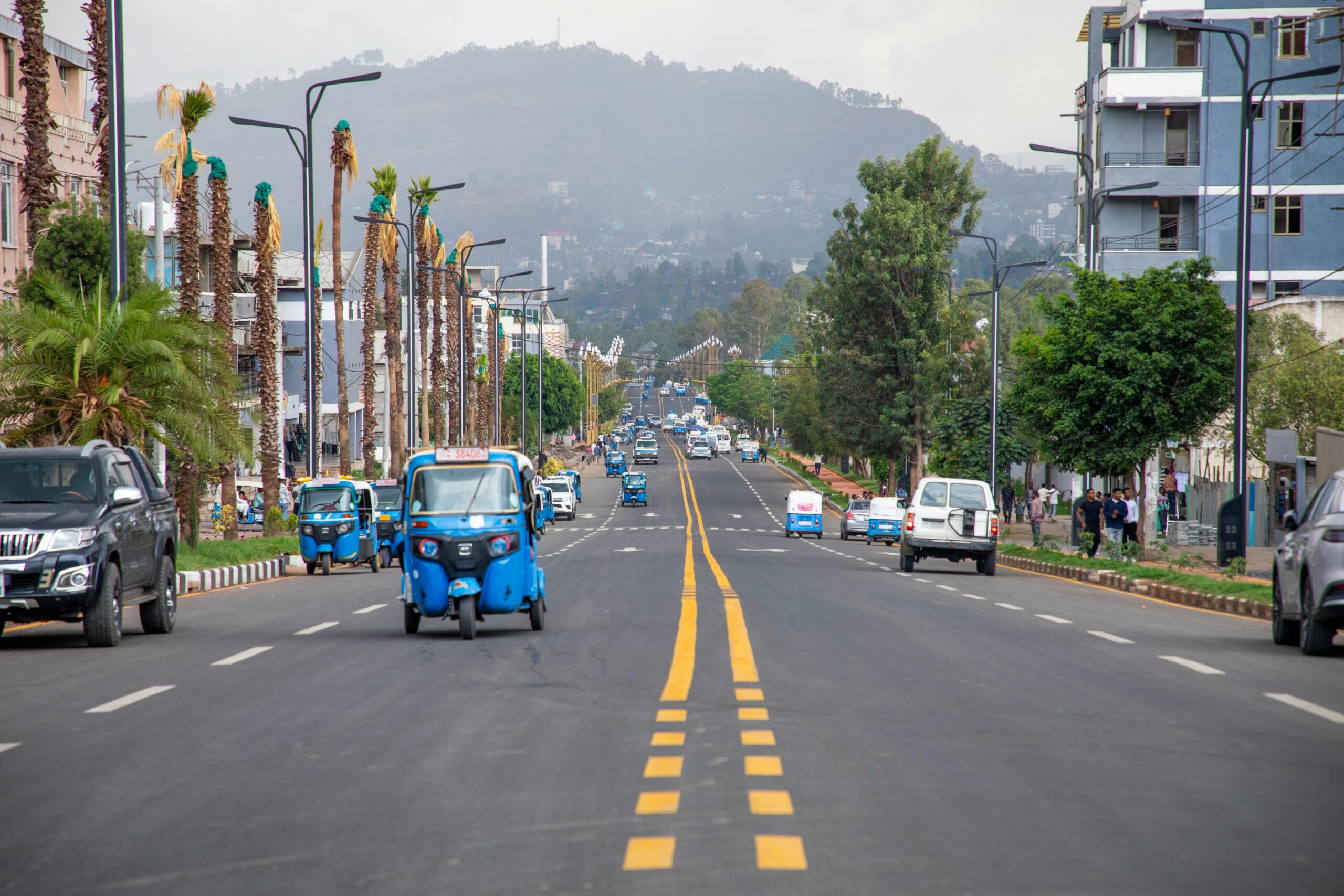
The city is chaotic in the way of African megacities — 4 million people, significant traffic, compressed urban poverty alongside extraordinary wealth — and contains two of the finest museums in Africa and the best coffee in the world.
The National Museum of Ethiopia
The most important natural history and cultural museum in Ethiopia. The collection includes Lucy — Australopithecus afarensis, 3.2 million years old, the most complete early hominid skeleton found in Africa at the time of discovery (1974) and still among the most significant. The cast on display in the main hall (the original is in a secure vault) gives a sense of scale: Lucy was 3.7 feet tall and walked upright.
The museum also contains royal artefacts, Ethiopian Orthodox religious objects, and ethnographic displays covering the country’s 80+ ethnic groups. Entry: £4. Budget 2 hours.
The Ethnological Museum (Institute of Ethiopian Studies), Addis Ababa University
Inside the former palace of Haile Selassie, the last Emperor of Ethiopia (deposed in 1974, died in detention in 1975). The bedroom and bathroom where he lived are preserved. The collection covers Ethiopian art, clothing, musical instruments, and material culture from across the country. The building itself — the former imperial palace, now a university museum — is the attraction as much as the collection. Entry: £2.
The Mercato
The largest open-air market in Africa. A grid of streets organised by trade — electronics, spices, household goods, textiles, grain, livestock on the periphery — covering 4 square kilometres of the Addis Ababa westside. Go with local guide knowledge rather than independently (a guide arranged through your hotel for a morning market walk costs £15-25 and is money well spent for navigation and context).
The market is a functional economic centre, not a tourist attraction. It operates as such, with corresponding energy.
The Coffee Ceremony
Ethiopia is the birthplace of coffee. The arabica coffee plant (Coffea arabica) originates in the Kaffa region of southwestern Ethiopia — the word “coffee” is a corruption of “Kaffa.” The Ethiopian coffee ceremony (jebena buna) is a 45-minute ritual: green coffee beans are roasted over charcoal, the smoke from the beans is wafted over the guests as incense, the beans are ground by hand and prepared in a clay pot (jebena), the coffee poured into small cups in three rounds (abol, tona, bereka — the third round considered a blessing). It is the full antithesis of a flat white ordered through an app.
The coffee itself: Ethiopian arabica at this preparation, in this context, from this region, is the finest coffee in the world. This is not nostalgia or nationalism. It is the considered opinion of specialty coffee buyers globally, who have been paying premium prices for Ethiopian single-origin beans for 30 years.
Attend a ceremony at a local home (arranged through a guide or your hotel) rather than at a tourist restaurant. Thirty minutes of genuine hospitality, genuinely excellent coffee.
Piazza and Churchill Avenue
The old Italian-influenced quarter — Ethiopia was occupied by Italy from 1936 to 1941, and the architecture of Piazza (the neighbourhood around Churchill Avenue) reflects this briefly. The St. George Cathedral (built 1896, where Haile Selassie was crowned in 1930) and the surrounding market streets give a more navigable introduction to the city than the Mercato.
Lalibela — The Rock-Hewn Churches
Lalibela is one of the most extraordinary places on Earth. I say this with full awareness of the hyperbole in travel writing and the need to earn such claims. In this case, the claim is earned.
Eleven monolithic churches, cut directly into the volcanic basalt of a mountain plateau in the Lasta region of northern Ethiopia, built in the reign of King Lalibela (approximately 1181-1221 CE). The king is said to have been instructed by God in a vision to build a new Jerusalem in Ethiopia after the Muslim conquest of the original — the churches are named after Jerusalem sites (the Tomb of Adam, the Jordan River), and the town’s geography is arranged to replicate the holy city.
The construction method: the rock was not assembled but excavated. Each church was created by cutting away the surrounding stone — trenches carved around the perimeter, then the interior hollowed out, then the architectural details carved. The churches are not buildings inside mountains. They are mountains from which churches have been subtracted.
The Two Groups:
The churches divide into two clusters connected by a sunken pathway:
The Northwestern Group — five churches, the largest concentration. Bete Medhane Alem (the largest rock-hewn church in the world — 33.7m long, 23.7m wide, 11.5m tall, supported by 34 pillars) and Bete Maryam (the most ornate, with painted interior frescoes) are the anchors. The churches are connected by tunnels and passages carved through the rock.
The Southeastern Group — six churches, including the most famous.
Bete Giyorgis (St. George’s Church):
A Greek-cross plan carved 15 metres into the rock — the roof is at ground level, the church descending below you as you approach the edge of the pit. The roof surface (which is the top of the church, at your feet) is carved with three concentric Greek crosses. The church walls are perfectly vertical, the carved stone around it a sheer cliff. The church is approached by a tunnel from ground level that emerges into the pit.
It should not be possible to have built this without modern tools. It was built in the 12th century. The engineering and the audacity of the ambition are equally staggering.
The Experience:
The churches are active — Ethiopian Orthodox Christians worship here daily. The priests conduct morning services beginning at dawn, the chanting audible from the trenches before you descend to the church level. Pilgrims come from across Ethiopia, particularly for the major religious festivals. The churches are lit by candles and the light from above, the incense burning continuously.
Entry: £40 for the full two-day pass (all eleven churches). Non-negotiable — this is the correct allocation. You cannot see all eleven churches meaningfully in half a day.
The Timing:
Go in the morning — by 7am, before the site fills. Return in the late afternoon as the light changes (the volcanic basalt shifts colour in the low sun). The midday hours, when tour groups from Lalibela town are most numerous, are the least atmospheric.
Getting to Lalibela:
Domestic flight from Addis Ababa (1 hour 20 minutes, from £60 one way). Land at Lalibela airport (2,430m altitude — allow a few hours for acclimatisation before descending to the churches). The churches are a 20-minute drive from the airport.
Lalibela town: small, quiet, guesthouses from £18-35/night. The Roha Hotel (perched above the town with views toward the plateau) and the Mountain View Hotel are the most consistently recommended at mid-range.
The Danakil Depression — The Hottest Place on Earth
The Danakil Depression is in the Afar region of northeastern Ethiopia — a geological triple junction where the African, Arabian, and Somali tectonic plates are pulling apart simultaneously. The result: a landscape in active creation, with new volcanic activity, hydrothermal fields, lava lakes, salt flats, and sulphur springs.
It is 125 metres below sea level. Average annual temperature: 34.4°C — the highest annual average of any inhabited place on Earth. In summer (June-August), midday temperatures exceed 50°C. The cooler window (October-March) sees 35-40°C at midday.
Why this is not a reason to not go:
The Danakil Depression is one of the most visually extraordinary landscapes available to a traveller from the UK. Photographs of it circulate regularly as “this doesn’t look real” content. They are accurate. The landscape at Dallol — the sulphur springs creating pools of yellow, green, orange, and black across a white salt plain, steam rising continuously, the colours vivid enough to appear unnatural — is genuinely unlike anything else accessible from London.
What’s there:
Dallol Hydrothermal Field: the sulphur springs. The colours come from: yellow (sulphur), green (iron-rich brine), orange (iron oxide), black (manganese and organics). The pools are highly acidic and scalding — the walkways through the field are strictly defined and the guide system exists partly for this reason. The field is in a constant state of slow change — new pools form, others cool and crust over.
Erta Ale Volcano: one of only a handful of permanent lava lakes in the world. A shield volcano (not the steep-sided cone shape — Erta Ale is a broad, low mountain) with an active lava lake in the summit caldera. The hike to the crater rim is done at night (3-4 hours, departing after sunset when the temperature drops slightly) and the view into the lava lake — the molten rock circulating below, the glow illuminating the crater walls — is one of the most extraordinary things available in Africa.
The Salt Flats: the Danakil Depression was once covered by ocean. As the ocean retreated and the region dropped below sea level, the salt deposits from the evaporation created a flat of crystallised salt up to 5km thick. The Afar people have mined this salt for centuries — camel caravans still carry salt blocks from the flats to highland markets, the same trade route that has operated for a thousand years. The caravans moving across the white flat toward the horizon at dawn are one of the finest landscape images in Ethiopia.
The Guide Requirement:
The Danakil Depression is one of the few places in this guide where a guide is genuinely non-negotiable for reasons beyond local knowledge. The heat requires a support vehicle with water reserves. The access roads are unmarked. The political geography of the Afar region requires local liaison. And the geology itself (acidic pools, unstable ground in the hydrothermal field) requires someone who knows the safe paths.
3-day tours from Mekele (the nearest city with an airport, serviced by Ethiopian Airlines domestic flights from Addis Ababa): £150-250/person including transport, guide, accommodation (basic camping or simple lodges), water, and meals. Book through a reputable Mekele-based operator (Tesfa Tours, Ethiopian Quadrant, or Kibran Tours are the most consistently recommended).
The Simien Mountains — The Gelada and the Escarpments
The Simien Mountains (Simien meaning “north” in Amharic) are a UNESCO World Heritage Site in the northern Ethiopian Amhara Region — a high plateau at 3,000-4,550m above sea level, dissected by erosion over millions of years into sheer escarpments, isolated peaks, and river valleys up to 1,500m below the plateau rim.
The landscape is the finest mountain scenery in Africa. The escarpments drop vertically from the plateau — in places you walk the rim and the ground disappears beneath you, the valley floor visible 1,000m below. The highest peak, Ras Dashen (4,550m), is the fourth-highest mountain in Africa.
The Gelada Baboon:
The gelada (Theropithecus gelada) is found only in the Ethiopian highlands — a large ground-dwelling primate with a distinctive red chest patch that it uses for social signalling (the brightness of the patch indicates dominance and fertility). Geladas live in the largest primate groups of any non-human species — herds of 600+ individuals have been recorded in the Simiens.
The specific experience of the gelada in the Simiens: the animals are entirely habituated to human presence. They live on the cliff edges and plateau grassland, eating grass roots, seeds, and flowers. You walk among them. The herd continues its morning feeding as you move through it. A gelada will sit 1.5 metres from your feet and regard you with the specific calm of an animal that has decided humans are irrelevant to its concerns.
This is not a zoo encounter. These are wild animals in their natural habitat, approached because they have no reason to retreat.
Trekking the Simiens:
The standard circuit is 3-7 days from Debark (the gateway town, 100km north of Gondar). A guide and armed scout are legally required (the armed scout is for wildlife safety — the Ethiopian wolf and gelada encounters are why you’re there, but the guide and scout structure also supports local livelihoods in a conservation-dependent community).
Guide: £20-30/day. Scout: £15-20/day. Pack animals (donkeys or mules to carry camping gear): £15-25/day. Total trekking support cost: £50-75/day for the logistics. Accommodation in mountain huts (where available) or camping: £5-12/person/night.
The 3-day minimum: Sankaber camp (the first camp, 2.5 hours from Debark) gives the first proper escarpment views and the most accessible gelada encounters. Imet Gogo (a viewpoint 2 hours from Sankaber at 3,930m) is the iconic Simien landscape photograph — the plateau rim, the valley below, the isolated peaks beyond. Ghenek camp is where the Ethiopian wolf sightings are most consistent.
The Best Months:
October-February (dry season) for clearest skies and most accessible trekking. March-April has the best wildflowers (Ethiopian highland flowers bloom in the late dry season). June-August is the rainy season — trails are muddy, visibility is often poor, but the landscape is intensely green.
Gondar — The Camelot of Africa
Gondar is a city of 300,000 in the Amhara highlands, 3 hours north of the Simiens by road and 1 hour by domestic flight from Addis Ababa. It was the imperial capital of Ethiopia from 1636 to 1855 and contains the Fasil Ghebbi — a walled royal enclosure with six castles built by successive emperors over two centuries.
Fasil Ghebbi (Royal Enclosure):
The six castles — built between 1636 and 1855 — are architecturally unusual: a blend of Portuguese, Moorish, Arab, and indigenous Ethiopian styles that reflects Gondar’s position as a court that received ambassadors, Jesuits, merchants, and travellers from across the known world. The result is a collection of stone buildings that looks entirely incongruous in sub-Saharan Africa and entirely coherent when you understand the history behind it.
The Fasilides Castle (the original, built 1636): the largest, with a rooftop terrrace view over the enclosure and the city. The Chancellor’s Hall, the library building, the bathhouse — all within the enclosed walled compound. UNESCO-listed. Entry: £5. Budget 2 hours.
The Fasilides Bath:
One kilometre north of the main enclosure — a sunken swimming pool (the “Fasilides Bath”) that is flooded and used only once a year during Timkat (Ethiopian Epiphany, January 19th). During Timkat, the clergy and faithful enter the water for a mass blessing — the most visually extraordinary annual religious event in Gondar and one of the finest in Ethiopia.
Debre Berhan Selassie Church:
On the hill above the city — an 18th-century Ethiopian Orthodox church with the finest interior in Gondar. The ceiling: painted with 80 cherub faces looking downward, each slightly different, arranged in rows across the entire ceiling of the church. It is the most famous ceiling painting in Ethiopia and entirely unlike any European equivalent — a distinctly Ethiopian Orthodox aesthetic that owes nothing to the Renaissance tradition that shaped most European religious art.
Entry: included in Fasil Ghebbi ticket (combined pass). Dawn is the best time — the morning light through the eastern windows and the monks completing morning prayers in the compound create the atmosphere the church was built for.
Harar — The Hyena City
Harar is a walled city in eastern Ethiopia — the fourth holiest city in Islam, with 82 mosques in an area smaller than 1 square kilometre. The old city (Jugol) is enclosed by walls built in the 16th century, with 368 narrow alleys connecting the mosques, shrines, traditional Harari houses, and the markets that have operated continuously for centuries.
It is accessible by a 1-hour domestic flight from Addis Ababa or by an 8-10 hour overnight bus. The city is in the Harari Region, in eastern Ethiopia — a Muslim-majority area with a distinct culture, architecture, and language from the Amhara and Tigray highlands to the north.
The Jugol (Old City):
The medina-like old city of Harar is less-visited than Morocco’s medinas and more intact. The traditional Harari house (gegar) has a specific interior arrangement — tiered platforms covered in woven baskets and lacquerware, the walls decorated with ceramic plates and traditional objects. Several houses are open to visitors as cultural museums (entry £1-2); the house of Arthur Rimbaud (the French symbolist poet who lived in Harar as a trader from 1880-1891, one of the more unexpected biographical facts about a canonical European literary figure) is among them.
The Hyena Man:
Every evening, as darkness falls, members of the Yusuf family take up positions outside the Fallana Gate in the city walls and begin calling the spotted hyenas.
The hyenas of Harar are not caged or kept. They are wild animals from the surrounding savannah that have approached the city walls for generations — according to Harari tradition, the practice of feeding them began during a famine in the 16th or 17th century when the hyenas were given food to prevent them preying on livestock. The feeding ritual has continued every night since. The current generation of “Hyena Men” (members of two families who have inherited the tradition) call the hyenas by name — individuals they recognise and have given names.
The hyenas come. Wild spotted hyenas, the most powerful predator in Africa by jaw pressure, weighing 60-80kg — they approach within arm’s length of the feeder and take meat from the stick held in his mouth. Tourists who want to feed the hyenas themselves can do so (the meat is held in the tourist’s mouth on a stick, the hyena takes it without touching the person). The entire interaction costs a small tip to the Hyena Man (£3-5 is appropriate) and no other charge.
This is completely real. The hyenas have not been trained, drugged, or declawed. They are wild animals that have developed a learned behaviour over centuries of association with a specific human family. It happens every night.
The Harar Jugol Market:
The covered market inside the old city has been in operation since the 16th century. Incense, chat (khat, the stimulant leaf chewed throughout eastern Ethiopia and the Horn of Africa), grain, spices, silver jewellery, traditional Harari textiles. The chat merchants — who supply the daily afternoon leaf-chewing session that is as much a social institution as a stimulant habit in eastern Ethiopia — operate from the early morning.
The Omo Valley — The Cultural Question
The Omo Valley in southwestern Ethiopia is home to a concentration of indigenous tribes — the Mursi, Hamar, Dassanech, Karo, Ari, and others — that has made it one of the most visited “cultural tourism” destinations in Africa. It’s also one of the most controversial.
The honest situation:
Omo Valley tribal tourism has grown rapidly since the 1990s. The most photographed element — Mursi women with clay lip plates — has created an economy around tourist photography that has significantly distorted the authentic practice. The lip plate (a clay disk inserted into a cut lower lip of women at puberty) is a traditional Mursi cultural marker. It has also become a transaction: Mursi women in tourist-facing areas insert the plate specifically for tourist visits and request payment for photographs.
The result is an industry where the cultural practice is real but the encounter is transactional rather than genuine, and where the payment structure has created significant changes in how the practice is maintained (some women now insert plates specifically for tourist income who might not have done so under traditional circumstances alone).
This does not make visiting the Omo Valley wrong. It does mean that the visit should be approached with honest understanding of what it is rather than framed as an encounter with “untouched” culture. The communities are not museum exhibits; they are people navigating the intersection of tradition and a tourist economy.
What responsible engagement looks like:
Work with a local guide from the specific community you’re visiting, not an outside guide from Addis Ababa or Arba Minch. Community-based tourism organisations in the Omo Valley connect visitors directly to community-employed guides. The entry fees paid at Mursi and Hamar village visits go to the community — verify this before booking.
If you photograph, pay the requested fee. Do not bargain on photography fees in the Omo Valley — the payment structure is the arrangement the community has established.
Getting to the Omo Valley: 2-3 hour domestic flight from Addis Ababa to Jinka (the nearest airport), then road transport into the valley. The Omo Valley circuit is a 4-5 day addition to an Ethiopia itinerary.
The Tigray Rock Churches — The Harder Journey
Important note: The Tigray region is subject to Foreign Office travel advice against travel as of the current publication date due to the aftermath of the 2020-2022 conflict. This section is included because the Tigray rock churches are among the most extraordinary sites in Ethiopia and because the situation may change — check current advice before planning.
The Tigray rock churches are the older cousins of the Lalibela complex — churches carved into cliff faces and rock outcrops across the Tigray Highlands, most dating from the 4th to 10th centuries (significantly older than Lalibela). Unlike the sunken churches of Lalibela, the Tigray churches are often perched on cliff faces, requiring short climbs (with chains and rock holds) to reach. The interiors contain original pre-12th-century frescoes in a state of preservation that reflects their relative inaccessibility.
Abuna Yemata Guh — the most famous — is carved 2,580m up a vertical cliff face in the Gheralta landscape. The approach: a 30-minute walk followed by a 15-minute barefoot climb up a sheer cliff face with chain handholds, then the final approach along a narrow ledge above a 200m drop. The church interior: a completely intact 5th-century fresco cycle covering every surface. The experience of standing in a church this age, this remote, this utterly inaccessible, that has been used continuously for 1,500 years — is unlike anything in Lalibela.
When Tigray becomes accessible again: go.
Hidden Ethiopia — The Places Worth the Detour
The Blue Nile Falls (Tis Issat)
30km from Bahir Dar (a city on Lake Tana, 1-hour domestic flight from Addis). The Blue Nile emerges from Lake Tana and drops 45 metres in three falls over the Tis Abay River — the widest waterfall in Africa during the rainy season (July-September), significantly reduced in the dry season. The 40-minute walk from the parking area crosses the gorge and approaches from below. Entry: £3.
Lake Tana itself: the source of the Blue Nile and home to 37 island monasteries, some dating from the 14th century. The monastery of Kebran Gabriel (boat access from Bahir Dar, entry included in a half-day boat tour: £20-25/person) contains illuminated manuscripts and processional crosses of extraordinary artistry.
The Bale Mountains — Ethiopian Wolf
The Bale Mountains in southeastern Ethiopia contain the Sanetti Plateau (4,000m+) where the Ethiopian wolf (Canis simensis) — the rarest canid in the world, approximately 450 remaining — is most reliably observed. The wolves hunt Afro-alpine rodents on the plateau in the early morning. A ranger accompanies all visitors. Entry to Bale Mountains National Park: £5. The wolf-sighting probability on the Sanetti Plateau in the early morning: very high (80-90% on most mornings, significantly higher than many wildlife encounters marketed as “reliable”).
Aksum — The Original Kingdom
Aksum, in Tigray, was the capital of the ancient Aksumite Empire from approximately the 1st to 7th centuries CE — trading empire, Christian kingdom, the civilization that erected the stelae (obelisks) that are Ethiopia’s most distinctive ancient monuments. The Church of Our Lady Mary of Zion, where the Ark of the Covenant is believed to rest (in a separate chapel accessible only to the Guardian priest — no one else enters), is the most sacred site in Ethiopia.
Subject to the same Tigray travel advisory as the rock churches above. When accessible: Aksum should be one of the first destinations revisited.
Yirga Alem and the Kaffa Region — Coffee’s Birthplace
The Kaffa region of southwestern Ethiopia contains the wild coffee forests from which arabica coffee originates. The Kafa Biosphere Reserve UNESCO listing covers the remnant wild coffee forest. Tours from Yirga Alem or Jimma visit the forest, the wild coffee plants, and the traditional coffee-processing communities. For anyone serious about coffee, this is the equivalent of going to Burgundy for someone serious about wine. Accessible from Addis Ababa by domestic flight to Jimma (1 hour).
What It Costs — Real Numbers
Ethiopia’s costs are structured differently from most destinations in this guide. The base accommodation and food costs are among the lowest in Africa. The activities — the Danakil tour, the Lalibela entry, the guide and scout costs in the Simiens — are where significant costs concentrate.
Daily Budgets
Budget (£30-45/day, outside guided activities)
- Accommodation: budget guesthouse (£10-18/night)
- Food: local restaurants, injera meals (£4-7/day)
- Transport: local minibuses and shared taxis
- Note: add specific activity costs (Danakil tour, Simien guides) on top
Mid-Range (£55-80/day including activities amortised)
- Accommodation: mid-range hotel (£25-45/night)
- Food: mix of local and better restaurants (£10-16/day)
- Activities amortised across the trip
- Domestic flights for key routes
Comfortable (£90-130/day)
- Accommodation: boutique lodge or best available local hotel (£45-70/night)
- Food: restaurant meals (£18-30/day)
- Private vehicle for flexibility
Key Fixed Costs
| Activity | Cost |
|---|---|
| Lalibela church entry (2-day pass) | £40/person |
| Danakil Depression 3-day tour | £150-250/person |
| Simien Mountains guide + scout (per day) | £35-55/day |
| Domestic flights (most routes) | £40-90 one way |
| Ethiopian e-visa | £45 |
What 10 Days in Ethiopia Actually Costs from the UK
| Category | Budget | Mid-Range |
|---|---|---|
| Return flights (Ethiopian Airlines direct) | £550–750 | £650–850 |
| E-visa | £45 | £45 |
| 10 nights accommodation | £130–200 | £280–450 |
| Lalibela churches entry | £40 | £40 |
| Domestic flights (3 hops) | £120–200 | £150–250 |
| Danakil Depression 3-day tour | £150–200 | £200–250 |
| Food (10 days) | £55–95 | £110–175 |
| Simien guide (2 days) | £70–110 | £70–110 |
| Total | £1,160–1,600 | £1,505–2,170 |
Eating in Ethiopia — Injera and Everything Built Around It
Ethiopian food is one of the great cuisines of the world. It is also one of the most consistently underestimated by travellers who haven’t eaten it in Ethiopia — the injera and stew combination that represents the complete picture of the cuisine requires the real injera (sour, slightly bitter, the fermentation developed over days), the real berbere (the spice blend that forms the base of many stews, made fresh and complex rather than from a powder), and the communal eating context in which everything tastes better than when served to one person on one plate.
The Structure
Ethiopian food is served communally: a large piece of injera is spread on a round tray (a mesob), the stews placed directly on the injera surface (never on a plate), and eaten with the right hand by tearing pieces of injera and using them to scoop the stews. More injera is served separately in rolls. The meal is shared between everyone at the table.
Injera — the sourdough flatbread made from teff flour (a grain cultivated only in the Ethiopian Highlands), fermented for 2-3 days, then cooked on a flat griddle into a large, spongey, slightly sour disc. The pores in the surface absorb the stew. The sourness of the injera is the flavour contrast that balances the richness of the berbere-spiced wots. In Ethiopia, the injera is inseparable from the meal — it is simultaneously the plate and the cutlery and the starch component.
The Dishes
Doro Wot — chicken stew slow-cooked in a berbere-spiced sauce (berbere: dried chilli, fenugreek, coriander, rue, ajwain, black pepper, cardamom, and more — each family or cook has their own blend) with a whole hard-boiled egg. The national dish for feast days and special occasions. The sauce reduces for hours until it’s intensely concentrated. The egg absorbs the sauce. The chicken is tender enough to pull apart with injera. When you eat a good doro wot, you understand why Ethiopian cooking has been praised for centuries.
Tibs — sautéed meat (beef, lamb, or goat) with onion, rosemary, and awaze (a chilli sauce), served either wet or dry. The dry version (yebeg tibs, lamb) is closer to stir-fried than stewed, the meat slightly charred. Available at any restaurant; the quality varies but even a basic tibs is excellent with good injera.
Shiro — a stew of ground chickpeas or beans, simmered with berbere and onion into a thick, smooth paste. The staple on fasting days in Ethiopian Orthodox practice (about 180 fasting days per year in the Orthodox calendar, when meat is prohibited). The best shiro is made from freshly ground legumes rather than powder. At a local restaurant: £0.80-1.50 for a generous portion on injera.
Kitfo — Ethiopian-style steak tartare: raw (or very lightly cooked) minced beef dressed with mitmita (a spice blend with cardamom and chilli) and niter kibbeh (clarified butter infused with spices). The quality is defined by the beef — fresh-ground that morning at a trusted butcher, not the day before. Available at specialist kitfo restaurants in Addis Ababa and the larger cities. Not for the raw-averse, extraordinary for everyone else.
Firfir — shredded injera torn into pieces and cooked with berbere sauce and sometimes meat, then served with fresh injera. The breakfast version: firfir with a fried egg on top, eaten at the market before any tourist is awake, costs £0.60-0.80 and is one of the finest breakfasts available in East Africa.
Tej — Ethiopian honey wine (mead), made from honey fermented with the leaves and bark of the gesho plant (a specific buckthorn that grows in the Ethiopian highlands and provides a slight bitterness similar to hops in beer). Served in a berele (a round-bottomed flask with a small opening, designed to slow drinking and allow the sediment to settle). Alcohol content varies significantly. Available at tej houses (tej bet) in every Ethiopian city. Price: £0.40-0.80 per flask.
Buna (Ethiopian Coffee):
Already covered in the Addis section. The full ceremony is the definitive experience. Outside the ceremony: Ethiopian coffee served at any local café in a jebena (clay pot), poured into small cups, consumed in three rounds. Stronger than espresso, aromatic, the most distinctive coffee character in the world. Never add milk in an Ethiopian context — it changes the balance the preparation is designed around.
Practical Notes
Visa: E-visa required for UK passport holders. Apply online at evisa.ethiopia.gov.et before travel. Cost: £45 for a 30-day single-entry tourist visa. Processing: 3-5 working days typically; apply at least 10 days before travel to allow a buffer.
Getting there: Ethiopian Airlines direct from London Heathrow to Addis Ababa (Bole International Airport). Flight time: 8 hours. The airline is excellent — one of the finest in Africa, modern fleet, good service.
Currency: Ethiopian Birr (ETB). £1 ≈ 135 ETB at time of writing (the exchange rate has fluctuated significantly — verify before travel). ATMs in Addis Ababa are reliable. ATMs are available in Lalibela, Gondar, Harar, and major regional cities but can be unreliable — carry sufficient cash from Addis for your highland itinerary. USD is sometimes accepted in tourist-facing businesses.
Getting around: Ethiopian Airlines domestic network covers Addis Ababa, Lalibela, Gondar, Mekele, Jinka, Jimma, Dire Dawa (for Harar), Bahir Dar, and more. Domestic flights are inexpensive and frequent. Book through ethiopianairlines.com or through your tour operator.
Road travel between cities is possible but distances are long and road quality varies. The route from Gondar to Debark (Simien Mountains gateway) is 3 hours by road — fine. The route from Addis to Harar is 10 hours — take the 1-hour flight instead.
Language: Amharic is the official language; the script (Ge’ez script, the fidel) is used throughout the country. English is spoken in tourist-facing businesses in Addis Ababa, Lalibela, and Gondar. Outside these areas: limited. A few Amharic phrases — “ameseginalehu” (thank you), “shlam” (hello), “yidenagnish” (please, formal) — are received with genuine warmth.
Health: Yellow fever vaccination required for entry (the yellow card must be presented at immigration). Also recommended: Hepatitis A, Typhoid, and ensuring routine vaccinations are current. Malaria prophylaxis is recommended for the Afar region (Danakil) and the Omo Valley lowlands. The Ethiopian highlands (Addis, Lalibela, Gondar, Simiens) are above the mosquito transmission altitude for malaria. Altitude sickness awareness: Lalibela is at 2,430m, the Simien Mountains reach 4,550m — acclimatise progressively.
Photography and respect: The Ethiopian Orthodox churches are active places of worship. Photography inside churches is sometimes prohibited (check with the priest). During morning services: no photography, no raised voices, no inappropriate dress (shoulders covered, shoes removed at church entrances). The communities in the Omo Valley: photography fees apply — pay them without bargaining.
The 10-Day Historical Route Itinerary
This route covers the core Ethiopia historical circuit — Addis, Lalibela, Gondar, the Simiens, and Harar — using domestic flights to eliminate the overland travel times that would otherwise double the duration.
Day 1: Addis Ababa
Land at Bole International Airport. Hotel in the Bole or Kazanchis neighbourhood (mid-range hotels from £35-55/night). Afternoon: National Museum (Lucy, the collection). Evening: coffee ceremony arranged through the hotel. Dinner in the Merkato neighbourhood.
Day 2: Addis Ababa
Morning: Ethnological Museum at Addis Ababa University (Haile Selassie’s former palace). Afternoon: the Merkato with a guide (2 hours). Evening: tej at a tej bet in the Piazza neighbourhood.
Day 3: Lalibela (fly)
Morning flight Addis → Lalibela (1 hour 20 minutes, from £60). Arrive midday. Altitude acclimatisation (Lalibela is at 2,430m — take the afternoon slowly). Late afternoon: descend to the southeastern church group (Bete Giyorgis at 4pm when the light enters the pit). Night in Lalibela.
Day 4: Lalibela
Full day in the churches. Start at 6:30am at the northwestern group (Bete Medhane Alem, Bete Maryam). Move to the southeastern group mid-morning. Return to Bete Giyorgis in the late afternoon. This is the day to spend 4-5 hours among the churches, moving slowly, watching the priests, observing the pilgrims. Do not rush.
Day 5: Lalibela → Gondar (fly)
Morning flight Lalibela → Gondar (via Addis or direct, from £60). Arrive afternoon. Fasil Ghebbi (Royal Enclosure) in the late afternoon (the golden hour light on the castles is worth waiting for). Night in Gondar.
Day 6: Gondar and Simiens
Morning: Debre Berhan Selassie Church (the angel ceiling at 7am). Afternoon: road transfer to Debark (3 hours, start of the Simien Mountains trekking). Night in Debark.
Day 7: Simien Mountains Trek
Trek from Debark to Sankaber camp (2.5 hours). Gelada baboon encounters throughout. Escarpment views in the afternoon. Night in Sankaber camp.
Day 8: Imet Gogo and Return
Early morning: hike to Imet Gogo viewpoint (2 hours). The escarpment view. Return to Sankaber. Trek back to Debark (2.5 hours). Drive back to Gondar. Night Gondar. Fly Gondar → Addis → Dire Dawa (for Harar) next morning — or fly the following day.
Day 9: Harar
Flight Addis → Dire Dawa (50 minutes, from £45). Road to Harar (50 minutes). Old city walk (Jugol — the blue alleyways, the 82 mosques, the Harari houses). Arthur Rimbaud house. Evening: the Hyena Man feeding at sunset (outside Fallana Gate, 7pm). Night in Harar.
Day 10: Harar → Addis → Home
Morning: Harar market. Flight Dire Dawa → Addis (50 minutes). Connection for London flight (Ethiopian Airlines direct, departure late evening).
Final Thought
I was standing at the edge of Bete Giyorgis at 6:45am. The sun hadn’t yet reached the bottom of the pit — the church was still in shadow, the rock walls still dark. From somewhere below, the sound of chanting came up through the morning air.
A priest emerged from the tunnel entrance at the side of the pit and descended the stone steps to the church level. He didn’t look up. He had things to do.
The chanting continued.
I stayed at the edge for 20 minutes as the light descended the opposite wall of the pit toward the church roof. By 7:10am the sun reached the carved cross pattern on the roof and the stone glowed briefly, intensely, red-orange.
Then it moved on and the church was just a church again. Extraordinary and ordinary simultaneously. Built in the 12th century by order of a king who had been told in a vision to construct a new Jerusalem. Used every morning since.
Ethiopia rewards the traveller who arrives without too many expectations and leaves with too many impressions to organise. Go with time. The country requires it.
Question about Ethiopia this guide doesn’t cover? Drop it in the comments.