
The complete guide for UK travellers: how the Sustainable Development Fee works and what it actually covers, the monastery on a cliff face that shouldn’t exist, the 17th-century fortress at the confluence of two rivers, the mountain pass where nine Himalayan peaks appear through prayer flags, the festival calendar, and why Bhutan is the most thoughtfully designed tourism experience on Earth.
Reading time: 15 minutes | Last updated: 2026
Bhutan is the only country in the world that measures Gross National Happiness instead of GDP.
This is not a marketing line. It is a constitutional provision — the 2008 Constitution of Bhutan requires the government to pursue the welfare of the nation through “good governance, sustainable development, preservation and promotion of culture, and environmental conservation.” Development projects are evaluated against a Gross National Happiness index. The philosophy shapes everything: the tourism model, the land use rules, the economy, the relationship between the government and its people.
The practical effects of this philosophy on a visitor:
72% of Bhutan is forested by constitutional requirement — you cannot reduce the forest cover below that proportion. Plastic bags have been banned since 1999. Tobacco sales are illegal. The country is carbon negative — it absorbs more CO2 than it produces. Tourist numbers are limited by design: you cannot visit independently, all tourists must book through a licensed Bhutanese tour operator, and a daily Sustainable Development Fee funds hospitals, schools, and conservation. You will not encounter tour buses at Tiger’s Nest. You will have the suspension bridge viewpoint to yourself or nearly so.
These are not accidents. They are outcomes of a country that decided, explicitly and officially, that what matters is not how much visitors spend but whether the act of hosting them improves or degrades the place and the people.
Bhutan is not a budget destination. It is the most thoughtfully designed tourism experience on Earth. This guide explains how to access it.
Quick Navigation
- The Bhutan Tourism Model — The Honest Explanation
- When to Go — Festivals, Rhododendrons, and Clear Skies
- Getting There — The Flight, the Approach, and What Happens Next
- Thimphu — The Capital Without a Traffic Light
- Paro — Tiger’s Nest and the Sacred Valley
- Tiger’s Nest Monastery (Paro Taktsang) — The Hike in Detail
- Punakha — The Fortress at the River Confluence
- Dochula Pass — The Pass of 108 Chortens
- Bumthang — The Cultural Heartland
- Phobjikha Valley — The Black-Necked Cranes
- The Dzong Architecture — Why the Fortresses Matter
- The Festival Calendar — Which Tshechu to Plan Around
- Trekking in Bhutan — Snowman Trek and the Alternatives
- What It Costs — The Complete Real Picture
- Eating in Bhutan — Ema Datshi and the National Palate
- Practical Notes
- The 7-Day Itinerary — The Classic Western Bhutan Circuit
The Bhutan Tourism Model — The Honest Explanation
Before any description of what Bhutan contains, the tourism model needs to be understood. It is the single most frequently misunderstood aspect of visiting Bhutan, and getting it wrong (booking flights without an operator, arriving without the correct documentation, misunderstanding what the daily fee covers) results in not being able to enter the country.
The Sustainable Development Fee (SDF):
All international tourists are required to pay a daily Sustainable Development Fee. The fee structure has changed multiple times in recent years — verify the current rate at the Tourism Council of Bhutan website (tourism.gov.bt) before planning, as it was reduced from $250/day to $100/day in 2023 and may change again.
At the current rate of approximately $100/day (around £80): the fee is paid per day in the country, not per person for the whole trip. A 7-day trip for one person: $700. A 7-day trip for two people: $1,400.
The SDF is a royalty that goes directly to Bhutan’s education and healthcare funding and to conservation. It is not a “tourism tax” in the pejorative sense — it is the mechanism by which Bhutan limits visitor numbers while ensuring that the visitors who do come generate sufficient revenue to make the tourism economy sustainable without growing beyond the country’s capacity.
What the operator fee covers:
The SDF is paid to the government. Separately, you pay your licensed Bhutanese tour operator for: accommodation (at a specified minimum standard), all meals, an English-speaking licensed guide, internal transport, monument entry fees, and the paperwork required to obtain your Tourist Visa Clearance.
Operators are not all equivalent. The quality of guide and accommodation varies significantly across the hundred-plus licensed operators. Established operators with track records of international visitors: Bhutan Cultural Tours, Bhutan Spirit Sanctuary, Etho Metho Tours, Namgay Adventures. Research specific operators on travel forums (TripAdvisor, Lonely Planet forum, Bhutan-specific Facebook groups) and read reviews from the last two years.
The visa system:
You cannot obtain a Bhutan visa on arrival or through a Bhutanese embassy in the UK. The visa is arranged entirely by your licensed tour operator after you book. The operator applies for a Tourist Visa Clearance from the Tourism Council; the clearance is issued before your departure and used at Paro Airport immigration to receive the visa stamp. This process takes 7-10 working days — book with enough lead time.
What you cannot do:
Independent travel without a licensed guide. Travelling between districts without the guide. Entering monastery interiors in some restricted sites. Photography inside most dzong interiors (exterior and grounds always permitted).
What this model means in practice:
You will have a guide throughout your trip. This is not incidental — your guide is your interpreter, your connection to the culture, and (with a good operator) your most important source of understanding. The guide is not optional; they are built into the tourism model by design.
The quality of the experience is substantially determined by the quality of the guide. Ask specifically about the guide when selecting an operator.
When to Go — Festivals, Rhododendrons, and Clear Skies
Bhutan has two primary tourist seasons separated by the monsoon.
March to May — Spring
The rhododendrons bloom throughout Bhutan’s forests from late March through May — red, pink, white, and purple, covering the hillsides at altitude and the forest floor at lower elevations. Tiger’s Nest views are generally clear in spring before the monsoon haze builds. The Paro Tshechu (Bhutan’s most famous festival) falls in the spring window — typically late March or April, depending on the lunar calendar. The spring season is peak for both visitors and festival activity.
September to November — Autumn
The clearest skies of the year. After the monsoon, the Himalayan peaks appear in full — the view from Dochula Pass in October, with nine peaks above 7,000m visible, is available in the spring but more reliably so in autumn when the air is at its most transparent. The Thimphu Tshechu (the capital’s festival, September) and the Punakha Drubchen and Tshechu (February/March) are the other major festival windows.
June to August — The Monsoon
Significant rainfall. Trekking is difficult. Some roads wash out. The landscape is intensely green. Tiger’s Nest is accessible but the viewpoint photograph is more often in cloud than in the other seasons. Not recommended for first visits.
December to February — Winter
Cold at altitude (Thimphu: 5-10°C, higher passes below freezing). Clear skies. The Phobjikha Valley black-necked cranes are present (they arrive from Tibet in November and leave in March). Low season for accommodation — some lodges reduce services. The Punakha Drubchen (a dramatised re-enactment of a 17th-century battle, unique to Punakha) falls in February.
The festival recommendation:
If you can organise your visit around a major tshechu (festival), do so. The festivals — masked dancing, traditional music, enormous thangka paintings (called thondrel) unfurled from the dzong facades — are the concentrated expression of Bhutanese Buddhist culture that gives the dzong architecture and the monastery visits their fullest context.
The Paro Tshechu (late March/April) and the Thimphu Tshechu (late September/October) are the two most accessible for international visitors. Exact dates shift with the Bhutanese lunar calendar — confirm the year’s dates through tourism.gov.bt.
Getting There — The Flight, the Approach, and What Happens Next
The Airline:
Bhutan is served by only two airlines: Druk Air (the national carrier) and Bhutan Airlines. Both fly to Paro International Airport — the only international airport in the country, in the Paro Valley 6km from Paro town.
The connection points from the UK: Bangkok (6 hours from London, then 3 hours to Paro), Delhi (9 hours from London, then 2 hours to Paro), Kathmandu (11 hours from London, then 1.5 hours to Paro), Kolkata (12 hours from London, then 2 hours to Paro). The Bangkok routing via Thai Airways or British Airways is the most common for UK visitors.
Total journey time from London: approximately 18-22 hours including connections. Plan a full day of travel each way and build a rest day into the start of the itinerary.
The Paro Approach:
The landing at Paro Airport is one of the most dramatic aviation experiences accessible to civilian passengers. The Paro Valley is 2,235m above sea level, surrounded by mountains rising to 5,500m. The aircraft descends into the valley, banking sharply between the mountains, the wingtips uncomfortably close to the terrain, the river valley visible below before the runway appears. Only 8 pilots in the world are certified to fly this approach. The reputation for drama is entirely accurate and entirely safe.
Arriving:
Your guide will meet you at Paro Airport arrivals with a WELCOME sign. This is the beginning of the guided experience — from this point, transport, accommodation, meals, and itinerary management are handled by your operator. Your job is to arrive; everything else is arranged.
Thimphu — The Capital Without a Traffic Light
Thimphu is the capital of Bhutan and, with a population of approximately 115,000, the only capital city in the world without a single traffic light (a traffic roundabout replaced the one light that briefly existed in the 1990s, which had itself replaced a white-gloved traffic police officer who the public missed and requested be reinstated).
The city sprawls across a valley at 2,334m — modern Bhutanese architecture (traditional style is required by law for all buildings in the valley) next to dzong fortresses next to the weekend vegetable market where farmers from the surrounding hills bring produce every Saturday.
The Buddha Dordenma:
A 51-metre bronze Buddha statue on the hill above the city — the largest sitting Buddha in the world. The base of the statue contains 125,000 smaller Buddha figures. The view from the viewing platform below the statue takes in the full Thimphu valley, the dzong fortress, and (on clear days) the mountains beyond. Free entry.
The Tashichho Dzong:
The seat of Bhutan’s government and the summer residence of the Druk Desi (the senior monk of Bhutan). The dzong is a large, white-washed fortress-monastery at the northern end of the valley, rebuilt in 1962 in traditional style. The interior (accessible at specific hours with your guide) contains government offices, monk residences, and the main temple. The exterior and grounds: always open for photography, the dzong reflected in the Thimphu Chhu river when the water is calm.
The National Museum (temporarily at Nagtshang Goenpa):
The original National Museum (in the Ta Dzong watchtower above Paro) is currently under restoration. A temporary exhibition is located above Paro town. The collection: armoury, thangkas, religious objects, natural history specimens, and the most complete display of Bhutanese stamps in the country (Bhutan is famous for its unusual stamps — circular, three-dimensional, playing recorded music in the 1970s, depicting notable Bhutanese scenes).
The Weekend Market:
Every Saturday and Sunday, the open-air market below the dzong assembles farmers from the surrounding valleys selling vegetables, dairy, dried meat, and handicrafts. This is not a tourist market — the prices are in Ngultrum and the conversations are in Dzongkha. The correct approach: walk slowly, buy something, don’t rush.
Takin Preserve:
The takin (Budorcas taxicolor) — Bhutan’s national animal, a large ungulate that appears to be a genetic impossibility (the body of a wildebeest crossed with a goat) — is kept in an enclosure above the city. The legend of the takin: the Divine Madman (Drukpa Kunley, a 15th-century Buddhist saint known for unconventional teaching methods including the consumption of two entire animals and the assembling of the bones into a new creature) created it from the leftover bones of a cow and a goat. The takin that results from this story is a real animal found only in the Himalayas. Free entry to the enclosure.
Paro — Tiger’s Nest and the Sacred Valley
Paro is the second significant stop on the standard western Bhutan circuit — a fertile valley at 2,200m, surrounded by peaks and pine forests, with a density of dzongs, temples, and monasteries that reflects its historical importance as the gateway to Bhutan from Tibet.
The Paro Valley is where most visitors begin and end their trips (the airport is here) and where Tiger’s Nest defines the entire journey.
The Rinpung Dzong (Paro Dzong):
A 17th-century fortress-monastery on a spur above the Paro Chhu river — the administrative and religious centre of the Paro district. The covered wooden cantilever bridge across the river below the dzong (Nyamai Zampa, built in the 14th century and rebuilt after a flood) is the foreground of most Paro Dzong photographs. The interior: monks in training, a temple complex, the administrative offices of the district. Open for visits during daylight hours.
The National Museum (Ta Dzong):
The circular watchtower above the Rinpung Dzong. Currently under restoration; a temporary exhibition location is operational. The original collection is worth seeing when it returns — the armoury alone justifies the climb.
Kyichu Lhakhang:
One of the oldest temples in Bhutan, believed to have been built in the 7th century by the Tibetan king Songtsen Gampo as one of 108 temples constructed simultaneously across the Himalayan region to pin a demoness to the ground. The original 7th-century temple and a replica built by the current royal family in the 1960s stand side by side in the same courtyard. The 7th-century structure is small, darkened by centuries of butter lamps, the walls covered in painted scenes that have been touched and renewed over 1,300 years. One of the oldest continuously used religious structures in the Himalayas.
Tiger’s Nest Monastery (Paro Taktsang) — The Hike in Detail
Paro Taktsang — Tiger’s Nest — is the defining image of Bhutan and the most important pilgrimage site in the country. A monastery complex clinging to a vertical cliff face at 3,120m above sea level, 900m above the Paro Valley floor. It has been there, in various forms, since the 8th century.
The legend: Guru Rinpoche (Padmasambhava), the Indian saint who brought tantric Buddhism to Bhutan and Tibet, flew to this spot on the back of a tigress (a transformed version of his consort, Yeshe Tsogyal) in the 8th century. He meditated in a cave here for three months. The cave is now the innermost sanctum of the monastery — the most sacred room in Bhutan, accessible to visitors who remove their shoes and complete the final approach.
The monastery was largely destroyed by fire in 1998 and rebuilt to the original specifications by 2004. The reconstruction preserves the original form and the religious character of the site.
The Hike:
Start at the car park at 2,600m. The trail climbs through pine and rhododendron forest to the main viewpoint (2,700m) — the location of most Tiger’s Nest photographs, where the monastery appears below and to the left across a valley. This point is 1.5-2 hours from the car park for fit walkers, longer for others.
From the viewpoint, the trail descends sharply into the valley between the cliff and the viewing point, crosses a stream at the base, and climbs steeply back up to the monastery entrance. Total return: 4-5 hours for most walkers.
The Viewpoint Photo:
The suspension bridge across the valley between the viewpoint and the monastery entrance is the foreground of the most famous Tiger’s Nest photograph. The monastery appears above the bridge, the cliff behind it. The light in the morning (approaching from the east) is better than the afternoon for the main viewpoint image.
The Monastery Interior:
Remove shoes at the entrance. Photography is not permitted inside. The main temples contain significant religious art — thangka paintings, butter sculpture, gilt bronze figures. The cave of Guru Rinpoche (the innermost sanctum) is the pilgrimage endpoint — a small, dark, intensely sacred room where the saint meditated.
The Practical Advice:
Leave the car park at 7:30am to reach the monastery before the mid-morning heat and any other tour group. Take water. The hike is not technically demanding but the altitude (the viewpoint is at 3,000m+) and the gradient make it tiring. Horses are available for the initial section of the climb (£10-15) — this is worth considering if fitness is a concern, as the first hour is the steepest.
The viewpoint in clear weather: extraordinary. The viewpoint in cloud: extraordinary in a different way. Cloud can arrive at any time at any altitude in Bhutan — it is weather, not a reason to postpone.
Punakha — The Fortress at the River Confluence
Punakha is the former winter capital of Bhutan — at 1,200m, it’s significantly warmer than Thimphu in winter and was the seat of the government from the 17th century until Thimphu’s designation as the permanent capital in 1955.
The drive from Thimphu passes the Dochula Pass (see separate section) and descends through extraordinary alpine scenery into the subtropical Punakha Valley — the change in climate (from alpine to subtropical in 45 minutes of driving) is one of the more dramatic transitions available in Bhutan.
Punakha Dzong (Pungthang Dechen Phodrang):
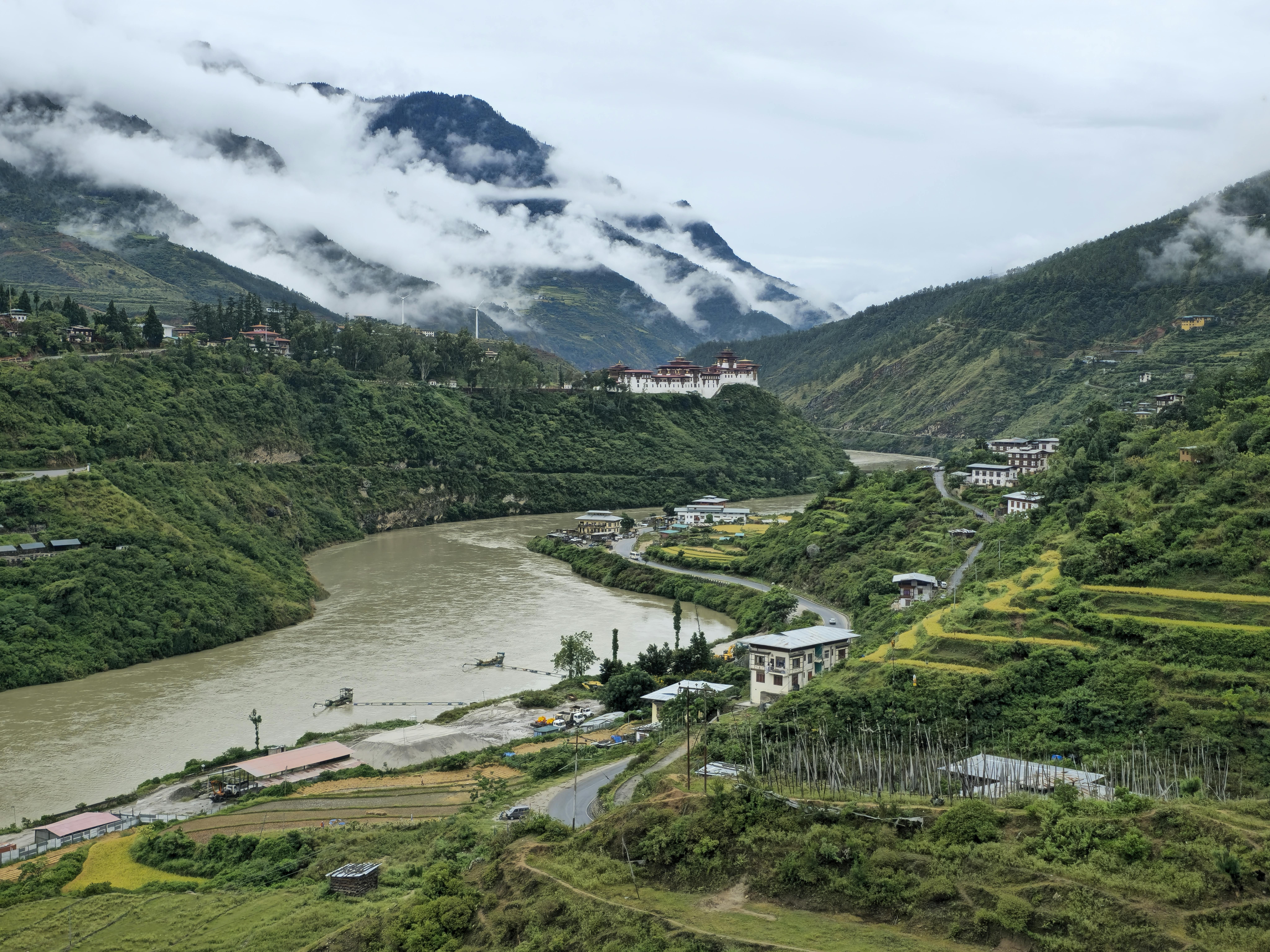
The most beautiful dzong in Bhutan and the most significant historically. Built at the confluence of the Mo Chhu (Mother River) and Pho Chhu (Father River) in 1637-38 by the unifier of Bhutan, Zhabdrung Ngawang Namgyal. The dzong serves as the winter headquarters of the monk body (the Central Monk Body migrates from Punakha to Thimphu’s Tashichho Dzong in summer, then back in winter — a migration that happens every year and has happened every year since the 17th century).
The exterior: white-washed walls rising directly from the confluence of the two rivers, the nine-storey central tower (utse) rising from the courtyard. In March and April, jacaranda trees in the courtyard bloom purple and the petals fall on the river surface. This is the image most associated with Punakha.
The interior: three large courtyards, the administrative and monastic sections, the main temple (machenma lhakhang) with its gold Buddha and painted walls. The 17th-century murals in the main courtyard are among the finest in Bhutan.
The Wooden Cantilever Bridge:
A 180-metre suspended bridge across the Pho Chhu — the longest traditional footbridge in Bhutan, with the dzong visible upstream. Cross the bridge to reach the Khamsum Yulley Namgyal Chorten (a modern chorten on the far side, a 30-minute walk through rice paddies that gives the finest view back toward the dzong).
The Punakha Drubchen and Tshechu:
The Punakha Drubchen (typically February) is a dramatised re-enactment of the 1639 battle in which Bhutan repelled a Tibetan-Mongol invasion, involving hundreds of participants in traditional armour. The Tshechu follows the Drubchen. Together they form the most historically specific of Bhutan’s major festivals. The specificity — the armour, the choreography, the dzong as backdrop — makes it the most dramatic festival experience in Bhutan outside the Paro Tshechu.
Dochula Pass — The Pass of 108 Chortens
The Dochula Pass (3,100m) is on the road between Thimphu and Punakha — 30km from Thimphu, about an hour’s drive. The pass itself is marked by 108 chortens (memorial stupas) built in 2004 by the Royal Queen Mother as a commemoration of Bhutanese soldiers killed in a military operation against Indian separatist militants who had entered Bhutanese territory.
The 108 chortens in a tiered arrangement, surrounded by prayer flags, with the Himalayan peaks visible behind on clear days: this is the image that appears in most photographs described as “Bhutan” but isn’t always identified specifically. It is taken from this pass, facing south and east toward the peaks, usually in the morning before cloud builds.
The Peak View:
On clear mornings (most reliably in October, November, and March), nine peaks above 7,000m are visible from the pass simultaneously: Masagang (7,194m), Tsendagang, Terigang, Jejegangphugang, Kangphugang, Zongphugang, Rinchentag, Gangkar Puensum (the highest in Bhutan at 7,570m and, due to a ban on climbing mountains above 6,000m in Bhutan, the highest unclimbed peak in the world). The view requires a clear morning and a morning stop on the Punakha day — make your guide aware that this matters to you.
The Cloud Version:
If the peaks are in cloud (which happens frequently, even in clear seasons), the 108 chortens in mist and prayer flags moving in the wind is a different and arguably more atmospheric image. Both are Dochula.
The Druk Wangyal Lhakhang:
A temple adjacent to the pass, built in 2008 to commemorate the 100th anniversary of the Wangchuck dynasty. The murals inside depict scenes from recent Bhutanese history — unusually secular subject matter for a Bhutanese temple interior. Open for visits.
Bumthang — The Cultural Heartland
Bumthang is the most culturally concentrated district in Bhutan — four valleys at 2,600-3,500m altitude in central Bhutan, containing the oldest temples in the country, the ancestral home of the royal family, and the landscape (alpine meadows, pine forests, the smell of juniper) that most Bhutanese associate with their cultural identity.
It is also further from Paro than the western Bhutan circuit (Thimphu, Punakha, Paro) — adding Bumthang requires either 3 additional days on an extended road trip (8 hours each way from Thimphu, over mountain passes, genuinely spectacular driving) or a domestic flight from Paro to Bumthang (40 minutes, not always available, arrange through your operator).
Jakar Dzong:
The “White Bird Castle” — a 17th-century dzong on a ridge above the Chamkhar Valley, named for the white bird that appeared during its construction and was interpreted as an auspicious omen. The dzong is the administrative and religious centre of Bumthang district. The surrounding Jakar town is the largest settlement in central Bhutan — a small market town with the atmosphere of a place that receives a fraction of Paro’s visitors.
Jambay Lhakhang:
One of the 108 temples built simultaneously in the 7th century by the Tibetan king Songtsen Gampo (the same king associated with Kyichu Lhakhang in Paro). The original structure is 1,400 years old and still in active use. The annual Jambay Lhakhang Drup festival (October) includes the Mewang (fire ceremony) — a tradition of walking through fire, believed to bring blessings and purification, one of the most specific and least-photographed of Bhutan’s major festival rituals.
The Bumthang Trek:
The Bumthang Cultural Trek is a 3-day moderate trek through the Bumthang valleys — passing through villages, forest, and meadows, with overnight stays in farmhouses and guesthouses. This is the most accessible multi-day trek in Bhutan for travellers with limited trekking experience: lower altitude than the mountain passes of the longer routes, genuine cultural immersion in working agricultural communities.
Phobjikha Valley — The Black-Necked Cranes
The Phobjikha Valley is a glacial valley in western Bhutan at 2,900m — a broad, marshy bowl surrounded by fir and bamboo forest, managed as a nature reserve for the black-necked crane (Grus nigricollis).
The black-necked crane migrates from the Tibetan Plateau every October as winter closes in and returns north in March as Bhutan’s spring begins. The Phobjikha Valley holds approximately 600 cranes each winter — the entire population of black-necked cranes that winters in Bhutan. They roost in the marsh, feed in the surrounding meadows, and return to the same valley every year.
The Phobjikha Valley Festival (November) celebrates the arrival of the cranes with a ceremonial dance and children dressed as cranes — one of the more specific and visually unusual cultural events in Bhutan.
The valley is a 3-hour drive from Punakha or 2 hours from Wangdue Phodrang — typically added to the circuit between the western Bhutan sites and an extension to Bumthang, or as a 2-day addition on the return from Punakha to Paro.
The Gangtey (Black Mountain) Monastery above the valley: a 17th-century monastery in the Nyingma tradition with an active monk community and panoramic views over the entire valley and the crane habitat below.
The Dzong Architecture — Why the Fortresses Matter
Every district in Bhutan has a dzong — a fortress-monastery that serves simultaneously as the administrative headquarters of the district government, the residence and workplace of the monk body, and the religious centre of the district’s population. The dzong model was established by the unifier of Bhutan, Zhabdrung Ngawang Namgyal, in the 17th century and has been maintained as the organisational principle of Bhutanese governance ever since.
The architecture is specific and remarkable. The outer walls are massive (1-4 metres thick), constructed without nails or metal fasteners from timber and stone. The central tower (utse) rises from the inner courtyard — multi-storey, ornately decorated, the main temple at the top. The whitewashed walls slope slightly inward (battered walls) for structural stability and aesthetic effect. Red bands of rammed earth mark the upper sections.
The dzongs are not museums. They are functioning institutions — the district government operates from the administrative wing, the monks perform daily rituals in the temple wing, festivals use the courtyard. Visitors move through a living institutional environment rather than an archaeological one.
Understanding this — the dzong as a functional institution with 400 years of continuous operation — changes what you see when you stand in a dzong courtyard. You’re not looking at the past. You’re looking at an ongoing practice.
The Festival Calendar — Which Tshechu to Plan Around
Bhutan’s major festivals (tshechu) are held at the dzong of each district on specific days of the Buddhist lunar calendar. The dances (cham) performed at the festivals — masked dances depicting the subduing of demons, the lives of Buddhist saints, and aspects of tantric teachings — are the living performance of traditions that have been maintained continuously since the 17th century.
The major tshechu dates vary by year (lunar calendar) — confirm the current year’s dates through the Tourism Council of Bhutan website before booking.
Paro Tshechu (March/April)
The most famous and most visited. The festival includes the unrolling of the Thongdrel — an enormous silk thangka painting covering the entire facade of the Paro Dzong — on the final morning before dawn. The thangka is displayed for approximately two hours before being rolled up until the following year. Witnessing it is considered to bring liberation. The pre-dawn assembly, the gradual illumination of the thangka as the light grows, the monks and laypeople prostrating — this is the event around which most international Bhutan trips are organised.
Thimphu Tshechu (September/October)
The capital’s festival. Three days of cham at the Tashichho Dzong, followed by the Thongdrel unrolling on the final morning. Slightly more accessible for international visitors than Paro due to Thimphu’s larger accommodation capacity, but the Paro Tshechu is traditionally considered the more significant.
Punakha Drubchen and Tshechu (February/March)
The most historically specific and the most dramatic visually — the armour re-enactment and the festival in the most beautiful dzong in Bhutan.
Jambay Lhakhang Drup, Bumthang (October/November)
The fire ceremony (Mewang) and the Naked Dance (Tercham) — one of the few Bhutanese festivals where non-Buddhist elements of Bhutanese folk religion are explicitly present. Less international visibility than the Paro or Thimphu festivals and more intense for it.
Trekking in Bhutan — Snowman Trek and the Alternatives
Bhutan has some of the finest high-altitude trekking terrain in the Himalayas and a fraction of the trail infrastructure of Nepal — meaning the treks are more challenging logistically but more remote and less crowded.
The Snowman Trek (25-30 days)
The hardest multi-day trek in Bhutan and one of the hardest in the Himalayas — crossing 11 passes above 4,500m, reaching a maximum altitude of 5,320m, covering 350km through the northern border region. The success rate is approximately 50% due to altitude, terrain, and weather. For serious trekkers with high-altitude experience only. Organised through licensed operators with full camping support, guides, and pack animals.
The Druk Path Trek (5-6 days)
A moderate-strenuous trek from Paro to Thimphu across the mountains between the two valleys — four days of walking through pristine alpine scenery (glacial lakes, rhododendron forest, yak pastures) between the two primary western Bhutan tourist destinations. Maximum altitude: 4,200m. Full camping support required. The most frequently recommended trek for travellers who want a significant trekking experience within the standard western Bhutan circuit.
The Bumthang Cultural Trek (3 days)
Described in the Bumthang section. The most accessible option for non-specialist trekkers.
The Jhomolhari Trek (8 days)
A classic trek to the base of Mount Jhomolhari (7,326m) on the Bhutan-Tibet border. The mountain is sacred in Bhutan (and therefore unclimbed) and the view from the base camp is among the finest mountain views in Bhutan. Four days in, four days out, camping throughout. The approach valley (the Paro Chhu valley north of Paro town) is through traditional villages with minimal tourist infrastructure.
What It Costs — The Complete Real Picture
Bhutan is the most expensive country in this guide per day on the ground. It is not, however, the most expensive trip — the all-inclusive nature of the operator fee means costs are predictable and controllable, unlike destinations where individual spending decisions compound across two weeks.
The Full Cost Breakdown
The Sustainable Development Fee:
Current rate: $100/person/day (approximately £80/day). Subject to change — verify at tourism.gov.bt. For a 7-day trip: $700/person (£560). For two people: $1,400 (£1,120). The fee is paid to the Tourism Council through your operator.
The Operator Fee:
This covers accommodation, all meals, guide, internal transport, and monument entries. The operator fee varies significantly by accommodation standard:
- Standard (3-star equivalent guesthouses): £80-120/person/day
- Mid-range (comfortable hotels): £130-180/person/day
- Luxury (Uma by COMO, Amankora, and equivalent): £350-600/person/day
A 7-day trip at mid-range including SDF: approximately £1,470-1,820 per person (operator fee) + £560 (SDF) = £2,030-2,380 per person, excluding flights.
Flights:
London → Bangkok → Paro return: £700-1,000 (Bangkok legs on Thai Airways or British Airways; Paro leg on Druk Air). London → Delhi → Paro return: £650-900. Book the Druk Air/Bhutan Airlines leg separately from the main international flight — do not book as a connecting ticket, as the Paro flight operates on its own schedule and delays affect differently.
Total Budget for One Week in Bhutan from the UK:
| Category | Cost Per Person |
|---|---|
| Return flights (via Bangkok or Delhi) | £700–1,000 |
| Sustainable Development Fee (7 days) | £560 |
| Operator fee — mid-range (7 days) | £910–1,260 |
| Personal spending (souvenirs, extra drinks, tips) | £100–200 |
| Total | £2,270–3,020 |
The Value Framing:
For the same money as a 7-day guided luxury safari in Tanzania or Kenya (£2,500-4,000 per person), you get Bhutan — with all accommodation, meals, guide, and transport included, and far fewer visitors at any site you visit. The mandatory guide means the experience is explained and contextualised throughout. The daily fee funds hospitals and schools. The country is carbon negative.
This is not a cheap trip. It is an extremely well-priced trip relative to what it delivers and how it delivers it.
Eating in Bhutan — Ema Datshi and the National Palate
Bhutanese food is built around chillis and cheese — a combination that surprises most visitors who arrive expecting something between Tibetan and Indian cuisine and find something entirely its own.
Ema Datshi
The national dish. Fresh green or red chillis (ema means chilli; datshi means cheese) cooked together with the local fresh cheese in a heavy stew — the chilli is not the seasoning here, it is the primary vegetable. The cheese (typically datshi, a soft, semi-fermented cheese made from yak or cow milk) melts into the chilli broth. The heat level ranges from genuinely fiery (the traditional version) to adapted-for-tourists (milder, still characterful). Available at every meal at most guesthouses and restaurants in Bhutan. If you eat only one Bhutanese dish, eat this one.
Kewa Datshi and Shamu Datshi
Variations on the datshi theme: potato (kewa) with cheese, or mushroom (shamu) with cheese. The mushroom version uses the wild mushrooms gathered in Bhutan’s forests — an extraordinary ingredient source given the density of the forest cover. More approachable than ema datshi for those with low chilli tolerance; the same principle of fresh ingredients in a cheese sauce.
Red Rice
Short-grain, nutty, slightly sticky red rice — grown specifically in the Paro and Punakha valleys in Bhutan. The rice is naturally red from the bran (not processed to remove it), with a specific mineral taste that white rice doesn’t have. It’s the staple grain of the Bhutanese diet and genuinely different from any rice in neighbouring countries. Served at every meal.
Phaksha Paa
Pork belly with dried red chillies — the dried chillis (thinner and more concentrated than fresh) adding a deep, slightly smoky heat to the rendered pork fat. Traditional to western Bhutan. Available at local restaurants and some guesthouses as a meat main course.
Momo
The Himalayan dumpling — found throughout the Himalayan region from Nepal to Tibet, Bhutan’s version uses buckwheat dough (where Nepal typically uses wheat flour), filled with cheese and vegetables or meat. The flavour is earthier than the Nepali momo. At restaurants in Thimphu and Paro: £1.50-3 for a serving of eight.
Ara
The traditional alcoholic drink — a hot rice or corn wine, drunk from a wooden cup. Offered at ceremonies and social occasions throughout Bhutan. The taste: between sake and baijiu, with a specific fermented grain character. Accepting a cup when offered at a local home is an act of social reciprocity.
The Operator Meals:
All meals are provided by your operator through the guesthouses and lodges on your itinerary. The quality ranges from home-style Bhutanese cooking (at smaller family-run guesthouses) to more elaborate presentations at the higher-end lodges. The best meals in Bhutan are almost always at smaller guesthouses where the cook is making what their family eats.
Practical Notes
Visa: Not applied for independently. Your licensed Bhutanese tour operator applies for a Tourist Visa Clearance on your behalf from the Tourism Council of Bhutan. The clearance is emailed to you before departure and used at Paro Airport immigration. Processing: 7-10 working days after booking confirmation and payment. Apply at least 3 weeks before travel.
Getting there: Druk Air (bhutan.drukair.com) and Bhutan Airlines (bhutanairlines.bt). Connection points: Bangkok (Suvarnabhumi), Delhi, Kathmandu, Kolkata, Singapore, Mumbai. Book the international leg (London to Bangkok/Delhi) separately from the Druk Air leg. The Druk Air booking engine accepts international cards. Flight time Paro to Bangkok: 3 hours. Paro to Delhi: 2 hours.
Currency: Bhutanese Ngultrum (BTN), pegged 1:1 to the Indian Rupee (INR). Indian Rupees are also accepted. £1 ≈ 106 BTN at time of writing. Credit cards accepted at major hotels and some shops in Thimphu and Paro. Cash necessary for smaller purchases, monastery donations, and outside the main towns. Your operator will advise on cash requirements.
Altitude: Thimphu at 2,334m, Paro at 2,280m, Punakha at 1,200m, Dochula Pass at 3,100m, Tiger’s Nest viewpoint at 3,000m+. Take the first day in Thimphu slowly. Drink plenty of water. The altitude is manageable for most travellers who aren’t ascending rapidly from sea level.
Photography: Permitted in most dzong exteriors and courtyards; prohibited inside most temple interiors. Ask your guide before photographing monks or ceremonies — some festivals specifically prohibit photography of certain dances, others welcome it. Never photograph worshippers during prayer without permission.
Dress code: Visiting dzongs and monasteries requires traditional or formal dress: for men, a gho (the traditional knee-length robe) is required inside dzong administrative areas; for women, a kira (traditional ankle-length dress) is required. Your operator will provide these for the days you need them or will guide you to where to rent them in Thimphu. Covered knees and shoulders are the minimum.
Tipping: Your guide and driver are not included in the operator fee. A tip of $10-15/day for the guide and $5-8/day for the driver is the accepted practice for good service. Budget this into your total.
The 7-Day Itinerary — The Classic Western Bhutan Circuit
This is the standard western Bhutan circuit — covering Thimphu, Punakha, and Paro — that most first-time visitors complete. It is the minimum itinerary for seeing Tiger’s Nest, Punakha Dzong, and Dochula Pass. Adding Bumthang requires 3 additional days minimum.
Day 1: Arrival in Paro
Flight from Bangkok/Delhi arrives Paro in the afternoon. Guide meets at arrivals. Drive to Paro or Thimphu. Rest and acclimatisation. Dinner at the guesthouse. Early night.
Day 2: Thimphu
Drive to Thimphu (1 hour from Paro). The Buddha Dordenma. Tashichho Dzong. The weekend market (if Saturday or Sunday). The Takin Preserve. National Folk Heritage Museum. Dinner in Thimphu.
Day 3: Thimphu to Punakha (via Dochula Pass)
Drive from Thimphu toward Punakha. Stop at Dochula Pass (30 minutes) — the 108 chortens, the Himalayan peaks if the morning is clear. Descend to Punakha. Punakha Dzong. The cantilever bridge and the rice paddy walk to the Khamsum Yulley Namgyal Chorten. Stay in Punakha.
Day 4: Punakha Valley
Morning: Chimi Lhakhang (the temple of the Divine Madman — a fertility temple 30 minutes across the rice paddies from the road, not to be missed). Afternoon: Phobjikha Valley drive if cranes are in season (October-March) — 3 hours each way, justifying a night in Phobjikha or a long day trip. Or: relax in the Punakha Valley.
Day 5: Punakha to Paro
Return drive to Paro (through Dochula Pass — the afternoon light on the chortens is different from the morning). Arrive Paro late afternoon. Rest. The Paro Dzong exterior from the bridge. Dinner in Paro.
Day 6: Tiger’s Nest
Depart hotel 7:30am. Trekking gear and water. The car park at 8am. The hike: 4-5 hours return. The viewpoint. The monastery. Return by noon. Afternoon: Kyichu Lhakhang, the National Museum (or Ta Dzong exterior). Departure dinner.
Day 7: Departure from Paro
Morning: Rinpung Dzong interior (last visit) and the Paro town market. Transfer to Paro Airport. Afternoon flight to Bangkok or Delhi. Onward connection to London.
Final Thought
I was at the Tiger’s Nest viewpoint at 9:15am. The monastery had appeared around the last corner of the trail — on the ledge of the cliff, exactly where it appears in every photograph, and entirely different from the photographs in the specific way that scale always differs from representation.
The guide had stopped walking and was standing beside me.
“When I bring visitors here,” he said, “I always watch their face when they see it for the first time. Everyone has the same face.”
He didn’t say what the face was. He didn’t need to.
We stood there for ten minutes. Then the guide said: “Shall we go down?” and we went down.
That’s Bhutan. The most thoughtfully designed tourism experience on Earth, and within it, completely ordinary moments of standing somewhere extraordinary and not knowing what to say about it.
Question about Bhutan this guide doesn’t cover? Drop it in the comments.