
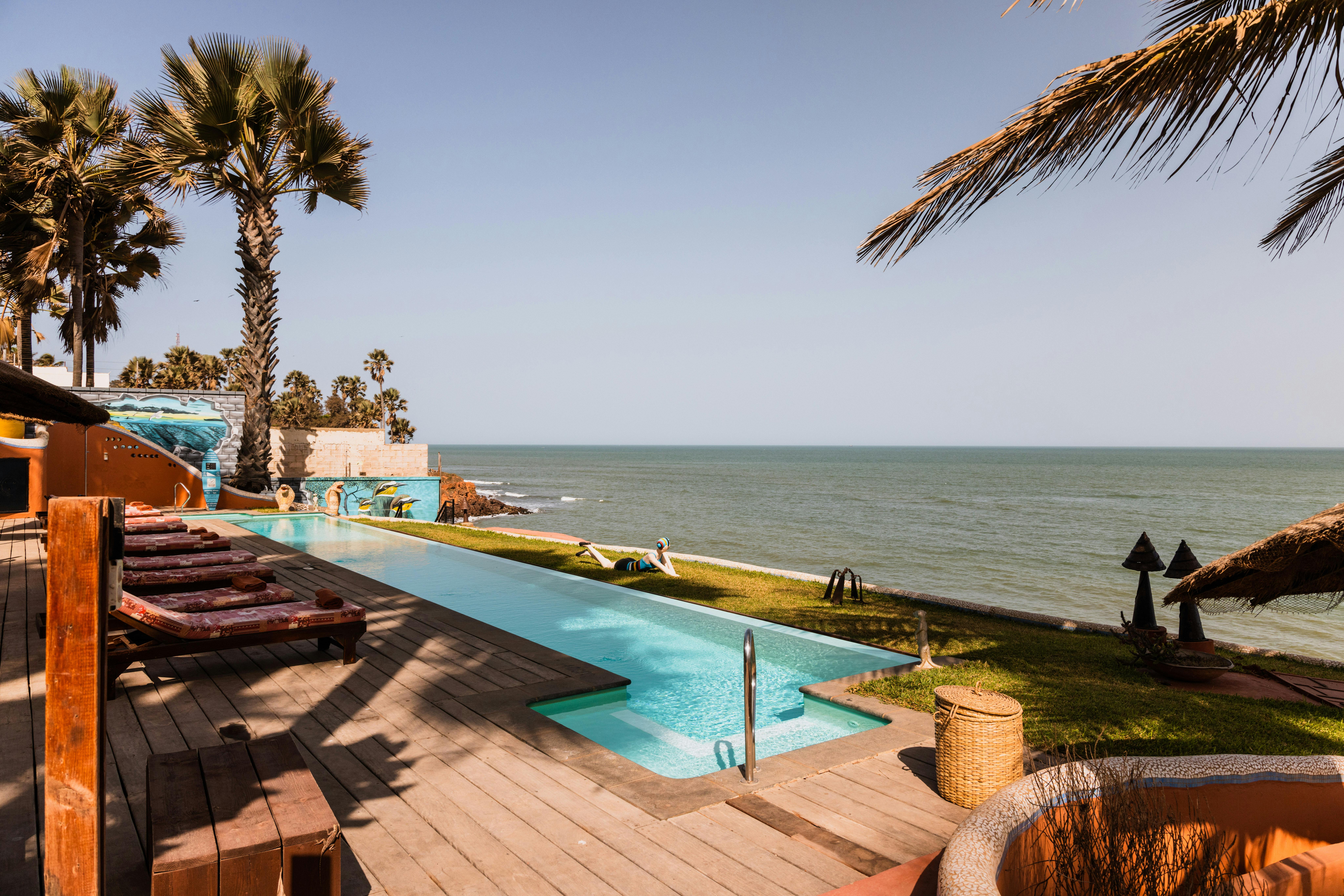
The complete guide for travellers: Dakar’s contemporary art scene that rivals anywhere in the world, Gorée Island and the history that has to be faced properly, the pink salt lake harvested by hand at dawn, a UNESCO mangrove delta where flamingos and dolphins share the channels, the green and river-carved south that most visitors never reach, the national dish that earned its UNESCO inscription, and why Senegal is the most complete West Africa introduction available from the UK.
Reading time: 14 minutes | Last updated: 2026
Teranga is a Wolof word that has no single English equivalent.
It means hospitality, but not in the hotel industry sense. It means welcome, but deeper than a greeting. It describes a relationship between host and guest that is a genuine cultural value in Senegalese society — an orientation toward the stranger that precedes any commercial transaction. The pirogue driver who shows you where the pelicans are without being asked. The guesthouse owner who feeds you before the bill is discussed. The market vendor who gives you extra with no expectation of return.
Teranga is also the word Senegal has chosen as its national identity slogan. The difference between a marketing choice and a genuine cultural value is the gap between intention and practice. In Senegal, the gap is small.
This matters for how Senegal is experienced as a destination. You land in Dakar — a West African capital with 3.7 million people, a vibrant contemporary arts scene, the best live music on the continent, and a fish market where the fishing boats come in at dawn — and the city receives you in a specific way. Not as a tourist economy receiving a visitor, but as a place that is genuinely curious about why you came and pleased that you did.
Senegal is the most accessible West Africa introduction available from the UK. Direct flights from London. No visa required. A tourist infrastructure (guesthouses, pirogue trips, eco-lodges in the delta) that has been developing around community benefit rather than mass hotel development. Daily costs from £25-40 at the mid-range. And the combination of sites — the weight of Gorée Island, the pink salt lake, the mangrove delta, the southern Casamance region that most visitors never reach — that makes a 10-day itinerary as dense with distinct experience as anywhere in this guide.
Quick Navigation
- The Case for Senegal — Teranga and What It Means in Practice
- When to Go — The Dry Season and the Pink Lake
- Getting There — Direct from London
- Dakar — The Capital That Rewards Engagement
- Gorée Island — The History That Has to Be Faced
- Lac Rose — The Pink Lake at Dawn
- The Petite Côte — The Atlantic Coast South of Dakar
- The Sine-Saloum Delta — UNESCO Mangrove Country
- Casamance — The Green South
- Saint-Louis — The Colonial River City
- Hidden Senegal — The Places Most Itineraries Miss
- What It Costs — Real Numbers
- Eating in Senegal — Thieboudienne and the Food UNESCO Listed
- Practical Notes
- The 10-Day Itinerary — Dakar to Casamance
The Case for Senegal — Teranga and What It Means in Practice
The practical case first.
Senegal is politically stable — one of the most consistently democratic countries in West Africa since independence in 1960. The Foreign Office does not advise against travel to Dakar, the Petite Côte, Saint-Louis, or the Saloum Delta. The Casamance region in the south has historically had security concerns related to a decades-long separatist movement; the situation has improved significantly since 2012, and the specific tourist areas (Ziguinchor city, Cap Skirring beach) are accessible to visitors. Check current FCDO advice before booking for Casamance specifically.
Direct flights from London Heathrow to Dakar on Air Senegal. No visa required for UK passport holders. A country that runs on CFA Francs (the West African currency, pegged to the Euro and therefore stable) with ATMs in Dakar and major towns.
The experiential case is harder to compress.
Senegal’s contemporary art scene — centred on the Dakar Biennale (Dak’Art, held in even years), the Les Galeries gallery network in the Plateau neighbourhood, and the permanent collections at the IFAN museum — is the most significant in sub-Saharan Africa. Artists from the École de Dakar (the postcolonial movement that synthesised African aesthetics with global modernism in the 1960s-1970s) are represented in the world’s major modern art collections. The artists working in Dakar now — Soly Cissé, Omar Victor Diop, Magatte Diop — are among the most internationally significant contemporary African artists.
The music: mbalax, the percussive Wolof music form made internationally known by Youssou N’Dour, is the sound of Dakar — originating in the sabar drumming tradition and synthesised with Cuban son, jazz, and Afrobeat over the 1970s and 1980s. The live music venues of Dakar (Just 4 U, the Thiossane) present the most vibrant live music culture in West Africa. N’Dour himself still performs occasionally at the Thiossane venue he owns.
When to Go — The Dry Season and the Pink Lake
October to June — The Dry Season
The main travel window. Dakar and the north are hot and dry (28-35°C). The Casamance and the south receive less rain than the north during the wet season and are accessible throughout the dry season. The harmattan wind (the dry, dusty wind from the Sahara) arrives in December-January, reducing visibility and bringing red-tinged skies over Dakar.
The Lac Rose (Retba) is most vividly pink in the dry season — the high evaporation rate concentrates the algae and bacteria that produce the colour. The peak colour months are November through April.
July to September — The Wet Season
Heavy rains throughout Senegal, particularly in Casamance (the wettest region). The Saloum Delta floods to its most expansive, making pirogue navigation through flooded mangrove channels possible but some roads impassable. The Casamance rice paddies are vivid green. Wildlife in the national parks (Niokolo-Koba, the Delta de Saloum) is at its most active. Hotel prices drop significantly.
The migratory birds arrive from Europe in October — the delta reaches its highest bird diversity in November-February, when European wading birds join the resident West African species.
The BGGD recommendation: November-February for the full circuit. November specifically: the harmattan hasn’t fully arrived, the Lac Rose is at its pinkest, the migratory birds have just arrived in the delta, and the temperatures are manageable.
Getting There — Direct from London
Air Senegal operates direct flights from London Heathrow to Dakar (Blaise Diagne International Airport, DSS — the newer airport 50km southeast of Dakar, opened in 2017). Flight time: approximately 6.5 hours. Return flights: £400-600 booked 6-10 weeks ahead. The airline has a reasonable on-board product and a good punctuality record.
Alternative routing: Via Paris (Air France or Air Senegal connection) or via Casablanca (Royal Air Maroc). The Paris routing adds 3-4 hours total but can be price-competitive and allows a Paris connection if combining with Europe.
Getting from Dakar airport to the city:
The new Blaise Diagne Airport is 50km from Dakar city centre. Options:
Airport taxi (fixed rate): negotiate before getting in the car. The official rate to central Dakar: approximately £20-25. Drivers will attempt significantly higher rates; negotiate firmly to the official rate.
Dem Dikk bus: the official airport bus service connecting the airport to Dakar’s Petersen bus station. Cost: £3. Journey: 1-1.5 hours depending on traffic. Buy the ticket at the airport bus counter before boarding.
Shared van (sept-place): occasionally available from the road outside the airport departure hall — significantly cheaper but less reliable.
Dakar — The Capital That Rewards Engagement
Dakar is a peninsula city — the Cap-Vert peninsula, the westernmost point of the African mainland. The city sprawls across the peninsula in neighbourhoods of distinct character: the Plateau (the colonial-era city centre, the government buildings and the old Medina), the Almadies peninsula (the beach clubs, the expat restaurants, the Atlantic-facing coastline), Ouakam and Yoff (the traditional Lebou fishing villages absorbed by the city’s growth), and the banlieues (the densely populated suburbs where the majority of Dakar’s residents live and work).
The African Renaissance Monument
On the Mamelles hill above the western city — a 49-metre bronze statue commissioned by former President Abdoulaye Wade, completed in 2010 by North Korean artists. The statue depicts a man, a woman, and a child emerging from a volcanic rock, the man’s arm raised pointing outward. The scale is extraordinary: larger than the Statue of Liberty when measured from the base of the figure. The symbolism is contested — Wade commissioned it as an affirmation of African renaissance and sovereignty; critics objected to the cost (£22 million), the aesthetics, and the foreign authorship.
Whether you consider it a triumph or a misfire, it is visible from most of Dakar and worth ascending (118 steps inside the structure give access to the crown viewpoint): the full peninsula, the Atlantic, the island of Gorée, and the city spread below. Entry: £8. The most comprehensive single viewpoint in Dakar.
The Village des Arts and the Dakar Art Scene
The Village des Arts on the Route de la Corniche is a complex of open studios for established Senegalese visual artists — painters, sculptors, textile artists, ceramicists. The studios are open to visitors during working hours (typically 9am-6pm, weekdays). The correct approach: walk slowly, enter studios that are open, watch the artists work, buy directly from the artist if something speaks to you.
The Les Galeries network in the Plateau and Almadies neighbourhoods: the commercial galleries showing contemporary Senegalese art with international distribution. The IFAN (Institut Fondamental d’Afrique Noire) Museum on Place de l’Indépendance: the finest collection of West African traditional art and ethnographic objects in Senegal, covering 16 West African countries. Entry: £3.
The Sandaga and Kermel Markets
Sandaga: the main central market of Dakar — fabrics (the wax-print cotton that is the most distinctive material in West African fashion), electronics, household goods, tailors working at sewing machines in the market lanes, the specific commercial energy of a city market of this density.
Kermel: a covered market in the Plateau neighbourhood, originally a colonial-era covered hall, rebuilt after a fire in 1993. Crafts, leather goods, jewellery, the fresh produce section below the craft level. More manageable than Sandaga for first-time visitors, but less representative of the city’s actual commercial life.
The Corniche — La Route de la Corniche
The coastal road running along the Atlantic face of the peninsula — the sea wall, the beach clubs (Terrou-Bi, Lagon 2), the fishermen’s beaches where the pirogues are drawn up, the early morning surf culture that has developed on the breaks north of the city. The Corniche at 6am, when the joggers and the fishermen share the road and the Atlantic is flat in the pre-dawn calm, is the most specifically Dakar moment available before breakfast.
Gorée Island — The History That Has to Be Faced
Gorée Island is 15 minutes by ferry from Dakar’s port (the ferry runs every 30-60 minutes throughout the day; last return from Gorée at 11pm; cost £1.50 return for visitors). The island is approximately 900 metres long and 350 metres wide.
From the 15th to the 19th century, Gorée was successively under Portuguese, Dutch, French, and British control and served as a depot for enslaved Africans during the transatlantic slave trade. The Maison des Esclaves (House of Slaves) is the most visited site in West Africa — a building constructed in 1776 that has been identified as the site from which enslaved people boarded ships for the Americas. Every president of the United States since Bill Clinton has visited the “Door of No Return” — the doorway opening directly onto the sea from which enslaved people were loaded onto ships.
The historical accuracy of the Maison des Esclaves as a primary slave-trading site has been disputed by some historians who note that Gorée’s primary role was as a trading post and administrative centre rather than a major slave-loading point, and that larger slave ports operated elsewhere on the West African coast. The debate among historians does not change the weight of what the island represents or the importance of attending it with full seriousness.
The visit:
Enter the Maison des Esclaves with an official guide (guides are available at the entrance; the official guide fee is negotiated separately from entry). The guide’s context is essential — the physical layout of the building (the men’s cells at ground level, the women’s cells, the children’s rooms, the Door of No Return at the rear), the timeline of the slave trade, the numbers (approximately 12.5 million people were transported from West Africa to the Americas across the full period of the transatlantic trade), and the specific history of Gorée in the regional context.
No photography inside the Maison des Esclaves. This is stated at the entrance and should require no explanation.
Beyond the Maison des Esclaves: the island’s streets, lined with pastel-coloured colonial houses draped in bougainvillea, are beautiful in a way that sits uncomfortably with the island’s history. Both things are present simultaneously. Walk the streets. Visit the IFAN Historical Museum of Gorée (the oldest museum in West Africa, covering Gorée’s full history from Portuguese settlement to independence). Eat lunch at one of the island’s restaurants (the seafood is excellent, the grilled fish caught from the waters around the island).
Return to Dakar on the afternoon ferry.
Lac Rose — The Pink Lake at Dawn
Lac Retba (universally called Lac Rose) is a saline lake 30km northeast of Dakar — separated from the Atlantic Ocean by a narrow sand spit. The lake’s salinity reaches 40% (ten times the salinity of the ocean) during the dry season, creating conditions for Dunaliella salina (a salt-tolerant algae) and halophilic bacteria that produce carotenoid pigments, turning the water pink to rose-red.
The colour varies by time of day and season: most vivid in the dry season (November-April), most vivid in the morning and late afternoon when the light is low. At noon in April, the lake can appear a deep rose. At dawn in November, it can appear almost red with areas of deep pink.
The salt harvest:
Men wade waist-deep into the water, breaking up the crust of crystallised salt from the lake floor with long-handled implements, loading it into pirogues, and paddling to the shore where women sort and bag the harvest. The workers coat their skin in shea butter to protect against the corrosive salt. This has been happening at the same lake for generations.
The salt from Lac Rose is sold throughout Senegal and exported to West Africa and parts of Europe. Watching the harvest at dawn — the men in the pink water, the pirogues loaded with white salt, the light coming across the lake from the east — is one of the most specific and most underrated visual experiences in Senegal.
Getting there:
Day trip from Dakar: shared taxi from the Gare Routière de Parcelles Assainies (the correct bus station for the north — ask at your guesthouse for the current route) costs £4-6 each way. Alternatively, organise through your guesthouse or a tour operator (£12-20 for a private car, worth it for the dawn timing).
Arrive before 7am to see the harvest in the best light. By 10am the tour groups from Dakar’s hotels have arrived and the experience changes character.
The Petite Côte — The Atlantic Coast South of Dakar
The Petite Côte runs south from Dakar for approximately 80km — a series of fishing villages, beach resorts, and the most accessible Atlantic coast within easy reach of the capital.
Toubab Dialaw:
50km south of Dakar — an artist’s village on a rocky Atlantic promontory where a community of Senegalese artists, musicians, and writers established an arts centre (Sorano) in the 1980s. The village has a handful of guesthouses, the Sorano arts centre with a performance schedule, and a beach below the rocky headland. One of the most characterful small communities on the Petite Côte.
Saly:
The primary beach resort zone of Senegal — a strip of hotel developments catering primarily to French package holidaymakers. Not the most interesting section of the Petite Côte, but the beach itself (calm, wide, well-maintained) is the most accessible beach to Dakar with full facilities.
Mbour:
The main fishing port of the Petite Côte — a working city with the largest fishing fleet in Senegal. The fish market at Mbour’s port (the landing and sorting of the catch, the buyers, the smoke-houses where some of the catch is preserved) is one of the most significant working fishing port experiences in West Africa. Go at dawn when the boats return. The energy, the scale, and the specific smell of a major fish landing are unlike anything else on the Petite Côte.
The Sine-Saloum Delta — UNESCO Mangrove Country
The Sine-Saloum Delta is where the Sine and Saloum rivers meet the Atlantic — a system of tidal channels, mangrove forests, seasonal marshes, and the extraordinary shell islands (iles de coquillages) that are low-lying mounds formed from centuries of accumulated oyster and shellfish remains from ancient communities. UNESCO designated it as a biosphere reserve in 1981.
The delta is 4-5 hours south of Dakar by shared taxi or car (the road south from Dakar through Mbour and Joal to the delta gateway town of Ndangane passes through a landscape of baobab trees, millet fields, and Serer fishing communities).
What the delta contains:
Birds — the delta hosts one of the largest concentrations of waterbirds in West Africa: great white pelicans (in flocks of hundreds), pink flamingos on the shallower pans, royal terns, yellow-billed stork, African spoonbill, western reef heron, grey-headed gull, and hundreds of species of European migratory waders that winter here from November to March.
Wildlife — bottlenose dolphins in the outer channels (sighted on most pirogue trips through the delta), sea turtles (the beaches of the outer islands are nesting sites for green and loggerhead turtles), monitor lizards in the mangroves.
The shell islands (Dionewar, Betanti, Guior) — low-lying inhabited islands accessible only by pirogue, the communities living on the accumulated oyster shell middens of their ancestors. The communities of the shell islands maintain traditional Serer fishing culture, speak Serer alongside Wolof and French, and host visitors through a community-based eco-tourism programme.
The pirogue trip:
Arrange through your eco-lodge or through the pirogue operators at Ndangane pier. A half-day trip (3-4 hours) covers the main bird viewing channels, a stop at a mangrove channel to observe the vegetation and its inhabitants, and a landing at one of the shell island communities. Cost: £15-25/person for a shared pirogue, £40-70 for a private pirogue.
The dawn departure (5:30am) gives the finest bird activity and the best light. The mangrove channels in the early morning mist, with the sounds of the delta before the day wind picks up, is one of the most immersive natural experiences in West Africa.
Eco-lodge accommodation:
The Saloum Delta has some of the finest community eco-lodges in West Africa — guesthouses owned and staffed by local communities, where the accommodation income stays in the village, the food is cooked by community members using local ingredients, and the pirogue trips are operated by local fishermen. Rates: £30-60/night full board. Book ahead — the best eco-lodges (La Palmeraie de Ndangane, Keur Saloum) are small and fill up.
Casamance — The Green South
Casamance is the southern region of Senegal — geographically separated from the north by The Gambia (which occupies a strip of territory along the Gambia River, dividing Senegal into north and south). The Casamance River runs through a landscape of dense forest, rice paddies, mango groves, and mangrove channels that is entirely different from the dry savannah of northern Senegal.
The region is the homeland of the Diola people — an ethnic group known for their traditional animist spiritual practices (maintained alongside Islam and Christianity in a syncretism specific to the Casamance) and their resistance to central authority (the separatist movement MFDC — Movement of Democratic Forces of Casamance — conducted a low-level insurgency from 1982 to approximately 2012, with sporadic incidents since).
The current situation:
The FCDO advises exercising caution in Casamance, with specific areas of the region subject to higher advisory levels. The tourist areas — Ziguinchor city, the road between Ziguinchor and Cap Skirring, and Cap Skirring itself — are considered accessible. Check the current FCDO advice at gov.uk/foreign-travel-advice/senegal before planning Casamance travel.
Ziguinchor:
The regional capital — a relaxed, genuinely un-touristed city of 250,000 people on the Casamance River. The fruit market in the morning (the mangoes, papayas, and citrus of the south, grown in the riverside orchards), the pirogue traffic on the river, the Catholic and animist shrines alongside the mosques. The most laid-back city in Senegal, by the assessment of everyone who has been to both Dakar and Ziguinchor.
Cap Skirring:
A beach 80km from Ziguinchor on the Atlantic coast — broad, uncrowded, the ocean unobstructed to the horizon. The wave energy here is higher than the sheltered Petite Côte beaches north of Dakar; the surfing is developing, the tourism infrastructure is minimal, and the beach at sunset (walked to the fishing village on the northern end, where the pirogues are drawn up) is as good as any in West Africa.
The pirogue trips from Cap Skirring into the mangrove channels: guided by local Diola fishermen, passing through the forest channels where the birds are dense and the sound of the ocean disappears. The forest interior of the Casamance, accessible by pirogue on the river channels, is the closest thing to pristine West African forest available within range of a tourist circuit.
Getting to Casamance:
The most straightforward option: domestic flight from Dakar to Ziguinchor on Air Senegal or Transair (1 hour, £60-90 one way — worth it). The road from Dakar to Casamance requires crossing The Gambia (at the Karang border crossing) — manageable but adds significant time (8-10 hours total) and the Gambian border crossing.
The ferry from Dakar to Ziguinchor (the Aline Sitoé Diatta ferry): a 20-hour overnight journey on the Casamance Express ferry, departing Thursday and Friday evenings from Dakar’s port. The ferry is an experience in itself — the Atlantic crossing, the Casamance River approach at dawn. Budget: £15-25 for deck class, £30-45 for a cabin. Book at the Dakar ferry terminal or through a Dakar travel agent.
Saint-Louis — The Colonial River City
Saint-Louis is in the north of Senegal, on the Langue de Barbarie — a narrow sand spit between the Senegal River and the Atlantic, near the Mauritanian border. Founded by the French in 1659, Saint-Louis was the capital of French West Africa until 1902 and the capital of Senegal until independence in 1960.
The city is UNESCO-listed. The colonial architecture — faded but intact, the iron balconies, the coloured facades, the specific narrowness of the island streets — gives it the most distinct urban character of any city in Senegal. Saint-Louis is often described as “Africa’s New Orleans” for the jazz and blues tradition that developed here (the St. Louis du Sénégal Jazz Festival, held annually in May, is one of the finest music festivals in West Africa).
The Langue de Barbarie:
The sand spit south of the island city — a 26km narrow strip of sand between the ocean and the river, the Parc National de la Langue de Barbarie at its southern end. The park hosts the most important bird colony in West Africa’s coast: the Île aux Oiseaux (Bird Island) where cormorants, herons, royal terns, and a dozen other species nest in extraordinary concentrations.
The pirogue trip from Saint-Louis to the bird colony: £10-15/person in a shared pirogue, the fisherman paddling past the colonial riverfront through the city to the open river, then south to the park. Bird colony visits at dawn when the activity is highest.
The Peul cattle herding and the Sahel:
North of Saint-Louis, the landscape transitions to Sahel — the semi-arid band at the southern edge of the Sahara. The Mauritanian border is 10km north. The Peul (Fulani) pastoralists who drive their cattle through the Sahel cross the Senegal River seasonally. The landscape north of Saint-Louis — flat, dry, the acacia trees silhouetted against the harmattan sky — is Africa’s northern edge, a distinct landscape from anything else in Senegal.
Getting to Saint-Louis:
4 hours from Dakar by shared taxi or NDiaga Ndiaye bus (£6-10) via Thiès. The road is good. Worth 2 nights minimum.
Hidden Senegal — The Places Most Itineraries Miss
The Dakar Medina
The Medina neighbourhood of Dakar — built by the French colonial administration in 1914 as a segregated area for the African population (the Point-E and Plateau areas were reserved for Europeans) — is the most densely populated and most culturally authentic neighbourhood in Dakar. The Grand Mosque of Dakar (the largest mosque in West Africa, completed 1964) is in the Medina. The neighbourhood market (Marché HLM) sells the finest quality wax-print fabrics in Dakar, the tailors of the Medina produce custom clothing at a fraction of boutique prices, and the music coming from the recording studios and rehearsal spaces is the most concentrated mbalax production available in the country.
The Bassari Country
The southeastern corner of Senegal — the Pays Bassari, UNESCO World Heritage Listed for its cultural landscapes and the traditional ceremonies of the Bassari, Fula, and Bedik peoples. The Bassari male initiation ceremonies (held in May-June) are among the most significant traditional ceremonies in West Africa still practiced in their original form. The landscape: forested hills that feel more like central Africa than the Sahelian north.
Access: 8-10 hours from Dakar by bush taxi toward Kedougou. Remote, genuinely off-circuit, accessible to travellers who plan ahead and contact community tourism organisations in advance.
The Touba Mosque
The holy city of Touba, 200km east of Dakar — the spiritual capital of the Mouride brotherhood, the largest Sufi order in Senegal. The Great Mosque of Touba is one of the largest mosques in Africa. Non-Muslims can enter the city and observe the exterior of the mosque; the interior is restricted.
The Magal de Touba (the annual Mouride pilgrimage, dates vary by Islamic calendar) brings 3-4 million pilgrims to Touba in a single week — one of the largest religious gatherings on Earth and entirely off the international travel radar.
Podor and the Fleuve
A colonial-era river town on the Senegal River in the far north — the Faidherbe bridge (a smaller version of the bridge built by the same engineer in Saint-Louis), the colonial-era Fort de Podor, and the river communities of the Fleuve (the Senegal River basin). Accessible from Saint-Louis by shared taxi (2 hours). Genuinely remote from the international tourist circuit.
What It Costs — Real Numbers
Senegal is comfortably affordable for UK travellers — not as cheap as Southeast Asia but significantly cheaper than most African safaris, with better-developed community tourism infrastructure than most comparable West African destinations.
Daily Budgets
Budget (£20-30/day)
- Accommodation: guesthouse, shared bathroom (£8-15/night)
- Food: local restaurants, street food, rice and fish (£5-8/day)
- Transport: shared taxis, sept-place vans between cities
Mid-range (£35-55/day)
- Accommodation: guesthouse private room or small boutique hotel (£18-30/night)
- Food: restaurant meals, one good dinner (£10-16/day)
- Activities: pirogue tours, guided site visits
Comfortable (£70-100/day)
- Accommodation: eco-lodge in the Saloum Delta or boutique hotel Dakar (£40-65/night full board)
- Food: quality restaurants in Dakar (£18-28/day)
- Activities: private pirogue, guided art tours
What 10 Days in Senegal Actually Costs from the UK
| Category | Budget | Mid-Range |
|---|---|---|
| Return flights (Air Senegal direct) | £400–600 | £450–650 |
| 10 nights accommodation | £100–175 | £220–380 |
| Food (10 days) | £60–95 | £110–175 |
| Gorée Island ferry | £2 | £2 |
| Saloum Delta eco-lodge (2 nights full board) | £65–90 | £90–130 |
| Pirogue tours and activities | £40–65 | £60–100 |
| Internal transport (taxis, domestic flight to Casamance) | £50–90 | £80–140 |
| Total | £717–1,117 | £1,012–1,577 |
Eating in Senegal — Thieboudienne and the Food UNESCO Listed
Senegalese cuisine was inscribed on the UNESCO Representative List of the Intangible Cultural Heritage of Humanity in 2021 — specifically thieboudienne, the national dish, and the broader food culture around it. The designation cites the communal preparation, the knowledge transmission between generations, and the cultural identity embedded in the dish.
Thieboudienne (pronounced “cheh-boo-JEN”) is the most important single dish in Senegalese culture. Understanding it properly requires understanding the components.
Thieboudienne
Rice cooked in a tomato and fish broth, served with whole fish (typically thiof — white grouper, the finest fish in Senegalese waters) and vegetables (cassava, cabbage, aubergine, carrot, sweet potato) arranged around the rice on a communal platter. The rice absorbs the fish and tomato flavour during cooking; the crust that forms at the bottom of the pot (the xoon) is considered the finest part.
Eaten communally — the platter placed in the centre of the floor or a low table, everyone eating with their right hand (the left hand is not used for eating). The fish is broken apart and distributed by the host; the sharing of the fish is a social act, not just a meal.
At any good Dakar restaurant: £3-6 for a full plate. At the women’s food cooperatives in the residential neighbourhoods: £2-3. At a guesthouse: typically included in the half-board rate.
Yassa
Chicken (yassa poulet) or fish (yassa poisson) marinated in lemon juice and mustard, then slow-cooked with an enormous quantity of caramelised onions until the onion is collapsed and sweet. The dish originates in the Casamance region but is now eaten throughout Senegal. The balance of citrus, mustard, and sweetened onion is the most specifically Senegalese flavour profile in the cuisine. At any restaurant: £2.50-5.
Mafé
A peanut stew — lamb or chicken in a sauce of ground peanuts (groundnut paste), tomato, and spices. The peanut gives a thick, rich, slightly sweet base that absorbs the spices completely. West African peanut stew exists in variations from Senegal to Ghana; the Senegalese version is typically thicker and more deeply spiced than its neighbours. At local restaurants: £2.50-4.
Thiakry
A dessert of fermented millet (couscous millet) mixed with sweetened sour cream (crème fraîche), raisins, and sometimes coconut. Cooling, slightly sour, the millet giving a textural contrast to the cream. Available from street vendors and at the end of communal meals. The specific taste of soured dairy and fermented grain is an acquired preference that most visitors acquire after the second or third encounter.
The communal eating culture:
The bowl or platter placed in the centre for communal eating is not merely a serving format. It encodes relationships: who shares with whom, who serves the best portions, how guests are distinguished from family members by the quality of the fish they receive. Accepting the invitation to share a communal meal in a Senegalese home is an expression of teranga from both sides — the host’s welcome and the guest’s willingness to participate.
Ataya (Senegalese tea ceremony):
The three-round green tea ceremony — similar to the Moroccan version but with specific Senegalese character. Chinese gunpowder green tea, steeped strong in a small teapot with large quantities of sugar, poured from height into small glasses to create foam, served in three progressively weaker rounds. The ceremony takes 30-45 minutes. Each round has its meaning (bitter as life, sweet as love, mild as death — the traditional formulation). Participating in the ataya ceremony when offered is the equivalent of accepting coffee in Ethiopia or tea in Morocco — a social signal that you’re willing to be present.
Practical Notes
Visa: No visa required for UK passport holders. Stamp on arrival at Dakar airport. Up to 90 days. No fee.
Getting there: Air Senegal operates direct flights from London Heathrow to Dakar. Flight time: approximately 6.5 hours. Return flights: £400-600. Air France (via Paris) and Royal Air Maroc (via Casablanca) also serve Dakar with single-connection routings.
Currency: West African CFA Franc (XOF, specifically the BCEAO franc). £1 ≈ 850 XOF at time of writing (the CFA franc is pegged to the Euro, so the rate is stable). ATMs are widely available in Dakar, Saint-Louis, Ziguinchor, and tourist areas. Cash is necessary for market purchases, shared taxis, and rural areas. Euros are accepted at some guesthouses and hotels but at a slightly unfavourable rate.
Getting around: Shared taxis (taxi-brousse) and sept-place vans connect all major cities — the most economical intercity transport. Depart from the gare routière (bus station) in each city. Dakar to Saint-Louis: 4 hours, £6. Dakar to Kaolack (for the Saloum Delta): 3 hours, £5. Within Dakar: local taxis (negotiate the price before getting in), Dakar Dem Dikk buses, and occasionally Yango (the local ride-hailing app).
Domestic flights: Air Senegal and Transair serve Dakar-Ziguinchor (Casamance) and occasionally Dakar-Saint-Louis. Worth the price for the Casamance connection.
Language: Wolof is the most widely spoken language in Senegal (by approximately 90% of the population as a first or second language, despite Wolof speakers being approximately 43% of the population by ethnicity — Wolof functions as the lingua franca). French is the official language of government, education, and formal business. English is limited to tourist-facing establishments in Dakar; outside the capital, French is the required second language. “Naka nga def?” (how are you in Wolof), “Jamm rekk” (peace only — the standard response), “Jerejef” (thank you in Wolof) — these are received with the specific warmth that greetings in Wolof produce from Senegalese people.
Health: Yellow fever vaccination certificate required for entry — carry the yellow card. Malaria prophylaxis recommended throughout Senegal. Hepatitis A and Typhoid recommended. The harmattan dust in December-January affects respiratory conditions — bring nasal saline spray if sensitive to dust.
Photography etiquette: Ask before photographing people — particularly at markets, in religious spaces, and in rural communities. The Senegalese attitude toward photography of individuals is generally warm but requires the respect of asking. At Gorée Island’s Maison des Esclaves: no photography inside the building.
The 10-Day Itinerary — Dakar to Casamance
This route runs from Dakar south through the Petite Côte to the Saloum Delta and then to Casamance — the full north-to-south arc of the country’s most rewarding circuit.
Day 1: Arrive Dakar
Land at Blaise Diagne Airport. Dem Dikk bus or negotiated taxi to accommodation in the Plateau or Almadies. Rest and orientation. Evening walk along the Corniche.
Day 2: Dakar
Morning: African Renaissance Monument (8am before the tour groups). Village des Arts late morning. Sandaga market at noon. IFAN Museum afternoon. Dinner in the Plateau neighbourhood.
Day 3: Gorée Island
Ferry from Dakar port at 9am (20 minutes). Maison des Esclaves with official guide (1.5 hours). IFAN Historical Museum. Lunch on the island (seafood at one of the waterfront restaurants). Afternoon walk the streets. Return ferry at 4pm. Evening ataya at a local café.
Day 4: Lac Rose + Afternoon
Shared taxi from Parcelles Assainies at 5:30am to Lac Rose. Dawn salt harvest. Return to Dakar by 11am. Afternoon: rest or the Kermel market. Evening: live music at Just 4 U or another Dakar music venue (ask at accommodation for current schedule).
Day 5: Petite Côte — Mbour
Shared sept-place from Dakar south to Mbour (2 hours). Fish market at the port (late morning, after the boats return). Afternoon: beach. Night in Mbour or continue to Joal.
Day 6: Saloum Delta — Ndangane
Bush taxi from Mbour to Kaolack (2 hours), then to Ndangane (1.5 hours). Check into eco-lodge. Afternoon pirogue in the delta channels for the bird watching.
Day 7: Saloum Delta
5:30am pirogue departure for the dawn bird activity. Shell island community visit. Mangrove channel navigation. Back to eco-lodge by noon. Afternoon rest. Evening: dinner at the lodge (thieboudienne from the morning’s catch).
Day 8: Ziguinchor, Casamance (fly)
Return bush taxi to Kaolack. Domestic flight from Kaolack or Dakar to Ziguinchor (Air Senegal, 1 hour). Check in Ziguinchor. Afternoon: the fruit market, the river front, the relaxed evening of the most un-touristed city in Senegal.
Day 9: Cap Skirring
Bush taxi or private car from Ziguinchor to Cap Skirring (1.5 hours). Beach day on the Atlantic coast. Afternoon: pirogue into the mangrove channels from the village pirogue landing. Evening: grilled fish at the beach.
Day 10: Return to Dakar
Morning flight Ziguinchor to Dakar (1 hour). Afternoon in Dakar for final purchases (fabric from the Medina, crafts from the Village des Arts). Evening flight home.
Final Thought
I was in a pirogue at dawn in the Saloum Delta. The engine was off — we were drifting through a mangrove channel so narrow that the roots touched the sides of the boat. The fisherman at the stern was using a paddle to guide us, making no sound.
The birds were everywhere. A great white pelican passed overhead at eye level — so close I could see the individual feathers. A purple heron stood motionless in the mangrove roots. The sound was entirely birdsong and water.
Then the fisherman spoke quietly in Wolof and pointed. In the channel ahead: a pod of bottlenose dolphins, four of them, navigating the channel in the same direction we were moving. They didn’t change course. We followed for three minutes at the same unhurried pace, the dolphins visible just below the surface, the mangroves closing around us.
This is what teranga looks like when it’s applied to an ecosystem rather than a person. The fisherman who has known this channel for thirty years, who knows where the dolphins go in the morning, who shares that knowledge without being asked, without a charge, because the knowledge is not a product.
Senegal is the most welcoming country I’ve been to in Africa. The welcome isn’t a performance. It’s the place, and the people in it, being entirely and genuinely themselves.
Question about Senegal this guide doesn’t cover? Drop it in the comments.