

The cork oak forests where the bark has been stripped in the pattern that makes the trees look like they’re wearing socks, Évora’s Roman temple standing in the middle of a modern city as though the gap between then and now doesn’t exist, the painted whitewashed villages on the Spanish border that receive the finest afternoon light in Portugal, the Alentejo wine that earns its comparison to Burgundy and costs a quarter of the price, the megalithic monuments that predate Stonehenge and stand in farmland with no fencing and no entry fee, and why this is the Portugal that most visitors miss entirely.
Reading time: 12 minutes | Last updated: 2026
The Alentejo is Portugal’s largest region by area — a third of the entire country, south of Lisbon, north of the Algarve, bordered by Spain to the east. Its population is approximately 750,000. Its landscape is the cork oak plateau, the olive grove, the wheat field, the sunflower (in summer, the sunflower fields of the central Alentejo are among the finest agricultural landscapes in Europe), and the whitewashed hill town on the ridge above the plain.
It receives approximately 8% of Portugal’s international tourism.
This statistic is the most useful single piece of information for planning a Portugal trip. The Alentejo contains: the finest Roman temple on the Iberian Peninsula, one of the most significant prehistoric megalithic landscapes in Europe, some of the finest red wine produced in the Western Mediterranean, the most intact collection of medieval fortified hill towns in Portugal, and the specific quality of silence and light that comes from a landscape of enormous scale with very few people in it.
Visitors come from Lisbon (1.5 hours by road), look at Évora for a day, and go back. The Alentejo that exists beyond Évora — the border fortresses, the cork forests of the Alentejo coast, the wine estates of the Guadiana valley, the prehistoric monuments of the Évora plateau — is available to anyone willing to stay two more nights.
This guide covers why that’s worth doing.
Quick Navigation
- The Three Alentejo Zones
- When to Go — The Specific Case for Spring and Autumn
- Getting There
- Évora — The Roman Capital
- The Megalithic Monuments — Older Than Stonehenge
- The Alentejo Wine — The Region That Punches Above Its Weight
- The Border Fortresses — Elvas, Marvão, Monsaraz
- The Alentejo Coast — The Undiscovered Atlantic
- The Cork Oak Forest — What It Is and How It Works
- The Herdades — Estate Tourism
- Hidden Alentejo
- What It Costs
- Eating in the Alentejo — The Pork, the Bread, and the Soup
- Practical Notes
- The 4-Day Itinerary
The Three Alentejo Zones
Alto Alentejo (Upper Alentejo): The northern section, bordering Spain — the marble quarry country (Estremoz, Borba, and Vila Viçosa are the three towns of the Alentejo marble triangle, the quarries producing 40% of the world’s white marble), the fortified border towns (Elvas, Marvão), and the wine estates of the Portalegre region (the highest Alentejo vineyards, the coolest climate, the most elegant wines).
Baixo Alentejo (Lower Alentejo): The southern section, bordering the Algarve — flatter, hotter in summer, the cork oak forests of the Alentejo coast, the Guadiana River valley, and the Alqueva reservoir (the largest artificial lake in Western Europe, created in 2002, the dark-sky reserve around it one of the finest stargazing sites in Europe).
Alentejo Central: Évora and the surrounding plateau — the prehistoric megalithic sites, the Roman city, the wine estates of the Évora DOC, and the painted hill towns of the Évora district.
When to Go — The Specific Case for Spring and Autumn
March to May — Spring
The finest season. The wildflowers of the Alentejo plateau (March-April — the cistus, the poppies, the wild lavender, the asphodel that covers the cork oak forest floor) are at peak. The megalithic monuments surrounded by wildflowers rather than burnt summer scrub. The temperature is ideal for walking (18-24°C). The wine estates begin the outdoor season. The sunflower fields haven’t yet bloomed (that’s June) but the wheat is green.
June — The Sunflower Moment
Late June: the sunflower fields of the central Alentejo plain are in full bloom — a specific agricultural landscape that exists for approximately 3 weeks before the flowers turn brown. An entirely different Alentejo from any other month.
July and August — Hot
40-45°C in August. The Alentejo has the hottest summer climate in continental Portugal. The outdoor activities (cycling the cork forest trails, the megalith walks) require very early morning starts. The wine estates operate; the fortified towns are easier with the heat in mind.
September to November — The Best Second Window
The harvest. September: the grape harvest in the wine estates (the vindima, the most atmospheric time to visit a herdade). October: the olive harvest beginning. November: the cork forest turning in autumn colour. The temperature at 20-28°C. The tourist density lower than spring.
The BGGD recommendation: April for the wildflowers and the megaliths. September for the harvest and the wine.
Getting There
From Lisbon: 1.5 hours by car to Évora. Direct bus from Lisbon Sete Rios bus station to Évora (1.5 hours, €12.50 / £10.75, Rede Expressos — book at rede-expressos.pt). Train from Lisboa Oriente to Évora (1.5 hours, €12 / £10.35). Car hire from Lisbon is the most flexible option for the full Alentejo circuit.
From the Algarve: 2.5-3 hours north from Faro by car. The natural pairing: Algarve week, Alentejo extension, Lisbon finish.
From Spain: The border town of Elvas is on the main Lisbon-Madrid motorway — the Alentejo is the natural first stop for travellers arriving from Spain by road.
Getting around: Car hire essential for the full Alentejo circuit. The public bus network connects the main towns (Évora, Beja, Portalegre, Elvas) adequately; the border fortresses, the wine estates, and the megalithic sites require a car.
Évora — The Roman Capital
Évora is a UNESCO World Heritage Site — the finest preserved medieval city in Portugal, built on and around a Roman city (Liberalitas Julia, established in the 1st century BCE) that itself was built on an earlier Celtic and possibly pre-Celtic settlement.
The Roman Temple:
The most visible Roman structure in Portugal — 14 granite columns of a 2nd-century CE temple (traditionally attributed to Diana but probably dedicated to the imperial cult) standing in the city centre, the columns intact to the Corinthian capital level. The temple is not behind a fence or managed at a distance — it stands in the Largo do Conde de Vila Flor, adjacent to the terrace of a café where people drink coffee within 10 metres of it.
The specific quality: the temple has not been turned into a museum. It is simply there, in the city, in the way that the Romans left it (and the subsequent medieval inhabitants preserved it, using it as the city abattoir in the 14th century — which is why the stones survived rather than being quarried).
Free access. Best at 6am when the street is empty and the morning light comes from the east.
The Chapel of Bones (Ossuário, Igreja de São Francisco):
The chapel whose walls and ceiling are entirely decorated with the skulls and bones of approximately 5,000 Franciscan monks — the inscription above the entrance reads “We bones that are here await yours.” Built in the 16th century from the bones of monks disinterred from the city’s overcrowded cemeteries.
The specific quality: this is not a macabre spectacle arranged for tourism. It was built as a memento mori — a reminder of mortality for the monks who passed through daily — in a theological tradition that treated the contemplation of death as spiritually useful. The bones are arranged with artistic intention: the skulls in patterns, the long bones in friezes, the effect closer to a specific artistic vision than to horror.
Entry: €4 / £3.45.
The Cathedral (Sé de Évora):
The largest medieval cathedral in Portugal, begun in 1186 on the highest point of the city — the Romanesque portal with the Apostles carved in the voussoirs, the Gothic cloister (the only Royal cloister in Portugal, the royal tombs of the House of Avis arranged in the cloister walls), the 18th-century sacristy with its azulejo tile programme. Entry: €4 / £3.45.
The Évora University:
Founded 1559 by Cardinal Henrique (the future king) — the second university established in Portugal after Coimbra. The cloister of the University building is one of the finest Renaissance cloisters in the country. The azulejo panels covering the lecture room walls (the panels depicting the great thinkers of antiquity — Aristotle, Plato, Pythagoras — in 18th-century blue-and-white tile work) are the most instructive single decorative programme in Évora.
The Megalithic Monuments — Older Than Stonehenge
The Évora plateau is one of the most significant prehistoric megalithic landscapes in Europe — a concentration of dolmens, menhirs, and stone circles from the Neolithic period (4500-2000 BCE) that predates Stonehenge by 500-1,000 years.
The specific Alentejo megalithic quality: most of the monuments are in farmland, accessible from the road, with no fencing, no entry fee, and no significant visitor infrastructure. You walk from your car, across a field, to a 6,000-year-old stone tomb. No queue, no ticket booth, no audio guide.
The essential sites:
Anta Grande do Zambujeiro: The largest dolmen in Portugal and one of the largest in Europe — a 6-metre high granite burial chamber with a 14-metre diameter capstone (now collapsed to one side). 10km west of Évora, accessible by a farm track. Often completely empty of visitors.
Cromeleque dos Almendres: A stone circle of 95 granite monoliths, oval in plan, dated to approximately 5000 BCE — the largest megalithic complex on the Iberian Peninsula. 15km west of Évora. Adjacent to the site (200m along the same track): the Menir dos Almendres, a single standing stone 2.5m high with carved cup marks and a schematic face.
Anta de São Brissos and Anta de Tapadão: Two dolmens north of Évora accessible from the same road — both in olive orchards, both accessible on foot from a field gate.
The experience:
The Almendres stone circle at 7am in April: the wildflowers covering the surrounding scrubland, the cork oaks visible on the ridge above, the stones standing in the low morning light, no other visitors. 5,000 years before the morning. The specific quality of standing inside a monument of this age in complete solitude — which is entirely possible in the Alentejo in a way that it is not at Stonehenge or Carnac — cannot be manufactured at any other site.
The Alentejo Wine — The Region That Punches Above Its Weight
The Alentejo produces approximately 50% of Portugal’s bottled wine by volume and has become, over the past 20 years, the most internationally acclaimed Portuguese wine region. The DOC Alentejo covers the full region; the sub-regions (Borba, Redondo, Évora, Vidigueira, Granja-Amareleja) each produce wines of distinct character.
The grapes:
The indigenous Alentejo red varieties — Aragonez (Tempranillo), Alicante Bouschet (a teinturier — a grape whose flesh as well as skin is red, producing deeply coloured wines), Trincadeira, and Touriga Nacional — produce the region’s finest reds. The Antão Vaz and Arinto grapes produce the white wines, which are underknown internationally but some of the finest warm-climate whites in Portugal.
The wine estates:
Herdade do Esporão: The most visitor-ready — a large estate near Reguengos de Monsaraz with a contemporary winery building by a Portuguese architect, a restaurant serving estate and local produce, a wine museum, and olive oil production. Tours and tastings: €8-15 / £7-13. The Esporão Reserva (the estate’s most visible wine internationally) is fine; the Monte Velho (the second wine) represents extraordinary value at €6 / £5 at the cellar door.
Herdade dos Grous: South of Beja — a smaller, more intimate estate with a guesthouse (the finest estate accommodation in the Baixo Alentejo), a restaurant, and a wildlife reserve on the property (the Great Bustard, the heaviest flying bird in the world, uses the estate’s uncultivated sections). Tastings by appointment.
Adega Mayor: In Campo Maior, near Elvas — a winery designed by the Portuguese architect Álvaro Siza Vieira, the architectural quality as significant as the wine. Guided visits of the architecture and tastings by appointment.
The price reality:
A bottle of Esporão Reserva at the cellar door: €12-15 / £10-13. An equivalent quality wine from Burgundy: €60-200. The Alentejo wine is the finest-value quality red wine in the Western Mediterranean.
The Border Fortresses — Elvas, Marvão, Monsaraz
The Portuguese-Spanish border in the Alentejo was the most contested frontier in the Iberian Peninsula for 600 years — the War of Restoration (1640-1668), the Peninsular War (1807-1814), and multiple smaller conflicts produced one of the most militarised landscapes in western Europe. The fortified towns that guarded the border are the physical record.
Elvas:
A UNESCO World Heritage Site — the most intact military fortification complex in Europe, the town surrounded by a system of star-shaped fortifications (the abaluartada, the Vauban-influenced defensive system of angled bastions) that was considered impregnable in its day. The aqueduct (the Amoreira Aqueduct, 7km long, 843 arches, completed 1622 — the longest aqueduct in Portugal, its water supply the key to withstanding siege). The town within the walls: the Praça da República, the Cathedral (the former collegiate church of Nossa Senhora da Assunção — the finest Manueline portal in the Alentejo), the fortresses of Santa Luzia and Graça on the hills above. Free access to the walls and the town. Entry to the Forte de Santa Luzia: €3 / £2.60.
Marvão:
A fortified village at 862m above the Tagus valley — the most dramatically sited settlement in the Alentejo, the granite walls of the castle built directly from the rock of the ridge, the village of 190 people clustered within the walls. The view from the castle ramparts: Spain visible to the east, the Serra de São Mamede to the north, the Alentejo plain to the south and west. The Portuguese-Spanish border is 10km away.
The village at dawn: the narrow granite streets, the morning light coming from the Spanish side, the village as intact as it was in the 18th century. Free access to the village; castle entry €2.50 / £2.15.
Monsaraz:
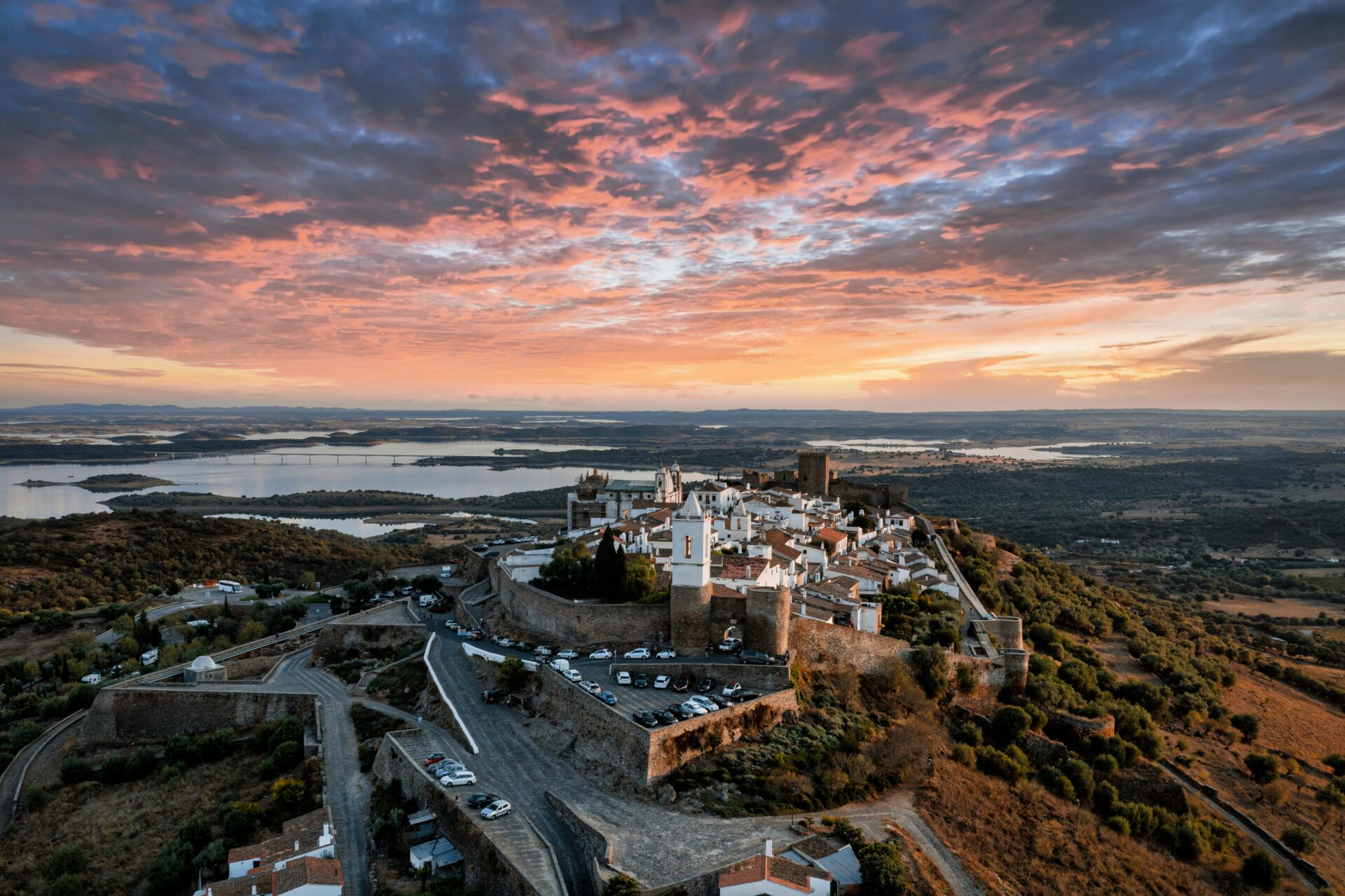
A walled hilltop village above the Alqueva reservoir — 800 permanent residents inside the medieval walls, the village layout unchanged since the 15th century. The view from the eastern wall: the Alqueva reservoir below (the largest artificial lake in Western Europe, 250 square kilometres), the Spanish hills beyond. The Alqueva dark-sky reserve: the area around the reservoir is certified as the first Starlight Tourism Destination in the world — the light pollution is so low that the Milky Way is visible on clear nights.
The Alentejo Coast — The Undiscovered Atlantic
The Alentejo coast (Costa Alentejana) — the Atlantic coastline between the Tagus estuary and the Algarve — is the least-visited stretch of coast in mainland Portugal. The Natural Park of the Arrábida (technically in the Setúbal peninsula south of Lisbon) and the Vicentina Coast (shared with the Algarve) bracket a 150km section of Atlantic coast with dune beaches, cliff walks, fishing villages, and almost no tourist infrastructure.
Comporta:
A village 1 hour south of Lisbon where the Alentejo meets the Atlantic — the rice paddies, the cork forest, and the flat Atlantic beach. The natural park protects the dune system. The straw-roofed beach houses of the Portuguese elite (Comporta is Portugal’s answer to the Hamptons — the city-escape for Lisbon’s professional class) exist alongside the rice farming community. The beach (wide, flat, rarely crowded outside peak season) and the specific quality of the Comporta landscape (the rice paddies beside the sand dunes) are unlike anything else on the Portuguese coast.
Sines and the Santiago do Cacém area:
The fishing port of Sines (the birthplace of Vasco da Gama — the most undervisited birthplace of a major historical figure in Europe, the house now a small museum) and the beaches north and south. The Lagoa de Santo André (a freshwater lagoon separated from the Atlantic by a sand bar, the flamingos and the herons using the shallow water year-round).
The Cork Oak Forest — What It Is and How It Works
Cork oak (Quercus suber) is the defining tree of the Alentejo landscape — the montado (the Portuguese word for the cork oak savannah, listed as a globally significant ecosystem by the IUCN) covers approximately 730,000 hectares of the Alentejo, producing 50% of the world’s cork supply.
The bark is stripped every 9 years (the minimum interval required for full regeneration) — the process leaves the trunk and lower branches bare and red-orange for the first year after stripping, producing the “socks” appearance that makes a recently harvested cork oak visually distinctive.
The cork harvest (July-August, when the bark separates most cleanly from the tree): the workers using long-handled axes to score and peel the bark in large sheets, the sheets stacked by the road for collection. The trees are not harmed — the bark regenerates, the tree continues producing for 200+ years.
The montado ecosystem:
The cork oak savannah is among the most biodiverse agricultural landscapes in Europe — the Iberian lynx (critically endangered, population recovering slowly in Spain and Portugal) uses the montado, the black stork nests in the oaks, and a specific diversity of orchids, insects, and small mammals inhabits the forest floor. The black pigs (Alentejano black pigs, the same breed used for Iberian ham) are fattened in the montado on acorns from the cork and holm oaks — the acorn diet gives the distinctive fat composition that makes Iberian ham unique.
The Herdades — Estate Tourism
The herdade (estate) is the Alentejo’s equivalent of the Tuscan agriturismo — a large agricultural estate that has developed visitor accommodation and experiences around the estate’s production: wine, olive oil, cork, and the specific landscape of the Alentejo plateau.
The experience:
Staying at a herdade gives access to the estate activities (the wine harvest in September, the cork harvest in July-August, the olive harvest in November, the spring wildflower walks) in a way that visiting as a day-tripper doesn’t. The dinner at the estate table — the fixed menu of Alentejo dishes made with estate and regional ingredients, the wine from the estate production, the olive oil from the estate trees — is the most complete Alentejo experience available.
Recommendations:
Herdade da Malhadinha Nova (near Beja): the most awarded agriturismo in the Baixo Alentejo — architecture, wine, food, and the specific hospitality of a family estate. Rooms from €180 / £155.
Herdade do Coelho (near Évora): smaller, more intimate, the winemaker resident. Rooms from €85 / £73.
L’And Vineyards (near Montemor-o-Novo): contemporary wine hotel, pool, and the Michelin-starred L’And restaurant (the only Michelin star in the Alentejo wine region). Rooms from €220 / £190.
Hidden Alentejo
The Marble Triangle:
Estremoz, Borba, and Vila Viçosa — three towns of the Alto Alentejo where the white marble that was used in the floors of the Vatican, the Buckingham Palace renovation, and the Lisbon Jerónimos Monastery is quarried and processed. The quarries outside Estremoz and Borba are the largest in the world — the quarry walls are vertical white marble 70 metres deep, the machinery on the quarry floor appearing miniature against the scale. The towns themselves are built almost entirely of marble — the town squares, the castle walls, the doorsteps and window frames all the same material as the quarry above.
The Coa Valley by way of the Alentejo:
The Côa Valley Archaeological Park (the world’s largest outdoor Paleolithic rock art site, with 25,000+ engravings from 22,000 years ago) is at the northern edge of the Alentejo’s sphere — technically in the Trás-os-Montes region but accessible from Évora in 3 hours. The most significant archaeological site in Portugal receiving approximately 5,000 visitors per year.
The Castro da Cola:
A pre-Roman hill fort (castro) near Ourique in the Baixo Alentejo — 2,500-year-old Iron Age walls on a hilltop, largely unexcavated, accessible across open farmland. The view from the castro over the Alentejo plain is extraordinary; the site receives approximately 200 visitors per year.
What It Costs
The Alentejo is the finest value accommodation in mainland Portugal outside the Algarve off-season. The herdade estates are mid-range in international terms and genuinely good value for the quality of experience.
Daily Budgets
Budget (£35-50/day)
- Accommodation: guesthouse in Évora or a small village (£18-30/night)
- Food: local tasca, market lunch (£10-15/day)
- Wine: the cellar door bottle for dinner (£5-8)
Mid-range (£65-95/day)
- Accommodation: small herdade or boutique hotel (£40-65/night)
- Food: herdade dinner, restaurant lunch (£20-32/day)
What 4 Days in the Alentejo Costs from the UK
| Category | Budget | Mid-Range |
|---|---|---|
| Flights (Lisbon, add to Portugal trip) | Included in Portugal circuit | Included |
| Car hire 4 days | £70–110 | £85–125 |
| 4 nights accommodation | £85–155 | £220–360 |
| Food (4 days) | £55–85 | £110–170 |
| Wine tasting at herdade | £8–15 | £12–20 |
| Total (Alentejo section) | £218–365 | £427–675 |
Eating in the Alentejo — The Pork, the Bread, and the Soup
Açorda Alentejana:
The most specifically Alentejo dish — a thick bread soup of garlic, coriander, olive oil, and eggs, poured over day-old Alentejo bread (the bread absorbs the liquid, softening but not dissolving). The preparation: the garlic and coriander are pounded in a clay pot, the boiling water added, the eggs poached in the liquid, the whole poured over the bread in the bowl. The flavour: intensely garlicky, the coriander giving freshness, the egg yolk breaking into the soup when the spoon penetrates. It is one of the most apparently simple and genuinely complex dishes in Portuguese cooking. At any Alentejo tasca: €6-9 / £5-7.75.
Carne de Porco à Alentejana:
The pork and clam combination described in the Portugal guide — the definitive Alentejo main course. At an Évora restaurant: €12-18 / £10-15.50.
Migas:
The bread-and-garlic preparation that accompanies grilled pork — fried bread cubes with garlic and asparagus (migas de espargos, the spring version when wild asparagus covers the montado floor) or with tomato and pork fat (migas de tomate). The Alentejo migas are a complete food culture — the approach to using leftover bread without waste, developed over centuries of peasant cooking. At any Alentejo tasca: €4-6 / £3.45-5.20 as a side.
Alentejo olive oil:
The Alentejo produces the finest olive oil in Portugal — the Alentejo DOC olive oil from the Galega, Cordovil de Serpa, and Cobrançosa varieties. Early harvest oil (the oil pressed from olives harvested green in October-November) has the highest polyphenol content, the most intense flavour, and the most vivid green colour. At a herdade or an Évora oil producer: €8-12 / £7-10 for a 500ml bottle of estate oil. On bread (with nothing else): sufficient.
Practical Notes
Getting there: By car from Lisbon (1.5 hours to Évora) or direct bus from Lisbon. No airport in the Alentejo.
Car hire: Essential for the full circuit. From Lisbon or from Faro for a south-north approach.
Best time: April for wildflowers and megaliths. September for harvest and wine. Avoid July-August if sensitive to heat (42-45°C possible).
Language: Portuguese. English limited outside Évora. The Alentejo accent is the most distinct in Portugal (slower, more vowel-heavy, several consonants elided).
The 4-Day Itinerary
Day 1: Évora Morning: Roman temple at 6am. Chapel of Bones. Cathedral cloister. Afternoon: Évora University azulejo lecture rooms. Evening: dinner at one of the Rua de Burgos restaurants (the street of the best traditional Alentejo restaurants).
Day 2: Megaliths + Wine 7am: Almendres stone circle before the heat. Zambujeiro dolmen. Morning in the cork forest. Afternoon: herdade wine visit (Esporão or equivalent, booked in advance). Overnight at or near the herdade.
Day 3: Border Fortresses Monsaraz (morning, the Alqueva view). Drive east: Elvas (the aqueduct, the star fortifications, lunch). Marvão (the hilltop village, late afternoon). Night in Marvão (the Santa Maria guesthouse within the walls — the most atmospheric overnight in the Alentejo).
Day 4: Return to Lisbon or South to Algarve Morning walk on the Marvão walls. Drive south (3 hours to Faro for the Algarve) or north (2 hours to Lisbon).
Final Thought
I was at the Almendres stone circle at 7:05am in April. The wildflowers covered the surrounding scrubland in a density I hadn’t anticipated — yellow and white and blue, the cistus not yet open, the surrounding oak forest casting morning shadows across the stones.
95 granite monoliths, standing in their oval arrangement, some of them carved with cup marks from 5,000 years ago that I could touch with my finger. No fence. No ticket booth. No interpretive panel. The only sound: the birds in the oak forest above.
A Portuguese family arrived 40 minutes later — a man, his wife, their two teenage children. They walked around the circle slowly. The man put his hand on one of the stones for a long moment without saying anything.
Then they left.
This is what the Alentejo offers that nowhere else in Portugal does: the direct encounter with something extraordinary, unmediated, in a landscape of silence. The monument is there. You are there. The 5,000 years between the carvers and you collapse in the 10 seconds it takes to touch the stone.
Stay longer than Évora. The region has more than one day of this.