
The Linha do Douro from Porto to Pocinho is one of the finest railway journeys in Europe and almost nobody outside Portugal knows it exists. The quintas on the valley terraces — their names still British in many cases, the Sandeman, the Graham, the Cockburn — produce the wines that have been keeping the UK warm since the Methuen Treaty of 1703. The vindima in September when the harvest on the impossible slopes happens entirely by hand. The miradouros above the valley that make the landscape comprehensible from above. And why this river, this wine, and this train together constitute the most underrated day or weekend available within 2.5 hours of London.
Reading time: 11 minutes | Last updated: 2026
The Douro River rises in Spain (where it’s called the Duero), flows 897km west through Portugal, and empties into the Atlantic at Porto. The final 100km — from the Douro wine region to the sea — passes through a wine landscape that has been under continuous production for at least 2,000 years and that looks, from the train window, as though the river has been travelling specifically to give you this view.
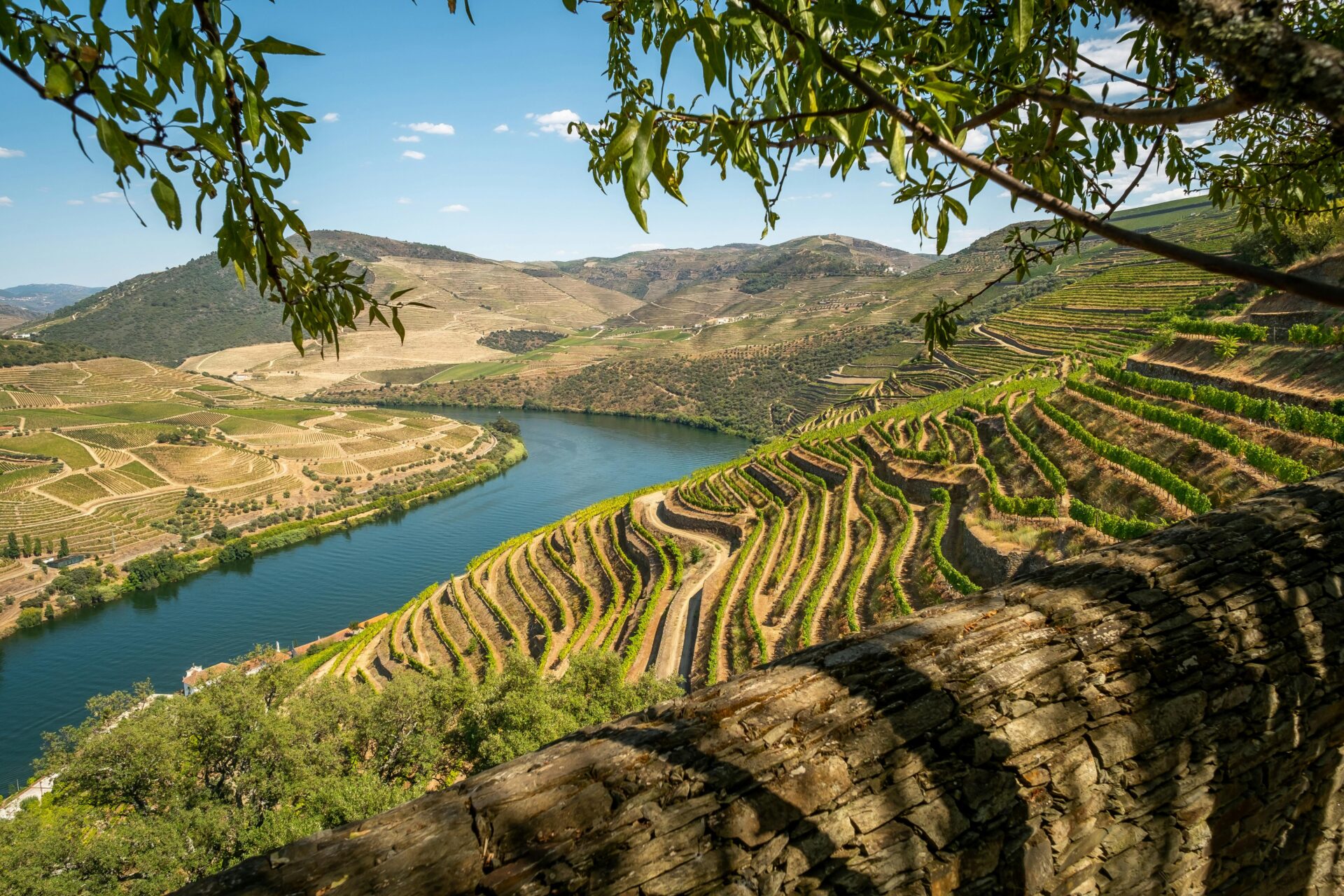
The terraces: the valley walls are so steep (gradients of 30-60% in the finest vineyard sections) that the grapes cannot be grown on the slope without the socalcos — the dry-stone terrace walls built by hand over centuries into the schist rock, each terrace holding a strip of vineyard that must be worked entirely on foot (or by the small Douro tractors that run on single-track rails between the terrace rows). The scale of the terrace engineering — hundreds of thousands of retaining walls, each built without mortar — is one of the most significant agricultural feats in European history.
The wine: port wine has been made from these grapes since the late 17th century, the British merchants who established the trade creating the lodges of Vila Nova de Gaia and the partnerships with the Douro quinta owners that are still reflected in the British names on the port wine labels. The Douro’s more recent development — the production of dry Douro wines (table wines, not fortified) from the same grapes — has produced wines of international significance: Touriga Nacional, Touriga Franca, Tinta Roriz, and a dozen other indigenous varieties making reds of extraordinary depth.
The train: the Linha do Douro runs from Porto Campanhã station to Pocinho (160km, 3.5 hours), following the river from the coastal plain through the gorge section into the heart of the wine region. The section between Régua and Pinhão — where the valley narrows, the terraces rise from the water on both sides, and the river makes a series of bends that place the vineyards at every angle — is the finest single train stretch in Portugal and one of the finest in Europe.
This guide covers the train, the wine, the harvest, the viewpoints, and why the Douro rewards the 2-day version over the day trip.
Quick Navigation
- The Train — The Linha do Douro
- When to Go — The Vindima and the Light
- Getting There — Porto as the Base
- Pinhão — The Heart of the Port Wine Region
- The Quintas — Visiting the Wine Estates
- The Miradouros — The Valley from Above
- The Vindima — The Harvest
- Lamego — The Pilgrimage City
- The Upper Douro — Beyond Pinhão
- The Boat Alternative
- What It Costs
- Eating and Drinking in the Douro Valley
- Practical Notes
- The 2-Day Itinerary
The Train — The Linha do Douro
The Linha do Douro (Douro Line) is a 152km railway from Porto Campanhã to Pocinho — opened in sections between 1879 and 1887, the engineering challenge of following the Douro gorge requiring tunnels, viaducts, and sections of track cut directly into the cliff face.
The journey:
Porto Campanhã station → Marco de Canaveses → Régua (the regional capital, 2 hours, where the valley opens and the terraced vineyards begin to be continuous on both sides) → Pinhão (2.5 hours, the heart of the Douro wine region, the station itself decorated with azulejo tile panels depicting the traditional harvest activities — the most beautiful railway station in Portugal) → Pocinho (3.5 hours, the eastern end of the Douro wine region where the valley character changes).
The specific section:
The Régua-to-Pinhão section (30 minutes) is the finest. The valley narrows here, the river making three significant bends, the terraced vineyards rising from the water to the ridge on both sides. The train hugs the north bank, the south bank terraces visible across the water throughout. In September (the vindima): the workers visible on the terraces, the tractors on the terrace tracks, the collection trailers at the quinta gates.
The viewing strategy:
Sit on the right side (south-facing) for the Régua-Pinhão section when travelling east from Porto. The afternoon westward journey (Pinhão to Porto) places the sun to the west — the light coming from behind the train illuminates the south-facing vineyards directly. The afternoon return is frequently cited as the more photographically interesting direction.
The train: a regional train, two to three carriages, clean and comfortable. Book at cp.pt. Campanhã to Pinhão: €12.25 / £10.55, approximately 2.5 hours. Campanhã to Pocinho: €15.65 / £13.50, approximately 3.5 hours.
When to Go — The Vindima and the Light
September — The Vindima
The grape harvest in the Douro runs from mid-September through October, with the Touriga Nacional (the finest port wine grape) typically harvested in the third and fourth weeks of September. The vindima is the finest time to be in the Douro:
The visual: the harvest on the steep terraces — workers moving up the slope with baskets, the traditional foot-treading of the grapes in stone lagares at some quintas (the method preferred for certain port styles, the foot’s yielding pressure extracting the right tannin level), the tractors on the narrow terrace tracks. The valley smells of fermenting grape juice from every quinta.
The atmospheric: the quintas are at their most active and most accessible — most offer a harvest visit and tasting during vindima. The quinta family members are present for the harvest in a way they aren’t at other times. The valley has a purpose during September that the tourist-facing months don’t.
June to August — Summer
The valley is hot (35-42°C in August), the terraces baking, the river low. The quintas are open for visits. The Linha do Douro runs on its full summer schedule. Not the best season for the outdoors but manageable in the morning.
March to May — Spring
The almond blossom (February-March in the lower valley), the vine budding (April), the specific green of the Douro in spring before the summer heat. The Douro in spring light: a different palette from the golden September tones.
October to November — Autumn
Post-harvest — the vine leaves turning gold and red on the terraces, the quintas quieter, the wine making visible in the lodges. The autumn colour on the Douro valley is the finest in Portugal.
The BGGD recommendation: September for the vindima. October for the colour and the post-harvest quiet.
Getting There — Porto as the Base
Porto is the correct base for the Douro Valley — the train to Pinhão departs from Porto Campanhã (connected to Porto São Bento, the main city station, by a 5-minute commuter train), and the return by afternoon train makes a long day trip feasible.
The day trip option:
Depart Porto Campanhã at 7:30am → arrive Pinhão at 10am. Explore Pinhão, visit a quinta for the morning tasting, lunch at a quinta restaurant. Depart Pinhão at 3pm (afternoon train, the westward direction, the light on the south-facing terraces). Arrive Porto by 5:30pm.
This is the most efficient single-day Douro experience. It is genuinely satisfying and genuinely incomplete.
The 2-day option:
Stay overnight in Pinhão or at a quinta — the valley at dusk and dawn, the vindima before the day visitors arrive, a proper tasting at two or three quintas. The Douro in the early morning (before the heat, before any other visitors, the mist on the river if the season is right): entirely different from the midday experience.
From Porto: fly from UK to Porto (easyJet, Ryanair — return from £50-120), stay 2 nights in Porto, train to Pinhão for 2 nights, return to Porto for the flight home. The complete circuit.
Pinhão — The Heart of the Port Wine Region
Pinhão is a village of approximately 600 permanent residents at the confluence of the Pinhão River and the Douro — the hub of the finest port wine production in the valley, surrounded by the most celebrated quintas (Quinta do Crasto, Quinta de la Rosa, Quinta do Vale Meão are all within 10km).
The Pinhão azulejo station:
The railway station of Pinhão is decorated with 24 azulejo tile panels depicting the activities of the traditional Douro wine year — the pruning, the harvesting, the treading, the transporting down-river on the rabelo boats (the traditional flat-bottomed port wine boats that carried the barrels from the upper valley to the Vila Nova de Gaia lodges, now largely replaced by road transport). The panels were designed and installed in 1937. They are the finest single set of azulejo narrative panels outside Lisbon’s São Bento station.
The station is not a museum. It is a functioning railway station. The panels are on the platform wall and accessible to anyone on the platform.
The village:
The quayside promenade, the Igreja de São Salvador with its tilework facade, and the waterfront restaurants serving the Douro river fish (the lamprey, the shad, the barbel — freshwater fish that most international visitors don’t expect in a wine region). The miradouro above the village (a 15-minute walk): the full valley visible, the Pinhão River joining the Douro below, the quintas visible on the slopes in every direction.
The Quintas — Visiting the Wine Estates
The Douro quinta is the wine estate — the production unit of the port wine industry, each owning a section of the terraced valley wall and managing the production of grapes that go either to their own wine or to the shippers’ blends.
The quintas are open for visits — the quality of experience varies significantly.
The most rewarding visits:
Quinta do Crasto: A large estate on the Douro’s south bank above Régua — the most visitor-ready quinta in the valley, with panoramic infinity pool views, a wine museum, and guided tours that cover both the terraced vineyards (accessible by the estate’s own land vehicle) and the winery. Tasting of 4-6 wines: €10-15 / £8.60-12.90. Book at quintadocrasto.pt.
Quinta de la Rosa: Family-run estate on the north bank above Pinhão — one of the first quintas to develop agritourism (the quinta guesthouse, the restaurant, the terraced gardens above the river). The harvest experience is managed particularly well here — tastings during vindima are the most atmospheric available in the valley. Book at quintadelarosa.com.
Quinta do Vale Meão: Historically significant (part of the legendary Quinta do Vesúvio estate, separated in the 1990s to produce the Douro’s most celebrated table wine, Meandro do Vale Meão, which launched the modern Douro dry wine renaissance). Visits by appointment.
Quinta da Pacheca: South of Régua — the most architecturally distinctive quinta, with accommodation in giant wine barrel-shaped suites on the estate (a deliberate tourist innovation that is simultaneously eccentric and effective). The barrel suites are booked months ahead in September.
The tasting notes:
The Douro dry wines (table wines, not port) produced from Touriga Nacional, Touriga Franca, and Tinta Roriz are among the most complex and most age-worthy red wines in Portugal. The Douro was internationally dismissed as a table wine region until the 1990s; the subsequent 30 years have produced a series of internationally acclaimed producers. A tasting at a quality quinta: 3-6 wines, €10-20 / £8.60-17.25.
Port wine tasting (the fortified wines): the 10-year and 20-year tawny ports (barrel-aged, smooth, nutty, amber-coloured) are the styles most appropriate for warm weather tasting. The vintage ports (aged in bottle, produced only in exceptional years declared by the Port Wine Institute) require cellaring but are the wines for which the Douro is most celebrated internationally.
The Miradouros — The Valley from Above
The valley from the train is the horizontally framed version — the river level, the terraces rising on both sides. The miradouros (viewpoints) give the vertically framed version — looking down into the valley from the ridge, the river far below, the geometric patchwork of the terraces covering the entire valley wall.
São Leonardo de Galafura:
Above Peso da Régua — the most widely photographed Douro viewpoint, the valley bend below giving a 180-degree panorama of the terraced slopes. The specific image: the valley curves from east to west, the Douro a narrow ribbon far below, the terraces on both sides of the bend creating the characteristic stepped pattern. Best in late afternoon when the sun is in the west.
São Cristóvão do Douro:
On the south bank above Pinhão — a less-visited viewpoint giving the Pinhão valley confluence visible below, the terraces of the finest port wine quintas directly in the foreground.
Casal de Loivos:
Above Pinhão, the north bank — a small village with a viewpoint terrace at the village café (the café at Casal de Loivos is the most specifically placed café in the Douro: a table on a terrace above a 200-metre drop to the river, the valley in every direction, the coffee served by the owner who has been watching the valley from this table for 40 years).
The Vindima — The Harvest
The Douro harvest (vindima) is the defining seasonal event of the valley — and genuinely one of the most visually extraordinary agricultural events accessible to visitors in Europe.
The context:
The Douro terraces are so steep that mechanical harvesting is impossible on most of the valley’s finest vineyards. The harvest is done entirely by hand — teams of workers (vindimadores) moving up the terrace paths with baskets, cutting the grape clusters with curved knives, filling the baskets and carrying them (often on their backs) to the collection trailers at the terrace edge.
The vintage schedule: Touriga Franca and Tinta Roriz are typically harvested first (early-to-mid September), Touriga Nacional later (mid-to-late September), the final varieties extending into October in the higher, cooler quintas.
The foot-treading:
Some quintas (Quinta do Crasto, Quinta Nacional) still practice the traditional foot-treading of the grapes in stone lagares — granite tanks where teams of workers tread in a coordinated line for 4-6 hours, the human foot’s yielding pressure extracting the ideal tannin level for port wine. The treading is done to music (the accordionist plays the pace), the workers’ arms linked for balance, the labour genuinely hard.
A vindima visit during the treading (arranged through the quinta, typically in the evening): one of the most specific cultural experiences available in Portugal.
Lamego — The Pilgrimage City
30km south of Pinhão across the ridge (not accessible by train — hire car or taxi from Pinhão or Régua): Lamego, a cathedral city in a valley of the Serra das Meadas. The Sanctuary of Nossa Senhora dos Remédios — an 18th-century pilgrimage church at the top of a Baroque staircase of 686 steps flanked by azulejo tile panels depicting scenes from the Old Testament. The staircase is the finest example of Portuguese Baroque landscape architecture, the tile panels the most extensive outdoor azulejo programme in Portugal.
The church at the top: modest in itself. The staircase: extraordinary. The climb takes 20 minutes; the descent by the zigzag path through the gardens is 15.
Lamego also produces the finest sparkling wine in Portugal — the espumante natural (méthode champenoise) from the Basto and Rua districts, using Encruzado and Malvasia Fina grapes at a cooler altitude than the main Douro.
The Upper Douro — Beyond Pinhão
The train continues east from Pinhão to Pocinho — a further hour through the Douro Superior (the upper Douro), where the valley widens, the schist gives way to granite, and the landscape becomes more arid (the rain shadow of the Serra de Bornes creating a near-desert climate in the far upper valley). The Coa Valley (the Paleolithic rock art site) is 30km south of Pocinho.
The upper Douro is the least-visited section of the valley for international travellers and the most specifically Portuguese — the small schist villages, the terraces narrower and steeper than the middle valley, the railway stations without tourist facilities. The Quinta do Vale Meão is in this section.
The Boat Alternative
The traditional transport of the Douro wine trade was the rabelo boat — a flat-bottomed wooden vessel with a large square sail, used to carry the barrels of new wine from the upper valley to the Vila Nova de Gaia lodges. The navigation was dangerous (the rapids of the upper Douro required expert pilots) and was replaced by road transport after the Douro dams were built in the 1950s-70s.
The Douro cruise:
Several operators run cruise boats from Porto or from Régua through the Douro valley. The day cruise from Régua to Pinhão and back (4 hours on the water, the valley from the water rather than from the train): €35-55 / £30-47 per person.
The river perspective gives a different view from the train — looking up at the terraces rather than across at them, the quintas and their walls seen from below, the valley narrowing as the gorge sections pass. The combination: train one direction, boat the other, gives both perspectives.
The Douro cruise from Porto (full day):
The 6-hour cruise from Porto to Régua and back (through the 5 Douro locks — the dams and their navigation locks are one of the specific engineering experiences of the river): €65-85 / £56-73. Lunch served on board.
What It Costs
The Douro Valley is affordable — significantly cheaper than the equivalent wine tourism experience in Bordeaux, Burgundy, or Tuscany.
Day Trip from Porto
| Item | Cost |
|---|---|
| Porto → Pinhão return train | €24.50 / £21.10 |
| Quinta visit and tasting | €10–20 / £8.60–17.25 |
| Lunch at Pinhão | €15–25 / £12.90–21.50 |
| Day trip total | €49.50–69.50 / £42–60 |
2-Day Extension from Porto
| Category | Budget | Mid-Range |
|---|---|---|
| 2 nights (Pinhão guesthouse or quinta) | £50–90 | £120–220 |
| Train Porto–Pinhão–Porto | £21 | £21 |
| 2 quinta visits + tastings | £18–35 | £25–50 |
| Food (2 days) | £35–55 | £60–95 |
| Miradouro taxi or car hire | £20–35 | £30–50 |
| 2-day total (excluding Porto costs) | £144–236 | £256–436 |
Eating and Drinking in the Douro Valley
The lampreia (lamprey):
A jawless, parasitic river fish that returns to the Douro River to spawn from January through April — the lamprey is the prestige ingredient of the Douro season, prepared à Bordalesa (in the Bordalesa style — the fish cooked in red wine, its own blood, and its liver, the preparation producing one of the richest and most specific river fish dishes in European cooking). Available at restaurants in Régua and Pinhão from January through April.
The shad (sável):
The Douro shad (a migratory river fish that spawns in the upper river from April through June) — grilled over charcoal, the many bones requiring careful eating but the flavour exceptional. The Douro shad with rice prepared in the cooking juices (arroz de sável): a specific April-May dish available at the riverside restaurants of Pinhão and Régua.
The Douro table wines with food:
The Douro reds are best matched with the valley’s own lamb (borrego da Serra de Peneda-Gerês — the mountain lamb of the northern highlands), the local presunto (the cured ham from Lamego’s mountain pigs), and the robust cheeses of the Beira Alta region immediately north. At a Pinhão quinta restaurant: a full lunch with estate wine: €25-45 / £21.50-38.75.
The white wines:
The Rabigato and Códega varieties produce the white wines of the upper Douro — dry, mineral, high-acid whites that cut through the richness of the valley food. Underknown internationally; at a quinta tasting: the white often surprises visitors who came specifically for the red.
Practical Notes
Train booking: cp.pt — book at least the day before, optionally weeks ahead in September when the valley fills with vindima visitors. The train is not reservable by seat — just the ticket. Show up 10 minutes before departure.
Car hire: Useful for the miradouros and the south-bank quintas (the train only serves the north bank). The N222 road (on the south bank — consistently rated one of the most beautiful drives in Portugal) gives the valley from the car window at river level. Car hire from Porto or from Régua (where some local operators exist).
Quinta booking: Most quintas require advance booking for tastings (typically 24-48 hours), with harvest visits during vindima requiring booking 2-4 weeks ahead.
Language: Portuguese. English spoken at the visitor-facing quintas. In the villages: Portuguese only.
The 2-Day Itinerary
Day 1: Porto to Pinhão by Train
7:30am: train from Porto Campanhã. Sit on the right side facing forward.
Arrive Régua at 9:30am. Disembark briefly if time allows — the Régua wine museum (Museu do Douro, in the old customs house, the finest wine museum in Portugal, entry €6 / £5.20) and the Régua azulejo panels on the station facade (the other great Douro station).
Re-board for Pinhão at 10:15am. Arrive 10:45am.
Morning: the Pinhão station azulejo panels. Walk the village. Quinta de la Rosa visit and tasting (booked in advance — the morning tasting at 11:30am includes the terrace view and 4 wines).
Lunch: the restaurant at Quinta de la Rosa (the valley view, the lamb, the estate wine).
Afternoon: taxi to Casal de Loivos miradouro (15 minutes). Coffee at the village café-terrace above the valley. Walk back down to Pinhão (1 hour on the road).
Evening: dinner at the Casa de Pasto in Pinhão village (the most traditional restaurant in the village, the presunto and the lamb).
Day 2: Vindima Visit + Return to Porto
6:30am: the valley before the day visitors arrive. The mist on the river if the season is right.
9am: Quinta do Crasto vindima visit (booked 2-3 weeks ahead in September — the harvest walk on the terraces, the lagar foot-treading if the timing aligns).
Lunch at the Crasto restaurant (the valley view, the lamb, the estate wine).
3pm: return train from Pinhão to Porto (the westward direction, the afternoon light on the south-facing terraces). Arrive Porto by 5:30pm.
Final Thought
I was on the train between Régua and Pinhão at 10:20am in late September. The carriage was half full. A man in front of me had fallen asleep before Régua and was still asleep. Everyone else was looking out the window.
The valley changed outside — the terraces beginning, the vines on both sides of the river, the schist slopes rising from the water. The geometry of the terracing: the horizontal bands on the vertical face, each band a strip of vine, the accumulation of 400 years of wall-building visible in the cross-section of the hillside.
A white bird crossed the river. The man in front woke up, looked out the window for 10 seconds, and went back to sleep.
This is the Linha do Douro. You get off at Pinhão. You go to a quinta. You drink wine. You look at the valley that made the wine.
It takes 2 days to do it properly. It is worth 2 days without reservation.