

The stone circles that were built 7,000 years before Stonehenge, by hunter-gatherers who shouldn’t have been capable of building anything this organised, which changes everything we thought we knew about the origins of human civilisation, buried deliberately by the people who built it, undiscovered until a Kurdish shepherd’s plough struck something in 1963, and how to visit a site that might be the most significant archaeological discovery of the 20th century before the crowds figure out it exists.
Reading time: 10 minutes | Last updated: 2026
Göbekli Tepe changes the story.
The story it changes is the one that runs: hunter-gatherers were nomadic, disorganised, incapable of the sustained collective effort required for monumental construction. That organised society, temples, and long-term planning only became possible after agriculture — when settled farming communities had the surplus food and the social structures to support specialised workers.
Göbekli Tepe was built by hunter-gatherers. The site dates to approximately 9600-8200 BCE — more than 11,000 years ago, 7,000 years before Stonehenge, 6,000 years before the pyramids, and 3,000 years before agriculture reached this part of Anatolia.
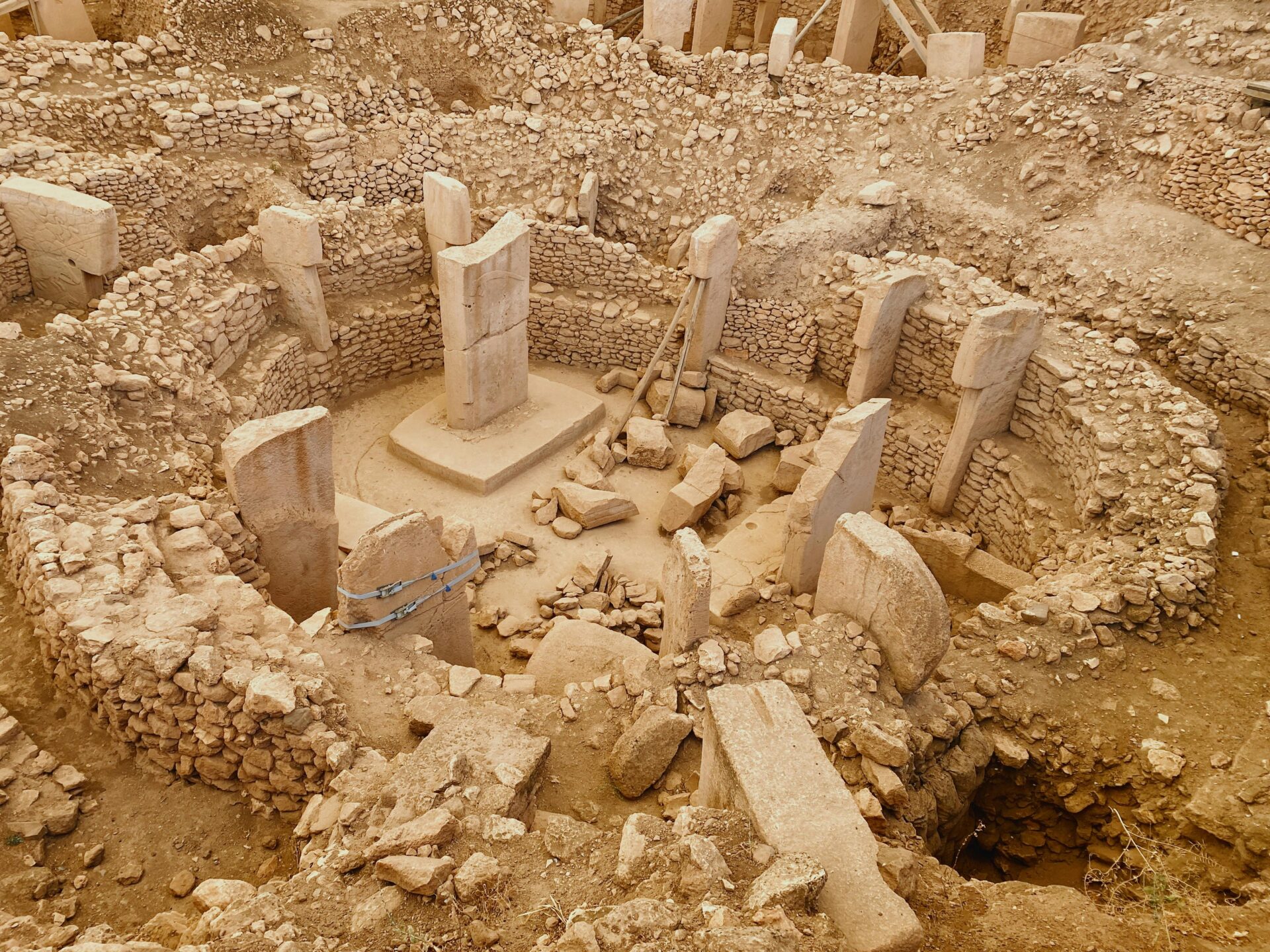
The site: a series of circular stone enclosures on a hilltop in southeastern Turkey, each enclosure containing T-shaped limestone pillars up to 5.5 metres high and weighing up to 20 tonnes, many of them carved with animals — foxes, boars, lions, vultures, scorpions, cranes — in relief. The pillars were quarried from the limestone bedrock 500 metres from the site and moved without wheels, without draft animals, and by people who had no permanent settlement and no agriculture.
The question this produces — why did they do this, and how — has not been satisfactorily answered. The site was deliberately buried by its builders around 8200 BCE, the enclosures filled with clean soil and flint, the site covered completely. The burial is as puzzling as the construction.
The German archaeologist Klaus Schmidt excavated Göbekli Tepe from 1996 until his death in 2014. When Schmidt died, only approximately 5% of the site had been excavated. The rest remains under the hill.
This guide covers what you’ll see, how to get there, and why this site — which receives approximately 600,000 visitors per year compared to Ephesus’s 3 million — might be the most important archaeological site you can currently visit.
Quick Navigation
- Why Göbekli Tepe Matters — The Specific Argument
- When to Go
- Getting There — Şanlıurfa as the Base
- The Site — What You Actually See
- The Enclosures — Layer III and Layer II
- The Pillars and the Carvings
- The Museum and the Visitor Centre
- The Karahan Tepe Connection
- Şanlıurfa — The City Worth a Day
- Hidden Context — What the Excavation Has Revealed
- What It Costs
- Practical Notes
- The 2-Day Itinerary — Şanlıurfa and Göbekli Tepe
Why Göbekli Tepe Matters — The Specific Argument
The conventional model of human civilisation’s development runs as follows: hunter-gatherers → agriculture → settled villages → surplus food → social stratification → specialised workers → monumental construction → civilisation.
Göbekli Tepe breaks this sequence at the first step.
The pillars are monumental — up to 5.5 metres high, weighing up to 20 tonnes, carved with imagery that implies an established symbolic vocabulary. The enclosures required sustained, coordinated labour from large numbers of people over extended periods. The site shows evidence of feasting (large quantities of animal bones, primarily gazelle and aurochs) suggesting the site functioned as a gathering place for multiple communities.
All of this happened before agriculture.
Schmidt’s hypothesis — which has become the leading interpretation — is that the construction of Göbekli Tepe required the feeding of a large workforce, and that this requirement drove the development of agriculture rather than the other way around. In other words: the temple came first, and agriculture was invented to feed the people building it.
If this is correct — and it is the dominant interpretation among archaeologists, though not universally accepted — then the sequence is inverted: religion (or at minimum organised ritual) preceded agriculture, and agriculture preceded settled civilisation. The motivation for the entire development of human civilisation may have been the desire to build something like this.
This is why Göbekli Tepe changes the story.
When to Go
April to June and September to October — The Best Windows
Southeastern Turkey has an extreme continental climate — hot summers (40-45°C in August in Şanlıurfa), cold winters (below 0°C in January). The spring and autumn windows give temperatures of 20-30°C, comfortable for the outdoor site.
April is particularly good — the site is green from spring rains, the surrounding landscape of the Harran plain showing the agricultural transformation that happened here 11,000 years ago.
July and August — Very Hot
The site is largely exposed — the shelter structures over the excavated enclosures provide some shade, but the walk from the car park and the open sections of the site are in direct sun. Go at 8am opening and be done by 11am in summer.
November to March — Off-Season
Cold and sometimes wet. The site is open year-round. In winter, visitor numbers drop to almost nothing — the site in winter solitude has a specific atmospheric quality. Check current opening hours.
The BGGD recommendation: Late April or October. Both give comfortable temperatures, the lowest visitor numbers of the accessible seasons, and the most striking light on the limestone pillars.
Getting There — Şanlıurfa as the Base
Şanlıurfa (Urfa):
The nearest city to Göbekli Tepe — 15km north, the GAP Şanlıurfa Airport connected to Istanbul by Turkish Airlines and Pegasus (1.5 hours). From Istanbul: return flights from £80-150.
From the UK: fly to Istanbul (4 hours, Turkish Airlines, easyJet from Gatwick) then domestic connection to Şanlıurfa (1.5 hours). Total journey: 8-10 hours.
Göbekli Tepe from Şanlıurfa:
Taxi from Şanlıurfa city centre: 30 minutes, approximately £8-12 each way (negotiate in advance, include waiting time). The taxi driver will wait at the site for the return. No public transport connects Şanlıurfa to the site.
Car hire from Şanlıurfa airport: £20-30/day — useful if combining with Harran and Karahan Tepe.
The site opening hours:
8am to 7pm in summer, 8am to 5pm in winter. The site has been open since 1995; current entry procedures include a turnstile entry point at the site car park. Check current opening at kultur.gov.tr before visiting — the site management has changed as the excavation and visitor infrastructure develops.
The Site — What You Actually See
The elevated wooden walkway system (the primary visitor infrastructure installed since 2018) gives access to the main excavated areas without allowing visitors onto the site surface itself — the walkway runs above the enclosures, giving an elevated view of the T-pillars and their carved surfaces.
The first impression:
The site from the access path: a hill in an otherwise flat agricultural landscape, the protective shelter roofs (steel and canvas) visible from the approach road. Nothing about the approach prepares you for the scale of what’s below the shelters.
Under the first shelter: the circular enclosure, the T-shaped pillars in their ring formation, the carved reliefs visible on the pillar surfaces. The scale of the central pillars (the two large central pillars in each enclosure, reaching 5.5 metres) relative to the surrounding smaller pillars and the enclosure wall: the spatial arrangement suggests an interior space designed for gathering, with a focal point at the centre.
What you cannot see:
The majority of the site. The 5% that has been excavated represents a fraction of the full complex. Ground-penetrating radar surveys have identified at least 20 additional enclosures beneath the surrounding hillsides. The site that visitors see is the beginning of a much larger structure.
The Enclosures — Layer III and Layer II
The archaeological layers at Göbekli Tepe represent different periods of construction:
Layer III (the oldest, 9600-8800 BCE):
The large enclosures — the ones designated A, B, C, and D — containing the most impressive T-pillars. Enclosure D is the most excavated and the most accessible from the walkway: the two central pillars reach 5.5 metres, the surrounding ring of smaller pillars enclosing a space of approximately 20 metres diameter. The carvings on Enclosure D’s central pillars include arms and hands carved on the pillar shafts (implying that the pillars represent anthropomorphic figures — perhaps deities or ancestors) and a belt motif at the base. The animals carved in relief include foxes, boars, cranes, and a vulture carrying a sphere (interpreted as possibly the earliest representation of the sun).
Layer II (later, 8800-8200 BCE):
Smaller, more rectangular enclosures with smaller pillars. Layer II represents a later phase of construction — the quality of workmanship is generally considered less sophisticated than Layer III, suggesting that the building tradition was in decline rather than developing. The site was deliberately buried during this period.
The burial:
The deliberate filling of the enclosures with clean rubble is one of the most puzzling aspects of the site. The fill was not random — it consisted of clean soil and flint, not the debris of occupation. The builders, or a later community, took significant effort to bury the site they had created. No satisfactory explanation has been accepted.
The Pillars and the Carvings
The T-shaped limestone pillars are the defining visual element of Göbekli Tepe. The T-shape is not random: the horizontal top of the T represents a head (in profile), and the arms carved on some of the central pillars’ shafts represent the body. The pillars are stylised human figures — standing, facing the enclosure interior.
The animals:
The most commonly represented animals across the site’s pillars:
Vulture: The most symbolically significant — vultures appear frequently in Neolithic burial art across the region, associated with sky burial (the practice of leaving bodies exposed for vultures to consume) and possibly with the transition between life and death. The vulture panel in Enclosure D is the most detailed single carved surface visible at the site.
Fox: The most frequently carved animal — possibly a totem or clan symbol. The fox imagery on Enclosure B’s pillars includes a sequence of foxes in different postures.
Boar: Large, with prominent tusks, carved in realistic proportion. The aurochs (wild cattle) appear on the later enclosures.
The H-stone: A portable carved stone discovered at the site — a complete T-pillar in miniature, standing 60cm high, with facial features (eyes, nose) carved on the front face. The H-stone is now in the Şanlıurfa Museum and is the clearest evidence that the T-pillars represent human or divine figures.
The Museum and the Visitor Centre
The Taş Tepeler Visitor Centre:
Opened in 2022, the visitor centre adjacent to the site contains scale models, explanatory panels in Turkish and English, and replica carvings. The contextual information in the visitor centre — covering the excavation history, the Neolithic period in southeastern Anatolia, and the specific interpretive questions the site raises — is genuinely well-produced and worth 30-45 minutes before walking the site.
The Şanlıurfa Archaeological Museum:
In the city itself — the finest collection of Göbekli Tepe and Karahan Tepe artefacts outside the site, including the H-stone, carved animal figurines, and excavation documentation. The museum was expanded in 2015 specifically to accommodate the growing importance of the Taş Tepeler discoveries. Entry: TRY 60 / £1.65.
The Karahan Tepe Connection
Göbekli Tepe is no longer unique.
Since 2019, the Taş Tepeler (Stone Hills) project has identified and begun excavating a series of similar sites across the Harran Plain and the Karaçadağ mountains — at least 12 sites with comparable T-pillar construction from the same period. The most significant is Karahan Tepe, 35km east of Göbekli Tepe.
Karahan Tepe:
Excavated from 2019 under the direction of Necmi Karul — the site has already produced remarkable finds: a carved human head (the most naturalistically carved human face from the Neolithic period, the eyes, nose, and mouth fully rendered in a way that the T-pillar faces aren’t), a room containing phallus-shaped pillars emerging from the floor, and evidence of ritual practices different from those inferred at Göbekli Tepe.
The site is open to visitors (2-hour drive from Şanlıurfa, plus taxi from the nearest village of Yağmurlu). In 2025 the excavation is ongoing and the visitor infrastructure is basic — a path around the perimeter of the active dig, a site guardian. The experience of visiting an active major excavation (the archaeologists working, the tents and the equipment visible, the finds being processed on site) is itself significant.
The Karahan Tepe carved head is in the Şanlıurfa Museum.
Şanlıurfa — The City Worth a Day
Şanlıurfa (usually called simply Urfa or by its Ottoman name Edessa) is a city of 600,000 people with a claim to be among the oldest continuously inhabited cities in the world — the Book of Job is traditionally set here, the Prophet Abraham is believed by local tradition to have been born in a cave beneath the city, and the city has been continuously inhabited since at least the 4th millennium BCE.
The Pool of Sacred Fish (Balıklıgöl):
The most significant site in Şanlıurfa — a pool of sacred carp in a park below the old city, the fish traditionally the descendants of the fish that appeared when Abraham was thrown into a fire by the Assyrian king Nimrod and the fire became water (the specific narrative differs between Islamic and local traditions). The carp are considered sacred and untouchable.
The setting: the pool is in a formal garden below the Şanlıurfa castle, the mosque complexes surrounding it, the old city above. The specific atmosphere of a sacred site embedded in a living city — pilgrims from across Turkey and the Middle East arriving to walk the pool perimeter, to pray at the adjacent mosques, to buy the sacred carp bread sold by vendors around the pool.
The Old Bazaar:
The Kapalı Çarşı (covered bazaar) of Şanlıurfa — extending from the pool complex into the network of covered lanes between the old city mosques. The copper merchants, the spice sellers, the specific southeastern Anatolian market culture that is closer in character to the markets of Aleppo and Mosul than to the tourist bazaars of Istanbul.
The local food market: the pepper paste sellers (the biber salçası — a thick red paste from the local Urfa pepper, the defining ingredient of Şanlıurfa cooking), the isot sellers (the dried, purple-black Urfa pepper that is the culinary signature of the city).
The Dergah (Abraham’s Cave):
The cave beneath the pool where Abraham is believed to have been born — a mosque has been built over the cave entrance, the cave itself accessible and visited as a pilgrimage site. Non-Muslims may enter respectfully outside prayer times.
Hidden Context — What the Excavation Has Revealed
The feasting evidence:
Analysis of the animal bones from the site (predominantly gazelle, with aurochs, red deer, and wild boar) has shown that the feasting at Göbekli Tepe was on an extraordinary scale — estimates suggest that the gatherings may have involved hundreds or thousands of people consuming hundreds of animals at each event. The logistics of feeding this number of hunter-gatherers in a specific location for extended periods would have required planning, coordination, and possibly the beginnings of food storage.
The isotope analysis:
Strontium isotope analysis of human teeth found at the site has shown that people came to Göbekli Tepe from considerable distances — not just the local population but communities from a 50-100km radius. The site was a pilgrimage destination.
The snake imagery:
Snakes are the most frequently carved animal in terms of sheer number of representations across the site — many pillars have multiple snake images in different positions. The significance is debated. Some interpretations connect the snake imagery to the shamanistic traditions of hunter-gatherer cultures; others see astronomical significance. No consensus has been reached.
The 5%:
The most significant fact about Göbekli Tepe is what hasn’t been excavated. The ground-penetrating radar surveys suggest the buried structures are significantly larger than what has been revealed. The site that visitors see in 2025 is the beginning.
What It Costs
Göbekli Tepe is extraordinary value — one of the most significant archaeological sites in the world, with entry costs that reflect the Turkish tourism pricing rather than the UNESCO premium.
| Item | Cost |
|---|---|
| Site entry | TRY 200 / £5.50 |
| Visitor centre | Included |
| Şanlıurfa Museum | TRY 60 / £1.65 |
| Taxi Şanlıurfa → site (return, with wait) | £18–25 |
| Overnight Şanlıurfa (mid-range hotel) | £35–65/night |
| Full 2-day experience | £80–120 per person |
Return flights to Şanlıurfa from UK (via Istanbul): Turkish Airlines/Pegasus: £200-380 return total. The additional domestic leg (Istanbul-Şanlıurfa) typically adds £60-100 to the total.
Practical Notes
Getting there: Fly UK → Istanbul (4 hours), connect to Şanlıurfa GAP Airport (1.5 hours). Turkish Airlines and Pegasus serve the route. Total journey: 8-10 hours.
Combining with: Şanlıurfa combines naturally with Cappadocia (domestic flight Şanlıurfa → Kayseri, 1.5 hours, £30-60) or with the Turquoise Coast (requires a full cross-Turkey transit — better as a separate trip). The correct Turkey pairing is Göbekli Tepe + Şanlıurfa (2 days) + Cappadocia (2 days) + Istanbul (2 days) as a single Turkey circuit.
What to wear: The site is outdoor and exposed. Comfortable walking shoes required (the access path from the car park is 500 metres of gravel). Sun protection essential. In summer: arrive at 8am and leave by noon.
Language: Turkish and Arabic in Şanlıurfa (the city has a significant Arabic-speaking population from the southeastern region). English at the visitor centre and at upmarket hotels; limited elsewhere.
Currency: Turkish Lira. Card acceptance variable in the city; ATMs widely available.
The 2-Day Itinerary — Şanlıurfa and Göbekli Tepe
Day 1: Şanlıurfa
Morning: the Pool of Sacred Fish and the Dergah (Abraham’s Cave). The mosque complexes of the pool garden — the Halil-ur-Rahman Mosque (built over the cave), the Rıdvaniye Mosque, the reflection of the mosque minarets in the pool at 8am before the pilgrims arrive.
Late morning: the Şanlıurfa Archaeological Museum — 1.5 hours. The H-stone, the Karahan Tepe carved head, the artefacts from all 12 Taş Tepeler sites in one building. The finest prehistoric art museum in Turkey.
Afternoon: the old bazaar. The pepper paste market. The specific Şanlıurfa heat of the afternoon (rest or explore the covered sections of the bazaar where shade is available).
Evening: dinner at one of the Şanlıurfa kebap restaurants on the main boulevard. The Urfa kebab (the specific preparation: the ground lamb mixed with biber salçası and isot, charcoal-grilled on a flat skewer, served with flatbread, raw onion, and fresh herbs) is one of the finest versions of its specific form available in Turkey.
Day 2: Göbekli Tepe + Karahan Tepe
7:45am: taxi from the hotel to Göbekli Tepe (negotiate return with wait, approximately £20 for a 3-hour combination).
8am: arrive at opening. The visitor centre first (30 minutes), then the site. The walkway over Enclosures A, B, C, D. The central pillar carvings — the vulture panel in Enclosure D, the fox sequence in Enclosure B. Allow 1.5 hours on the site.
10am: taxi continues to Karahan Tepe (45 minutes). The active excavation. The site guardian. The walk around the perimeter of the dig. Return to Şanlıurfa by noon.
Afternoon: departure from GAP Airport, or rest and an additional afternoon at the museum.
Final Thought
I was standing on the walkway above Enclosure D at 8:20am. The archaeologists hadn’t yet arrived for the day’s work. The site guardian was sitting on a chair at the entrance reading his phone.
The two central pillars of Enclosure D rose from the floor of the enclosure below me — 5.5 metres of carved limestone, the T-shape that represents a body, the arms carved on the shaft, the belt at the base. The vulture on the adjacent pillar carried a sphere that some archaeologists believe is a representation of the sun.
11,500 years ago, someone moved these pillars here from a quarry 500 metres away. Without wheels. Without draft animals. Before agriculture. Before any city. Before writing.
Why?
We don’t know. The burial deepens the mystery rather than resolving it. The 95% still under the hill may answer it, or may not.
Standing above the enclosure, looking at the carvings, the absence of an answer is not a frustration. It is the entire point. Göbekli Tepe is the place where human civilisation becomes incomprehensible to itself — where the story we tell about how we got here turns out to be insufficient.
That is worth the flight.