
The 7-hour journey from Kandy to Ella through the tea plantation highlands is the finest train journey in South Asia and one of the finest in the world. The second-class blue seats, the open door between carriages from which the view is unobstructed, the tea pickers in the fields below, the mist on the Nuwara Eliya plateau, the specific British colonial character of the hill country railway that has been running since 1867, and why the train is the point rather than the destination.
Reading time: 8 minutes | Last updated: 2025
The Kandy to Ella train is the travel experience most consistently described as the best in Sri Lanka by the travellers who have done the full country — the 7-hour journey through the central highlands, ascending from 400m at Kandy to 1,868m at Pattipola (the highest railway station in Sri Lanka) before descending to Ella at 1,041m, passing through tea plantations, waterfalls, forest reserves, and the specific landscape of the British colonial hill country development.
The railway was built between 1867 and 1894 to carry tea from the highlands to Colombo — the engineering required viaducts, tunnels, and the hairpin spiral at Demodara (where the track loops around itself to gain altitude — the famous “Demodara Loop,” visible from the Nine Arch Bridge above). The route has not significantly changed since construction.
The Train in Detail
The departure point: Kandy station, central Kandy. Tickets from the Kandy station booking office or online at eRail.lk (bookable up to 30 days in advance — book as far ahead as possible for the Observation Car seats and the reserved second-class seats in peak season).
The classes:
Observation Car (First Class Viewing): A panoramic car at the rear of the train with large windows facing both sides and the rear. The finest views, seats fully booked weeks ahead in tourist season. Tickets: LKR 1,500 / £4.10. Worth booking the moment tickets become available (30 days ahead).
Second Class Reserved: The middle option — individual seats with windows that open fully, the seats facing the direction of travel. Tickets: LKR 500 / £1.40. Book ahead.
Second Class Unreserved: Standing or sitting in the corridor sections, the doors open between carriages. The budget option (LKR 200 / £0.55) that provides the finest views — the open door between carriages allows the unobstructed view and the wind and the specific immediacy of the landscape passing at 20-30km/h.
The journey time: 7 hours (Kandy to Ella). The train departs Kandy at approximately 8:30am and arrives Ella at approximately 3:30pm — the times vary and the train runs late regularly. Check the current schedule at eRail.lk.
The view direction:
Sitting on the left side (facing forward) gives the finest views of the tea valleys. The right side gives better views of the mountain faces. The open door between carriages allows you to shift sides freely.
The Key Sections
Kandy to Nanu Oya (for Nuwara Eliya):
The first 3 hours — the train climbing from the warm Kandy valley through jungle into the highland plateau. The Peradeniya Botanical Gardens visible from the train window immediately after Kandy station. The waterfalls on the hillsides. The temperature dropping as the altitude increases (from 28°C at Kandy to 15°C at the Nuwara Eliya plateau by mid-morning).
Nuwara Eliya plateau:
The British colonial “Little England” — the colonial-era bungalows, the golf course, the racecourse, the specific British hill station character that the colonials imposed on the highland landscape. The train doesn’t stop in Nuwara Eliya itself (the station is Nanu Oya, 8km away) but the plateau character is visible from the carriage window throughout this section.
The Nine Arch Bridge:
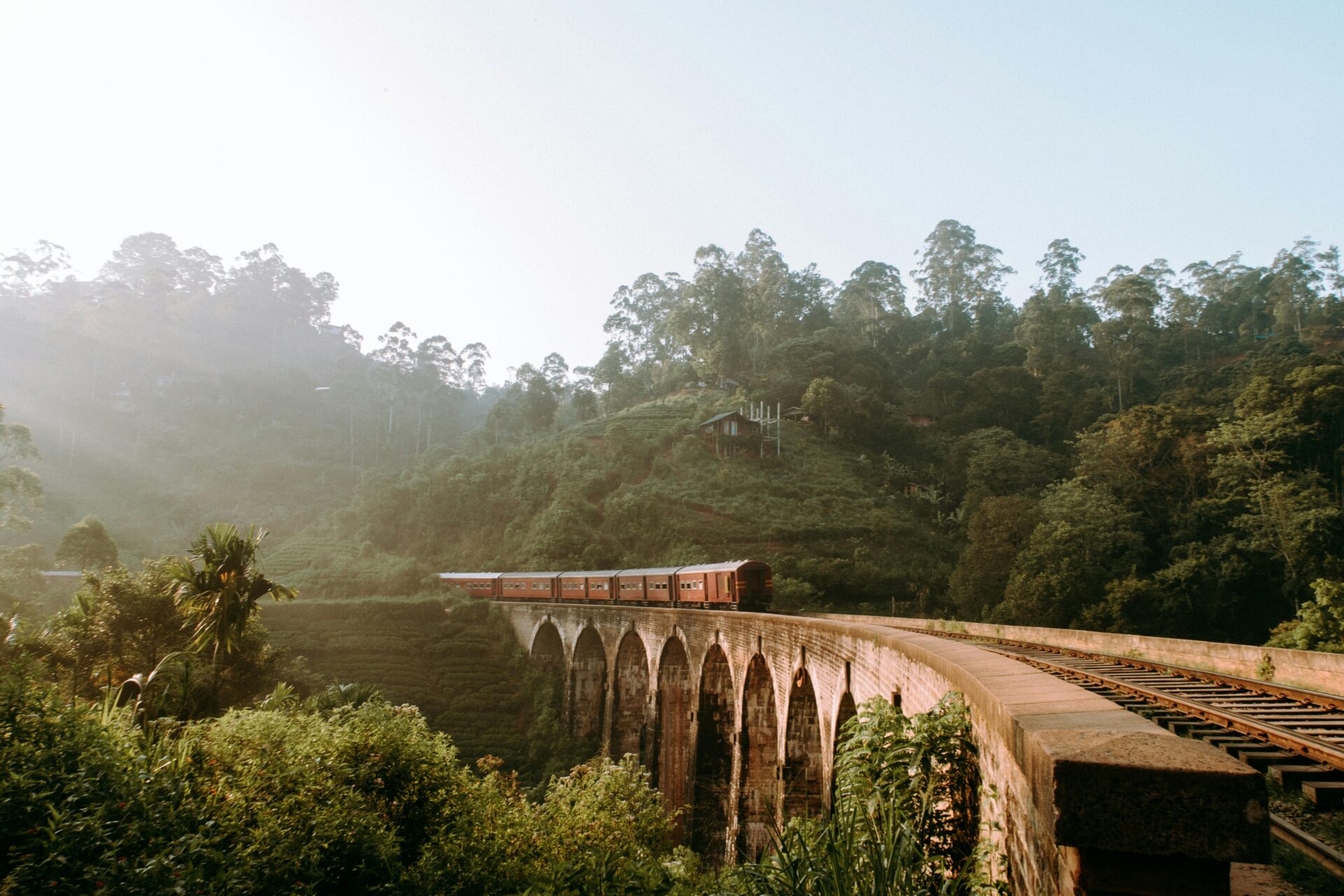
Near Ella — the most photographed railway viaduct in Sri Lanka, a 9-arch stone viaduct built by British engineers and Sri Lankan labourers in 1921. The bridge is visible from the train window as you approach Ella, but the finest view is from above — walking from the Ella town centre to the viewpoint above the bridge takes 20 minutes. The train crosses the bridge at approximately 3pm when coming from Kandy — arriving at the viewpoint above by 2:30pm and watching the train pass below is the recommended experience.
The Practical Guide
Book: 30 days ahead on eRail.lk for the Observation Car and reserved second class. The unreserved second class doesn’t require booking — just arrive at Kandy station and buy the ticket.
The open door:
The space between carriages (the vestibule, with the connecting door open to the air) is where the finest experience is — not in a seat, but standing in the doorway with the wind and the unobstructed view. This is available on all classes. The train staff are accustomed to foreign visitors standing in the doorway for extended periods.
Combine with: Kandy (the Temple of the Tooth Relic, the Kandy Lake, the Peradeniya Botanical Gardens — 1-2 days before the train). Ella (the Ella Rock hike, Little Adam’s Peak, the Nine Arch Bridge walk — 2-3 days after the train before continuing to Yala).
The full Sri Lanka circuit: Colombo → Kandy (train, 2.5 hours) → Sigiriya (2 hours by road, day trip or overnight) → Kandy → Ella (the 7-hour train) → Yala (3-4 hours by road) → Colombo (5-6 hours by road).
The Closing Moment
I was standing in the open doorway of carriage 3 between Hatton and Nanu Oya. The train was moving at 25km/h — slow enough to see the details of the tea plantation below the carriage door. The pickers in the lower rows, the specific bright green of the young tea leaves against the darker established bush, the rows curving with the contour of the hillside.
The mist was coming in from the south. The tea plantation disappeared into it 200 metres below the track.
The train had been climbing for 90 minutes. The air at this altitude was cool enough for a light layer. The wind in the open doorway was exactly the wind that has been hitting the face of every traveller who has stood in this spot since 1867.
Sri Lanka does not have many experiences that are genuinely irreplaceable. This is one of them.