

The floating markets that operate on the water before dawn, the fruit orchards between the delta channels, the specific flatness of a landscape that is 40,000 square kilometres of river silt deposited over 6,000 years, the coconut candy factories in Bến Tre, the Cao Dai temple whose theology synthesises Confucianism and Christianity and Buddhism and Victor Hugo, and why the Mekong Delta rewards the traveller who stays two nights rather than taking the day trip from Ho Chi Minh City.
Reading time: 8 minutes | Last updated: 2026
The Mekong River carries 475 million tonnes of sediment per year from the Tibetan Plateau to the South China Sea. Where it reaches the sea it spreads across a delta of 40,000 square kilometres — nine distributaries, 2,400km of canals, rice paddies and fruit orchards and floating markets and a population of 17 million people living at or below sea level on land that didn’t exist 6,000 years ago.
Most visitors take a day trip from Ho Chi Minh City (3 hours each way, leaving 3 hours on the delta). They visit one floating market, one coconut candy factory, and one fruit orchard. They eat a lunch prepared for tour groups. They return to the city.
This is the delta’s surface.
The Two-Night Version
Stay in Cần Thơ — the largest city in the delta, 170km from Ho Chi Minh City (3 hours by road or 4 hours by express boat). Two nights gives the following that the day trip doesn’t:
Cái Răng Floating Market at dawn: The largest floating market in the Mekong Delta — hundreds of boats carrying wholesale fruit and vegetables, the trading done by boat-to-boat negotiation, the goods displayed on long poles extending from the bow (the specific “pole advertising” system where a papaya hung on the pole means papaya is for sale). The market operates from 5am to approximately 9am, when the wholesale trading is complete and the day-trippers arrive.
At 5:30am: the market in the dark and the early light, the cooking fires on the boats where the traders eat breakfast, the engine noise of hundreds of small boats, the smell of river water and diesel and cooking. At 9am: tourist boats circling a quieter market. Go at 5:30am.
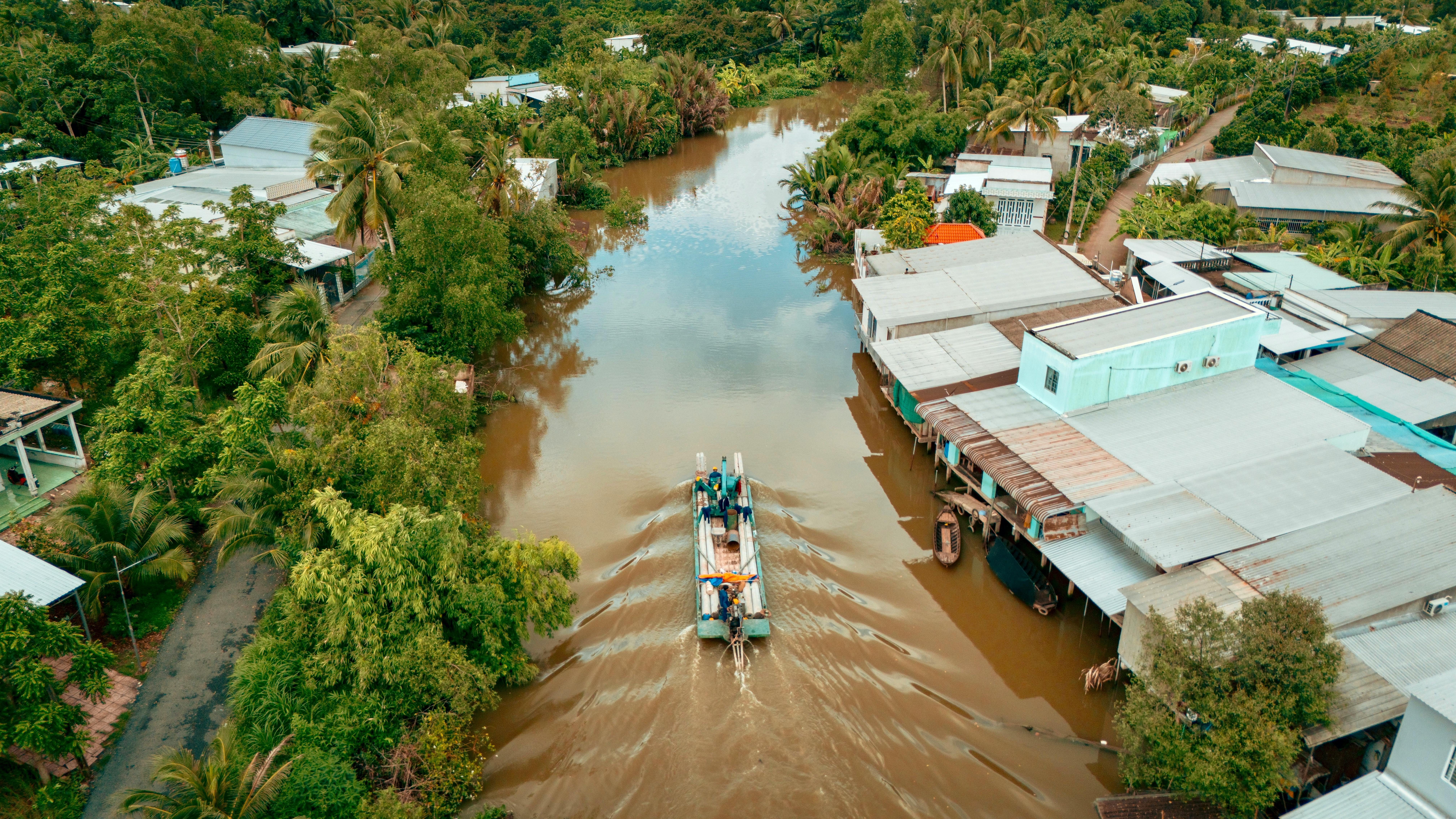
The canal routes: The delta’s canal network is navigable by small motorboat through channels between the rice paddies and orchards. The specific character of the narrow canal routes (the canal surface 3-4 metres wide, the boat engine at low speed, the orchards on both banks — longan, jackfruit, rambutan, durian — the specific density of vegetation at water level): the Mekong Delta in the way a day trip from Ho Chi Minh City cannot deliver.
Bến Tre province: The “coconut kingdom” — the province southeast of Cần Thơ where the coconut palm covers every available surface and the coconut candy industry operates in family workshops. The specific Bến Tre canal routes (the coconut groves along both banks, the candy factories visited by small boat) are the finest canal experience accessible from Cần Thơ in a day.
The Cao Dai Temple
At Tây Ninh, 100km north of Ho Chi Minh City — the Holy See of Caodaism, the Vietnamese syncretic religion founded in 1926 that combines elements of Buddhism, Taoism, Confucianism, Christianity, and Islam with a specific pantheon that includes Victor Hugo, Sun Yat-sen, and Nguyen Binh Khiem as official saints.
The Great Divine Temple at Tây Ninh: a building of extraordinary architectural exuberance, combining Gothic spires with Buddhist architectural elements and painted dragons in a palette of pink, yellow, and blue. The twice-daily religious ceremonies (at noon and 6pm) are conducted by the Cao Dai priests in coloured robes (representing the three original religious traditions) with a liturgy that synthesises the traditions it combines.
Non-believers are welcome to observe from the upper gallery. The ceremony at noon: 45 minutes, the priests in the nave below, the specific combination of incense and chanting and the architectural spectacle. One of the most specifically unusual religious experiences available in Southeast Asia.
Day trip from Ho Chi Minh City: 2 hours each way. Combine with the Cu Chi Tunnels (the Viet Cong tunnel network north of the city) in the same day.
Essentials
Getting there: Ho Chi Minh City to Cần Thơ by road (3 hours, Futa Bus from Mien Tay bus station, £4) or express boat (4 hours, the Cần Thơ Express, £8 — the slower but more atmospheric option).
Where to stay in Cần Thơ: The Victoria Cần Thơ Resort (on the riverbank, the finest hotel in the delta, pool, restaurant, organises the market boats — £60-90/night). Mid-range: Nam Bộ Boutique Hotel (the best balcony view over the Cần Thơ River, the market boats visible from the rooms at 5am).
The floating market boat: Organised through the hotel or from the Cần Thơ tourist pier. Private boat hire for the dawn market trip: £8-15. Worth hiring a private boat (2-4 people) rather than joining a group boat — the private boat can stay as long as you want.
The Closing Moment
I was on the boat at 5:45am. The market was at its fullest — the noise of a hundred engines, the calling between boats, a woman on the boat beside us making phở over a gas burner, the steam rising in the pre-dawn air.
A boat loaded with pomelos was being unloaded into a smaller boat. The negotiation had happened before I arrived. The transfer was mechanical, efficient, the two boat operators working without conversation.
The Mekong Delta at dawn: the oldest commerce in Vietnam, conducted on water, unchanged in method since the river first filled with traders. The day trip from Ho Chi Minh City sees the edges of this at 10am. The two-night version sees it in operation.