

The largest salt pan in Africa and the wildlife that comes to the waterholes surrounding it because there is nowhere else to drink, the lion that arrives at the Okaukuejo floodlit waterhole at 11pm and stays until 3am, the elephant herds that come at dusk in columns from the bush, the black rhino that exists in Etosha in numbers found nowhere else in Africa, the specific logic of the waterhole safari that inverts the conventional game drive, and why sitting still at a waterhole for three hours produces better wildlife viewing than six hours of driving.
Reading time: 9 minutes | Last updated: 2026
Etosha National Park is built around a paradox: the central feature of the park — the Etosha Pan, a 4,800 square kilometre salt flat — supports almost no life. The pan is white, flat, blinding in the midday sun, and almost entirely devoid of the vegetation, water, and shelter that wildlife requires.
The wildlife exists because of the pan’s edges. The rains that fall across the park flow toward the pan but don’t drain from it — they evaporate, leaving salt. The springs and waterholes that form around the pan’s margins are therefore the only permanent water sources in a landscape of intense seasonal aridity. Every animal within range comes to these waterholes. There is no alternative.
The result is the most concentrated wildlife viewing available in southern Africa, and one of the most specific safari experiences anywhere in Africa: the waterhole safari, where the animals come to you.
The Waterhole Logic
The conventional African game drive covers distance — the vehicle moves through habitat, the guide searching for wildlife sign, the animals found in their context (the leopard in the tree, the lion on the kill). The Etosha waterhole safari inverts this: the vehicle is stationary, the wildlife arrives.
The specific advantage: at a productive Etosha waterhole, multiple species appear within minutes of each other throughout the day and night. The springbok are permanent; the zebra herds come and go; the giraffe approach with the specific hesitance of animals whose drinking position (front legs spread wide, neck extended to the water) leaves them vulnerable; the elephant herd arrives from downwind, the adults forming a protective ring while the calves drink; the lion emerges from the bush at dusk, the herbivores withdrawing to a precise distance they have calculated as safe.
The floodlit waterholes:
Etosha is unique in African safari parks for its floodlit night waterholes — three of the main camps (Okaukuejo, Halali, Namutoni) have waterholes immediately adjacent to the camp perimeter, lit by spotlights from dusk to dawn, accessible to camp guests without a vehicle. The waterhole is viewable from benches and a low wall: the lion on a night visit, the black rhino at 1am, the elephants at 3am.
This is wildlife viewing in pyjamas if necessary. It is also, in terms of the quality of the encounters, some of the finest wildlife viewing in Africa.
The Wildlife
The black rhino:
Etosha has the largest population of black rhinos in the world — approximately 1,700 individuals in a park that has maintained its rhino population through the poaching crises of the 1970s-90s. The black rhino is nocturnal and more solitary than the white rhino, making it more difficult to find on a game drive. The floodlit waterholes solve this: the black rhino comes to water at night, appearing at the Okaukuejo waterhole at variable hours between dusk and dawn.
Sitting at the Okaukuejo waterhole from 9pm to midnight in the dry season: black rhino sighting probability is very high. A lone black rhino drinking at a floodlit waterhole, 30 metres from where you’re sitting, is one of the finest wildlife experiences in Africa.
The elephant:
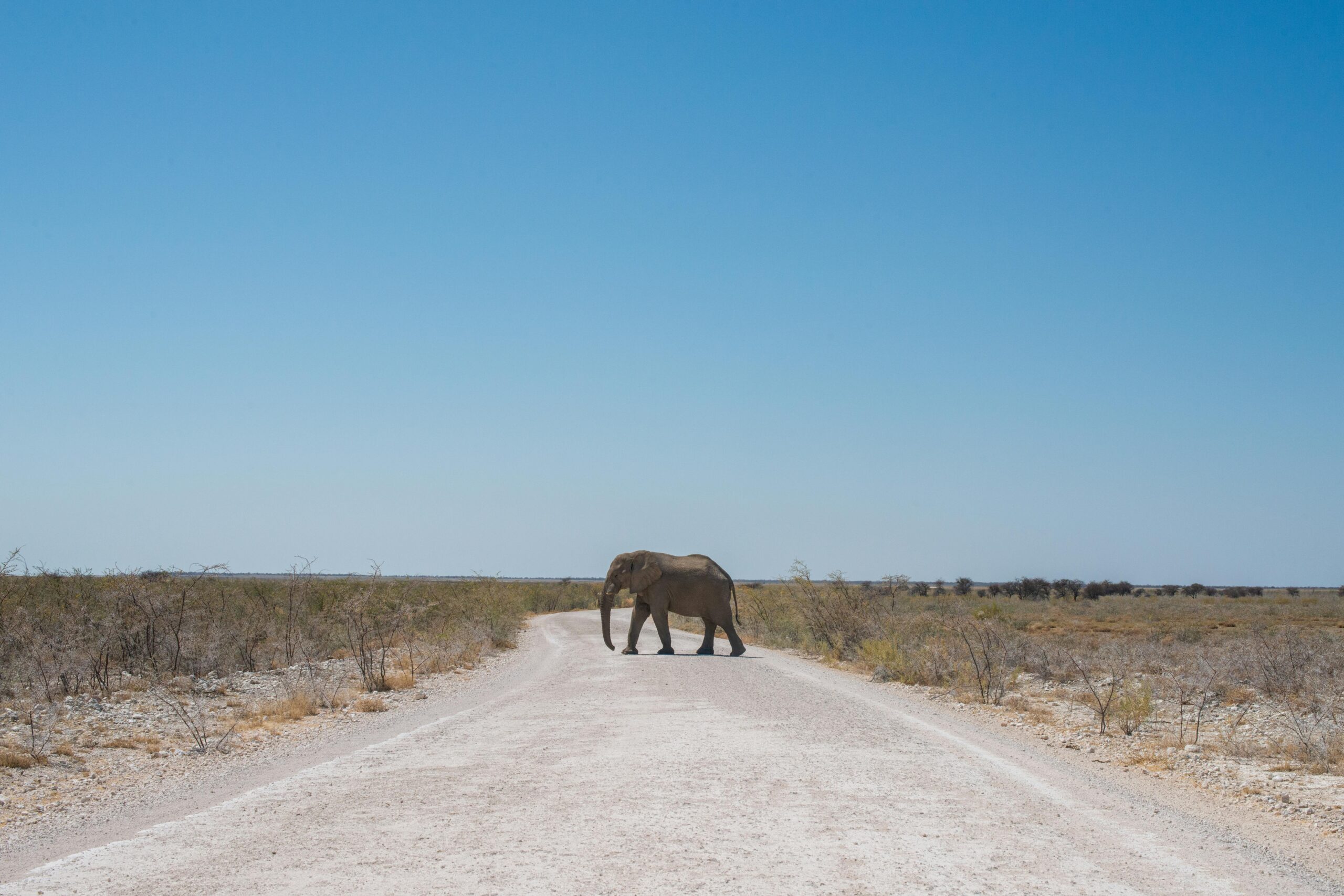
The Etosha elephants are the desert-adapted subspecies — longer legs, larger feet, a physiology adapted to covering the distances between water sources in an arid landscape. The elephant herds arrive at the waterholes in columns from the bush, the matriarch leading, the youngest calves in the centre. At a large waterhole (the Chudob waterhole in the east, the Rietfontein waterhole near Halali), multiple herds may arrive within the same hour, the jostling for position producing the most complex elephant social behaviour visible from a vehicle in southern Africa.
The lion:
The Etosha lions hunt the open pan margins and the waterhole peripheries — the specific hunting strategy of the pan environment is different from woodland hunting, the open terrain allowing coordinated pursuit rather than ambush. The lion at the waterhole (drinking before or after a hunt, or simply resting in the cool of the waterhole surrounds) is the most accessible large predator in the park.
The springbok:
Present everywhere, always. The springbok is the default wildlife of the Etosha pan — the herds that cover the pan margin, the pronking (the specific vertical leaping behaviour) visible from the vehicle throughout the day. The springbok’s ubiquity makes them easy to overlook; the male springbok territorial displays and the migration-like movements of the large dry-season herds are worth specific attention.
The Camps
Etosha has three main government-operated camps within the park — each with accommodation, a restaurant, and a floodlit waterhole.
Okaukuejo (western camp): The most famous waterhole in Etosha — a round, clay-bottomed spring with a floodlit viewing area and the highest density of night wildlife of any accessible waterhole in southern Africa. The black rhino visits here are the most reliable in the park. Accommodation: chalets and camping, £35-95/night.
Halali (central camp): The most underrated camp — the surrounding area has some of the finest game drive terrain in the park (the Helio and Rietfontein waterholes are within 15km), the camp waterhole is less famous than Okaukuejo but still productive. The Halali camp itself: the most characterful of the three, the rocky outcrops around the camp giving the best birding.
Namutoni (eastern camp): A former German colonial fort converted to a camp — the fort walls and the tower giving the camp a specific architectural character unique in Etosha. The eastern section of the park is the most productive for cheetah sightings (the open savannah terrain east of Namutoni is the finest cheetah habitat in Etosha). The Chudob waterhole (10km from Namutoni): the most productive elephant waterhole in the park.
The Essentials
Getting there: Namibia’s main entry point is Windhoek (Hosea Kutako International Airport, WDH) — accessible from Frankfurt (Lufthansa, direct), Johannesburg (multiple airlines, 2 hours), and Cape Town (1.5 hours). From the UK: fly via Frankfurt or Johannesburg. Return flights UK to Windhoek: £700-1,100.
Windhoek to Etosha: 435km north on the B1 highway, 4-5 hours by car. Car hire from Windhoek is essential — Etosha is not accessible by public transport and a self-drive safari is the standard approach.
Park fees: N$180 / £7.60 per person per day + N$80 / £3.40 per vehicle per day. Paid at the gate; valid for 24 hours.
When to go: June to October (the dry season) for the best waterhole wildlife concentration. The waterholes are the only water available; every animal in the park must visit them. July and August are the peak months. The rainy season (November-March) disperses wildlife — the waterholes less productive, the game drives more scenic but less concentrated.
Self-drive rules: No walking outside designated areas. Vehicles must be back inside camp before sunset (the gate times are enforced). Speed limit on park roads: 60km/h.
The 3-Day Itinerary
Day 1: Arrive Okaukuejo by noon (the Anderson Gate in the west). Game drive to the Okondeka waterhole (lion territory in the west). Camp at Okaukuejo. Waterhole from 8pm until midnight (the black rhino window).
Day 2: 5:30am: dawn game drive toward the pan edge (the light on the white pan surface in the first 20 minutes is extraordinary). Return Okaukuejo for breakfast. Drive east to Halali via the pan road (the road that runs along the southern edge of the pan — the most open terrain in the park, the best for the large herds). Halali camp waterhole at dusk.
Day 3: Early game drive from Halali toward Namutoni (cheetah territory). Chudob waterhole for the morning elephant herds. Exit through the Von Lindequist Gate in the east.
The Closing Moment
I was at the Okaukuejo waterhole at 11:45pm. The camp was quiet. The floodlights lit the waterhole and a ring of short grass around it; everything beyond was dark.
The springbok had been there since 10pm, steady, their reflective eyes visible at the edge of the light. At 11:47pm they moved — all at once, the entire group shifting 20 metres south, the specific collective movement that prey animals make when a predator has entered the zone but not yet been seen.
The lion came from the north. A male, walking steadily, the waterhole his destination. The springbok held their new position — not running, having calculated the distance. The lion drank for four minutes. Then he walked back into the dark.
The springbok returned to the waterhole at 11:58pm.
Eleven minutes. The entire drama in the light of the floodlight. No vehicle, no guide, no engine noise. Just the waterhole and the animals and the night.
This is the Etosha experience that no other safari park in Africa provides.