


3,000 stone jars scattered across the plateau of Xieng Khouang province in northern Laos, some of them weighing 30 tonnes, nobody knows who made them or why, the province was the most heavily bombed area in the history of aerial warfare during the Vietnam War, the UXO (unexploded ordnance) still covers approximately 30% of the province, the jars themselves are scattered between bomb craters, and the combination of the prehistoric mystery and the 20th-century devastation makes the Plain of Jars unlike any other archaeological site on Earth.
Reading time: 8 minutes | Last updated: 2026
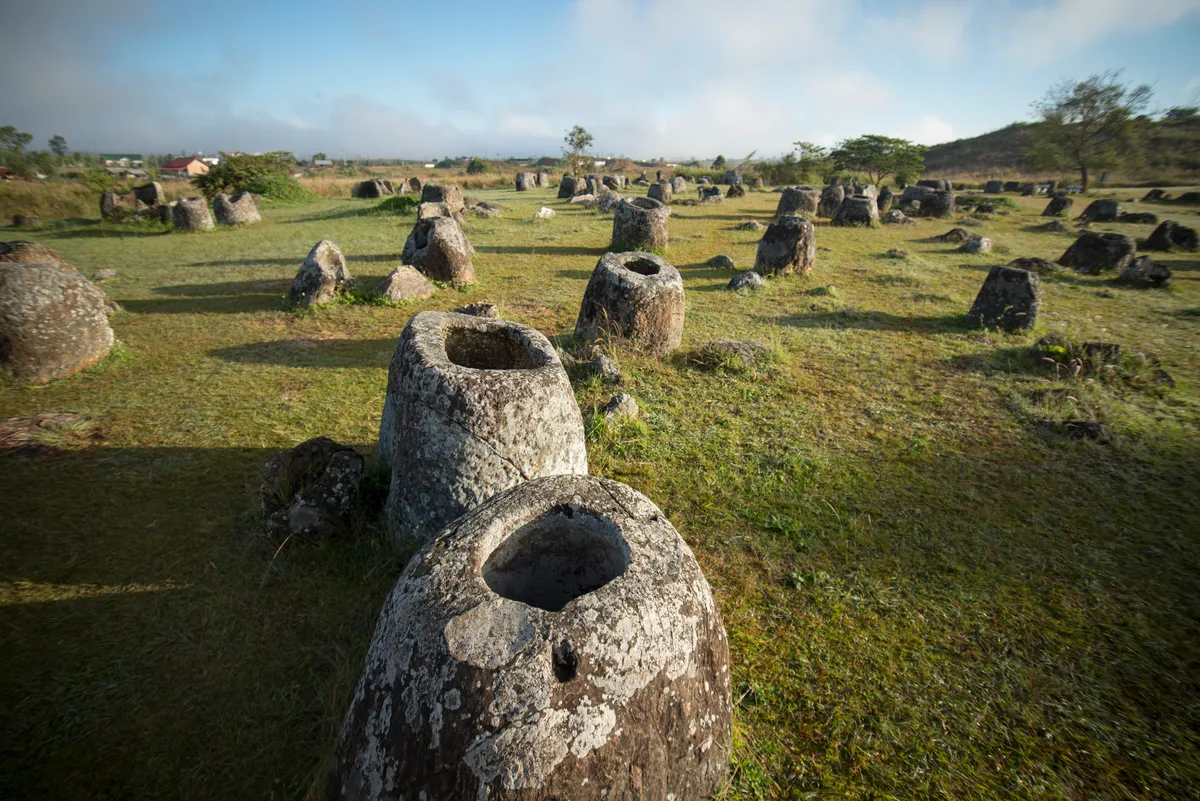
The Plain of Jars is in Xieng Khouang province, central Laos — a high plateau at 1,000-1,200m covered in clusters of stone jars, some as large as 3 metres high and weighing up to 30 tonnes.
Who made them: unknown. The jars were carved from sandstone, granite, conglomerate, and limestone (the type varying by cluster) by a civilisation that has left no other significant physical record. Carbon dating of organic material found inside the jars has placed them between 500 BCE and 500 CE. The purpose is debated: the most widely accepted hypothesis is funerary (the jars as burial vessels, the lids as covers — most of the original lids have been lost or broken), but the evidence is ambiguous.
The second context: Xieng Khouang province received more bombs per capita than any other country in history during the Vietnam War’s secret bombing of Laos (1964-1973). The US dropped 2.1 million tonnes of ordnance on Laos, approximately one tonne per person in the country at the time. Xieng Khouang, as a strategic corridor between North Vietnam and the Ho Chi Minh Trail, received a disproportionate share. The bombing continued for 9 years after the Geneva Accords required the US to withdraw from Laos.
The jars now sit in landscapes pocked with bomb craters. The access paths to every jar site are marked with cleared routes (the white posts indicating demined paths) and uncleared zones. Approximately 30% of Xieng Khouang province is still contaminated with UXO (unexploded ordnance). The MAG (Mines Advisory Group) and UXO Lao are still clearing ordnance from the province 50 years after the bombing ended.
The combination — the 2,500-year-old jars, the 50-year-old bomb craters, the ongoing demining — produces a site unlike any other in Southeast Asia.
The Three Main Sites
Site 1 (Thong Hai Hin): The largest and most visited site — 334 jars, the plateau accessible by a clearly marked path. The largest jar in the province is here: 2.5 metres high, carved from a single boulder. Entry: 15,000 kip / £0.65.
Site 2 (Hai Hin Phu Salato): A smaller site on a hillside — 93 jars, the approach by a walk through a rice paddy and a forested slope. Less visited than Site 1; the hillside setting gives a different spatial relationship between the jars and the landscape. The bomb crater adjacent to the largest jar group at this site: the specific juxtaposition of prehistoric mystery and modern destruction visible in a single frame.
Site 3 (Hai Hin Lat Khai): The furthest site from Phonsavan (the nearest town, 30km) — 150 jars on a hillside with a sweeping view of the surrounding plateau. The walk from the road: 20 minutes through a paddy field path between the white marker posts. Essentially empty of visitors on most days.
The UXO Context
The UXO visitor experience in Phonsavan (the provincial capital, the base for visiting the Plain of Jars) requires engagement — not optional background.
The MAG Visitor Information Centre in Phonsavan: free, covering the bombing campaign, the UXO situation, and the ongoing demining. The specific statistics (the 80 million bomblets — BLUs, or Bombies as Laotians call them — that failed to detonate and remain in the soil) are a different category of fact from anything encountered in a conventional archaeological site.
The COPE Centre in Vientiane (accessible on the way through from Bangkok): the organisation providing prosthetics and rehabilitation to UXO victims — the visitor centre covers both the human impact of the ongoing contamination and the work of clearing it.
The jar sites themselves: The white marker posts delineating the cleared zones are not decorative. Do not walk outside the marked paths. This instruction has the same weight at the Plain of Jars as it does in any active minefield.
Essentials
Getting there: Phonsavan airport from Vientiane (45 minutes, Lao Airlines) or from Luang Prabang (30 minutes). Alternatively: 8-9 hours by road from Luang Prabang on the Route 13 and Route 7 (the mountain road, genuinely scenic, genuinely long). The flight is the correct option for most visitors.
Where to stay: Phonsavan town — the Mealy Phonsavan Hotel (the best mid-range option, the owner organises guided jar site tours) or the Kong Keo Guest House (budget, £8-12/night). No accommodation at the jar sites themselves.
Day tours: Hire a guide and driver from Phonsavan for the three main sites: 100,000-150,000 kip / £4.25-6.40 per person. The guide provides both the archaeological context and the UXO context — both are essential for understanding what you’re looking at.
Combine with: Luang Prabang → Phonsavan (1 hour by air or 1 day by road) → 2 nights at the jars → return Luang Prabang or continue to Vang Vieng.
The Closing Moment
I was at Site 2 at 10am. The other tour group had left 20 minutes before. The guide was sitting on a rock eating his lunch.
The jar in front of me was 1.8 metres high, carved from a single piece of conglomerate, its lip chipped and worn. 2,500 years minimum. Nobody knows who made it. Nobody knows what it was for. The jar was standing in a rice paddy. A bomb crater was visible 30 metres to the right.
The specific combination — the unknown prehistoric, the known 20th-century — is not reconcilable in the way that most historical sites are. It doesn’t resolve into a narrative. The jars predate the bombs by 2,000 years and coexist with the craters without comment.
The Plain of Jars is the place where the past is genuinely beyond explanation and the present is genuinely beyond justification.
Both things are worth standing in for a while.