
The Djemaa el-Fna at 9pm when the smoke from the food stalls is rising and 10,000 people are in the square simultaneously, the souks before 10am when the vendors are arranging their stalls rather than working the tourist circuit, the Bahia Palace at opening time, the hammam that the neighbourhood uses rather than the tourist one, and the 48 hours that give the Marrakech that earns its reputation rather than the one that frustrates visitors who weren’t prepared for it.
Reading time: 8 minutes | Last updated: 2026
Marrakech is the most prepared-for and most surprisingly overwhelming city in North Africa. Every traveller who arrives has read about the medina, the souks, the touts, and the sensory overload. The preparation reduces the overwhelm by approximately 40%. The remaining 60% arrives anyway and requires 24 hours to metabolise.
By hour 25, Marrakech becomes navigable. By hour 36, it becomes genuinely pleasurable. These 48 hours are designed to accelerate that curve.
Hour-by-Hour
Day 1
7:00am — Djemaa el-Fna at Dawn
The famous square at 7am: the orange juice vendors setting up their carts (lines of oranges visible from across the square), the women selling argan oil products, the first snake charmers arranging their equipment. Nobody is selling anything aggressively yet. The square at this hour is a working marketplace rather than a tourist attraction.
The best coffee in the square at dawn: the Café de France on the north side (the rooftop terrace, the view over the square, the coffee served Moroccan style — thick, sweet, cardamom-scented). TRY 15 dirhams / £1.20.
8:30am — Bahia Palace
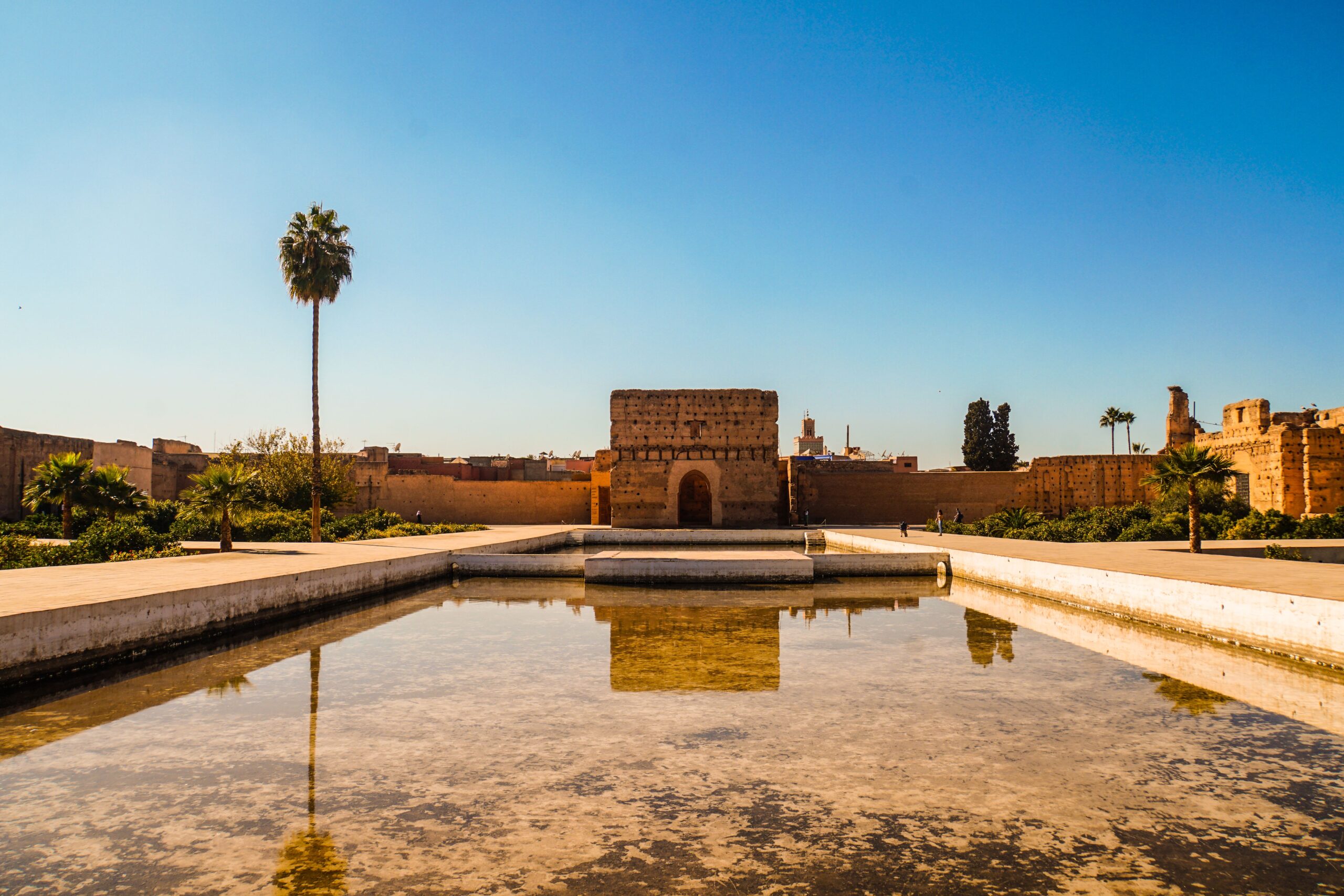
The 19th-century palace of the Grand Vizier Ba Ahmed — 160 rooms, the finest zouak painted ceiling in Marrakech, the tiled courtyards in morning light. At 9am opening with 20 other people rather than the 9am opening with 200 people that an 11am arrival produces.
Entry: 70 MAD / £5.60. Allow 1 hour. The painted cedar ceiling of the Grand Courtyard is the single finest decorative surface in Marrakech.
10:00am — The Souks (with the right approach)
The souks north of the Djemaa el-Fna: the textile souk (the bolts of fabric, the djellabas), the spice souk (the colours, the specific smells — cumin, ras el hanout, dried rose, argan), the lantern souk, the leather goods.
The approach: do not stop unless genuinely interested in buying. Make eye contact briefly, say “la shukran” (no thank you) once without elaborating, walk on. The vendors’ attention moves quickly to the next person. Walking the souks at a confident pace, looking but not engaging with every offer: the manageable version of a system that only becomes exhausting when each interaction is treated as a negotiation.
The specific purchases worth the engagement: Moroccan slippers (babouches) from the Souk des Semelles (the slipper souk, the fixed-price quality shops rather than the tourist-facing stalls — the artisan shops at the deeper end of the souk), the hand-knotted rugs from the carpet merchants (expect significant time investment and mint tea, the process genuinely enjoyable if you know you want a rug and don’t if you don’t).
12:30pm — Lunch: The Djemaa el-Fna Food Stalls
The food stalls assembling in the square from 11am onward. The strategy: walk the entire row before selecting (the circuit takes 10 minutes and gives the full menu). The correct order: the merguez (spiced lamb sausage) and the fresh harira (the thick legume soup) from the stalls with the highest local customer proportion, not the ones with the most elaborate customer calling.
The Stall 1 cluster at the northwest of the square and the Stall 32 area at the eastern end: consistently the most local-patronised. Lunch: 80-150 MAD / £6.40-12 per person.
2:00pm — The Saadian Tombs
The sealed royal mausoleum (1578-1603), rediscovered in 1917, the finest marble and plaster work in Marrakech — the Chamber of the Twelve Columns (the main mausoleum room, the carved cedar ceiling, the carved plaster walls, the Italian Carrara marble columns brought from the Badi Palace). Entry: 70 MAD / £5.60. The tombs are a 5-minute walk from the Bahia Palace — do both in the same morning circuit.
3:30pm — The Neighbourhood Hammam
Ask at your riad: “Which hammam does the neighbourhood use?” The local hammam (as opposed to the tourist spa hammam) charges 15-30 MAD / £1.20-2.40 for the standard entry including steam room and the kessa (the exfoliating mitt, brought or rented). The savon beldi (the black olive soap) applied by the hammam attendant and the subsequent kessa scrub: the specific Moroccan hammam experience that the tourist spa version replicates at 10 times the price and 30% of the atmosphere.
6:00pm — The Menara Gardens or the Majorelle Garden
Menara Gardens (free): The large olive grove and reflecting pool 3km west of the Djemaa el-Fna — the pavilion above the pool gives the Atlas Mountains visible behind Marrakech on clear days. Free access. Sunset with the mountains: the finest free view in Marrakech.
Jardin Majorelle (entry: 150 MAD / £12): The Yves Saint Laurent garden — the cobalt blue buildings, the cactus garden, the specific Moroccan-modernist aesthetic. Most photographed in the early morning (9am); at 6pm the light is golden from the west and the crowds have thinned from midday. Pre-book at jardinmajorelle.com.
9:00pm — Djemaa el-Fna at Night
Return to the square at 9pm. The transformation is complete: the food stalls at full production (100 of them, the smoke rising, the sellers calling), the acrobats, the gnawa musicians, the storytellers in the Arabic circles. The square at this hour is the reason Djemaa el-Fna was designated a UNESCO Intangible Cultural Heritage.
The rooftop view from the Café Argana (northeast corner of the square) or the terrace at Les Terrasses de l’Alhambra: the smoke and the scale of the square visible from above.
Day 2
8:00am — Koutoubia Mosque (exterior)
The Koutoubia Mosque minaret — the finest Almohad minaret in Morocco, the architectural model for the Giralda in Seville and the Hassan Tower in Rabat. The mosque is closed to non-Muslims; the exterior and the surrounding gardens are accessible. The Koutoubia at 8am: the morning prayer call audible in the city, the minaret in the early light, the adjacent rose garden.
9:00am — The Medersas: Ben Youssef
The Ben Youssef Medersa (Islamic college, 14th century) — the finest zellige tilework in Marrakech, the carved plaster and painted cedar in the upper galleries, the central pool in the courtyard. Entry: 70 MAD / £5.60. At 9am, manageable. By 11am, crowded.
10:30am — The Dyers’ Souk and the Leather Quarter
North of the Ben Youssef Medersa — the small specialist souks that the main tourist circuit bypasses: the dyers’ souk (the skeins of yarn in vivid colours hanging to dry above the alley), the Souk Haddadine (the blacksmiths, working at open forges with the specific sound of hammer on iron), the Souk Chouari (the carpenters’ and woodworkers’ souk). These are working commercial spaces, not demonstrations.
12:30pm — Lunch: The Mellah
The Mellah (the former Jewish quarter) is south of the Royal Palace — the specific Sephardic-Moroccan architecture, the former synagogues, and the spice and jewellery shops. The market at the Mellah entrance (the Rahba Kedima) has the most genuine cooking ingredient shopping in the medina. Lunch from the Mellah food stalls: pastilla (the pigeon-almond-egg pie in filo pastry), the specific Marrakchi preparation at the counter restaurants: 40-60 MAD / £3.20-4.80.
2:30pm — The Tanneries View
The Marrakech tanneries (smaller than Fes, but operational) — the viewing terrace at the leather shop on the northeast of the medina, the round tanning vats visible from the terrace, the workers in the dyes. The mint sprigs handed at the entrance: use them. Entry to the viewing terrace: included in the condition of briefly looking at the leather goods (the social contract is clear and manageable).
4:00pm — The Souks, Unpressured
Return to the souks in the late afternoon for the items identified in the morning. By 4pm, the vendors are into the later part of their day and the hardest selling pressure has passed. This is the correct time to engage with the carpet sellers if rugs are of interest.
7:00pm — Departure
The train from Marrakech to Casablanca (3.5 hours, from 55 MAD / £4.40) connects to the airport or continues north.
Essentials
Touts and navigation: The “La shukran” instruction is real and sufficient. Do not engage with offers to guide you somewhere. Do not elaborate the refusal — elaboration invites negotiation. Walk on.
Riad accommodation: The riads within the medina walls (the traditional Moroccan courtyard house turned guesthouse) are the correct Marrakech accommodation. Budget riads from £25-40/night, mid-range £55-90/night, boutique £100-200/night. All include breakfast; most have rooftop terraces. The specific advantage: a riad within the walls puts you 5 minutes from the Djemaa el-Fna rather than 30.
Currency: Moroccan Dirham. £1 ≈ 12.5 MAD. Cash economy — ATMs on the Djemaa el-Fna perimeter. The medina is primarily cash; the tourist-facing restaurants and riads take cards.
When: March-May or September-November. July-August: 40°C+, the medina alleys airless. December-February: cool, occasionally cold at night (wool djellaba weather), fewer tourists.